Within Job Offers
What Is the Offer Really Worth?
A job offer's real value depends on benefits, variable pay, time costs and risk, not just the headline salary.
On this page
- Base pay, bonuses and benefits as a full package
- Commute, hours and expenses as hidden costs
- Comparing guaranteed value with uncertain upside
Page outline Jump by section
Introduction
A job offer is worth more—or less—than its advertised salary. The real value comes from total compensation: guaranteed pay, bonuses, pension contributions, insurance, paid leave, flexibility, equity, and the time and money you must spend to do the job. Analytical thinking helps you avoid anchoring on the headline salary by comparing what is certain, what is conditional, and what each offer actually delivers in daily life.
 This matters because benefits represent a substantial share of employment costs. In the United States, for example, employer-paid benefits account for roughly 30% of private-sector compensation costs on average, demonstrating that two jobs with identical salaries can differ significantly in overall value.[Bureau of Labor Statistics]bls.gov• Supplemental payBureau of Labor StatisticsEmployer Costs for Employee Compensation - March 2026June 10, 2026 — Total benefit costs consist of five major…
Base pay, bonuses and benefits form one package
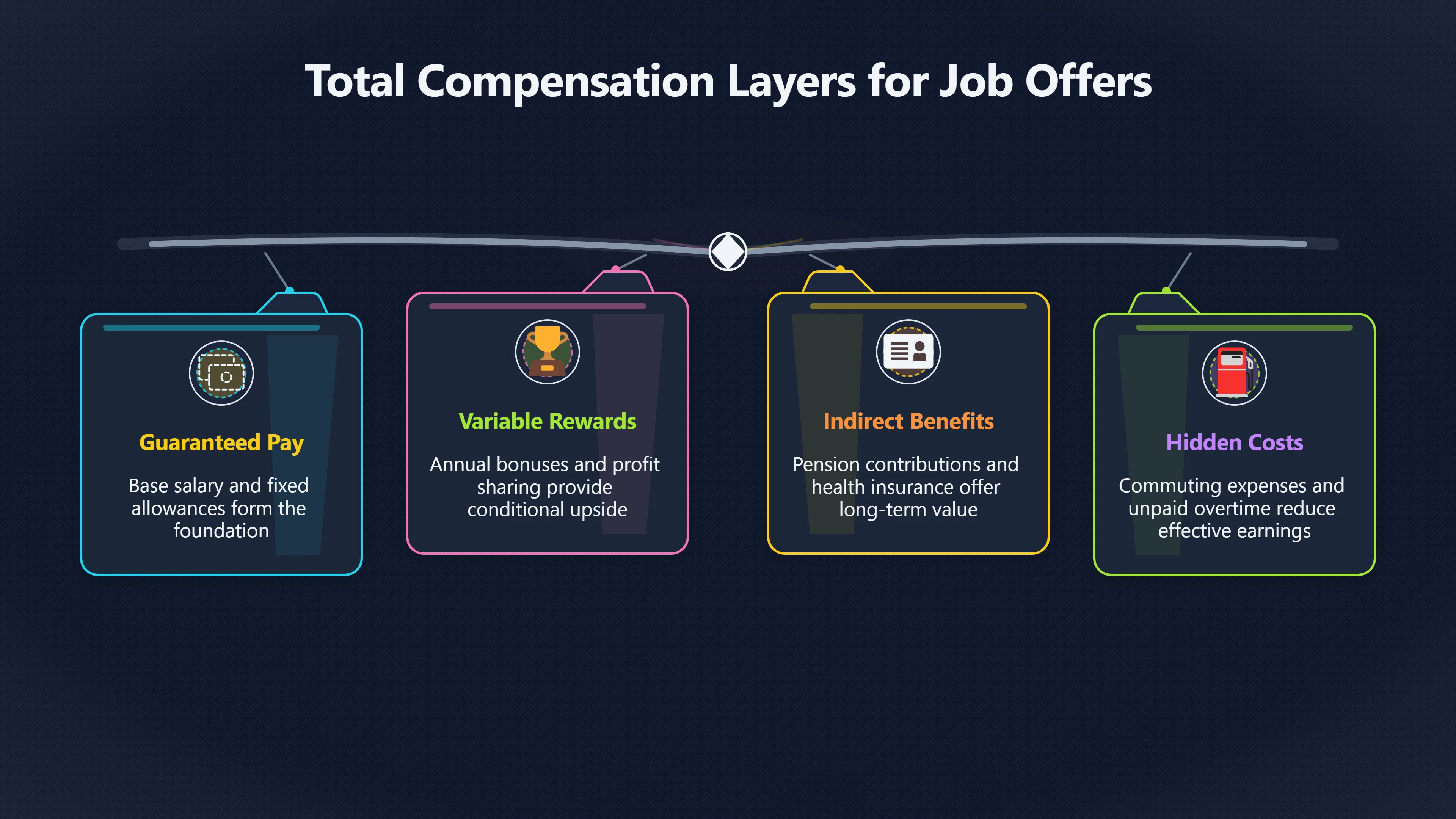
The simplest mistake is treating salary as the entire reward. Instead, think of an offer as three layers:
- Guaranteed compensation: base salary and any fixed allowances.
- Variable compensation: annual bonuses, commission, profit sharing or long-term incentives.
- Benefits: pension contributions, health insurance, life insurance, paid leave, parental leave, training budgets, wellness benefits and other employer-funded support.
Many employers describe this as a total compensation or total rewards package because employees receive value through multiple channels rather than wages alone. While exact packages differ by employer and country, compensation frameworks consistently distinguish between fixed pay, variable pay and indirect benefits.[chrc-ccdp.gc.ca]chrc-ccdp.gc.caOpen source on gc.ca.
For example, compare two offers:
ElementOffer AOffer BBase salary£62,000£58,000Employer pension contribution3%10%Annual bonusUp to 20%NonePrivate health coverNoYesExtra annual leaveStandard days
The higher salary is not automatically the better financial choice. If the bonus is uncertain while the pension and additional leave are guaranteed, Offer B may provide more dependable long-term value.
Hidden costs reduce real compensation
Compensation should also be measured against what the job requires from you.
A salary increase can disappear surprisingly quickly when the role demands longer commuting, unpaid overtime or expensive travel. These costs rarely appear in offer letters, yet they affect both finances and quality of life.
Key hidden costs include:
- Commuting expenses: fuel, rail fares, parking or vehicle depreciation.
- Commuting time: hours that reduce leisure, family time or opportunities for further learning.
- Longer working hours: reducing effective hourly earnings.
- Meals, clothing or equipment: if these are not reimbursed.
- Relocation or regular travel: particularly when allowances only partly cover expenses.
One useful calculation is your effective hourly pay:
Annual guaranteed compensation ÷ total annual hours actually devoted to work (including routine commuting where relevant).
A role paying £65,000 but requiring frequent unpaid evening work may deliver a lower effective hourly return than a £58,000 role with predictable hours and a short commute.
Guaranteed value versus uncertain upside
Variable compensation deserves special scrutiny because people naturally overweight optimistic outcomes.
Ask what is guaranteed
Base salary is usually contractual. Bonuses, commissions and equity often are not.
Questions worth answering include:
- Is the bonus discretionary or formula-based?
- How often has it actually been paid?
- What percentage of employees achieve the target?
- Can the company change the scheme?
- Does payment require remaining employed on a specific date?
A “20% bonus opportunity” may have little practical value if most employees historically receive only a fraction of it.
Equity can be valuable—or worthless
Start-up and high-growth companies frequently offer share options or restricted stock instead of higher cash salaries.
Equity may become highly valuable if the company succeeds, but several uncertainties affect its value:
- the company’s future performance;
- dilution from future fundraising;
- vesting schedules;
- tax treatment;
- whether there will ever be a liquid market to sell the shares.
Analytically, equity should usually be viewed as potential upside, not as a guaranteed replacement for cash compensation.
Benefits often have larger financial value than they appear
Many benefits are overlooked because they are not paid directly into a bank account.
Examples include:
- employer pension contributions;
- private medical insurance;
- disability or income protection insurance;
- life insurance;
- enhanced parental leave;
- paid professional qualifications;
- childcare support;
- employee share purchase plans;
- additional paid holiday.
Some of these would be expensive to purchase independently. Others reduce financial risk rather than increasing income. A generous income-protection policy, for example, may provide more practical security than a modest salary increase.
Research on total compensation also suggests that employees’ perceptions of the complete package—not salary alone—are associated with higher job satisfaction and organisational commitment, although workplace culture and management quality remain important influences alongside compensation.[Redalyc.org]redalyc.orgThis cross-sectional and confirmatory research has…
Compare offers using expected value rather than best-case thinking
Good analytical decisions separate certainty from possibility.
A practical comparison can be organised into three columns:
CategoryQuestionsGuaranteed valueWhat will I definitely receive?Probable valueWhat is likely, based on realistic assumptions? Upside potentialWhat could happen if everything goes well?
Suppose two offers are presented:
- Offer X: £70,000 salary with a bonus “up to 25%”.
- Offer Y: £66,000 salary with a 12% employer pension contribution, generous health cover and an extra week’s annual leave.
If historical evidence suggests that employees usually receive only a 5% bonus, the expected financial difference narrows substantially. The guaranteed benefits in Offer Y may outweigh the uncertain additional cash in Offer X.
This approach helps avoid optimism bias—the tendency to assume favourable outcomes without sufficient evidence.

Questions that reveal the real value of an offer
Before accepting a role, seek evidence rather than relying on marketing language.
Useful questions include:
- How is the bonus calculated?
- What percentage of employees earned the target bonus last year?
- What pension contribution does the employer make?
- How many days are employees typically expected to work beyond contracted hours?
- Are commuting or travel costs reimbursed?
- How does equity vest, and what happens if I leave?
- Which benefits begin immediately, and which require a qualifying period?
Specific answers are generally more informative than broad statements such as “excellent benefits” or “competitive compensation”.
A better mental model
The most reliable way to compare offers is to think of compensation as a portfolio rather than a single number.
A strong offer combines:
- substantial guaranteed income;
- valuable employer-funded benefits;[peoplemanagingpeople.com]peoplemanagingpeople.comtotal compensationHR's Guide to Total Compensation in 20268 Jan 2026 — What Is Total Compensation? Total compensation refers to the complete package of pay…
- realistic—not merely theoretical—variable pay;
- manageable time and commuting costs;
- an acceptable balance between security and upside.
Looking beyond base salary does not mean ignoring pay. Instead, it means recognising that salary is only one component of what an employer is actually offering. Careful comparison of guaranteed value, hidden costs and uncertain rewards produces decisions that are less vulnerable to anchoring, wishful thinking and persuasive marketing language.
Amazon book picks
Further Reading
Books and field guides related to What Is the Offer Really Worth?. Use these as the next step if you want deeper reading beyond the article.
I Will Teach You to Be Rich
Helps evaluate compensation in the context of overall finances.
eBay marketplace picks
Marketplace Samples
Example marketplace items related to this page. Use the search link to explore similar finds on eBay.




Endnotes
1.
Source: chrc-ccdp.gc.ca
Link:https://www.chrc-ccdp.gc.ca/organizations/pay-equity-act-responsibilities/obligation-1-develop-pay-equity-plan/gathering-data-and-establishing-foundation/calculating-total-compensation-for-job-classes
2.
Source: redalyc.org
Link:https://www.redalyc.org/journal/647/64768658025/html/
Source snippet
This cross-sectional and confirmatory research has...
3.
Source: youtube.com
Title: 9 Benefits That Can Beat a Higher Salary
Link:https://www.youtube.com/watch?v=1SXclg0_8zA
Source snippet
Total Compensation - How Much Are You Really Earning?...
4.
Source: youtube.com
Title: Total Compensation
Link:https://www.youtube.com/watch?v=9oeaH0hHgsU
Source snippet
What Is Included In My Total Compensation Package?...
5.
Source: youtube.com
Title: What Is Included In My Total Compensation Package?
Link:https://www.youtube.com/watch?v=Lqoe8DUh2-8
Source snippet
Total Compensation...
6.
Source: youtube.com
Title: Total Compensation
Link:https://www.youtube.com/watch?v=asuWMK9Ixh8
7.
Source: bls.gov
Title: • Supplemental pay
Link:https://www.bls.gov/news.release/pdf/ecec.pdf
Source snippet
Bureau of Labor StatisticsEmployer Costs for Employee Compensation - March 2026June 10, 2026 — Total benefit costs consist of five major...
Published: June 10, 2026
8.
Source: peoplemanagingpeople.com
Title: total compensation
Link:https://peoplemanagingpeople.com/payroll-compensation/total-compensation/
Source snippet
HR's Guide to Total Compensation in 20268 Jan 2026 — What Is Total Compensation? Total compensation refers to the complete package of pay...
Additional References
9.
Source: oecd.org
Link:https://www.oecd.org/en/data/indicators/labour-compensation-per-hour-worked.html
Source snippet
Labour compensation per hour workedLabour compensation per hour worked is defined as compensation of employees in national currency divid...
10.
Source: ijamtes.org
Link:https://ijamtes.org/gallery/36.%20nov%20ijmte%20-%201161.pdf
Source snippet
Employee Benefits under the Total compensation SchemePresent paper examined the various employee benefits provided under the compensation...
11.
Source: brightmine.com
Link:https://www.brightmine.com/uk/resources/total-rewards/
Source snippet
Total rewards resourcesTotal rewards resources | Trends, data, guides and other resources on key topics, including pay trends, pay equity...
12.
Source: eoc.org.hk
Link:https://www.eoc.org.hk/eoc/upload/userfiles/file/publication/research/epev_part_ii_e.pdf
Source snippet
dividual firms and not for the economy as a whole because firms are heterogenous and the “value”...
13.
Source: oecd.org
Title: pay transparency in the oecd an overview bdae8812
Link:https://www.oecd.org/en/publications/pay-transparency-in-progress_121f268d-en/full-report/pay-transparency-in-the-oecd-an-overview_bdae8812.html
Source snippet
Pay transparency in the OECD: An overview17 Apr 2026 — This chapter presents a stocktaking of pay transparency measures across OECD count...
14.
Source: youtube.com
Title: Base Salary vs Total Compensation What Actually Matters
Link:https://www.youtube.com/watch?v=K6Erf9GSxzo
Source snippet
9 Benefits That Can Beat a Higher Salary...
Topic Tree