Within Sharper Thinking
Will Thinking Skills Work in Real Life?
Reasoning skills matter most when they transfer from lessons and books into messy decisions outside the classroom.
On this page
- Why transfer is hard
- Use across domains
- Practice with real problems
Page outline Jump by section
Introduction
Thinking skills “work in real life” only when they survive transfer: the move from a lesson, book, course or workshop into a different, messier situation where no one labels the problem for you. That transfer is the hard part. Research on learning consistently finds that people may perform well on taught examples yet fail to recognise the same underlying pattern in a new context; near transfer is easier than far transfer, and spontaneous transfer is not something educators or learners can safely assume.[National Academies]nationalacademies.orgNational AcademiesHow People Learn: Brain, Mind, Experience, and SchoolStudents' abilities to transfer what they have learned to new situ…
For improving your thinking and analytical skills, this changes the target. The goal is not just to know a list of fallacies, biases or reasoning steps. It is to build habits that appear during real decisions: comparing explanations before committing, asking what evidence would change your mind, checking whether a familiar situation is actually different, and practising with problems that resemble the complexity of life outside the classroom.
Why Transfer Is Hard
The central problem is that people often learn the surface form of a task, not the deeper structure. A student may learn how to spot a weak causal claim in a psychology class, then fail to apply the same reasoning to a fitness advert, a workplace dashboard or a political claim. The reasoning pattern is similar, but the cues look different. The National Academies’ How People Learn frames transfer as a key sign of flexible learning: instruction may look successful if students remember taught facts, yet that does not prove they can use what they know in new settings.[National Academies]nationalacademies.orgNational AcademiesHow People Learn: Brain, Mind, Experience, and SchoolStudents' abilities to transfer what they have learned to new situ…
This is why “critical thinking” can be misleading if it is treated as a detachable mental muscle. Thinking is always about something. To judge a medical claim, a budget forecast or a historical argument, you need some domain knowledge: what counts as evidence, what errors are common, which mechanisms are plausible, and which comparisons are fair. Daniel Willingham’s work on teaching critical thinking stresses this tension: general reasoning principles exist, but they are difficult to apply without relevant background knowledge and practice recognising when the principle fits.[Education NSW]education.nsw.gov.auEducation NSWHow to Teach Critical ThinkingWillingham earned his B.A. from Duke University in 1983 and his Ph.D. in. Cognitive Psychology from. Harvard University in 1990.Read more…
Transfer is also hard because real situations do not announce which skill is needed. In a class, the chapter title may tell you that the day’s topic is “confirmation bias” or “correlation and causation”. In life, the prompt is more ambiguous: a colleague is confident, a graph looks persuasive, a friend forwards a health claim, or a deadline makes the first workable answer feel good enough. That is a recognition problem before it is a reasoning problem.
A useful distinction is between near transfer and far transfer. Near transfer happens when the new situation closely resembles the original practice, such as applying one spreadsheet-checking routine to a similar report. Far transfer asks for a bigger leap, such as using the logic of experimental controls from science to evaluate a business pilot. Perkins and Salomon’s work on transfer also distinguishes “low road” transfer, where well-practised routines are triggered automatically by familiar cues, from “high road” transfer, where the learner deliberately abstracts a principle and applies it elsewhere.[jaymctighe.com]jaymctighe.comTransfer of Learning Perkins and SalomonTransfer of Learning by Perkins and SalomonIn terms of the rough near-far distinction, near transfer is much more likely than far transfer…
The practical risk is overconfidence. A person can read about bias, practise textbook examples, and still assume the lesson will naturally appear when money, status, identity or time pressure is involved. Transfer usually needs design: varied examples, explicit comparison, reflection, feedback and repeated use in realistic settings.
What Actually Transfers Across Domains
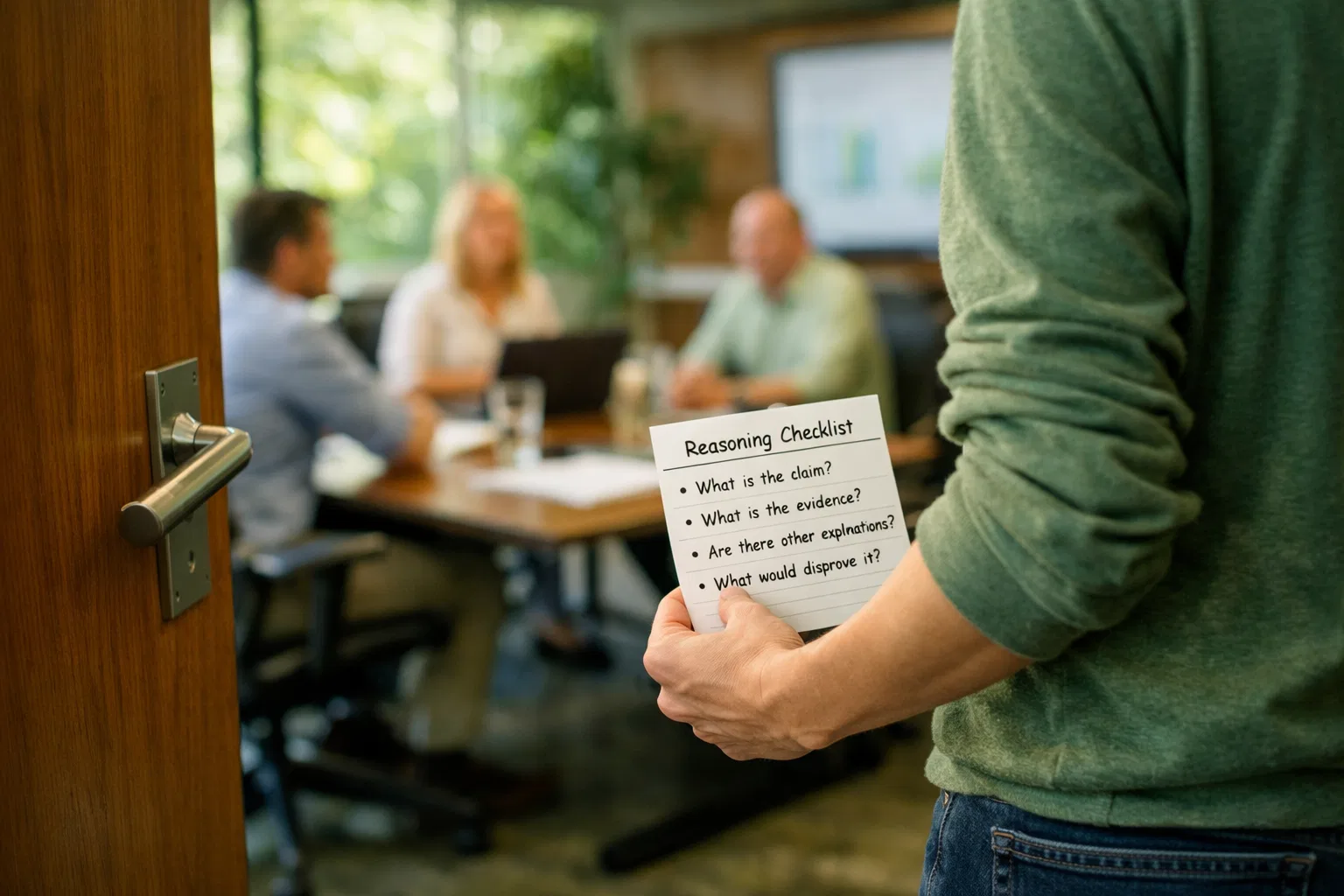
Some parts of thinking are more portable than others. Broad questions such as “What is the claim?”, “What evidence supports it?”, “What else could explain this?”, and “What would I expect to see if this were false?” can travel across domains. But they do not work equally well everywhere unless they are paired with enough knowledge of the situation. In other words, general reasoning prompts are useful handles, not complete substitutes for expertise.
Meta-analytic evidence suggests that critical thinking instruction can improve critical thinking, especially when it is explicit, purposeful and supported by opportunities for practice. Abrami and colleagues’ widely cited meta-analysis found positive effects from instructional interventions, with stronger results where critical thinking was an explicit instructional goal rather than merely an assumed by-product of studying a subject.[Sage Journals]journals.sagepub.comOpen source on sagepub.com.
The transfer debate is not simply “general skills versus domain knowledge”. The more realistic view is that transferable thinking grows from a combination of both. Halpern’s model of teaching critical thinking for transfer includes dispositions, explicit skills instruction, structure training and metacognitive monitoring: learners need to know the thinking move, want to use it, recognise when it applies, and monitor whether they are applying it well.[eipd.dcs.wisc.edu]eipd.dcs.wisc.eduHalpern Critical Thinking 1998Halpern Critical Thinking 1998
A physics student, for example, may learn to test competing explanations when diagnosing a mechanics problem. That habit can help outside physics only if the student learns the deeper move: distinguish rival explanations, identify what each predicts, and look for discriminating evidence. A study on domain-specific instruction in physics found that carefully designed instruction could support near and far transfer of critical thinking skills, but the authors emphasised systematic design, teacher coaching, feedback and student reflection rather than expecting transfer to happen automatically.[Lirias]lirias.kuleuven.beLirias Systematic design of domain-specific instruction on nearLirias Systematic design of domain-specific instruction on near
The transferable unit is therefore rarely a slogan such as “be sceptical”. It is more often a practised pattern:
- Separate claim, evidence and explanation. A claim says what is true; evidence is what supports it; an explanation says why it might be true.
- Compare alternatives before judging. Good analysis asks whether another explanation fits the same facts better.
- Look for the missing base rate or denominator. A vivid number may mislead if the relevant comparison is absent.
- Ask what would change the conclusion. This turns disagreement into a testable question.
- Use a checklist at the moment of decision. Transfer improves when cues in the real environment trigger the skill.
These patterns can travel, but they travel best when practised across varied, concrete cases rather than memorised as abstract advice.
Real-World Evidence Is Promising, but Uneven
The strongest case for real-world transfer is not that thinking courses magically improve every decision. It is that some forms of instruction and assessment do connect with behaviour outside the test. Heather Butler and colleagues have studied whether critical thinking predicts “real-world outcomes” such as avoiding negative life events. Their work found that people with higher critical thinking scores reported fewer negative outcomes, and that critical thinking added predictive value beyond intelligence in those studies.[Wiley Online Library]onlinelibrary.wiley.comOpen source on wiley.com.
That finding matters because it separates thinking skill from simply being bright. Intelligence helps with many tasks, but critical thinking measures try to capture whether people evaluate evidence, avoid poor inferences and reason through practical scenarios. The evidence does not prove that a short course will prevent bad decisions; the studies are not a guarantee of life success. But they do suggest that practical judgement is measurable and relevant to ordinary choices, not merely classroom performance.[ResearchGate]researchgate.netResearch Gate Predicting Real-World Outcomes: Critical Thinking Ability isResearch Gate Predicting Real-World Outcomes: Critical Thinking Ability is
Debiasing research gives another concrete example. Morewedge and colleagues found that short interventions, including an instructional game and video, produced reductions in several cognitive biases that persisted for at least two months, with practice and feedback producing stronger effects than passive instruction.[Bayes Business School]bayes.citystgeorges.ac.ukOpen source on citystgeorges.ac.uk. Later work on debiasing training in field settings found that trained participants were less likely to choose an inferior hypothesis-confirming solution, suggesting that at least some bias-reduction training can transfer beyond neatly labelled exercises.[Marketing Department]marketing.wharton.upenn.edu01.06.2020 Morewedge Carey PAPER DebiasingTransferstotheField01.06.2020 Morewedge Carey PAPER DebiasingTransferstotheField
Complex decision-making studies also show why transfer is more likely when instruction is tied to realistic tasks. Research on critical thinking instruction for complex decision-making found benefits not only during training but also on transfer to untrained problems, with improvements in both decision outcomes and decision processes.[PubMed]pubmed.ncbi.nlm.nih.govOpen source on nih.gov. This is the right kind of evidence for real-world thinking: not just “can the learner define the concept?”, but “does the learner approach a new problem differently?”
Still, the evidence base demands caution. Many studies use tests, simulations or self-reported outcomes rather than long-term observation of life decisions. Training effects can fade, transfer may depend on the closeness of the new task, and a skill that transfers in one domain may not transfer to a more emotionally charged or knowledge-heavy domain. The most honest conclusion is not “critical thinking always transfers”, but “transfer is possible when instruction is explicit, varied, feedback-rich and connected to the situations where the skill will be needed”.

Practice With Real Problems
Real-world transfer improves when practice resembles the conditions of use without becoming so narrow that the learner only memorises one setting. A person trying to improve analytical skill should practise on real decisions, but also deliberately vary the domain: one health claim, one financial choice, one workplace problem, one news story, one personal planning decision. Variation helps the learner notice what is deep and reusable rather than what is merely familiar.
A useful practice format is the same structure, different content approach. Take one reasoning move and apply it repeatedly to different situations. For example, “compare rival explanations” can be practised on a late project, an unexpected bill, a study result, a customer complaint and a family disagreement. The point is not to become an expert in all those domains at once. The point is to learn the cue: before accepting the first story, ask what else would produce the same observation.
Feedback is essential because people are poor judges of their own reasoning quality. The National Academies’ synthesis on learning and transfer emphasises understanding, time on task and opportunities to apply knowledge in new settings, rather than mere recall.[National Academies]nationalacademies.orgNational AcademiesHow People Learn: Brain, Mind, Experience, and SchoolStudents' abilities to transfer what they have learned to new situ… In everyday practice, feedback might come from a decision journal, a colleague’s critique, later outcome review, or comparing your prediction with what actually happened.
A practical transfer routine can be short enough to use in real life:
- Name the decision. What exactly has to be decided, and by when?
- State the current conclusion. What do you currently think is true or best?
- List two alternatives. What else might explain the facts, or what else could you do?
- Identify the hinge evidence. What information would most change the answer?
- Check the context. Is this a familiar problem, or only superficially familiar?
- Review the outcome. After acting, what did the result reveal about your reasoning?
This turns transfer into a habit loop. The learner does not wait to feel “critical”; the environment itself starts to cue a repeatable process.
Where Transfer Breaks Down
Transfer often fails when learning is too abstract. Reading a list of biases may create recognition without control: people can name confirmation bias, anchoring or availability bias, yet still fail to adjust their behaviour when a real decision rewards speed, agreement or confidence. Debiasing studies suggest that active practice and feedback are more powerful than exposure alone, which is one reason games and worked scenarios can outperform passive explanation.[Bayes Business School]bayes.citystgeorges.ac.ukOpen source on citystgeorges.ac.uk.
It also fails when the new domain has hidden technical constraints. A person may understand “correlation is not causation” but still lack the medical, statistical or historical knowledge needed to judge a particular claim responsibly. This is not a defeat for transferable thinking; it is a warning about its limits. Good thinkers know when a general reasoning rule is enough to ask better questions and when they need subject expertise before drawing a conclusion.
Another failure mode is social pressure. Real decisions often involve loyalty, hierarchy, fear of embarrassment or incentives to accept the convenient answer. A workplace team may know that it should test assumptions, but a senior person’s confidence can shorten the discussion. A consumer may know that anecdotes are weak evidence, but a personal story from a trusted friend can still feel more compelling than a base rate. Transfer has to be robust under emotion and incentives, not just under quiet study conditions.
Finally, transfer breaks down when there is no cue to use the skill. This is why checklists, prompts and decision templates are not childish crutches; they are transfer devices. They move a thinking skill from memory into the situation where it is needed. In high-stakes settings, external supports often outperform the hope that people will remember every principle unaided.
How to Use Thinking Skills Across Domains
The safest way to carry thinking skills from one domain to another is to transfer the question pattern, not the conclusion. A principle learned in one setting should not be copied mechanically into another. Instead, it should prompt a fresh investigation.
For example, a person who learns in science that stronger claims need stronger evidence can use that pattern when reading a business forecast. But they should not assume that business evidence works exactly like laboratory evidence. They should ask: What is the claim? What data supports it? What assumptions drive the projection? How often have similar forecasts been wrong? What incentive does the presenter have? The transferable skill is disciplined questioning, not pretending every field has the same proof standard.
Across domains, the most useful transfer prompts are:
- From education to work: “What would count as a good answer here, and who decides?”
- From statistics to news: “What is the comparison group or denominator?”
- From science to personal choices: “What evidence would distinguish a real effect from coincidence?”
- From project reviews to relationships: “Am I solving the stated problem or reacting to a story I have inferred?”
- From argument analysis to meetings: “Which claim is actually disputed, and which facts do we agree on?”
These prompts matter because they preserve humility. They help the learner use a general thinking move while still respecting local knowledge, context and uncertainty.

The Realistic Payoff
Real-world transfer is not a promise that learning critical thinking will make someone consistently rational. It is a way of increasing the odds that better questions appear at better moments. The payoff is often modest but valuable: one more alternative considered, one weak claim rejected, one misleading graph questioned, one decision reviewed before it becomes expensive.
The most defensible approach is therefore neither cynicism nor hype. Thinking skills can transfer, but they need help. They transfer best when learners practise across varied examples, receive feedback, abstract the deeper pattern, build cues into real decisions, and combine general reasoning habits with domain knowledge. Without those conditions, “improving your thinking” can remain a classroom performance. With them, it becomes a practical skill for navigating work, media, money, relationships and uncertainty.
Amazon book picks
Further Reading
Books and field guides related to Will Thinking Skills Work in Real Life?. Use these as the next step if you want deeper reading beyond the article.
Thinking, Fast and Slow
Provides broad thinking tools applicable across many real-world settings.
eBay marketplace picks
Marketplace Samples
Live-tested eBay searches with available results related to this page.

Top pick
critical thinking card game
Open a targeted eBay search for items related to this topic.
Browse eBay
Related search
critical thinking game
Open a targeted eBay search for items related to this topic.
Browse eBay

Related search
will memorabilia
Open a targeted eBay search for items related to this topic.
Browse eBayEndnotes
1.
Source: jaymctighe.com
Title: Transfer of Learning Perkins and Salomon
Link:https://jaymctighe.com/wp-content/uploads/2011/04/Transfer-of-Learning-Perkins-and-Salomon.pdf
Source snippet
Transfer of Learning by Perkins and SalomonIn terms of the rough near-far distinction, near transfer is much more likely than far transfer...
2.
Source: education.nsw.gov.au
Title: Education NSWHow to Teach Critical Thinking
Link:https://education.nsw.gov.au/content/dam/main-education/teaching-and-learning/education-for-a-changing-world/media/documents/How-to-teach-critical-thinking-Willingham.pdf
Source snippet
Willingham earned his B.A. from Duke University in 1983 and his Ph.D. in. Cognitive Psychology from. Harvard University in 1990.Read more...
3.
Source: eipd.dcs.wisc.edu
Title: Halpern Critical Thinking 1998
Link:https://eipd.dcs.wisc.edu/non-credit/LAAS-nonDEPD/LMOWS/LMOWS_6500_Leadership/hypothesis%20readings/M3/Halpern%20Critical%20Thinking%201998.pdf
4.
Source: onlinelibrary.wiley.com
Link:https://onlinelibrary.wiley.com/doi/abs/10.1002/acp.2851
5.
Source: researchgate.net
Title: Research Gate Predicting Real-World Outcomes: Critical Thinking Ability is
Link:https://www.researchgate.net/publication/318097450_Predicting_Real-World_Outcomes_Critical_Thinking_Ability_is_a_Better_Predictor_of_Life_Decisions_than_Intelligence
6.
Source: researchgate.net
Link:https://www.researchgate.net/publication/377905799_Predicting_Everyday_Critical_Thinking_A_Review_of_Critical_Thinking_Assessments
7.
Source: researchgate.net
Title: 281952187 Strategies for Teaching Students to Think Critically A Meta Analysis
Link:https://www.researchgate.net/publication/281952187_Strategies_for_Teaching_Students_to_Think_Critically_A_Meta-Analysis
8.
Source: researchgate.net
Link:https://www.researchgate.net/publication/2402396_Transfer_Of_Learning
9.
Source: researchgate.net
Title: 378671988 Transfer of training on Employee Job Performance A Literature Review
Link:https://www.researchgate.net/publication/378671988_Transfer_of_training_on_Employee_Job_Performance_A_Literature_Review
10.
Source: researchgate.net
Title: 333160617 Debiasing Training Improves Decision Making in the Field
Link:https://www.researchgate.net/publication/333160617_Debiasing_Training_Improves_Decision_Making_in_the_Field
11.
Source: researchgate.net
Link:https://www.researchgate.net/publication/49667441_The_Effects_of_Critical_Thinking_Instruction_on_Training_Complex_Decision_Making
12.
Source: sim.edu.sg
Link:https://www.sim.edu.sg/articles-inspirations/critical-thinking-skills-in-the-workplace-make-smarter-decisions-advance-your-career
13.
Source: bera-journals.onlinelibrary.wiley.com
Link:https://bera-journals.onlinelibrary.wiley.com/doi/10.1002/rev3.70001
14.
Source: youtube.com
Title: Design for Transfer of Training
Link:https://www.youtube.com/watch?v=x6jZOqppFRw
Source snippet
Daniel Willingham | Cognitive Psychology at the University of Virginia...
15.
Source: youtube.com
Title: Daniel Willingham | Cognitive Psychology at the University of Virginia
Link:https://www.youtube.com/watch?v=oZmBoI9Lzl4
Source snippet
All Things Learning Design with Julie Dirksen...
16.
Source: nationalacademies.org
Link:https://www.nationalacademies.org/read/9853/chapter/15
Source snippet
National AcademiesHow People Learn: Brain, Mind, Experience, and SchoolStudents' abilities to transfer what they have learned to new situ...
17.
Source: journals.sagepub.com
Link:https://journals.sagepub.com/doi/10.3102/0034654314551063
18.
Source: lirias.kuleuven.be
Title: Lirias Systematic design of domain-specific instruction on near
Link:https://lirias.kuleuven.be/retrieve/7bdad7dd-02ee-49af-b74b-73adbf8de3d8
19.
Source: pmc.ncbi.nlm.nih.gov
Link:https://pmc.ncbi.nlm.nih.gov/articles/PMC10890380/
20.
Source: bayes.citystgeorges.ac.uk
Link:https://www.bayes.citystgeorges.ac.uk/__data/assets/pdf_file/0019/355411/debiasing-decisions-training.pdf
21.
Source: marketing.wharton.upenn.edu
Title: 01.06.2020 Morewedge Carey PAPER DebiasingTransferstotheField
Link:https://marketing.wharton.upenn.edu/wp-content/uploads/2019/12/01.06.2020-Morewedge-Carey-PAPER-DebiasingTransferstotheField.pdf
22.
Source: pubmed.ncbi.nlm.nih.gov
Link:https://pubmed.ncbi.nlm.nih.gov/21141245/
23.
Source: pmc.ncbi.nlm.nih.gov
Link:https://pmc.ncbi.nlm.nih.gov/articles/PMC10103667/
24.
Source: journals.sagepub.com
Link:https://journals.sagepub.com/doi/abs/10.3102/0034654314551063
25.
Source: csun.edu
Title: How People Learn
Link:https://www.csun.edu/~SB4310/How%20People%20Learn.pdf
26.
Source: dictionary.cambridge.org
Link:https://dictionary.cambridge.org/dictionary/english/critical
27.
Source: youtube.com
Link:https://www.youtube.com/critical
28.
Source: ihomschool.org
Title: How People Learn
Link:https://www.ihomschool.org/ourpages/auto/2014/3/6/53101783/HowPeopleLearn.pdf
29.
Source: ris.utwente.nl
Link:https://ris.utwente.nl/ws/files/6442251/halpern.pdf
30.
Source: Wikipedia
Link:https://en.wikipedia.org/wiki/Halpern
31.
Source: academic.oup.com
Link:https://academic.oup.com/edited-volume/61768/chapter/553598472?searchresult=1
Additional References
32.
Source: files.ascd.org
Link:https://files.ascd.org/staticfiles/ascd/pdf/journals/ed_lead/el_198809_perkins.pdf
Source snippet
Teaching for TransferLow road transfer reflects the automatic triggering of well-practiced routines in circumstances where there is consi...
33.
Source: people.bath.ac.uk
Title: Willingham 2008 AEPR
Link:https://people.bath.ac.uk/edspd/Weblinks/MA_ULL/Resources/Learning%20to%20Learn/Willingham%202008%20AEPR.pdf
Source snippet
To cite this article: Daniel T. Willingham (2008): Critical Thinking: Why Is It So Hard to Teach...Read more...
34.
Source: academia.edu
Link:https://www.academia.edu/102389093/Transfer_of_Critical_Thinking_Skills_Across_Domains_Implicit_or_Explicit_Instructional_Approaches
35.
Source: aft.org
Link:https://www.aft.org/ae/fall2020/willingham
36.
Source: merriam-webster.com
Link:https://www.merriam-webster.com/dictionary/critical
37.
Source: academia.edu
Link:https://www.academia.edu/17107751/Debiasing_Decisions_Improved_Decision_Making_With_a_Single_Training_Intervention
38.
Source: scispace.com
Link:https://scispace.com/pdf/debiasing-training-improves-decision-making-in-the-field-2f9r4t5fj9.pdf
39.
Source: unistars.org
Link:https://unistars.org/papers/STARS2017/03F.pdf
40.
Source: smu.edu
Link:https://www.smu.edu/provost/cte/resources/-/media/site/provost/cte/teachingresources/how-people-learn.pdf
41.
Source: redeemerhealth.org
Link:https://www.redeemerhealth.org/providers/lee-halpern-md
Topic Tree