Within Mistakes
Do not let the past vote
Sunk-cost thinking lets past time, money and reputation influence choices that should depend on future costs and benefits.
On this page
- Why unrecoverable investments feel relevant
- Escalation after negative feedback
- Future only questions for quitting or continuing
Page outline Jump by section
Introduction
Sunk-cost thinking is the mistake of allowing past investments of time, money, effort or reputation to influence a decision that should depend only on expected future costs and benefits. Once those earlier investments cannot be recovered, they are economically irrelevant. Yet they often become psychologically dominant. This is why organisations continue funding failing projects, managers double down after disappointing results, and individuals remain committed to careers, businesses or relationships that no longer justify further investment. The danger is not simply wasting what has already been spent; it is allowing yesterday’s losses to create tomorrow’s losses as well. Research on the sunk-cost effect and escalation of commitment shows that this pattern is widespread across laboratory experiments, business decisions and public policy.[ResearchGate+2PMC]researchgate.netResearchGate(PDF) The psychology of sunk costThe sunk cost effect is manifested in a greater tendency to continue an endeavor once an inv…
Why unrecoverable investments feel relevant
A sunk cost is any cost that cannot be recovered regardless of what happens next. Rationally, whether a project has already consumed £10,000 or £10 million should not affect the decision to continue if those costs are gone either way. The only relevant question is whether investing additional resources is expected to create more value than stopping.
People rarely experience the decision this way. Instead, abandoning a project often feels like making the previous investment “count for nothing”. This creates an emotional pressure to continue, even when the objective evidence has turned negative. Arkes and Blumer’s classic experiments demonstrated that people become more willing to continue an activity after investing more money, effort or time, even though those previous investments cannot be recovered. They argued that much of this behaviour reflects a desire to avoid appearing wasteful rather than careful evaluation of future outcomes.[ResearchGate]researchgate.netResearchGate(PDF) The psychology of sunk costThe sunk cost effect is manifested in a greater tendency to continue an endeavor once an inv…
Several psychological forces reinforce this tendency:
- Loss aversion. Accepting a definite loss often feels worse than risking a larger future loss in the hope of recovery.
- Need for consistency. People prefer decisions that appear consistent with earlier choices rather than admitting that circumstances have changed.
- Self-justification. Leaders who approved the original project may feel that cancelling it implies they made a poor decision.
- Identity and reputation. The more public the commitment, the harder it becomes to reverse course without feeling that credibility has been damaged.[PMC]pmc.ncbi.nlm.nih.govA New Inaction-Effect Perspective on the Sunk-Cost Fallacyby G Feldman · 2018 · Cited by 66 — Escalation-of-commitment situations invo…
The result is that the mind quietly substitutes the wrong question—”How can we avoid wasting what we’ve already spent?”—for the right one: “What is the best decision from today onwards?”
Why negative feedback often increases commitment
The most surprising feature of escalation is that evidence against a project can strengthen commitment instead of weakening it.
Research on escalation of commitment examines situations where decision-makers receive negative performance information after making an initial commitment. Rather than treating disappointing results as evidence to reconsider, many participants invest even more resources in an attempt to recover earlier losses. Meta-analyses show that escalation becomes more likely when decision-makers feel personally responsible for the original decision, when sunk costs are high, and when they believe success remains just possible.[PMC]pmc.ncbi.nlm.nih.govA New Inaction-Effect Perspective on the Sunk-Cost Fallacyby G Feldman · 2018 · Cited by 66 — Escalation-of-commitment situations invo…
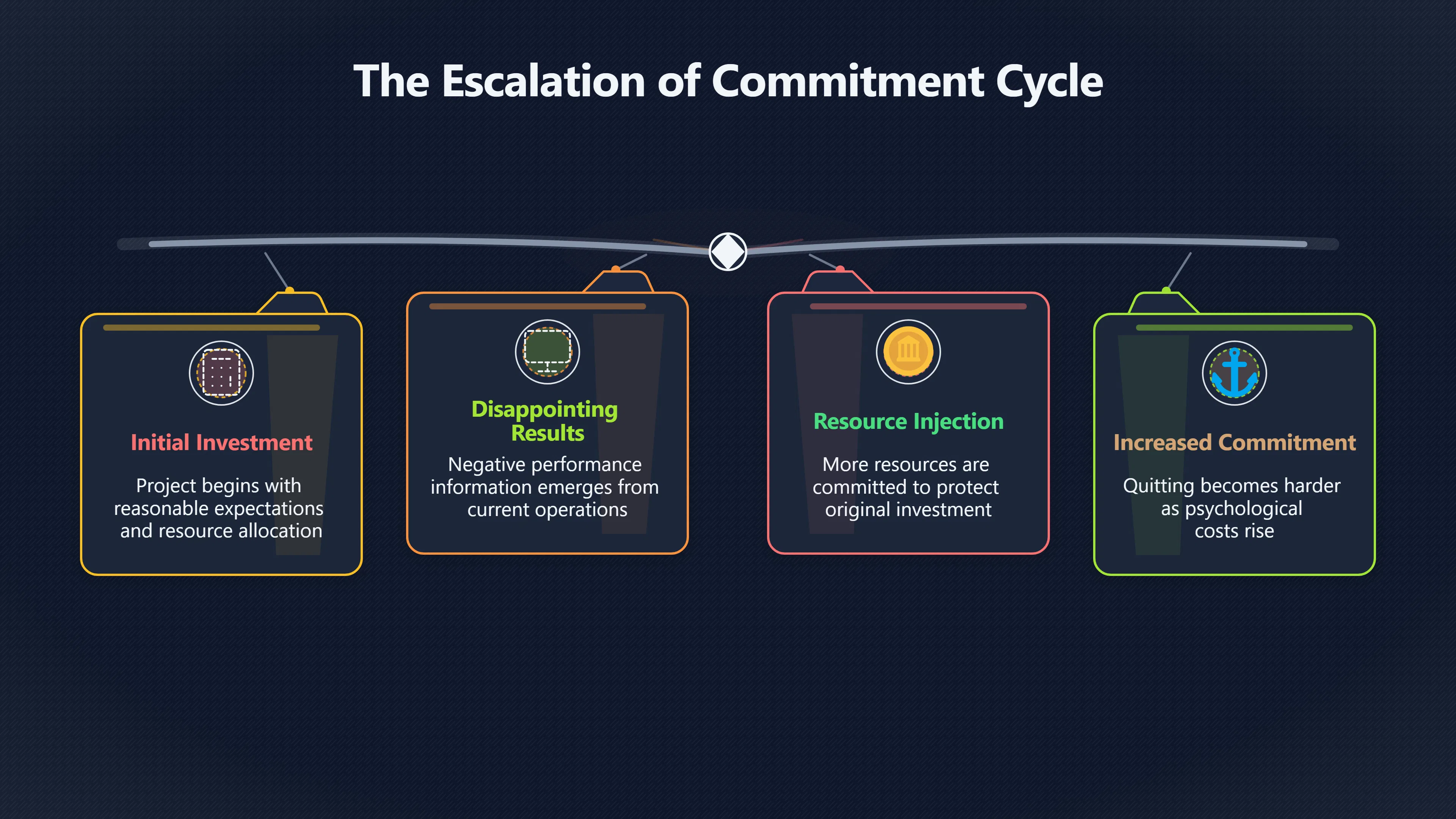
This creates a repeating cycle:
- A project begins with reasonable expectations.
- Results disappoint.
- More resources are committed to “protect” the original investment.
- New disappointments appear.
- The increased investment makes quitting feel even harder.
Each round raises the psychological cost of stopping while lowering the objective chance of success.
Importantly, this is not simply stubbornness. Decision-makers often reinterpret new evidence to support continued investment, convince themselves that recovery is just around the corner, or emphasise how close the project seems to completion. These reactions can feel rational from inside the decision even while producing systematically worse outcomes.[PMC]pmc.ncbi.nlm.nih.govA New Inaction-Effect Perspective on the Sunk-Cost Fallacyby G Feldman · 2018 · Cited by 66 — Escalation-of-commitment situations invo…
Why organisations are especially vulnerable
Projects rarely survive on one person’s judgement alone. Organisations create additional pressures that can keep failing initiatives alive.
Managers may worry that cancelling a project signals poor leadership or wastes previous budget allocations. Teams that have spent years developing specialist knowledge naturally become advocates for continuing. Political incentives can also reward avoiding visible failure today even if doing so creates larger costs later.
Large infrastructure and technology projects provide well-known illustrations. The supersonic Concorde programme became so closely associated with continued investment despite deteriorating economic prospects that the phrase “Concorde fallacy” entered discussions of decision-making. Other large public projects have similarly shown how reputational concerns, political commitments and previous spending can combine to delay termination long after warning signs emerge. These examples are complex and involve strategic, political and social considerations in addition to pure sunk-cost reasoning, but they illustrate how irrecoverable investments can distort future choices.[LuissThesis]tesi.luiss.itThesisThe Sunk Cost Fallacy in Decision-Making: Psychological…These examples demonstrate how decisions influenced by sunk costs a…
Modern project management research therefore treats escalation as more than an individual cognitive bias. Organisational structure, incentives and accountability can either amplify or reduce the tendency to continue failing projects.[Project Management Institute]pmi.orgpsychology project termination decision maker 5914Project Management InstituteThe psychology of project termination28 Oct 2013 — Arkes and Blumer (1985) present a number of experiments to…
Future-only questions for quitting or continuing
The most effective defence is to deliberately remove the past from the decision.
Useful questions include:
- If we had not already started, would we begin this project today?
- Ignoring what has already been spent, is the next pound, hour or employee likely to generate enough future benefit?
- What evidence would convince us to stop?
- If another team owned this project, what advice would we give them?
- What alternative use of these resources offers the highest expected return?
These questions shift attention away from recovering historical investments and towards comparing realistic future opportunities.
Another valuable practice is to define exit criteria before a project begins. Predetermined milestones, performance thresholds and review dates reduce the temptation to invent new reasons for continuing after disappointing results. Independent reviews by people who were not responsible for the original decision can also reduce self-justification pressures. Research on de-escalation suggests that changing how people frame future choices can make withdrawal psychologically easier without reducing accountability.[ResearchGate+2Communication Cache]researchgate.netResearchGate(PDF) Promoting De-Escalation of CommitmentStudy 2 thus provided direct evidence that promotion-focused motivations can reduc…
A common misunderstanding
Avoiding sunk-cost thinking does not mean abandoning every difficult project after early setbacks.
Many worthwhile projects require persistence because temporary losses are expected. Research, product development and long-term infrastructure frequently experience periods where progress appears disappointing before eventual success.
The critical distinction is between temporary evidence that a sound project remains worthwhile and continuing solely because previous investment feels too large to abandon.
Future evidence should determine the decision. Past expenditure should not.
When discussions repeatedly return to phrases such as “We’ve already spent too much to quit now,” “We have to justify all this effort,” or “We’re too far in to stop,” the conversation has probably shifted from evaluating future value to defending past choices. Recognising that shift is often the first step towards better judgement. Recent research also suggests that perceived social norms influence these decisions: people become more willing to pursue sunk costs when they believe others expect persistence, reinforcing the importance of organisational cultures that view prudent termination as evidence of good decision-making rather than failure.[papers.ssrn.com]papers.ssrn.come a greater tendency to continue an endeavor once an investment in money…Read more…
Amazon book picks
Further Reading
Books and field guides related to Do not let the past vote. Use these as the next step if you want deeper reading beyond the article.
Thinking, Fast and Slow
Explains escalation and irrational commitment within decision-making.
Mistakes Were Made (but Not by Me)
Explains why people justify previous commitments despite contrary evidence.
eBay marketplace picks
Marketplace Samples
Live-tested eBay searches with available results related to this page.

Top pick
critical thinking card game
Open a targeted eBay search for items related to this topic.
Browse eBay
Related search
critical thinking game
Open a targeted eBay search for items related to this topic.
Browse eBay

Related search
not memorabilia
Open a targeted eBay search for items related to this topic.
Browse eBayEndnotes
1.
Source: researchgate.net
Link:https://www.researchgate.net/publication/4812596_The_psychology_of_sunk_cost
Source snippet
ResearchGate(PDF) The psychology of sunk costThe sunk cost effect is manifested in a greater tendency to continue an endeavor once an inv...
2.
Source: researchgate.net
Link:https://www.researchgate.net/publication/49635118_Promoting_De-Escalation_of_Commitment_A_Regulatory-Focus_Perspective_on_Sunk_Costs
Source snippet
ResearchGate(PDF) Promoting De-Escalation of CommitmentStudy 2 thus provided direct evidence that promotion-focused motivations can reduc...
3.
Source: papers.ssrn.com
Link:https://papers.ssrn.com/sol3/Delivery.cfm/5066372.pdf?abstractid=5066372&mirid=1
Source snippet
e a greater tendency to continue an endeavor once an investment in money...Read more...
4.
Source: pmc.ncbi.nlm.nih.gov
Link:https://pmc.ncbi.nlm.nih.gov/articles/PMC5904751/
Source snippet
A New Inaction-Effect Perspective on the Sunk-Cost Fallacyby G Feldman · 2018 · Cited by 66 — Escalation-of-commitment situations invo...
5.
Source: Wikipedia
Title: Escalation of commitment
Link:https://en.wikipedia.org/wiki/Escalation_of_commitment
Source snippet
Escalation of commitmentEscalation of commitment is a pattern of decision-making in which individuals or groups continue to invest in...
6.
Source: tesi.luiss.it
Link:https://tesi.luiss.it/41510/1/265431_CAPRINO_CHIARA.pdf
Source snippet
ThesisThe Sunk Cost Fallacy in Decision-Making: Psychological...These examples demonstrate how decisions influenced by sunk costs a...
7.
Source: pmi.org
Title: psychology project termination decision maker 5914
Link:https://www.pmi.org/learning/library/psychology-project-termination-decision-maker-5914
Source snippet
Project Management InstituteThe psychology of project termination28 Oct 2013 — Arkes and Blumer (1985) present a number of experiments to...
8.
Source: communicationcache.com
Link:https://www.communicationcache.com/uploads/1/0/8/8/10887248/escalation_and_de-escalation_of_commitment_in_response_to_sunk_costs-_the_role_of_budgeting_in_mental_accounting.pdf
Source snippet
The Role of Budgeting in Mental Accountingby C HEATH · 1995 · Cited by 528 — Because attention to sunk costs can lead to de- escalation...
9.
Source: journals.ub.uni-heidelberg.de
Link:https://journals.ub.uni-heidelberg.de/index.php/jddm/article/view/71968
Source snippet
Sunk Costs: Importance matters when opportunity...by J Harman · 2020 · Cited by 6 — The sunk cost fallacy is a well-established phenomen...
Additional References
10.
Source: thedecisionlab.com
Link:https://thedecisionlab.com/biases/the-sunk-cost-fallacy
Source snippet
The Sunk Cost FallacyThe sunk cost fallacy is our tendency to follow through with something that we've already invested heavily in (be it...
11.
Source: thinkinsights.net
Link:https://thinkinsights.net/strategy/escalation-commitment
12.
Source: behavioraleconomics.com
Title: Behavioral Economics.com | The BE Hub Sunk cost fallacy
Link:https://www.behavioraleconomics.com/resources/mini-encyclopedia-of-be/sunk-cost-fallacy/
Source snippet
The BE HubSunk cost fallacy - BehavioralEconomics.com | The BE Hub4 Dec 2024 — Individuals commit the sunk cost fallacy when they continu...
13.
Source: thedecisionlab.com
Link:https://thedecisionlab.com/biases/commitment-bias
Source snippet
nger rational to do so simply because we've already devoted...Read more...
14.
Source: linkedin.com
Link:https://www.linkedin.com/pulse/what-sunk-cost-fallacy-escalation-commitment-costing-your-taylor-s3doc
Source snippet
cause it's working, but because we've already invested in it.Read more...
15.
Source: db.arabpsychology.com
Title: escalation of commitment 2
Link:https://db.arabpsychology.com/escalation-of-commitment-2/
Source snippet
Cost Fallacy: Escalation of Commitment ExplainedThe Sunk Cost Fallacy is defined as a specific cognitive bias—a flaw in reasoning—where p...
16.
Source: youtube.com
Title: Daniel Kahneman and the sunk-cost fallacy | The Night Science Podcast
Link:https://www.youtube.com/watch?v=Nd9QT9dO8yw
Source snippet
5 Steps To Avoid The Sunk Cost Fallacy As A Leader | Damon Lembi...
17.
Source: youtube.com
Title: 5 Steps To Avoid The Sunk Cost Fallacy As A Leader | Damon Lembi
Link:https://www.youtube.com/watch?v=1QJ0xaGlpX4
Source snippet
What is the Escalation of Commitment? | Psychology Facts...
18.
Source: youtube.com
Title: Escalation of Commitment: Why We Struggle to Walk Away (90 Seconds)
Link:https://www.youtube.com/watch?v=eeZ1xaD89pU
Source snippet
Sunk Cost Fallacy | Amir Nair | TEDxVNRVJIET...
19.
Source: youtube.com
Title: Sunk Cost Fallacy | Amir Nair | TEDx VNRVJIET
Link:https://www.youtube.com/watch?v=HvNtJPDgD8I
Source snippet
Daniel Kahneman and the sunk-cost fallacy | The Night Science Podcast - Ep 21...
Topic Tree