Within Fluency Trap
Guess First, Then Check Your Understanding
Making a prediction before seeing the answer stops the result from feeling obvious only after it appears.
On this page
- Why hindsight makes answers look easier
- How prediction tests a causal model
- Where to use predictions in study and analysis
Page outline Jump by section
Introduction
One of the quickest ways to mistake familiarity for understanding is to read an answer before asking yourself what you think will happen. Once the correct explanation is visible, it often feels obvious, creating the false impression that you understood it all along. This is closely related to hindsight bias: after learning an outcome, people systematically overestimate how predictable it was beforehand. [The Decision Lab]thedecisionlab.comThe Decision LabHindsight BiasThe hindsight bias describes our tendency to look back at an unpredictable event and think it was easily pr…
 A simple habit counters this illusion. Before revealing an answer, solution or result, make a prediction. Commit to what you expect, however uncertain you feel. Then compare your prediction with reality. This short pause turns passive reading into an active test of understanding. Instead of asking, “Does this explanation make sense?”, you ask, “Could I have anticipated it?” That difference exposes whether you possess a working mental model or merely recognise the explanation after seeing it.
Why hindsight makes answers look easier
Hindsight bias is often called the “I knew it all along” effect. Once an outcome is known, people unconsciously reconstruct their memory of what they previously believed, making the correct answer seem more predictable than it really was. This makes learning feel smoother than it actually is because success is judged after the crucial uncertainty has disappeared. [The Decision Lab+2PMC]thedecisionlab.comThe Decision LabHindsight BiasThe hindsight bias describes our tendency to look back at an unpredictable event and think it was easily pr…
This matters because recognition is much easier than prediction. Reading a convincing explanation can produce a strong feeling of comprehension without demonstrating that you could have generated the explanation yourself.
For example, imagine reading that a company increased prices and subsequently lost market share. After seeing the outcome, the explanation may appear inevitable. Before the result was revealed, however, several competing possibilities might have seemed plausible:
- customers might have accepted the increase;
- competitors might have raised prices too;
- demand might have remained stable because of strong brand loyalty.
Only by recording your expectation beforehand can you distinguish genuine foresight from hindsight.
The same problem appears in science, investing, medicine and everyday reasoning. When outcomes are judged only after they occur, people tend to exaggerate how obvious the causal chain always was, reducing opportunities to learn from mistakes. [The Decision Lab]thedecisionlab.comThe Decision LabHindsight BiasThe hindsight bias describes our tendency to look back at an unpredictable event and think it was easily pr…
How prediction tests a causal model
Making a prediction forces your mind to expose the model it is using.
Instead of merely recognising facts, you must answer questions such as:
- “What should happen next?”
- “Why do I expect that outcome?”
- “What evidence would make me wrong?”
If you cannot make even a rough prediction, it often indicates that your understanding is descriptive rather than causal. You may know definitions or examples without knowing how the parts interact.
Prediction is therefore a practical stress test for a mental model. A good model should allow you to anticipate at least the direction of an outcome, even if the exact details are uncertain.
Equally valuable are incorrect predictions. Research on the generation effect and pretesting shows that attempting to generate an answer before receiving feedback frequently improves later learning, even when the initial guess is wrong, provided corrective feedback follows. The effort of prediction activates existing knowledge, highlights gaps and makes the subsequent explanation more meaningful. Incorrect guesses are not necessarily harmful; corrected errors can still produce strong learning benefits. [PubMed+2ResearchGate]pubmed.ncbi.nlm.nih.govPrinciples of cognitive science in education: the effects…by J Metcalfe · 2007 · Cited by 261 — The answers to these questions a…
This is why prediction differs from random guessing. The aim is not to be correct immediately but to reveal the structure of your current thinking.
Where to use predictions in study and analysis
Prediction works best whenever feedback is delayed by even a few seconds.
Before reading an explanation
Pause before revealing the solution.
Ask yourself:
- What do I think the answer is?
- Why?
- How confident am I?
Only then compare your reasoning with the explanation.
This prevents the answer from borrowing credibility simply because it is already known.
Before worked examples
Many learners immediately read every step of a solved problem. A more revealing approach is to stop after reading the question and sketch your own method first.
Even an incomplete attempt makes differences between your reasoning and the worked solution far more visible.
Before experiments or demonstrations
When watching scientific demonstrations, predict the outcome first.
For example:
- Which object will fall first?
- Which graph will rise?
- Which treatment should produce the larger effect?
Whether your prediction succeeds or fails, the comparison reveals exactly which assumptions need revision.
Educational researchers increasingly encourage instructors to use prediction before demonstrations because it activates prior knowledge and prepares students to notice conflicts between expectation and observation. [BioInteractive]biointeractive.orgusing predictions enhance learningUsing Predictions to Enhance Learning5 Jan 2026 — Predicting can be considered a special case of the retrieval effect, beca…
During analytical work
Prediction is equally useful outside formal education.
Before checking data or reports, write down expectations such as:
- Which variable should change?
- Which explanation seems most plausible?
- What result would surprise me?
Keeping these forecasts prevents later memory from quietly rewriting what you thought beforehand.
Why incorrect predictions are valuable
Many people avoid predicting because they dislike being wrong.
Paradoxically, the possibility of error is what makes prediction useful.
When an incorrect expectation meets immediate feedback, several things happen simultaneously:
- attention increases because the mismatch is personally relevant;
- existing beliefs become easier to revise;
- the corrected explanation has somewhere to attach in memory.
Research on pretesting and the generation effect suggests that producing an answer before feedback often leads to stronger later recall than simply studying the correct answer from the beginning. The improvement appears to come from active retrieval and generation rather than passive exposure alone. [PubMed+2ResearchGate]pubmed.ncbi.nlm.nih.govPrinciples of cognitive science in education: the effects…by J Metcalfe · 2007 · Cited by 261 — The answers to these questions a…
The important condition is timely correction. Leaving incorrect beliefs uncorrected risks reinforcing them, whereas prompt feedback converts mistakes into informative comparisons.
A simple prediction routine
The habit takes less than a minute and can be applied almost anywhere.
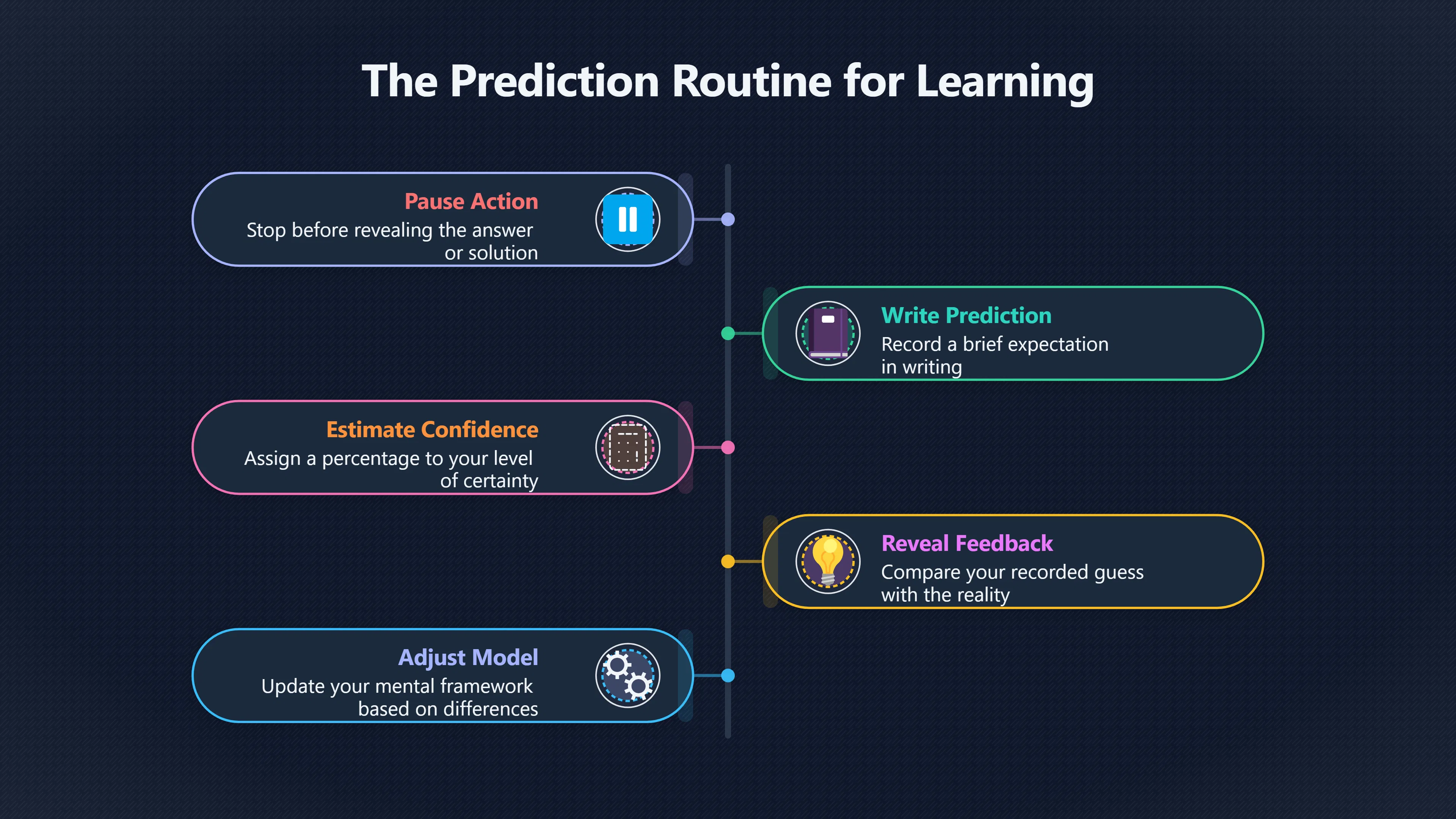
- Stop before revealing the answer.
- Write a brief prediction rather than keeping it in your head.
- Record a confidence estimate, such as 60% or 90%.
- Reveal the feedback.
- Compare not only whether you were right, but why your reasoning differed.
- Adjust your mental model before moving on.
Writing predictions is particularly valuable because hindsight bias can distort memory. Once you know the answer, it becomes surprisingly difficult to remember what you genuinely believed beforehand. An external record preserves the original judgement for honest comparison. [PMC]pmc.ncbi.nlm.nih.govHindsight Bias from 3 to 95 Years of Age - PMCby DM Bernstein · 2011 · Cited by 184 — Upon learning the outcome to a problem, people t…
What changes when you predict first
The greatest benefit of prediction is not higher accuracy on a single question but better calibration.
Instead of asking whether information feels familiar, you repeatedly test whether your understanding can anticipate unseen outcomes. Over time, this shifts attention from recognising explanations to building models that generate them.
That is a fundamental distinction between familiarity and genuine understanding. Familiarity says, “That makes sense now.” Prediction asks, “Could I have expected it before I was shown?” The second question is much harder, but it provides a far more reliable measure of whether you truly understand how something works.
eBay marketplace picks
Marketplace Samples
Topic-anchored marketplace searches for visual, collectible, or second-hand items related to this page.




Endnotes
-
Source: pmc.ncbi.nlm.nih.gov
Link: https://pmc.ncbi.nlm.nih.gov/articles/PMC3084020/Source snippet
Hindsight Bias from 3 to 95 Years of Age - PMCby DM Bernstein · 2011 · Cited by 184 — Upon learning the outcome to a problem, people t...
-
Source: researchgate.net
Link: https://www.researchgate.net/publication/6193801_The_generation_effect_A_meta-analytic_reviewSource snippet
(PDF) The generation effect: A meta-analytic reviewThe generation effect refers to the finding that subjects who generate information (eg...
-
Source: biointeractive.org
Title: using predictions enhance learning
Link: https://www.biointeractive.org/professional-learning/educator-voices/using-predictions-enhance-learningSource snippet
Using Predictions to Enhance Learning5 Jan 2026 — Predicting can be considered a special case of the retrieval effect, beca...
-
Source: thedecisionlab.com
Link: https://thedecisionlab.com/biases/hindsight-biasSource snippet
The Decision LabHindsight BiasThe hindsight bias describes our tendency to look back at an unpredictable event and think it was easily pr...
-
Source: Wikipedia
Title: Hindsight bias
Link: https://en.wikipedia.org/wiki/Hindsight_biasSource snippet
Hindsight biasHindsight bias may cause distortions of memories of what was known or believed before an event occurred and is a signifi...
-
Source: pubmed.ncbi.nlm.nih.gov
Link: https://pubmed.ncbi.nlm.nih.gov/17694905/Source snippet
Principles of cognitive science in education: the effects...by J Metcalfe · 2007 · Cited by 261 — The answers to these questions a...
-
Source: kognitivo.net
Title: generation effect
Link: https://www.kognitivo.net/p/generation-effectSource snippet
in learning: you are the generative engine17 Aug 2025 — The generation effect is the principle that you remember ideas better when you co...
-
Source: mindomax.com
Title: the generation effect
Link: https://www.mindomax.com/the-generation-effectSource snippet
Why the Answers You Create Are...2 May 2026 — A 2023 study of patients with mild cognitive impairment (MCI) found a decreased but still...
Published: May 2026
-
Source: ebsco.com
Link: https://www.ebsco.com/research-starters/psychology/hindsight-biasSource snippet
Hindsight bias | Psychology | Research StartersHindsight bias is a psychological phenomenon where individuals believe that they could hav...
-
Source: Wikipedia
Title: Generation effect
Link: https://en.wikipedia.org/wiki/Generation_effectSource snippet
Generation effectThe generation effect is a psychological phenomenon whereby information is better remembered if it is generated from...
Additional References
-
Source: nesslabs.com
Link: https://nesslabs.com/generation-effect-3Source snippet
The generation effectThe phenomenon where information is better remembered if it is actively created from one's own mind rather than simp...
-
Source: mrjoneswhiteboard.blog
Link: https://mrjoneswhiteboard.blog/2021/08/26/using-the-generation-effect-as-retrieval-practice-some-simple-ideas-for-the-classroom/Source snippet
Using the Generation Effect as Retrieval Practice26 Aug 2021 — The generation effect is the idea that information will be better retained...
-
Source: structural-learning.com
Title: Information learners create sticks better than information they read
Link: https://www.structural-learning.com/post/generation-effect-active-learningSource snippet
The Generation Effect: Why Creating Information Beats20 May 2026 — The generation effect improves memory, according to researchers...
Published: May 2026
-
Source: scribd.com
Link: https://www.scribd.com/document/630575034/Hindsight-BiasSource snippet
oreseeable than they actually were before the outcome occurred.Read more...
-
Source: theeffortfuleducator.com
Title: pretesting the benefits of errorful generation
Link: https://theeffortfuleducator.com/2021/11/05/pretesting-the-benefits-of-errorful-generation/Source snippet
Pretesting: The Benefits of Errorful Generation5 Nov 2021 — Both test types (pre or posttesting) enhanced memory relative to a no-test co...
-
Source: suebehaviouraldesign.com
Link: https://www.suebehaviouraldesign.com/en/blog/hindsight-bias-at-work/Source snippet
Hindsight bias at work: why you always think you saw it...27 Feb 2026 — Hindsight bias is the tendency to believe, after learning an out...
-
Source: bjorklab.psych.ucla.edu
Title: DeWinstanley EBjork 2004
Link: https://bjorklab.psych.ucla.edu/wp-content/uploads/sites/13/2016/07/DeWinstanley_EBjork_2004.pdfSource snippet
Bjork Learning and Forgetting LabProcessing strategies and the generation effectby P ANN · 2004 · Cited by 200 — The generation effect, w...
-
Source: notes.andymatuschak.org
Title: z26C6ing3sqi ZMHRVFu T6xn
Link: https://notes.andymatuschak.org/z26C6ing3sqiZMHRVFuT6xnSource snippet
effectThe generation effect suggests that people are better able to remember material which they themselves generate, compared to materia...
-
Source: youtube.com
Link: https://www.youtube.com/watch?v=OOU2YN2NnmkSource snippet
nformation better if it is generated by ourselves...
-
Source: youtube.com
Title: The Hindsight Bias
Link: https://www.youtube.com/watch?v=tjcjSsbjbGcSource snippet
THE INTELLIGENCE TRAP (The Mistake Smart People Make When Learning)...
Topic Tree