Within Problem Framing
Are You Fixing the Signal or the Source?
Visible trouble is often only the signal, not the thing that needs fixing.
On this page
- Why symptoms attract premature fixes
- How cause search changes the remedy
- When several causes matter at once
Page outline Jump by section
Introduction
When something goes wrong, the visible problem is usually the first thing we notice. A late project, a recurring argument, a missed bill payment, or a constantly cluttered kitchen all present themselves as obvious failures. Yet in many cases the visible failure is a symptom rather than the cause. The symptom is what appears on the surface; the cause is the mechanism that keeps producing it.
 This distinction matters because remedies aimed at symptoms often provide temporary relief while leaving the underlying process unchanged. Effective problem framing therefore begins with a simple question: are you fixing the signal that something is wrong, or the source that keeps generating the signal? Research and practice in root-cause analysis consistently emphasise that lasting improvement comes from understanding underlying causes rather than repeatedly treating recurring effects.[Tableau+2SafetyCulture]tableau.comRoot cause analysis: Definition, examples and a how-…Root cause analysis (RCA) is the process of discovering the root causes of…
Are You Looking at a Symptom or a Cause?
A symptom is an observable sign that a problem exists. A cause is a factor that contributes to producing that symptom. The two are connected, but they are not the same thing.
Consider these everyday examples:
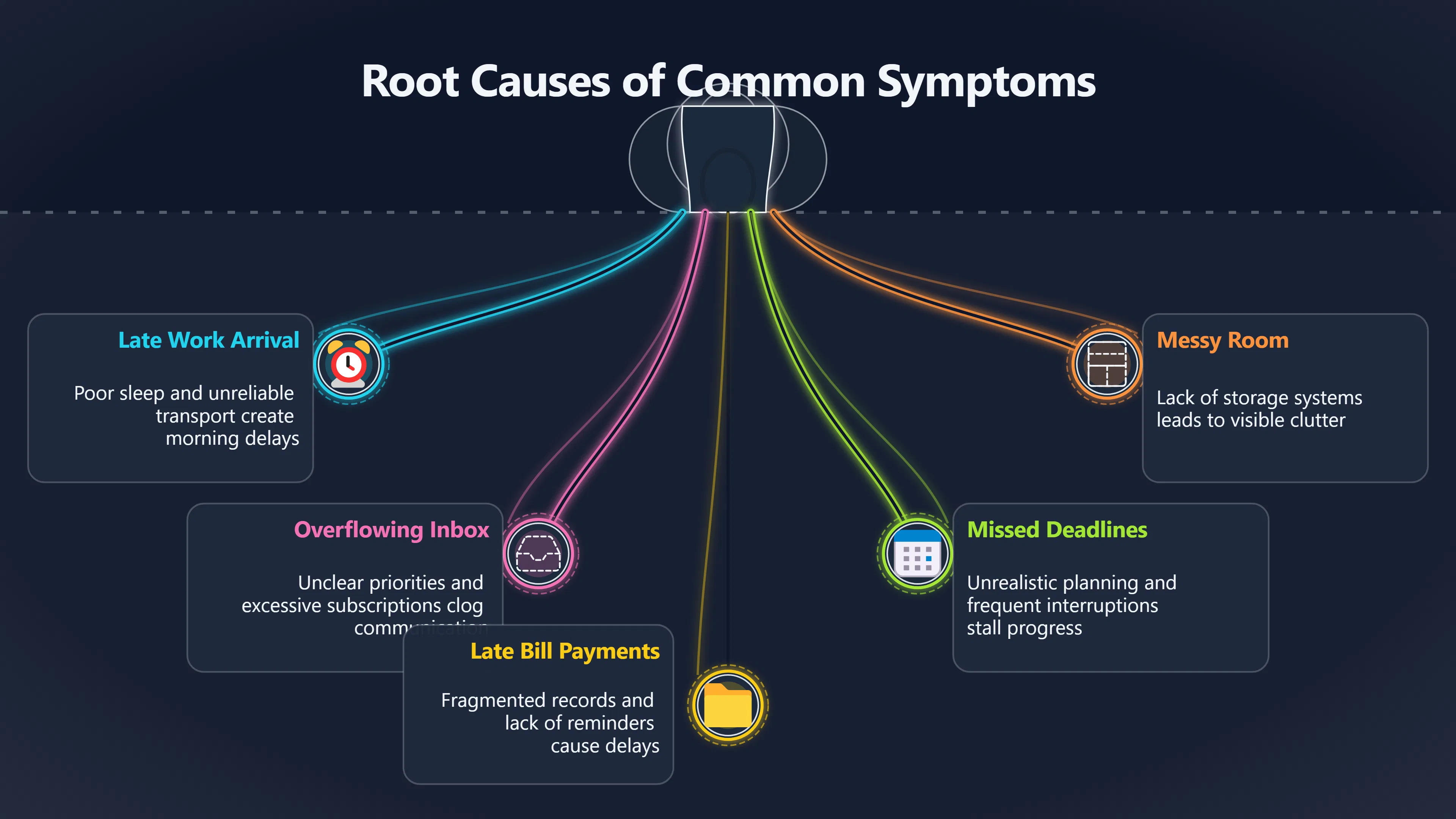
- Symptom: You are frequently late for work. Possible causes: poor sleep, unrealistic morning routines, unreliable transport, or leaving too little margin for delays.
- Symptom: Your inbox is constantly overflowing. Possible causes: unclear priorities, excessive subscriptions, poor filtering systems, or avoidance of difficult messages.
- Symptom: Household bills are paid late. Possible causes: fragmented record-keeping, lack of reminders, cash-flow problems, or administrative overload.
In each case, the symptom is real. It needs attention. But treating only the symptom often means the same problem returns.
Root-cause practitioners frequently describe symptoms as indicators rather than explanations. The symptom tells you where to investigate, not necessarily what to fix.[ATD]td.orgATDFind the Root Cause, Not Just the SymptomDefinitions of Symptoms and Causes · Content. A symptom is a sign or indication of a root cau…
Why Symptoms Attract Premature Fixes
Symptoms are attractive because they are visible, immediate and emotionally satisfying to address.
When a room is messy, cleaning it feels productive. When deadlines are missed, demanding faster work feels decisive. When customers complain, issuing refunds feels responsive. The trouble is that these actions may remove evidence of the problem without changing the process that generated it.
Several psychological tendencies push people towards symptom-focused solutions:
- Visibility bias: We naturally focus on what we can see directly.
- Urgency pressure: Immediate problems demand attention now, while causes often require investigation.
- Desire for closure: People prefer a quick answer to an uncertain search.
- Action bias: Doing something feels better than pausing to diagnose.
This tendency appears in organisations as well as personal life. Research discussed by Harvard Business School notes that many leaders believe organisations struggle more with diagnosing problems correctly than with implementing solutions once a problem is understood.[Harvard Business School]online.hbs.eduroot cause analysisHarvard Business SchoolRoot Cause Analysis: What It Is & How to Perform One3 Dec 2024 — According to research described in the Harvard Bu…
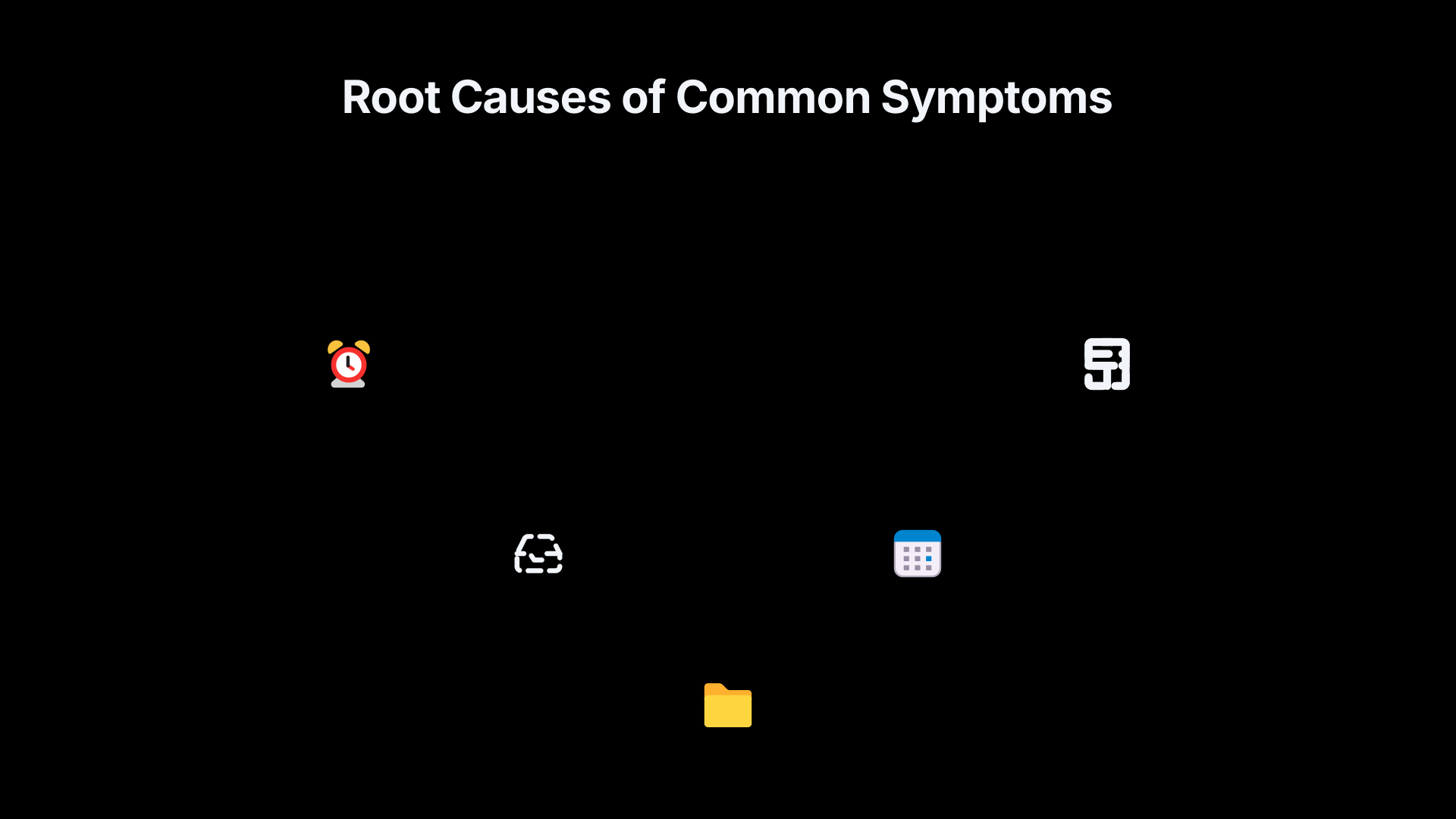
The result is a familiar cycle:
- A symptom appears.
- A quick fix removes the symptom temporarily.
- The underlying mechanism remains.
- The symptom returns.
- More effort is spent fighting the recurrence.
Repeated firefighting often signals that diagnosis has not yet reached the cause.
How Cause-Search Changes the Remedy
Finding a cause changes not only what you do but also where you intervene.
Imagine a student who repeatedly submits assignments late.
A symptom-focused remedy might be:
- Send reminders.
- Increase monitoring.
- Add penalties.
A cause-focused investigation might reveal:
- The student misunderstands assignment requirements.
- Instructions arrive through multiple channels.
- Planning skills are weak.
- Work begins too late because tasks feel overwhelming.
Once the mechanism becomes clearer, the remedy changes. Instead of increasing pressure, the solution may involve simplifying instructions, improving planning routines, or breaking work into smaller stages.
The key shift is from asking:
“How do I stop this problem?”
to:
[> "What keeps producing this problem?"]tulip.coWhat are the Five Whys? A Tool For Root Cause Analysis | TulipLearn about the Five Whys and how manufacturers use this problem-solving me…
Root-cause methods such as the “Five Whys” were developed specifically to encourage movement from visible effects towards underlying causal chains. The exact number of questions is less important than the habit of tracing cause-and-effect relationships beyond the first explanation.[ResearchGate+2Tulip]researchgate.netResearchGate(PDF) The Five Whys TechniqueThe Five Whys technique is a simple but powerful way to troubleshoot problems by exploring cause…
Following the Chain Without Stopping Too Early
A common mistake is stopping the investigation at the first plausible explanation.
Suppose someone frequently forgets appointments.
The reasoning might proceed as follows:
- Why was the appointment missed? Because it was forgotten.
That answer merely restates the symptom.
Continuing:
- Why was it forgotten? Because it was not entered into a calendar.
Continuing further:
- Why was it not entered? Because appointments are recorded in several different places.
Continuing:
- Why are they recorded in several places? Because there is no single trusted system.
Now the investigation points towards a more actionable mechanism. A reliable calendar process may solve many future misses, not just the latest one.
This illustrates an important principle: useful causes are not merely earlier events. They are factors that can realistically be changed to reduce recurrence.[Centers for Medicare & Medicaid Services]cms.govCenters for Medicare & Medicaid ServicesFive Whys Tool for Root Cause AnalysisOverview: Root cause analysis is a structured team process…
When Several Causes Matter at Once
Real-life problems rarely have one perfect root cause.
A missed deadline may result from:
- Unrealistic planning.
- Frequent interruptions.
- Unclear requirements.
- Delayed decisions from others.
Looking for a single cause can therefore become misleading.
Experts in problem framing and diagnosis increasingly emphasise that complex problems often emerge from interacting factors rather than one hidden culprit. Reframing exercises and systems-oriented approaches are valuable precisely because they reveal multiple contributing mechanisms operating together.[Harvard Business Review+2Harvard Business Review]hbr.orgdo you understand the problem youre trying to solveHarvard Business ReviewDo You Understand the Problem You're Trying to Solve?3 Apr 2024 — In this episode, you'll learn how to reframe tou…
In everyday diagnosis, it is often more useful to ask:
“Which causes contribute most to this outcome?”
than:
“What is the one true cause?”
A recurring household conflict, for example, may arise from stress, poor communication, conflicting expectations and lack of time. Removing any one factor may help, even if it does not eliminate the problem entirely.
Distinguishing Causes From Blame
People often avoid searching for causes because they fear it will become a search for someone to blame.
Cause analysis and blame assignment are different activities.
Blame asks:
“Whose fault was this?”
Cause analysis asks:[tableau.com]tableau.comRoot cause analysis: Definition, examples and a how-…Root cause analysis (RCA) is the process of discovering the root causes of…
“What conditions allowed this to happen?”
A forgotten task may involve a person’s mistake, but the broader cause may involve unclear responsibilities, poor reminders or an overloaded schedule.
Many root-cause frameworks explicitly warn against reducing diagnosis to individual fault because doing so can hide the larger mechanisms that make errors more likely.[Adobe for Business+2magnetic.app]business.adobe.com5 whys root cause analysisLearn about this problem-solving technique with…
When diagnosis becomes blame-focused, people defend themselves. When diagnosis becomes mechanism-focused, people can investigate what actually needs changing.
A Practical Test: Will the Problem Return?
One useful question helps distinguish symptoms from causes:
If I apply this fix, how likely is the same problem to reappear?
If the answer is “very likely”, you may still be operating at the symptom level.
For example:
- Restarting a frozen computer fixes the symptom.
- Discovering the software conflict that causes repeated crashes addresses the cause.
- Clearing clutter from a desk fixes the symptom.
- Creating a storage system addresses a cause.
- Working longer hours fixes a missed deadline this week.
- Correcting unrealistic workload estimates addresses a cause.
The goal is not to ignore symptoms. Symptoms often require immediate attention. The goal is to recognise that immediate relief and lasting resolution are different achievements.
What Good Problem Framers Learn to Notice
People who become skilled at diagnosis develop a habit of separating observations from explanations.
They notice the visible problem, but they resist treating the first explanation as the final answer. They look for patterns, recurrences and mechanisms. They ask what process, incentive, habit or condition keeps generating the same outcome.
That shift changes the quality of reasoning before any solution is chosen. Instead of repeatedly fixing what is visible, they investigate what is producing what is visible. In everyday life, that distinction often determines whether a problem returns next week or disappears for good.
Amazon book picks
Further Reading
Books and field guides related to Are You Fixing the Signal or the Source?. Use these as the next step if you want deeper reading beyond the article.
The Book of Why
Directly addresses the difference between observed effects and underlying causes, matching the symptom-versus-cause theme.
Thinking in Systems
Helps readers understand how recurring symptoms emerge from underlying system structures and feedback loops.
The Art of Thinking Clearly
Explains common reasoning errors that lead people to treat symptoms while missing deeper causes.
The Scout Mindset
Encourages looking past preferred explanations and investigating reality accurately before choosing remedies.
eBay marketplace picks
Marketplace Samples
Example marketplace items related to this page. Use the search link to explore similar finds on eBay.


Endnotes
1.
Source: tableau.com
Link:https://www.tableau.com/en-gb/learn/articles/root-cause-analysis
Source snippet
Root cause analysis: Definition, examples and a how-...Root cause analysis (RCA) is the process of discovering the root causes of...
2.
Source: safetyculture.com
Title: root cause analysis
Link:https://safetyculture.com/blog/root-cause-analysis
Source snippet
Root Cause Analysis: Solving Causes Not Symptoms13 May 2022 — Root cause analysis (RCA) is a model that helps identify probl...
Published: May 2022
3.
Source: td.org
Link:https://www.td.org/content/atd-blog/find-the-root-cause-not-just-the-symptom
Source snippet
ATDFind the Root Cause, Not Just the SymptomDefinitions of Symptoms and Causes · Content. A symptom is a sign or indication of a root cau...
4.
Source: researchgate.net
Link:https://www.researchgate.net/publication/318013490_The_Five_Whys_Technique
Source snippet
ResearchGate(PDF) The Five Whys TechniqueThe Five Whys technique is a simple but powerful way to troubleshoot problems by exploring cause...
5.
Source: tulip.co
Link:https://tulip.co/glossary/five-whys/
Source snippet
What are the Five Whys? A Tool For Root Cause Analysis | TulipLearn about the Five Whys and how manufacturers use this problem-solving me...
6.
Source: business.adobe.com
Title: 5 whys root cause analysis
Link:https://business.adobe.com/blog/basics/5-whys-root-cause-analysis
Source snippet
Learn about this problem-solving technique with...
7.
Source: magnetic.app
Link:https://www.magnetic.app/blog/root-cause-analysis-rca
Source snippet
erlying reasons behind issues or events within a business.Read more...
8.
Source: pelp.fas.harvard.edu
Link:https://pelp.fas.harvard.edu/resource/pel083p2pdf
Source snippet
Problem Solving Approach to Designing and...24 Apr 2017 — In order to keep the illustration as simple as possible, we chose only three s...
9.
Source: tulip.co
Title: what is the difference between a causal factor a root cause
Link:https://tulip.co/blog/what-is-the-difference-between-a-causal-factor-a-root-cause/
Source snippet
Root cause analysis works best when the investigation goes beyond surface symptoms.Read more...
10.
Source: researchgate.net
Title: 385047019 Mastering Root Cause Analysis with the 5 Whys Method
Link:https://www.researchgate.net/publication/385047019_Mastering_Root_Cause_Analysis_with_the_5_Whys_Method
Source snippet
Mastering Root Cause Analysis with the 5 Whys Method18 Oct 2024 — The 5 Whys technique involves iteratively asking the question "Why?" to...
11.
Source: online.hbs.edu
Title: root cause analysis
Link:https://online.hbs.edu/blog/post/root-cause-analysis
Source snippet
Harvard Business SchoolRoot Cause Analysis: What It Is & How to Perform One3 Dec 2024 — According to research described in the Harvard Bu...
12.
Source: hbr.org
Link:https://hbr.org/2017/01/are-you-solving-the-right-problems
Source snippet
Are You Solving the Right Problems?How good is your company at problem solving? Probably quite good, if your managers are like those at t...
13.
Source: cms.gov
Link:https://www.cms.gov/medicare/provider-enrollment-and-certification/qapi/downloads/fivewhys.pdf
Source snippet
Centers for Medicare & Medicaid ServicesFive Whys Tool for Root Cause AnalysisOverview: Root cause analysis is a structured team process...
14.
Source: hbr.org
Title: do you understand the problem youre trying to solve
Link:https://hbr.org/podcast/2024/04/do-you-understand-the-problem-youre-trying-to-solve
Source snippet
Harvard Business ReviewDo You Understand the Problem You're Trying to Solve?3 Apr 2024 — In this episode, you'll learn how to reframe tou...
15.
Source: hbr.org
Link:https://hbr.org/2024/01/to-solve-a-tough-problem-reframe-it
Source snippet
To Solve a Tough Problem, Reframe ItDelve into Root Causes. The iceberg model helps you investigate below the surface to understand. See...
16.
Source: hbr.org
Link:https://hbr.org/1998/03/the-set-up-to-fail-syndrome
Source snippet
Harvard Business ReviewThe Set-Up-To-Fail SyndromeThe employee doesn't understand the work, a manager might contend. Or the employee isn'...
17.
Source: Wikipedia
Title: Five whys
Link:https://en.wikipedia.org/wiki/Five_whys
Source snippet
Five whysFive whys (or 5 whys) is an iterative interrogative technique used to explore the cause-and-effect relationships underlying a...
18.
Source: linkedin.com
Link:https://www.linkedin.com/posts/harvard-business-review_to-solve-a-tough-problem-reframe-it-activity-7150140594776915968-VtAd
19.
Source: hbr.org
Title: Harvard Business Review
Link:https://hbr.org/
Source snippet
Ideas and Advice for LeadersFind new ideas and classic advice on strategy, innovation and leadership, for global leaders from the world's...
20.
Source: hbr.org
Title: the right way to solve complex business problems
Link:https://hbr.org/podcast/2018/12/the-right-way-to-solve-complex-business-problems
Source snippet
4 Dec 2018 — Phelps identifies the common traps and outlines a research-proven method to solve problems effectively.Read more...
21.
Source: hbr.org
Title: Diagnostic Thinking
Link:https://hbr.org/video/2226699673001/diagnostic-thinking
Source snippet
HBR VideoThe ability to look at a problem and not to go from problem to solution but engaging in an intermediate step of going from probl...
22.
Source: hbr.org
Title: the 5 whys
Link:https://hbr.org/2012/02/the-5-whys
Source snippet
7 Feb 2012 — Eric Ries, entrepreneur-in-residence at Harvard Business School, explains how to find the human causes of technical problems...
23.
Source: mindtools.com
Title: root cause analysis
Link:https://www.mindtools.com/ag6pkn9/root-cause-analysis/
Source snippet
7 Mar 2025 — What Is Root Cause Analysis? · Physical causes – Tangible, material items failed in some way (for example, a car's brakes st...
24.
Source: mindtools.com
Title: 5 whys
Link:https://www.mindtools.com/a3mi00v/5-whys/
Source snippet
30 Jun 2025 — The 5 Whys is a simple yet powerful method for identifying the root cause of recurring problems by repeatedly asking “Why?R...
25.
Source: kpifire.com
Title: 5 whys root cause analysis
Link:https://www.kpifire.com/blog/5-whys-root-cause-analysis/
Source snippet
A Simple Guide18 Apr 2025 — Understand 5 whys root cause analysis and how this simple, powerful tool helps identify underlying issues for...
Additional References
26.
Source: linkedin.com
Link:https://www.linkedin.com/posts/harvard-business-review_burnout-looks-different-across-the-org-chart-activity-7445884092040208384-DtLo
27.
Source: facebook.com
Link:https://www.facebook.com/groups/209829190372971/posts/1319357499420129/
Source snippet
Identifying root cause of problems effectivelyWhy do problems keep coming back even after a quick fix? It’s often because we only treat t...
28.
Source: facebook.com
Link:https://www.facebook.com/61566958478779/posts/root-cause-analysis-rca-the-power-of-the-5-whys-many-incidents-in-the-workplace-/122208024158565282/
Source snippet
ROOT CAUSE ANALYSIS (RCA) – The Power of the “5...Root Cause Analysis (RCA) helps us go beyond treating symptoms and focuses on addressi...
29.
Source: quality-one.com
Link:https://quality-one.com/rca/root-cause-analysis-and-the-5-whys/
Source snippet
Root Cause Analysis and the 5 Whys | Quality-OneThis article delves into how RCA and the 5 Whys complement each other and showcases pract...
30.
Source: bridgepointgroup.com.au
Link:https://www.bridgepointgroup.com.au/root-cause-analysis-a-guide-to-business-problem-solving-success/
Source snippet
Root Cause Analysis: A Guide to Problem-Solving SuccessStep 1: Define the Problem · Step 2: Collect Data · Step 3: Identify Possible Caus...
31.
Source: flashhub.io
Link:https://flashhub.io/root-cause-problem-solving/
Source snippet
Root Cause Problem Solving: 15 Essential TechniquesRoot cause problem solving involves steps like defining the issue, gathering data, ide...
32.
Source: horticulture.ahdb.org.uk
Link:https://horticulture.ahdb.org.uk/knowledge-library/using-root-cause-analysis-to-identify-issues
Source snippet
root cause analysis to identify issuesRoot cause analysis is a method used to identify the root cause of issues in your business, i.e. wh...
33.
Source: atlassian.com
Link:https://www.atlassian.com/team-playbook/plays/5-whys
34.
Source: leantech.no
Link:https://leantech.no/en/blog/61-root-cause-analysis
Source snippet
Delayed deliveries. High rejection rates. Frustrated customers. Symptoms are the leaves on the tree. They grow back if...Read more...
35.
Source: ceosquad.co
Link:https://ceosquad.co/mastering-problem-solving-from-harvard-business-review/
Source snippet
Engage diverse teams in the problem-solving process. Encourage open dialogue and idea-sharing to...Read more...
Topic Tree