Within Sharper Thinking
Why One Explanation Is Not Enough
Comparing plausible alternatives prevents a good-sounding explanation from winning by default.
On this page
- What counts as a live alternative
- Comparing explanations fairly
- Prediction tests for rival ideas
Page outline Jump by section
Introduction
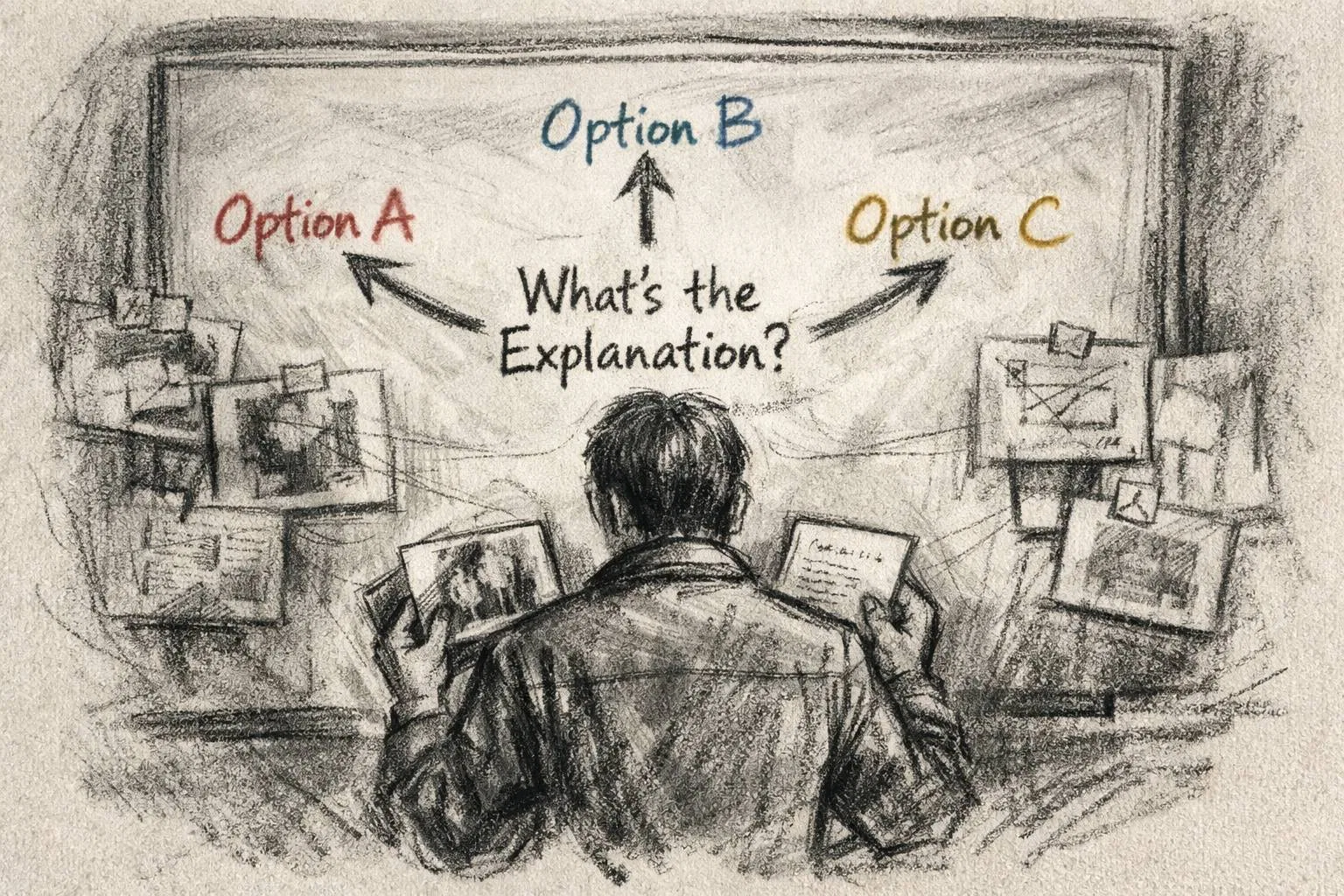
One of the most useful habits in better thinking is to keep more than one plausible explanation alive long enough for evidence to compete. A single explanation can feel persuasive simply because it is fluent, familiar, emotionally satisfying, or the first one that fits the visible facts. “Live alternatives” means treating rival explanations as real candidates, not decorative afterthoughts. The aim is not indecision. It is to stop a good-sounding story from winning by default before the evidence has been asked a sharper question: not “Does this fit?” but “Does it fit better than the other serious possibilities?” Research on confirmation bias, hypothesis testing, clinical diagnosis, intelligence analysis, and Bayesian evidence all points to the same mechanism: judgement improves when evidence is evaluated against competing explanations rather than used only to support a favourite one. [UC San Diego Pages+2Strathprints]pages.ucsd.edunickerson Confirmation BiasUC San Diego PagesConfirmation Bias: A Ubiquitous Phenomenon in Many…by RS Nickerson · 1998 · Cited by 12282 — Confirmation bias, as t…
This matters because many real errors do not begin with a ridiculous belief. They begin with a reasonable first explanation that becomes too comfortable too early. The skill is to generate alternatives that are plausible enough to threaten your current view, compare them fairly, and then design evidence checks that would actually separate them.
What counts as a live alternative
A live alternative is not every imaginable possibility. It is a rival explanation that is plausible enough, specific enough, and consequential enough to deserve comparison with your current favourite. “The customer complained because the product is bad” may be a live explanation. So might “the onboarding was unclear”, “the customer expected a different feature”, or “support mishandled the escalation”. “Aliens did it” is not live in an ordinary customer-service case unless there is extraordinary context that makes it genuinely relevant.
The point is to avoid two weak substitutes. The first is the straw alternative: a rival so silly that your preferred explanation easily defeats it. The second is the empty opposite: merely saying “maybe not” without offering a concrete competing mechanism. Research on “consider the opposite” and “consider an alternative” strategies suggests that debiasing works best when people generate meaningful rival explanations, not when they perform a ritual of doubt. Hirt and colleagues’ work on considering alternatives found that generating multiple explanations can reduce hindsight and overconfidence effects, but the usefulness depends partly on whether alternatives are easy enough to generate rather than forced and artificial. [Communication Cache]communicationcache.commultiple explanation a consider an alternative strategy for debiasing judgmentsmultiple explanation a consider an alternative strategy for debiasing judgments
A practical test is whether the alternative changes what you would look for next. If “the project failed because the team lacked discipline” and “the project failed because the goal was unstable” both lead to the same evidence search, one of them is probably too vague. A live alternative should point your attention towards different observations, records, witnesses, measurements, or predictions.
Good live alternatives usually have four traits:
- They explain the same core facts. A rival that ignores the main observation is not yet a rival.
- They name a mechanism. It should say how the outcome could have happened, not merely attach a label.
- They imply different expectations. If true, the alternative should make some future or hidden evidence more likely.
- They could change the decision. A rival matters more when it would alter the action, priority, diagnosis, investment, or conclusion.
The value of alternatives is clearest in abductive reasoning, often called inference to the best explanation. Abduction is the kind of reasoning used when you infer the most plausible explanation from incomplete facts. But “best” only has meaning relative to competitors. Philosophers of science such as Peter Lipton and later accounts of abduction stress that explanatory reasoning requires comparing candidate explanations, not simply admiring one story that fits. Stanford Encyclopedia of Philosophy+2HP Services at Cambridge [plato.stanford.edu]plato.stanford.eduEncyclopedia of Philosophy AbductionEncyclopedia of Philosophy Abduction

Why a favourite explanation wins too easily
A favourite explanation has several unfair advantages. It gets interpreted first, gathers supporting details first, and often shapes the way the question is asked. Once it exists, new evidence is more likely to be noticed, remembered, and interpreted in ways that fit it. Nickerson’s widely cited review defines confirmation bias as seeking or interpreting evidence in ways that are partial to existing beliefs, expectations, or hypotheses. [UC San Diego Pages]pages.ucsd.edunickerson Confirmation BiasUC San Diego PagesConfirmation Bias: A Ubiquitous Phenomenon in Many…by RS Nickerson · 1998 · Cited by 12282 — Confirmation bias, as t…
The problem is not that people consciously decide to be biased. Often, the search process itself is lopsided. Klayman and Ha’s work on the “positive test strategy” showed that people often test a hypothesis by looking where they expect confirming cases to appear. This can be a useful heuristic in some settings, especially when the hypothesis is sparse and confirming cases would be informative. But it can also mislead when the same confirming evidence would be expected under several rival explanations. [UC San Diego Pages]pages.ucsd.eduOpen source on ucsd.edu.
Imagine a manager who thinks a new employee is underperforming because they lack motivation. The manager then looks for signs of low effort: slow replies, missed details, quietness in meetings. Those observations may fit the “low motivation” explanation. But they may also fit unclear instructions, anxiety, poor onboarding, tool access problems, or a mismatch between the employee’s skills and the assigned work. The evidence only becomes useful when asked comparatively: which explanation would make these details most expected, and what evidence would distinguish them?
This is why confirmation is weaker than it feels. Evidence that is compatible with your explanation is not necessarily evidence that favours it. A fever is compatible with flu, food poisoning, heat illness, and many infections. A sales drop is compatible with weak marketing, seasonality, competitor action, price sensitivity, product defects, or measurement error. The analytical mistake is treating “fits my story” as though it meant “selects my story”.
Comparing explanations fairly
Fair comparison starts by asking the same questions of each explanation. Without this symmetry, the favoured explanation gets interpreted generously while rivals are examined only for flaws. This is one reason structured methods such as Analysis of Competing Hypotheses were developed in intelligence work: they force analysts to list hypotheses, compare evidence across them, and pay attention to evidence that is inconsistent with each candidate rather than only evidence that supports one. [Strathprints]strathprints.strath.ac.ukDhami etal ACP 2019 The analysis of competing hypotheses in intelligenceThe “analysis of competing hypotheses” in intelligence analysisby MK Dhami · 2019 · Cited by 81 — We examined the use of the…
A useful comparison does not require a large formal matrix every time. For ordinary thinking, the core move is simpler: put explanations side by side and ask how each would account for the same facts. The strongest evidence is often not the most dramatic fact, but the most diagnostic fact: the one that separates alternatives.
For example, suppose a website’s conversion rate has fallen. A single-explanation thinker may say, “The redesign made the page worse,” then search for evidence that users dislike the redesign. A live-alternatives thinker compares several mechanisms:
Observed factRedesign confusionTraffic-quality changeTracking errorCompetitor pressureFewer purchasesFitsFitsMight only appear to fitFitsSame traffic volumeFitsCould fit if sources changedFitsFitsDrop begins exactly on launch dayStrongly fitsWeak unless campaign changed tooStrongly fitsCoincidence neededPayment-page events also changed oddlyPossibleWeakStrongly fitsWeakCustomer complaints mention layoutStrongly fitsWeakWeakWeak
The question is not which story feels most natural. It is which observations would be surprising under each rival. Bayesian evidence expresses this formally: evidence supports one hypothesis over another when it is more likely under the first than under the second. Bayes factors and likelihood ratios are built around this comparative idea, quantifying support for one model or hypothesis relative to another rather than treating evidence as free-standing proof. [Wikipedia+2Jclinepi]WikipediaBayes factorBayes factor
This comparative framing prevents a common error: overvaluing shared evidence. If a fact would be likely under all live alternatives, it may be important background, but it is not decisive. If a fact would be expected under one explanation and strange under another, it deserves more weight.
Prediction tests for rival ideas
The best way to keep alternatives live is to turn them into predictions. A prediction test asks: “If this explanation were true, what should we expect to see that would be less likely if a rival explanation were true?” This moves thinking from story quality to evidence quality.
A prediction does not have to be a scientific experiment. It can be a document check, a follow-up question, a small pilot, a search for a missing record, or a comparison across cases. In medicine, this habit appears as differential diagnosis: clinicians keep multiple possible diagnoses in mind, gather evidence, and revise the list as findings accumulate. The danger of doing the opposite is known as premature closure, where a clinician accepts an early diagnosis and stops seriously considering reasonable alternatives. Reviews of diagnostic reasoning describe premature closure as a central contributor to diagnostic error because it shuts down further search. [Swiss Medical Weekly]smw.chOpen source on smw.ch.
The same pattern appears outside medicine. A team investigating a security incident may prefer “external attacker” because it is vivid and urgent. But live alternatives might include misconfigured permissions, a compromised vendor account, accidental data exposure, or an internal policy violation. Each explanation predicts different evidence: login patterns, permission histories, vendor access logs, file-transfer records, or employee workflows. The investigation improves when the team asks which evidence would discriminate between these mechanisms.
Useful prediction tests often take one of these forms:
- The absence test: What should be present if my favourite explanation is true, and is it actually missing?
- The rival-fit test: What evidence would my least-liked serious alternative predict?
- The timing test: Does the sequence of events fit one explanation better than the others?
- The mechanism test: Can the explanation actually produce the effect at the observed size or speed?
- The reversal test: What would I expect to see if the causal arrow ran the other way?
The strongest tests are designed before looking at the answer. If you first inspect the evidence and then decide what it “would have predicted”, you risk turning every result into post-hoc support. This is the same reason scientific and statistical thinking values pre-specified hypotheses and transparent model comparison: it reduces the freedom to reinterpret ambiguous results after the fact.

When alternatives improve judgement, and when they become clutter
Keeping alternatives alive is not the same as treating every idea equally. Too few alternatives causes tunnel vision; too many causes fog. The right number depends on the stakes, uncertainty, and cost of being wrong. For a low-stakes everyday choice, two alternatives may be enough. For a medical diagnosis, legal investigation, intelligence assessment, strategic forecast, or expensive business decision, the set should be broader and more explicit.
Structured analytic techniques can help, but they are not magic. Research on Analysis of Competing Hypotheses has found that although the method is designed to reduce confirmation bias, evidence for its effectiveness is mixed and depends on how analysts use it. A 2019 study of 50 intelligence analysts found that ACH changed aspects of the judgement process but did not provide simple proof that the technique automatically improves conclusions. A later study on task structure and confirmation bias similarly cautioned that focusing mechanically on disproving hypotheses can introduce its own distortions if the task is poorly structured. [Wiley Online Library]onlinelibrary.wiley.comOpen source on wiley.com.
That warning matters. “Generate alternatives” can fail in several ways:
- Token alternatives: rivals are listed but never allowed to influence the conclusion.
- Unequal scrutiny: the favourite gets charitable interpretation; rivals get hostile interpretation.
- Flat lists: alternatives are named at different levels, such as “bad strategy”, “poor pricing”, and “the team is incompetent”, making comparison messy.
- Premature elimination: a rival is dropped because of one weak point, even though the favourite has similar weaknesses.
- No decision link: the analysis expands but never clarifies what would change action.
The remedy is to keep alternatives live only while they are doing work. A rival should either explain something important, point to a discriminating test, protect against a costly mistake, or reveal that the original question is framed too narrowly. Once evidence strongly rules it out, it can be retired. Good thinking is not endless openness; it is disciplined openness followed by justified narrowing.
A practical routine for using live alternatives
The habit can be made simple enough to use in real life. Before committing to an explanation, write one sentence for your favourite view and at least two serious rivals. Then compare them against the evidence you already have and identify the next evidence that would most separate them.
A compact routine looks like this:
- Name the observation. What exactly needs explaining?
- State the favourite explanation. What mechanism do you currently think is at work?
- Add two live alternatives. What else could explain the same facts without being silly or evasive?
- List shared evidence. Which facts fit all explanations and therefore should not be overweighted?
- Find diagnostic evidence. Which fact would be likely under one explanation and unlikely under another?
- Run one prediction test. What can you check next that would actually move the comparison?
- Update, do not defend. Change confidence according to how the evidence treats the alternatives.
The smallest useful version is a three-column note:
QuestionFavourite explanationRival explanationWhat would this predict?What would be surprising?What should I check next?
This routine works because it turns vague open-mindedness into a mechanism. It gives your current explanation competitors, gives the evidence a job, and gives you a reason to update. It also makes your reasoning easier for other people to inspect. Someone can disagree with your alternatives, challenge your predictions, or point out missing evidence. That is a feature, not a flaw: visible reasoning can be corrected.
The core takeaway
One explanation is often enough to start thinking, but not enough to finish it. A good explanation should survive comparison with live rivals, not merely sound coherent in isolation. The question to practise is: “What else could explain this, and what would I expect to see if that rival were true?”
This habit improves analytical skill because it attacks the point where many errors enter: the quiet moment when a plausible first story becomes the only story. By keeping alternatives live, comparing them fairly, and testing their different predictions, you make your reasoning less dependent on fluency, confidence, and first impressions — and more dependent on evidence that actually distinguishes between competing possibilities.
Amazon book picks
Further Reading
Books and field guides related to Why One Explanation Is Not Enough. Use these as the next step if you want deeper reading beyond the article.
Superforecasting
Emphasizes weighing competing hypotheses, updating beliefs, and testing predictions.
The Scout Mindset
Focuses on evaluating evidence fairly instead of defending a preferred explanation.
The Demon-Haunted World
Rating: 4.5/5 from 43 Google Books ratings
Promotes skeptical inquiry, hypothesis testing, and comparing explanations with evidence.
How to Think About Weird Things: Critical Thinking for a New Age
Covers evaluating competing claims, evidence, and alternative explanations systematically.
eBay marketplace picks
Marketplace Samples
Live-tested eBay searches with available results related to this page.




Endnotes
-
Source: plato.stanford.edu
Title: Encyclopedia of Philosophy Abduction
Link: https://plato.stanford.edu/entries/abduction/ -
Source: cambridge.org
Link: https://www.cambridge.org/core/elements/abductive-reasoning-in-science/A380186A1C38650BB9842AF9536D235D -
Source: Wikipedia
Title: Bayes factor
Link: https://en.wikipedia.org/wiki/Bayes_factor -
Source: jclinepi.com
Link: https://www.jclinepi.com/article/S0895-4356%2821%2900132-3/fulltext -
Source: onlinelibrary.wiley.com
Link: https://onlinelibrary.wiley.com/doi/full/10.1002/acp.3550 -
Source: Wikipedia
Title: Abductive reasoning
Link: https://en.wikipedia.org/wiki/Abductive_reasoning -
Source: Wikipedia
Title: Confirmation bias
Link: https://en.wikipedia.org/wiki/Confirmation_bias -
Source: Wikipedia
Title: Analysis of competing hypotheses
Link: https://en.wikipedia.org/wiki/Analysis_of_competing_hypotheses -
Source: onlinelibrary.wiley.com
Link: https://onlinelibrary.wiley.com/doi/full/10.1002/acp.3738 -
Source: asmepublications.onlinelibrary.wiley.com
Link: https://asmepublications.onlinelibrary.wiley.com/doi/full/10.1111/medu.70229 -
Source: bpspsychub.onlinelibrary.wiley.com
Link: https://bpspsychub.onlinelibrary.wiley.com/doi/full/10.1111/bmsp.70011 -
Source: pages.ucsd.edu
Title: nickerson Confirmation Bias
Link: https://pages.ucsd.edu/~mckenzie/nickersonConfirmationBias.pdfSource snippet
UC San Diego PagesConfirmation Bias: A Ubiquitous Phenomenon in Many...by RS Nickerson · 1998 · Cited by 12282 — Confirmation bias, as t...
-
Source: strathprints.strath.ac.uk
Title: Dhami etal ACP 2019 The analysis of competing hypotheses in intelligence
Link: https://strathprints.strath.ac.uk/69049/1/Dhami_etal_ACP_2019_The_analysis_of_competing_hypotheses_in_intelligence.pdfSource snippet
The “analysis of competing hypotheses” in intelligence analysisby MK Dhami · 2019 · Cited by 81 — We examined the use of the...
-
Source: pages.ucsd.edu
Link: https://pages.ucsd.edu/~mckenzie/KlaymanHaPsychReview1987.pdf -
Source: communicationcache.com
Title: multiple explanation a consider an alternative strategy for debiasing judgments
Link: https://www.communicationcache.com/uploads/1/0/8/8/10887248/multiple_explanation-_a_consider-an-alternative_strategy_for_debiasing_judgments.pdf -
Source: hps.cam.ac.uk
Title: lipton inference
Link: https://www.hps.cam.ac.uk/files/lipton-inference.pdf -
Source: smw.ch
Link: https://smw.ch/index.php/smw/article/download/1609/2103?inline=1 -
Source: informationphilosopher.com
Title: best explanation
Link: https://www.informationphilosopher.com/knowledge/best_explanation.html -
Source: positivepsychology.com
Title: confirmation bias
Link: https://positivepsychology.com/confirmation-bias/
Additional References
-
Source: youtube.com
Title: Structured Analytic Techniques: Can One Method Beat Gut Feel?
Link: https://www.youtube.com/watch?v=YvuEv-aR97YSource snippet
Analysis of Competing Hypotheses Guide explains how to keep multiple working candidate explanations active simultaneously to counter inna...
-
Source: youtube.com
Link: https://www.youtube.com/watch?v=Y-J0FYOQRMYSource snippet
This CIA Manual Trains the World's Sharpest Analytical Minds...
-
Source: youtube.com
Title: Analysis of Competing Hypotheses (ACH): Finding Plausible Answers
Link: https://www.youtube.com/watch?v=xt4EnzvGA4wSource snippet
Analysis of Competing Hypotheses (ACH): A Structured Analytic Technique (SAT) for FinCrime...
-
Source: youtube.com
Title: Intelligence Analysis Skills: Analysis of Competing Hypotheses (Part 1)
Link: https://www.youtube.com/watch?v=J_eDCBf7R2ISource snippet
Structured Analytic Techniques: Can One Method Beat Gut Feel?...
-
Source: youtube.com
Title: This CIA Manual Trains the World’s Sharpest Analytical Minds
Link: https://www.youtube.com/watch?v=NMElghTG_kISource snippet
Intelligence Analysis Skills: Analysis of Competing Hypotheses (Part 1)...
-
Source: researchgate.net
Link: https://www.researchgate.net/publication/332882778_Competing_hypotheses_and_abductive_inference -
Source: researchgate.net
Link: https://www.researchgate.net/publication/232524779_Confirmation_disconfirmation_and_information_in_hypothesis_testing -
Source: researchgate.net
Link: https://www.researchgate.net/publication/316486755_Cognitive_Biases_and_Their_Influence_on_Critical_Thinking_and_Scientific_Reasoning_A_Practical_Guide_for_Students_and_Teachers -
Source: researchgate.net
Link: https://www.researchgate.net/publication/396169394_Cognitive_Bias_Mitigation_in_Executive_Decision-Making_A_Data-Driven_Approach_Integrating_Big_Data_Analytics_AI_and_Explainable_Systems -
Source: thedecisionlab.com
Link: https://thedecisionlab.com/reference-guide/philosophy/abductive-reasoning
Topic Tree