Within Active Learning
The Missing Step You Notice When Explaining
Explaining each step in your own words makes hidden assumptions, weak links and misconceptions easier to notice.
On this page
- What self explanation asks the mind to do
- How explanations reveal weak links
- Prompts for analytical self explanation
Page outline Jump by section
Introduction
Self-explanation is the practice of explaining an idea, argument or solution to yourself in your own words rather than simply rereading or accepting it. Within active learning, its distinctive value is not that it helps you speak more fluently, but that it exposes reasoning that was previously invisible. When you try to explain why each step follows from the previous one, hidden assumptions, missing evidence and weak logical connections become much easier to detect. Research over several decades has shown that learners who actively generate explanations often develop deeper understanding and transfer their knowledge more effectively than learners who merely study the same material.[Andy Matuschak+2ResearchGate]andymatuschak.orgChi et al 1994 Eliciting self explanations improves understandingAndy MatuschakEliciting Self-Explanations Improves Understandingby MTH CHI · 1994 · Cited by 4299 — Here, we explore the generality of th…
 Unlike passive review, self-explanation makes your thinking inspectable. Instead of asking, “Do I recognise this?”, it asks, “Can I justify why this step is true?” That small change shifts attention from familiarity to reasoning quality, making it particularly valuable for improving analytical skills.
What self-explanation asks the mind to do
A good self-explanation is not a paraphrase of what was read. It is an attempt to reconstruct why the information makes sense.
When people explain a worked example or an argument to themselves, they typically have to:[dictionary.cambridge.org]dictionary.cambridge.orgEnglish meaning - Cambridge Dictionaryrelating to all parts of a nation or to a nation as a whole rather than to any part of it: Nation…
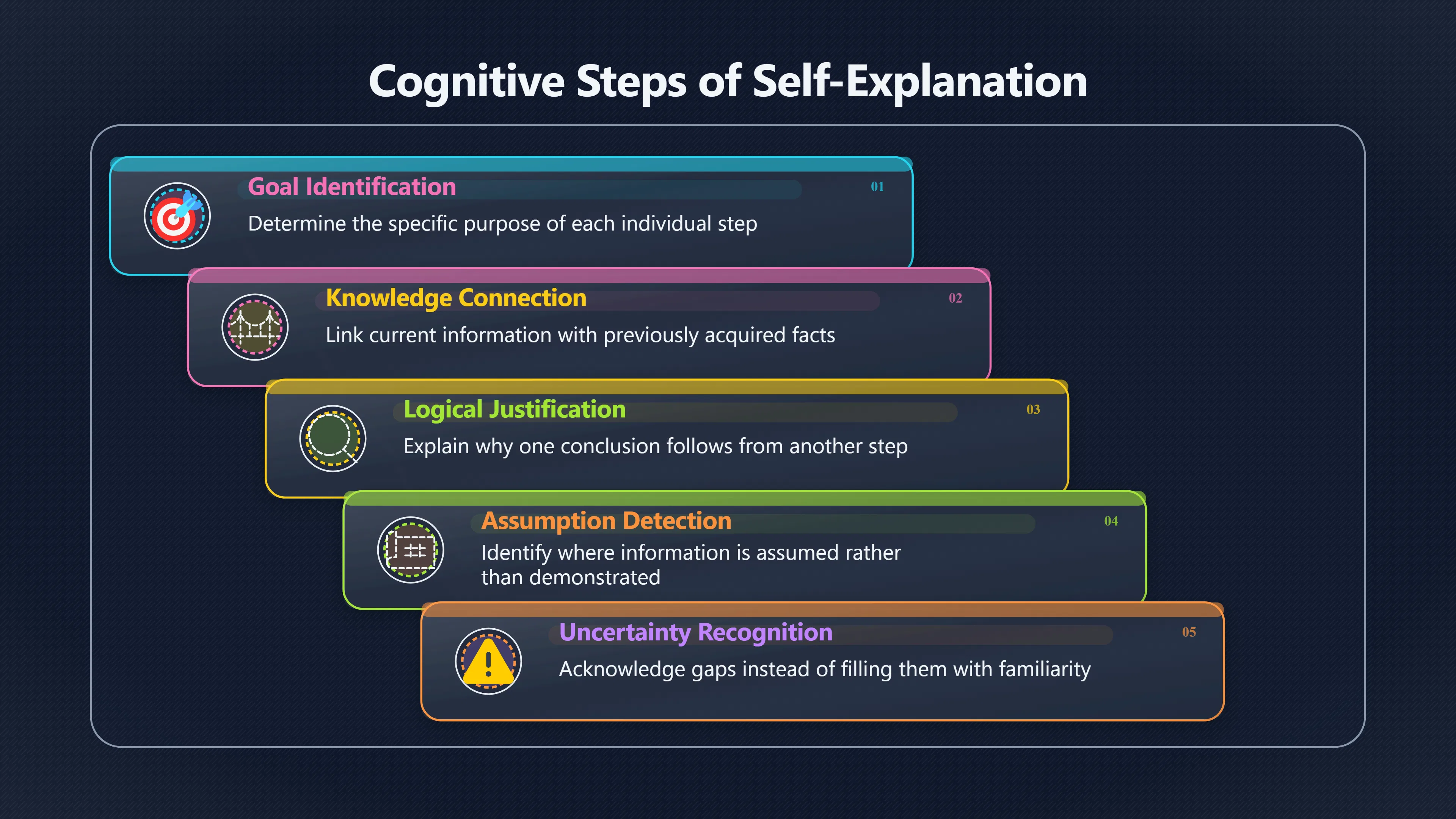
- identify the goal of each step;
- connect the current step with previous knowledge;
- explain why one conclusion follows from another;
- notice where information has been assumed rather than demonstrated;
- recognise uncertainty instead of filling gaps with familiarity.
This process is constructive rather than repetitive. Instead of repeating information already supplied, the learner generates additional reasoning that is absent from the original material. Research comparing self-explanation with simple paraphrasing suggests that much of its benefit comes from this active generation rather than merely spending longer with the material.[ResearchGate]researchgate.netResearchGate(PDF) The effect of self-explanation on robust learningSelf-explaining is a domain-independent learning strategy that general…
This is why explaining a proof, a statistical argument or a scientific mechanism often feels unexpectedly difficult. The difficulty signals that your mind is trying to build the missing logical connections rather than simply recognising sentences it has already seen.
How explanations reveal weak links
Reasoning failures often remain hidden until someone tries to explain them.
Consider a simple chain of reasoning:
- The evidence supports claim A.
- Therefore claim B is probably true.
- Therefore policy C should be adopted.
While reading, this sequence may appear perfectly coherent. During self-explanation, however, several questions naturally arise:
- Why does A support B?
- Are there alternative explanations for the evidence?
- What assumptions connect B with C?
- Could a different policy follow from the same evidence?
These questions expose what psychologists sometimes describe as “knowledge gaps”—places where the learner believed they understood but had never actually constructed the intermediate reasoning. Studies of successful learners solving worked examples found that they spontaneously generated explanations connecting solution steps, whereas less successful learners tended to focus on surface features without explaining why the procedures worked.[Andy Matuschak]andymatuschak.orgChi et al 1994 Eliciting self explanations improves understandingAndy MatuschakEliciting Self-Explanations Improves Understandingby MTH CHI · 1994 · Cited by 4299 — Here, we explore the generality of th…
In analytical work, these missing links often take familiar forms:
- Hidden assumptions: accepting an unstated premise without noticing it.
- Missing causal links: describing what happened without explaining why.
- Unjustified generalisations: moving from one example to a broad rule.
- Unsupported conclusions: reaching a claim that exceeds the available evidence.
- Confused definitions: using important terms consistently without being able to define them precisely.
Because self-explanation forces each transition to be justified, these weaknesses become visible before they become habits.
Why generating explanations matters more than rereading
One important finding from research is that the act of producing an explanation appears to contribute independently to learning.
Researchers have compared learners who simply reread worked examples with learners who explain each solution step. Others have compared complete examples with examples that intentionally omit intermediate reasoning. Across many studies, learners who actively generated missing explanations typically achieved stronger conceptual understanding and transferred their knowledge more effectively to new problems.[ResearchGate+2eScholarship]researchgate.netResearchGate(PDF) The effect of self-explanation on robust learningSelf-explaining is a domain-independent learning strategy that general…
This distinction matters because understanding is not merely possessing information. It is possessing enough connected reasoning to reconstruct an answer in unfamiliar situations.
An incomplete explanation therefore becomes useful rather than frustrating. Instead of treating the missing step as an inconvenience, self-explanation treats it as an opportunity to build the reasoning yourself.
Prompts for analytical self-explanation
The quality of self-explanation depends less on length than on the questions being asked. Prompts that focus attention on reasoning are consistently more effective than prompts encouraging simple summary.[ERIC]files.eric.ed.govERICSelf-explanation prompts explainedApril 7, 2022 — by K McGinn · 2019 · Cited by 3 — In this article Kelly, Laura and Julie explain the benefits of using self-explanation p…
Useful prompts include:
- Why is this step necessary rather than merely convenient?
- What evidence supports this conclusion?
- Which assumption is being used here?
- How would I justify this to someone who disagreed?
- Could the same evidence support another explanation?
- What would have to be false for this reasoning to fail?
- Which previous idea does this step depend upon?
- Can I explain this without repeating the author’s wording?
These prompts encourage inspection of reasoning rather than memorisation of conclusions.
When reviewing a worked example, another productive question is:[dictionary.cambridge.org]dictionary.cambridge.orgEnglish meaning - Cambridge Dictionaryrelating to all parts of a nation or to a nation as a whole rather than to any part of it: Nation…
“If this line were removed, could I reconstruct it?”
If the answer is no, that missing reasoning deserves attention before moving on.
A practical example
Imagine reading an article claiming that a new policy reduced traffic congestion.
Passive review might produce the impression that the argument is convincing.
A self-explanation proceeds differently:[researchgate.net]researchgate.netResearchGate(PDF) The effect of self-explanation on robust learningSelf-explaining is a domain-independent learning strategy that general…
- “The policy reduced congestion because drivers changed routes.”
- “How do we know drivers changed routes?”
- “The article cites traffic counts.”
- “Could traffic simply have fallen overall?”
- “Did anything else happen during the same period?”
- “Would the conclusion still hold without assuming comparable weather and travel demand?”
Nothing has been memorised differently. Instead, the reasoning itself has been examined. Missing assumptions become explicit, and uncertainty becomes easier to recognise.
The same approach applies to mathematics, programming, scientific papers, legal reasoning and everyday decision-making because the mechanism is the same: every conclusion depends on intermediate steps that can be inspected.

Common mistakes when self-explaining
Not every explanation produces deeper understanding. Several habits reduce its effectiveness:
- Repeating sentences verbatim. Copying the original wording often masks shallow understanding.
- Explaining only after reading everything. Waiting until the end reduces opportunities to detect confusion while it is still manageable.
- Accepting intuitive leaps. Statements such as “it’s obvious” frequently conceal the very reasoning that needs inspection.
- Focusing only on correct answers. Incorrect attempts often reveal more about missing reasoning than successful ones.
- Ignoring uncertainty. Saying “I’m not sure why this follows” is often the point at which genuine learning begins.
Research reviews place self-explanation among the more useful learning techniques when it actively requires learners to generate reasoning rather than simply restate information, although its effectiveness depends on thoughtful implementation and is often strongest when combined with other active-learning methods such as retrieval practice.[Westsächsische Hochschule Zwickau]whz.deWestsächsische Hochschule ZwickauImproving Students' Learning With Effective…by J Dunlosky · 2013 · Cited by 5900 — During a practice…
Turning explanation into analytical habit
The greatest value of self-explanation is not that it produces longer explanations but that it changes what you notice. With repeated use, learners become quicker at spotting unsupported claims, hidden assumptions and missing causal links because they have practised making reasoning visible.
For improving analytical skills, this habit shifts attention away from recognising finished arguments and towards evaluating how those arguments are constructed. Once the reasoning path is visible, weak links can be repaired instead of remaining hidden beneath a comforting sense of familiarity.
Amazon book picks
Further Reading
Books and field guides related to The Missing Step You Notice When Explaining. Use these as the next step if you want deeper reading beyond the article.
Make It Stick
Explains evidence-based learning strategies, including retrieval and elaborative techniques closely related to self-explanation.
How We Learn
Covers cognitive principles that help explain why active engagement and explanation improve understanding.
Ultralearning
Focuses on active learning, feedback, and methods that reinforce self-generated understanding.
A Mind for Numbers
Emphasizes explaining concepts, deep understanding, and effective learning habits rather than passive review.
eBay marketplace picks
Marketplace Samples
Example marketplace items related to this page. Use the search link to explore similar finds on eBay.

Endnotes
1.
Source: researchgate.net
Link:https://www.researchgate.net/publication/233663444_The_effect_of_self-explanation_on_robust_learning
Source snippet
ResearchGate(PDF) The effect of self-explanation on robust learningSelf-explaining is a domain-independent learning strategy that general...
2.
Source: escholarship.org
Link:https://escholarship.org/content/qt00q0t4h1/qt00q0t4h1_noSplash_0b1d51546bd7f26c1bb86e5bb3df1a4c.pdf?t=op2ipp
Source snippet
Learning by Solved Example Problems: Instructional...The second research question of this study addresses the effectiveness of self-expl...
3.
Source: files.eric.ed.gov
Title: ERICSelf-explanation prompts explained
Link:https://files.eric.ed.gov/fulltext/ED618186.pdf
Source snippet
April 7, 2022 — by K McGinn · 2019 · Cited by 3 — In this article Kelly, Laura and Julie explain the benefits of using self-explanation p...
Published: April 7, 2022
4.
Source: andymatuschak.org
Title: Chi et al 1994 Eliciting self explanations improves understanding
Link:https://andymatuschak.org/files/papers/Chi%20et%20al%20-%201994%20-%20Eliciting%20self-explanations%20improves%20understanding.pdf
Source snippet
Andy MatuschakEliciting Self-Explanations Improves Understandingby MTH CHI · 1994 · Cited by 4299 — Here, we explore the generality of th...
5.
Source: whz.de
Link:https://www.whz.de/fileadmin/lehre/hochschuldidaktik/docs/dunloskiimprovingstudentlearning.pdf
Source snippet
Westsächsische Hochschule ZwickauImproving Students' Learning With Effective...by J Dunlosky · 2013 · Cited by 5900 — During a [practice]({{ 'practice/' | relative_url }})...
6.
Source: india.gov.in
Link:https://india.gov.in/
Source snippet
National Portal of India: HomeThe National Portal of India provides single-window access to information and services offered by the gover...
7.
Source: dea.gov.in
Link:https://dea.gov.in/index.php/government-logos/national-portal-india
Source snippet
l Links. Archives · Website Policies...Read more...
8.
Source: nic.gov.in
Title: National Informatics Centre
Link:https://www.nic.gov.in/
Source snippet
ई. आई. टी. वाई.) के तहत राष्ट्रीय सूचना विज्ञान केंद्र (एन. आई. सी.) भारत सरकार का प्रौद्योगिकी भागीदार है। एन. आई. सी. की स्थापना वर्ष 1...
9.
Source: nth.gov.in
Link:https://nth.gov.in/en
Source snippet
Department of Consumer Affairs, Government of IndiaNTH Serves the Nation in a Rapidly Changing Globalized Economy with Human Face & Socia...
10.
Source: onos.gov.in
Link:https://www.onos.gov.in/
Source snippet
IndiaThe One Nation One Subscription (ONOS) initiative is aimed at providing access to scholarly research content to all individua...
Additional References
11.
Source: merriam-webster.com
Link:https://www.merriam-webster.com/dictionary/national
12.
Source: elementsoflearning.home.blog
Title: enhancing worked examples with self explanation
Link:https://elementsoflearning.home.blog/2022/09/29/enhancing-worked-examples-with-self-explanation/
Source snippet
worked examples with self-explanation29 Sept 2022 — Self-explaining involves generating an explanation for oneself in order to make sense...
13.
Source: youtube.com
Title: 3 Phases of Learning Every Self-Learner Must Master
Link:https://www.youtube.com/watch?v=DZjmp7gXQsI
Source snippet
Self-Explanation: Help Students Connect and Deepen Learning is highly relevant because it details how the metacognitive strategy of self...
14.
Source: researchschool.org.uk
Title: explaining self explanation
Link:https://researchschool.org.uk/devon/news/explaining-self-explanation
Source snippet
Dunlosky et al (2013). The study rates self-explanation as having 'moderate utility' (self-[testing]({{ 'testing/' | relative_url }}), in comparison, has 'high utility')...
15.
Source: papersflow.ai
Title: self explanation prompts
Link:https://papersflow.ai/research/topics/visual-and-cognitive-learning-processes/self-explanation-prompts
Source snippet
Self-Explanation Prompts: Research Guide & PapersResearch shows self-explanation prompts improve learning [outcomes]({{ 'outcomes/' | relative_url }}) across domains like me...
16.
Source: facebook.com
Link:https://www.facebook.com/nationalportalofindia/
Source snippet
National Portal of India (@nationalportalofindia)National Portal of India, New Delhi. 74805 likes · 747 talking about this. National Port...
17.
Source: youtube.com
Title: Self-Explanation: Help Students Connect and Deepen Learning
Link:https://www.youtube.com/watch?v=hSLPFMiJcQc
Source snippet
2 How Does Self-Explaining Improve Learning - mysimpleshow...
18.
Source: dictionary.cambridge.org
Link:https://dictionary.cambridge.org/dictionary/english/national
Source snippet
English meaning - Cambridge Dictionaryrelating to all parts of a nation or to a nation as a whole rather than to any part of it: Nation...
19.
Source: vocabulary.com
Link:https://www.vocabulary.com/dictionary/national
Source snippet
Definition, Meaning & SynonymsNational is an adjective that refers to something or someone that belongs to a nation or country. Baseball...
20.
Source: youtube.com
Title: How to Use the Feynman Technique
Link:https://www.youtube.com/watch?v=q-16DPh_VWw
Source snippet
5 3 Phases of Learning Every Self-Learner Must Master...
Topic Tree