Within Health Claims
Did the Diet Cause the Benefit?
Nutrition headlines often turn population patterns into personal rules before confounding and comparison groups are handled properly.
On this page
- Why healthy user bias matters
- The comparison group behind the claim
- When observational nutrition evidence is useful
Page outline Jump by section
Introduction
Nutrition headlines often sound more certain than the underlying evidence. A study reports that people who eat more nuts live longer, or that those who avoid a particular food have lower rates of disease, and the headline quickly becomes “eat this” or “avoid that”. The crucial analytical question is whether the diet caused the outcome, or whether people who ate differently also differed in many other ways. Diet is closely linked to income, education, exercise, smoking, sleep, healthcare use, cooking habits, and cultural practices. Unless these differences are handled carefully, an observed association may not reflect a causal effect. Observational nutrition research remains valuable, but understanding what it can and cannot show is an essential thinking skill for evaluating health claims.[PMC]pmc.ncbi.nlm.nih.govby KC Maki · 2014 · Cited by 185 — This editorial review is intended to 1) highlight some of these limitations of observational eviden…
Why healthy-user bias matters
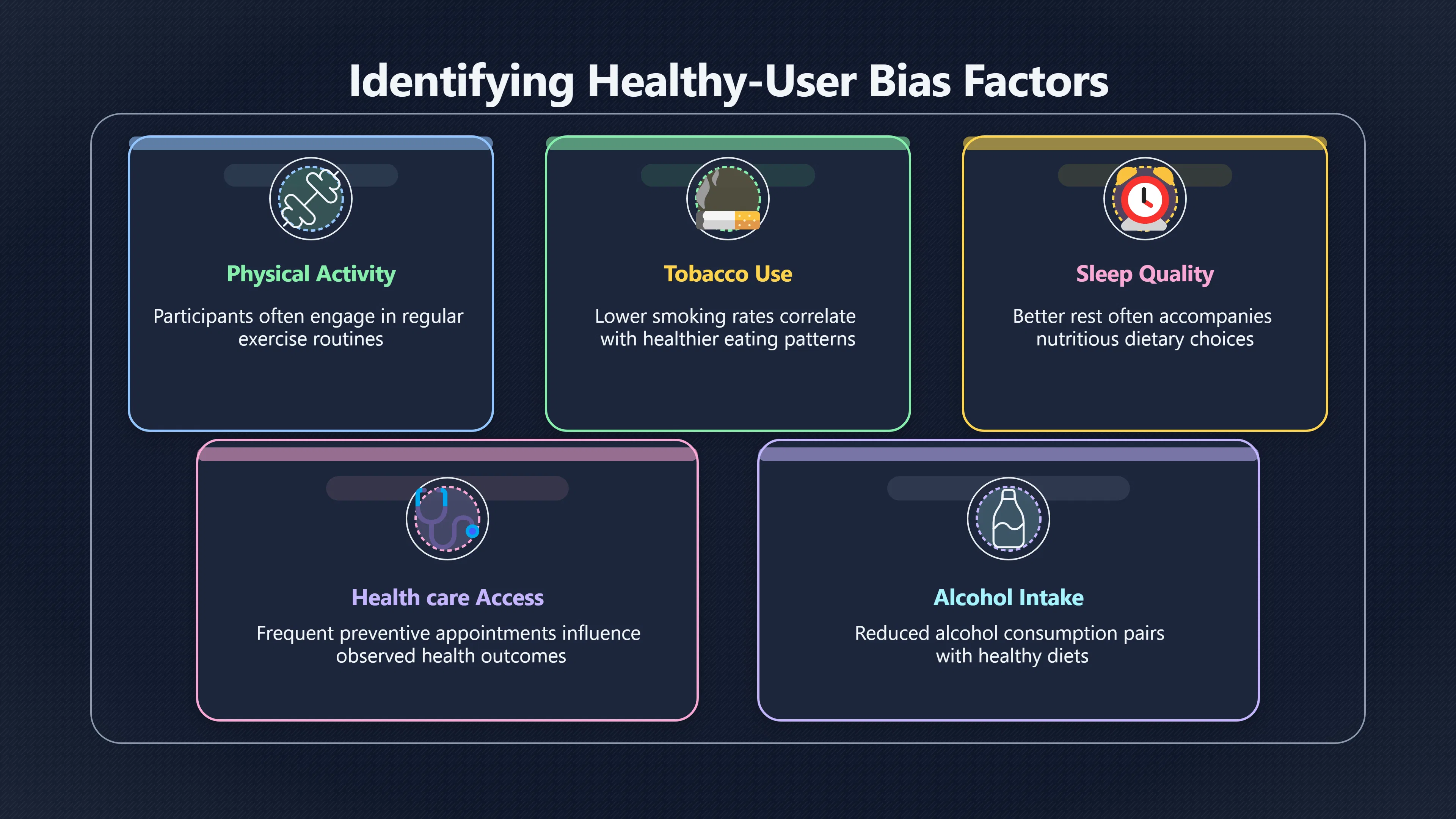
One of the biggest challenges in diet research is healthy-user bias. This occurs when people who adopt a supposedly healthy eating pattern also engage in many other health-promoting behaviours. They may exercise more, smoke less, attend preventive health appointments, sleep better, drink less alcohol, or have greater access to healthcare. If these factors are not fully measured and adjusted for, the apparent benefit of the diet may partly reflect the healthier lifestyle rather than the food itself.[PMC]pmc.ncbi.nlm.nih.govby KC Maki · 2014 · Cited by 185 — This editorial review is intended to 1) highlight some of these limitations of observational eviden…
Researchers try to account for these differences using statistical adjustment, but adjustment has limits. Some behaviours are measured imperfectly, while others may not be measured at all. This leaves residual confounding: differences between groups that continue to distort the estimated effect even after sophisticated analysis. Nutrition researchers have repeatedly noted that dietary habits are unusually difficult to separate from socioeconomic and lifestyle factors because they cluster together rather than occurring independently.[Taylor & Francis Online]tandfonline.comTaylor & Francis OnlineToward more rigorous and informative nutritional…by AW Brown · 2023 · Cited by 63 — The relationship of dietary…
A practical implication is that very small reported risk reductions deserve particular caution. If one dietary pattern is associated with a 10–20% lower disease risk, that difference may be within the range that residual confounding could plausibly explain. Larger, consistent effects observed across different study designs are generally more persuasive than isolated modest associations.[PMC]pmc.ncbi.nlm.nih.govby KC Maki · 2014 · Cited by 185 — This editorial review is intended to 1) highlight some of these limitations of observational eviden…
The comparison group behind the claim
Whenever a nutrition headline claims that a food “reduces risk”, ask: compared with what?
Dietary choices almost always replace something else. Eating more whole grains usually means eating less refined starch. Drinking water instead of sugary drinks differs from drinking water instead of milk. Replacing butter with olive oil is a different intervention from simply adding olive oil without changing anything else.
Ignoring the comparison group produces misleading conclusions because foods are rarely consumed in isolation. A statement such as “people who eat more fish have lower heart disease risk” may reflect the benefits of replacing processed meat, rather than a unique property of fish itself. Likewise, replacing sugar-sweetened beverages with artificially sweetened drinks addresses a different question from comparing artificially sweetened drinks with water. Substitution analyses, which explicitly model what food is being replaced, often provide more informative evidence than simply comparing high and low consumers of one food.[International Sweeteners Association]sweeteners.orgInternational Sweeteners AssociationAddressing reverse causality in observational research is…Reverse causality is a major source of b…
This comparison principle also explains why apparently contradictory nutrition studies sometimes coexist. Two studies may both be correct within their own comparison groups while answering different questions.
Reverse causation can make diets look harmful
Sometimes illness changes diet rather than diet changing illness. This is known as reverse causation.
For example, people who develop obesity, diabetes, or cardiovascular risk factors may deliberately switch to diet beverages, reduce fat intake, or change eating patterns after medical advice. An observational study may therefore find that consumers of these products have worse health outcomes—not because the products caused disease, but because higher-risk individuals were more likely to choose them.
Researchers increasingly attempt to reduce this problem by following people over time, measuring dietary changes repeatedly, excluding participants with existing disease, or analysing intended substitutions rather than one-time dietary snapshots. These approaches cannot eliminate all bias, but they generally provide stronger evidence than simple cross-sectional comparisons.[PMC+2International Sweeteners Association]pmc.ncbi.nlm.nih.govA Fresh Look at Problem Areas in Research Methodology in…by NJ Temple · 2025 · Cited by 1 — Reverse causation is another source of…
When observational nutrition evidence is useful
Observational studies should not be dismissed simply because they cannot prove causation. Many important nutrition questions cannot realistically be answered using long-term randomised trials. It would be difficult, expensive, or unethical to randomly assign thousands of people to follow specific diets for decades while ensuring perfect adherence.
Instead, observational evidence is particularly valuable for:
- Identifying possible long-term health associations.
- Detecting uncommon outcomes that trials may be too small to observe.
- Generating hypotheses for future experimental testing.
- Studying dietary patterns over many years under real-world conditions.
Confidence increases when multiple independent approaches point in the same direction. Stronger evidence emerges when observational studies, randomised trials of intermediate outcomes, biological mechanisms, and systematic reviews broadly agree rather than relying on a single study or headline.[Frontiers+2ResearchGate]frontiersin.orgFrontiersDetermining Causation from Observational Studiesby GA Jelinek · 2017 · Cited by 25 — New techniques in observational epidemiolog…
Questions that improve analytical thinking about diet claims
Rather than asking whether a headline is true or false, ask questions that reveal how the evidence was produced.
- Was this an observational study or a randomised trial? Observational studies identify associations; trials are generally better at testing interventions.
- Who was compared with whom? The comparison group often determines what the result actually means.
- Could healthier lifestyles explain part of the result? Consider exercise, smoking, income, healthcare use, education, and other linked behaviours.
- Could reverse causation explain the finding? Did existing illness encourage people to change their diets?
- Is the reported effect large enough to be convincing? Small relative differences are more vulnerable to residual confounding than large, consistent effects.
- Has the finding been reproduced? One observational study is much less persuasive than converging evidence across multiple study designs.[PMC+2PMC]pmc.ncbi.nlm.nih.govby KC Maki · 2014 · Cited by 185 — This editorial review is intended to 1) highlight some of these limitations of observational eviden…

A better way to read nutrition headlines
Most nutrition news should be interpreted as evidence about probability rather than proof. An observational finding that one dietary pattern is associated with lower disease risk is best understood as a clue that deserves further investigation, not as a personal prescription.
This distinction does not weaken nutrition science; it strengthens critical thinking. By separating association from causation, recognising healthy-user bias, examining the comparison group, and considering reverse causation, readers become better able to distinguish genuinely informative dietary evidence from claims that overstate what the data can actually support.[PMC+2American Journal of Clinical Nutrition]pmc.ncbi.nlm.nih.govby KC Maki · 2014 · Cited by 185 — This editorial review is intended to 1) highlight some of these limitations of observational eviden…
Amazon book picks
Further Reading
Books and field guides related to Did the Diet Cause the Benefit?. Use these as the next step if you want deeper reading beyond the article.
Bad Science
Covers weak causal claims, bad evidence, and misleading health journalism.
The Bad Food Bible
Helps readers separate nutrition fear, correlation, and evidence from overconfident diet claims.
In Defense of Food
Gives a broad, practical lens on diet advice, nutritionism, and food claims.
The Diet Myth
Discusses why individual diet responses and nutrition evidence are more complex than headlines suggest.
eBay marketplace picks
Marketplace Samples
Example marketplace items related to this page. Use the search link to explore similar finds on eBay.
Endnotes
1.
Source: pmc.ncbi.nlm.nih.gov
Link:https://pmc.ncbi.nlm.nih.gov/articles/PMC3884102/
Source snippet
by KC Maki · 2014 · Cited by 185 — This editorial review is intended to 1) highlight some of these limitations of observational eviden...
2.
Source: ajcn.nutrition.org
Link:https://ajcn.nutrition.org/article/S0002-9165%2822%2904453-7/fulltext
Source snippet
American Journal of Clinical NutritionThe role of epidemiology in developing nutritional...by T Byers · 1999 · Cited by 71 — The classic...
3.
Source: sweeteners.org
Link:https://www.sweeteners.org/latest-science-post/addressing-reverse-causality-in-observational-research-is-critical-to-establish-reliable-associations-between-low-no-calorie-sweeteners-and-cardiometabolic-health/
Source snippet
International Sweeteners AssociationAddressing reverse causality in observational research is...Reverse causality is a major source of b...
4.
Source: researchgate.net
Link:https://www.researchgate.net/publication/370683063_Editorial_Causal_inference_in_diet_nutrition_and_health_outcomes
Source snippet
Causal inference in diet, nutrition and health outcomesMay 10, 2023 — Background: Observational studies have demonstrated inv...
Published: May 10, 2023
5.
Source: pmc.ncbi.nlm.nih.gov
Link:https://pmc.ncbi.nlm.nih.gov/articles/PMC11946746/
Source snippet
A Fresh Look at Problem Areas in Research Methodology in...by NJ Temple · 2025 · Cited by 1 — Reverse causation is another source of...
6.
Source: tandfonline.com
Link:https://www.tandfonline.com/doi/full/10.1080/10408398.2021.1985427
Source snippet
Taylor & Francis OnlineToward more rigorous and informative nutritional...by AW Brown · 2023 · Cited by 63 — The relationship of dietary...
7.
Source: frontiersin.org
Link:https://www.frontiersin.org/journals/neurology/articles/10.3389/fneur.2017.00265/full
Source snippet
FrontiersDetermining Causation from Observational Studiesby GA Jelinek · 2017 · Cited by 25 — New techniques in observational epidemiolog...
Additional References
8.
Source: journals.lww.com
Title: causal assessment of the relationship between.83.aspx
Link:https://journals.lww.com/md-journal/fulltext/2025/05300/causal_assessment_of_the_relationship_between.83.aspx
Source snippet
Lippincott JournalsCausal assessment of the relationship between diet...by MA Jareebi · 2025 — By leveraging genome-wide association stu...
9.
Source: youtube.com
Title: Correlation vs Causation Explained: Why Patterns Can Mislead Us
Link:https://www.youtube.com/watch?v=ofweqU0Lz4I
Source snippet
Correlation and Causation - understanding the Bradford Hill criteria in a nutshell...
10.
Source: youtube.com
Title: Correlation and Causation
Link:https://www.youtube.com/watch?v=cvwRt9aCNpk
Source snippet
Harvard's New Study on Butter - Fact or Fiction?...
11.
Source: youtube.com
Title: Plant vs. Animal Protein: How Healthy User Bias Misleads Nutrition Science
Link:https://www.youtube.com/watch?v=WaunjUa7hjQ
Source snippet
Is Nutrition Science Broken? How to Find What Actually Works...
12.
Source: academic.oup.com
Link:https://academic.oup.com/aje/article/173/1/1/128615
Source snippet
Causation and Illness-related Weight Loss in...by KM Flegal · 2011 · Cited by 254 — The construct of reverse causation has come to be us...
13.
Source: explorationpub.com
Link:https://www.explorationpub.com/Journals/em/Article/1001139
Source snippet
Can we estimate the causal effects of diet and sedentary...by E Kupek · 2023 — Aim: To investigate the causal impact of diet and sedenta...
14.
Source: youtube.com
Title: Harvard’s New Study on Butter
Link:https://www.youtube.com/watch?v=mfLR1PDL_Uc
15.
Source: Wikipedia
Title: Healthy user bias
Link:https://en.wikipedia.org/wiki/Healthy_user_bias
Topic Tree