Within Transfer
Why Thinking Skills Still Need Knowledge
General reasoning prompts work best when paired with enough background knowledge to know what counts as evidence in the situation.
On this page
- What general prompts can and cannot do
- How expertise changes evidence judgement
- When a familiar rule is the wrong fit
Page outline Jump by section
Introduction
General reasoning prompts such as “What is the evidence?”, “What alternative explanations exist?” and “What would change my mind?” are valuable because they can be applied in many situations. They are not, however, sufficient on their own. Good judgement depends on knowing enough about the subject to recognise which evidence matters, which comparisons are fair, which mechanisms are plausible and which warning signs are genuinely important. Research in cognitive science consistently shows that thinking skills are closely tied to domain knowledge rather than operating as a completely general mental ability.[American Federation of Teachers+2danielwillingham.com]aft.orgWe've seen that domain knowledge is a crucial driver of thinking skill. What knowledge is…Read more…
 This does not mean that critical thinking cannot transfer across domains. Rather, transfer works best when broad reasoning habits are combined with enough background knowledge to interpret a new situation correctly. The same reasoning questions may travel from medicine to history to finance, but the answers depend on understanding how evidence works in each field.
What General Prompts Can and Cannot Do
General thinking prompts provide a useful framework for slowing down intuitive judgement. Questions such as:
- What exactly is the claim?
- What evidence supports it?
- Could something else explain the result?
- What evidence would change the conclusion?
remain useful almost everywhere.
The limitation is that these prompts do not tell you how to answer them. Knowing that you should “evaluate the evidence” is only the beginning. Evaluating evidence requires knowing what counts as strong evidence in the particular domain.
For example:
- In medicine, well-designed randomised controlled trials often deserve more weight than personal testimonials.
- In history, contemporary documents must be interpreted alongside knowledge of who wrote them, why they wrote them and the historical context.
- In engineering, physical constraints and known failure mechanisms may outweigh intuition.
- In financial markets, historical averages may matter less when structural conditions have changed.
The reasoning pattern remains similar, but the standards used to judge evidence differ substantially. Simply applying generic scepticism without understanding those standards often leads to poor decisions rather than better ones.[Education NSW]nsw.gov.auWe have seen that domain knowledge is a crucial driver of thinking skills.Read moreEducation NSWHow to Teach Critical ThinkingFebruary 13, 2025 — by DT Willingham · Cited by 153 — The importance of background knowledge t…
How Expertise Changes Evidence Judgement
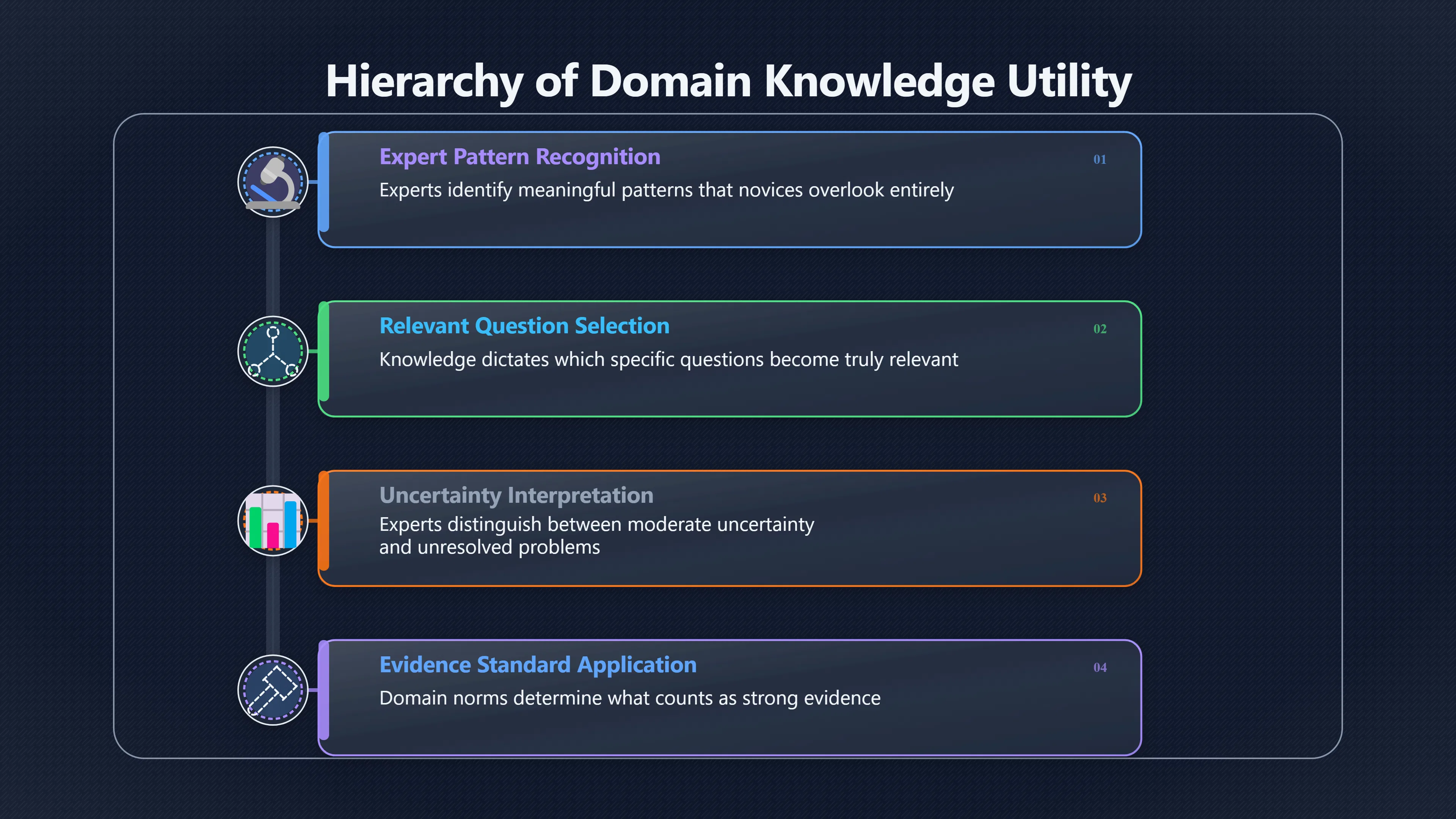
Domain knowledge improves judgement in several distinct ways beyond simply providing more facts.
It changes what you notice
Experts often recognise meaningful patterns that novices overlook.
A radiologist may immediately notice an abnormality on an image that appears ordinary to everyone else. An experienced historian may recognise that a document’s wording reflects political motives of the period. A software engineer may instantly identify a security risk hidden within otherwise functional code.
These differences are not simply faster reasoning. They arise because experience changes which features appear important in the first place.
It changes which questions become relevant
Beginners often ask whether evidence exists.
Experts ask whether the evidence could exist if the proposed explanation were true.
For example, experienced scientists routinely consider:
- possible confounding variables
- measurement reliability
- selection effects
- statistical power
- alternative causal mechanisms
Without enough background knowledge, many of these possibilities never occur to the decision-maker.
It changes how uncertainty is interpreted
Experts usually become better at recognising genuine uncertainty rather than treating every unknown as equally important.
Someone unfamiliar with climate science, medicine or economics may assume that disagreement automatically means “nobody knows.” Someone who understands the field can distinguish between:
- questions with overwhelming evidence,
- questions with moderate uncertainty,
- genuinely unresolved research problems.
Knowing where uncertainty actually lies is itself a form of expertise.[danielwillingham.com]danielwillingham.comOccasional Paper Series: How to Teach Critical Thinkingby DT Willingham · Cited by 153 — The importance of background knowledge to critic…
Why More Knowledge Does Not Automatically Mean Better Thinking
Although domain knowledge is essential, expertise creates its own risks.
Experts can become overconfident in familiar methods, overlook novel evidence or assume that techniques successful in one context automatically apply elsewhere. Cognitive scientists sometimes refer to the “curse of knowledge”: once people understand something deeply, they may underestimate how difficult it is for others or overlook assumptions they no longer notice.[Wikipedia]WikipediaCurse of knowledgeCurse of knowledge
Good judgement therefore requires balancing two strengths:
- enough expertise to understand the evidence,
- enough intellectual humility to question established interpretations when new evidence appears.
The best decision-makers continually update both their knowledge and their reasoning habits.
When a Familiar Rule Is the Wrong Fit
Many reasoning errors occur because people correctly remember a useful principle but apply it in the wrong setting.
Consider several common examples.
“Correlation does not imply causation.”
This is an important warning, but it does not mean every observed relationship is meaningless. In epidemiology, economics and social science, multiple independent lines of evidence can collectively support causal conclusions even when controlled experiments are impossible.
“Trust the experts.”
Expert opinion deserves weight, but only within the relevant domain. A distinguished physicist is not automatically an authority on nutrition, constitutional law or educational policy.
“Always demand more evidence.”
Additional evidence is valuable only if it addresses the important uncertainties. Collecting more low-quality observations may add less value than obtaining one carefully designed measurement.
These examples illustrate that reasoning rules are rarely wrong. They become misleading when detached from the context that originally gave them meaning.
Why Different Subjects Judge Evidence Differently
One reason transfer is difficult is that different disciplines have developed distinct standards for deciding what counts as convincing evidence.
DomainTypical evidence emphasisCommon judgement questionScienceControlled experiments, replication, predictionDoes the explanation fit all available observations?HistoryPrimary sources, corroboration, contextHow reliable is this account given who created it?LawWitness testimony, legal standards, admissible evidenceHas the required burden of proof been met?EngineeringTesting, safety margins, physical constraintsWill the system work reliably under realistic conditions?BusinessMarket behaviour, incentives, practical outcomesWill this decision produce sustainable results?
The general habit of evaluating evidence transfers across these areas, but the evidence itself—and the standards used to judge it—changes considerably.
This is why effective thinkers learn both general reasoning strategies and the norms of the fields in which they make important decisions.
Building Just Enough Domain Knowledge
Becoming an expert in every subject is impossible. Fortunately, better judgement usually requires sufficient understanding rather than complete mastery.
Useful habits include:
- Learn the basic vocabulary so that evidence can be interpreted accurately rather than by guesswork.
- Understand the major mechanisms that experts believe produce outcomes in the field.
- Know which forms of evidence practitioners regard as strongest and weakest.
- Learn the most common misconceptions and failure modes within that domain.
- Recognise where genuine expert disagreement exists instead of assuming all questions are equally settled.
This level of knowledge allows general reasoning skills to operate effectively without requiring decades of specialised study.
Thinking Skills Become Stronger When Knowledge Gives Them Direction
Portable reasoning habits remain valuable because they encourage careful questioning, comparison of explanations and openness to revision. However, they function more like navigation tools than automatic decision-makers. They help identify where to look, but they do not replace knowing the terrain.
The strongest real-world judgement therefore combines two ingredients. General thinking skills provide structure for analysing unfamiliar situations, while domain knowledge supplies the context needed to recognise meaningful evidence, detect misleading comparisons and understand when an apparently sensible rule no longer fits the problem at hand. Research consistently suggests that neither ingredient is sufficient by itself; robust judgement emerges from their interaction rather than from either one alone.[American Federation of Teachers+2danielwillingham.com]aft.orgWe've seen that domain knowledge is a crucial driver of thinking skill. What knowledge is…Read more…
Amazon book picks
Further Reading
Books and field guides related to Why Thinking Skills Still Need Knowledge. Use these as the next step if you want deeper reading beyond the article.
The Knowledge Gap
Explains why broad content knowledge is essential for comprehension, reasoning, and educational equity.
Make It Stick
Shows how durable knowledge supports flexible retrieval, transfer, and better performance in real tasks.
Why Don't Students Like School?
Argues that thinking depends heavily on background knowledge, not just abstract reasoning skills.
The Art of Thinking Clearly
Provides broad examples of judgement errors, useful as a parent-topic pick for analytical thinking.
eBay marketplace picks
Marketplace Samples
Live-tested eBay searches with available results related to this page.

Top pick
critical thinking game
Open a targeted eBay search for items related to this topic.
Browse eBay
Related search
critical thinking card game
Open a targeted eBay search for items related to this topic.
Browse eBay
Related search
still poster
Open a targeted eBay search for items related to this topic.
Browse eBay
Related search
still memorabilia
Open a targeted eBay search for items related to this topic.
Browse eBayEndnotes
1.
Source: danielwillingham.com
Link:https://www.danielwillingham.com/uploads/5/0/0/7/5007325/willingham_2019_nsw_critical_thinking2.pdf
Source snippet
Occasional Paper Series: How to Teach Critical Thinkingby DT Willingham · Cited by 153 — The importance of background knowledge to critic...
2.
Source: education.nsw.gov.au
Link:https://education.nsw.gov.au/content/dam/main-education/[teaching
Source snippet
Education NSWHow to Teach Critical ThinkingFebruary 13, 2025 — by DT Willingham · Cited by 153 — The importance of background knowledge t...
Published: February 13, 2025
3.
Source: Wikipedia
Title: Curse of knowledge
Link:https://en.wikipedia.org/wiki/Curse_of_knowledge
4.
Source: youtube.com
Title: The Role of Knowledge | Dan Willingham
Link:https://www.youtube.com/watch?v=mDdIDhCqYoE
Source snippet
Daniel Willingham | Cognitive Psychology at the University of Virginia...
5.
Source: youtube.com
Title: Daniel Willingham | Cognitive Psychology at the University of Virginia
Link:https://www.youtube.com/watch?v=oZmBoI9Lzl4
Source snippet
Irreplaceable Skills in the AI Age...
6.
Source: aft.org
Link:https://www.aft.org/ae/fall2020/willingham
Source snippet
We've seen that domain knowledge is a crucial driver of thinking skill. What knowledge is...Read more...
Additional References
7.
Source: facebook.com
Link:https://www.facebook.com/Chalkbeat/posts/experts-say-that-critical-thinking-still-rests-on-a-broad-base-of-knowledge/1574209538048063/
Source snippet
Does AI mean basic facts are less important for students to learn?Read more...
8.
Source: peterellerton.substack.com
Title: critical thinking skills are not
Link:https://peterellerton.substack.com/p/critical-thinking-skills-are-not
Source snippet
substack.com(Critical) Thinking skills are not domain specificBecause critical thinking is domain specific, critical thinking skills are...
9.
Source: deansforimpact.org
Link:https://www.deansforimpact.org/files/assets/thescienceoflearning.pdf
Source snippet
The Science of LearningThe first edition of The Science of Learning was developed in 2015 in close collaboration with Dan Willingham, a c...
10.
Source: youtube.com
Title: Critical Thinking with Garfield Gini Newman
Link:https://www.youtube.com/watch?v=4haqBS8Y6OI
Source snippet
TCT 007 | 5 Essential Components of Critical Thinking | Part 1: Logic vs. Argumentation...
11.
Source: pmc.ncbi.nlm.nih.gov
Link:https://pmc.ncbi.nlm.nih.gov/articles/PMC10744224/
Source snippet
Thinking, Formation, and Change - PMCby C Saiz · 2023 · Cited by 51 — In this paper, we propose an [application]({{ 'application/' | relative_url }}) of critical thinking (CT)...
12.
Source: people.bath.ac.uk
Link:https://people.bath.ac.uk/edspd/Weblinks/MA_ULL/Resources/Learning%20to%20Learn/Willingham%202008%20AEPR.pdf
Source snippet
University of Bath Personal HomepagesCritical Thinking: Why Is It So Hard to Teach?7 Aug 2010 — Experts in teaching science recom- mend t...
13.
Source: youtube.com
Title: Irreplaceable Skills in the AI Age
Link:https://www.youtube.com/watch?v=eAcz9UcbDq0
Source snippet
Critical Thinking with Garfield Gini Newman- Introduction...
14.
Source: youtube.com
Link:https://www.youtube.com/watch?v=cOYgTrCdve4
15.
Source: learningscientists.org
Link:https://www.learningscientists.org/blog/2021/9/23-1
Source snippet
But how do educators teach...
Topic Tree