Within Causation
When a Third Factor Creates the Pattern
The ice cream and drowning example shows how a hidden third factor can make a harmless pattern look causal.
On this page
- Why the obvious causal story is wrong
- How common causes create misleading links
- Questions that expose hidden third factors
Page outline Jump by section
Introduction
The relationship between ice cream sales and drowning deaths is one of the best-known examples of why correlation alone cannot establish causation. The two variables often rise and fall together, yet there is no credible mechanism by which buying or eating ice cream causes people to drown. Instead, both are influenced by a shared background factor: warm weather. Higher temperatures encourage people to buy more ice cream while also increasing swimming, boating and other water activities, which raise the opportunity for drowning incidents.[OTexts: Online, open-access textbooks]otexts.comThey are both caused by a third variable (temperature).Read moreOnline, open-access textbooks7.8 Correlation, causation and forecastingSo the two variables (ice-cream sales and drownings) are c…
 This example is memorable because it demonstrates a common analytical trap. When two trends move together, the real explanation may be a hidden third factor rather than a direct cause-and-effect relationship. Learning to recognise this pattern is an essential part of improving critical thinking and evaluating everyday claims.
When the obvious causal story is wrong
At first glance, the data appear persuasive. Plot monthly ice cream sales alongside monthly drowning incidents and both usually peak during the summer before falling again in colder months. A simple statistical analysis may reveal a strong positive correlation.[OTexts: Online, open-access textbooks]otexts.comThey are both caused by a third variable (temperature).Read moreOnline, open-access textbooks7.8 Correlation, causation and forecastingSo the two variables (ice-cream sales and drownings) are c…
The mistake is to leap from “these variables are associated” to “one causes the other”. If ice cream really caused drownings, then increasing ice cream consumption while holding everything else constant should increase drowning risk. There is no plausible biological or behavioural mechanism supporting such a claim, and the association disappears once the underlying seasonal conditions are taken into account.[Discover Magazine]discovermagazine.comDiscover MagazineStatistics: When Confounding Variables Are Out of Control2 Apr 2016 — The ice cream/drownings correlation would cease to…
The lesson extends far beyond this example. A striking statistical relationship may be genuine, but the explanation behind it may be completely different from the most obvious story.
How common causes create misleading links
The key mechanism is confounding, where a third variable influences both the supposed cause and the observed outcome.
In this example:
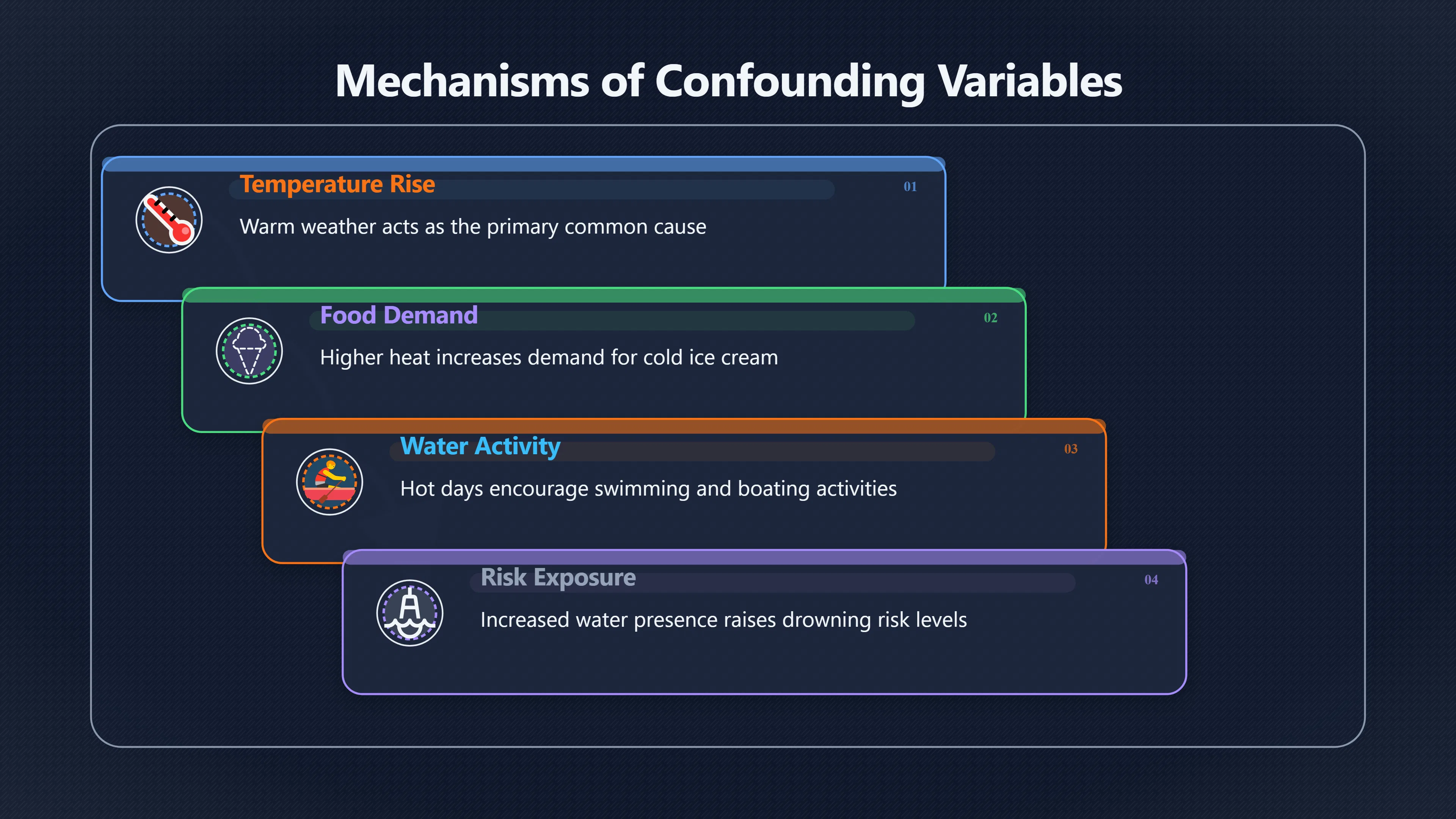
- Higher temperatures increase demand for cold foods such as ice cream.
- The same higher temperatures encourage more people to visit beaches, lakes and swimming pools.
- More people entering the water creates more opportunities for accidental drowning.
Temperature therefore acts as a common cause of both variables. Ice cream sales and drowning incidents become statistically linked even though neither directly produces the other.[OTexts: Online, open-access textbooks]otexts.comThey are both caused by a third variable (temperature).Read moreOnline, open-access textbooks7.8 Correlation, causation and forecastingSo the two variables (ice-cream sales and drownings) are c…
This is sometimes called a spurious relationship: the observed association is real, but interpreting it as direct causation is incorrect because the common cause has not been accounted for.[Wikipedia]WikipediaSpurious relationshipSpurious relationship
An important subtlety is that the correlation may still have predictive value. If unusually high ice cream sales reliably occur on very hot days, they might help forecast periods when drowning risk is also elevated. That does not mean ice cream is the mechanism causing drownings; it is acting as an indirect indicator of conditions associated with greater water exposure.[OTexts: Online, open-access textbooks]otexts.comThey are both caused by a third variable (temperature).Read moreOnline, open-access textbooks7.8 Correlation, causation and forecastingSo the two variables (ice-cream sales and drownings) are c…
Why this example remains so useful
The ice cream example has survived for decades because it strips away emotional or political distractions and lets the reasoning stand on its own.
Readers immediately recognise that:
- the correlation exists;
- the proposed causal explanation sounds absurd;
- a better explanation naturally emerges once the hidden variable is considered.
This makes the example an effective teaching tool for introducing confounding, hidden variables and causal reasoning in statistics, epidemiology, economics and data science. It has also been used in educational activities that ask students to identify the unseen variable before revealing temperature as the common cause.[Wikipedia]WikipediaOpen source on wikipedia.org.
Because the example is so intuitive, it encourages people to apply the same scepticism to less obvious situations where the hidden factor is much harder to detect.
Questions that expose hidden third factors
Whenever two variables appear strongly related, a few simple questions help uncover possible confounders.
Could both variables be responding to the same external condition?
Season, weather, economic conditions, age, income, education or underlying health frequently influence multiple outcomes at once.
Does a believable causal mechanism exist?
A statistical pattern is more convincing when supported by an explanation of how one variable could physically, biologically or socially influence the other.
What happens if the suspected confounder is held constant?
If the relationship weakens or disappears after accounting for temperature, season or another common cause, then the original association was probably driven largely by that factor rather than by a direct causal effect.[Discover Magazine]discovermagazine.comDiscover MagazineStatistics: When Confounding Variables Are Out of Control2 Apr 2016 — The ice cream/drownings correlation would cease to…
Would an intervention change the outcome?
If people were randomly encouraged to buy more ice cream without changing weather or swimming behaviour, there is no reason to expect drowning rates to increase. Thinking in terms of interventions helps distinguish prediction from genuine causation.[OTexts: Online, open-access textbooks]otexts.comThey are both caused by a third variable (temperature).Read moreOnline, open-access textbooks7.8 Correlation, causation and forecastingSo the two variables (ice-cream sales and drownings) are c…

The broader thinking habit
The ice cream and drowning example teaches a habit that applies far beyond statistics. Many everyday claims—about health, education, business performance or public policy—can appear convincing because two measures move together over time. Before accepting a causal explanation, ask whether both outcomes could simply be responding to the same underlying influence.
That small shift in thinking changes the question from “What caused this?” to “What else could explain both observations?” In analytical reasoning, that search for hidden common causes is often the difference between a persuasive story and a sound explanation.
Amazon book picks
Further Reading
Books and field guides related to When a Third Factor Creates the Pattern. Use these as the next step if you want deeper reading beyond the article.
The Art of Statistics
Explains correlation, causation, confounding variables, and how to interpret evidence.
The Book of Why
Directly addresses causal inference, confounding, and distinguishing association from cause.
Calling Bullshit
Shows how misleading correlations and hidden assumptions produce false conclusions.
How to Lie with Statistics
Introduces common statistical pitfalls, including mistaken interpretations of relationships in data.
eBay marketplace picks
Marketplace Samples
Example marketplace items related to this page. Use the search link to explore similar finds on eBay.


Endnotes
1.
Source: otexts.com
Title: They are both caused by a third variable (temperature).Read more
Link:https://otexts.com/fpp3/causality.html
Source snippet
Online, open-access textbooks7.8 Correlation, causation and forecastingSo the two variables (ice-cream sales and drownings) are c...
2.
Source: Wikipedia
Link:https://en.wikipedia.org/wiki/Confounding
3.
Source: Wikipedia
Title: Spurious relationship
Link:https://en.wikipedia.org/wiki/Spurious_relationship
4.
Source: Wikipedia
Title: Correlation does not imply causation
Link:https://en.wikipedia.org/wiki/Correlation_does_not_imply_causation
5.
Source: discovermagazine.com
Link:https://www.discovermagazine.com/statistics-when-confounding-variables-are-out-of-control-9159
Source snippet
Discover MagazineStatistics: When Confounding Variables Are Out of Control2 Apr 2016 — The ice cream/drownings correlation would cease to...
Additional References
6.
Source: askfilo.com
Title: example ice cream sales and drowning deaths are correlated 3435393334383234
Link:https://askfilo.com/user-question-answers-smart-solutions/example-ice-cream-sales-and-drowning-deaths-are-correlated-3435393334383234
Source snippet
Ice cream sales and drowning deaths are correlated...4 Feb 2026 — Example: Ice cream sales and drowning deaths are correlated because of...
7.
Source: vaia.com
Title: Describe an association between two variables
Link:https://www.vaia.com/en-us/textbooks/math/statistics-unlocking-the-power-of-data-2-edition/chapter-1/problem-72-describe-an-association-between-two-variables-giv/
Source snippet
Give a... - VaiaA possible confounding variable in the association between ice cream sales and deaths by drowning is the temperature. In...
8.
Source: facebook.com
Title: correlation is not causation but people still get it wrong every dayjust because
Link:https://www.facebook.com/perfectexpertsutorials.co.za/posts/correlation-is-not-causation-but-people-still-get-it-wrong-every-dayjust-because/1416210337190269/
Source snippet
Ice cream sales ↑ Drownings ↑ Does ice cream cause drowning?Read more...
9.
Source: andreasrmadsen.medium.com
Title: a story of ice cream drowning and causal modelling fff3967f7671
Link:https://andreasrmadsen.medium.com/a-story-of-ice-cream-drowning-and-causal-modelling-fff3967f7671
Source snippet
This may lead to two theories: A: Selling ice cream somehow courses more drowning...Read more...
10.
Source: youtube.com
Title: How Ice Cream Kills! Correlation vs. Causation
Link:https://www.youtube.com/watch?v=VMUQSMFGBDo
Source snippet
Correlation vs Causation Explained: Why Patterns Can Mislead Us provides a comprehensive explanation of how statistical traps like hidden...
11.
Source: enablersofchange.com.au
Link:https://www.enablersofchange.com.au/understanding-causation-and-correlation/
Source snippet
Understanding causation and correlation5 Feb 2024 — So the hot weather causes increased ice cream sales and more people to be swimming, h...
12.
Source: arxiv.org
Link:https://arxiv.org/abs/2412.04150
13.
Source: youtube.com
Title: Correlation vs Causation Explained: Why Patterns Can Mislead Us
Link:https://www.youtube.com/watch?v=ofweqU0Lz4I
Source snippet
Confounding Variables Explained: Why Correlation is NOT Causation...
14.
Source: youtube.com
Title: Confounding Variables Explained: Why Correlation is NOT Causation
Link:https://www.youtube.com/watch?v=STZso1RFSdc
Source snippet
Causation Mistake? Here's Why Your Research Might Be Wrong...
15.
Source: youtube.com
Title: Causation Mistake? Here’s Why Your Research Might Be Wrong
Link:https://www.youtube.com/watch?v=63RaAEaGJdo
Source snippet
Correlation vs Causation: Understanding the Difference for Beginners...
Topic Tree
Follow this branch
Parent topic
Causation Does the Evidence Show a Cause?Related pages 5
- App Scores Does the App Raise Scores, or Track Motivation?
- Berkeley Data When the Combined Data Tells the Wrong Story
- Fair Tests Why Randomised Trials Make Causal Claims Stronger
- Onboarding Bias Did Onboarding Help, or Did Motivated Customers Join?
- Sleep Claims Does Short Sleep Cause Risk, or Signal It?