Within Objections
Can Outside Challenge Prevent Groupthink?
Red teams challenge official assumptions so organisations can find blind spots before a crisis exposes them.
On this page
- Why internal confidence can mislead
- How red teams test assumptions
- What preparedness failures reveal
Page outline Jump by section
Introduction
Strong objections are most valuable before a crisis, when assumptions can still be challenged without immediate operational pressure. One of the most effective ways organisations try to institutionalise that challenge is through red teaming: assigning an independent group to question prevailing assumptions, test plans from an adversary’s perspective, and expose vulnerabilities before they become real-world failures. Rather than assuming the official plan is correct, a red team asks what would have to be true for it to fail.
 In preparedness, this approach is especially important because confidence can be misleading. Emergency plans are often built over many years, endorsed by respected experts and repeatedly reused. Those features create stability, but they can also encourage groupthink, where shared assumptions become so widely accepted that alternative possibilities receive little serious attention. Recent inquiries into pandemic preparedness have concluded that a lack of organised challenge contributed to important planning failures, leading to renewed interest in formal red-team processes.[UK Covid-19 Inquiry]covid19.public-inquiry.ukUK Covid-19 InquiryModule 1 report: The resilience and preparedness of the…The UK failed to plan to prevent the widespread illness and…
Why internal confidence can mislead
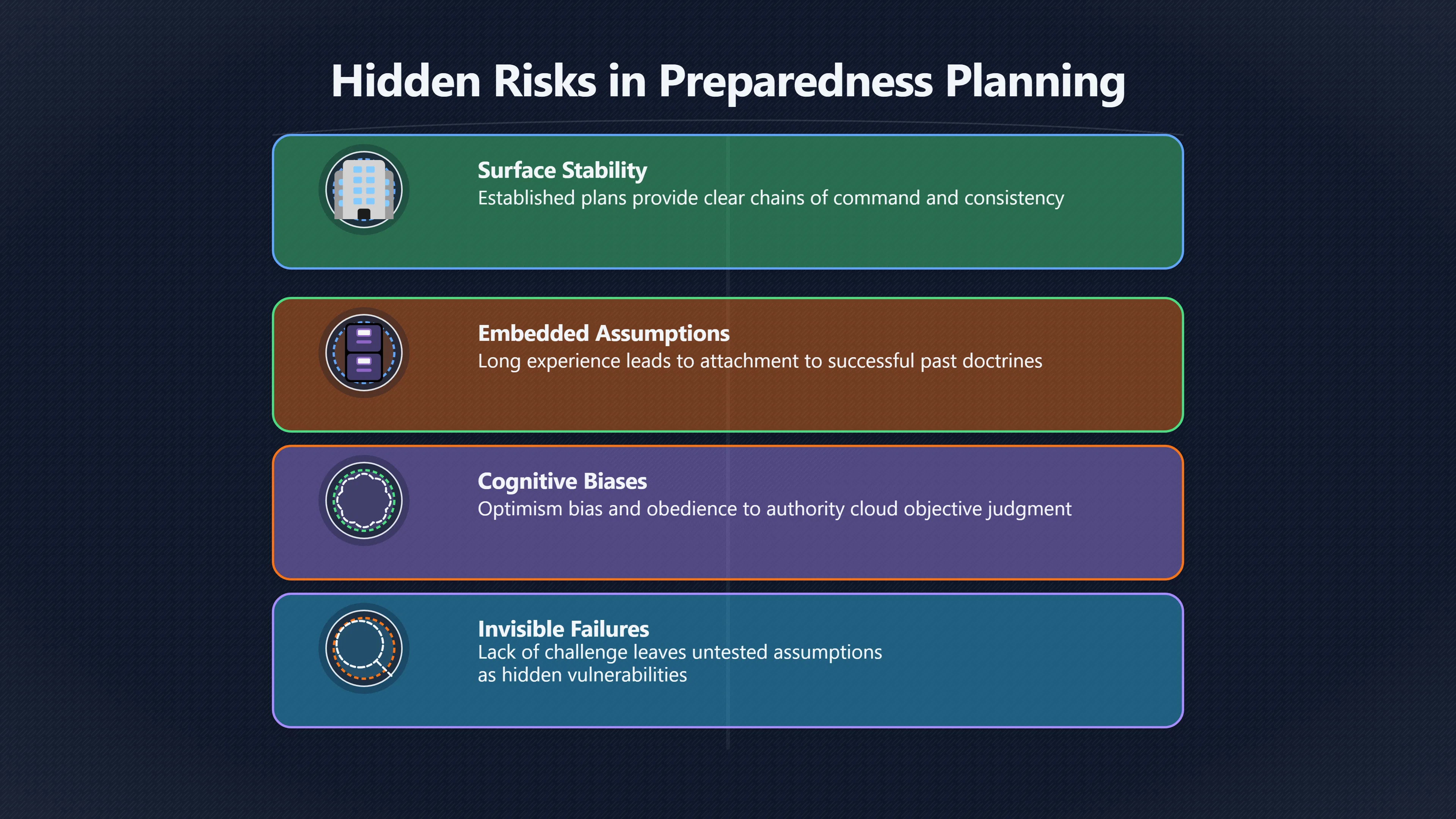
Preparedness planning rewards coordination, consistency and clear chains of command. Those are essential during emergencies, but they can unintentionally discourage disagreement during planning.
Groups with long experience often become attached to successful doctrines, previous exercises and established risk models. Over time, assumptions become embedded in planning documents, training programmes and institutional culture. Once this happens, dissent can appear unnecessary or even disruptive, particularly if it comes from junior staff or outsiders.
The UK Ministry of Defence’s Red Teaming Handbook identifies several recurring psychological and organisational risks, including obedience to authority, optimism bias, commitment to existing plans, and the tendency to search only for information that supports current thinking. Rather than treating these as individual failings, the handbook argues they are predictable features of group decision-making that require deliberate countermeasures.[GOV.UK]assets.publishing.service.gov.ukTeaming Handbook, 3rd EditionJune 25, 2021 — A failure to challenge (faulty) guidance can occur due to social pressures…
Preparedness planning is especially vulnerable because success is difficult to measure. If a major emergency never occurs, organisations rarely discover whether their assumptions were genuinely robust or merely untested.
How red teams test assumptions
A red team is not simply a committee of critics. Its purpose is to improve decisions by systematically examining how accepted views might be wrong.
Effective red teams typically:[croakey.org]croakey.orgred teams may help to improve pandemic responses and other lessons from abroadRed teams may help to improve pandemic responses, and…25 Jul 2024 — The report describes a failure to identify those who were vulnerab…
- Challenge the assumptions underlying official plans rather than only reviewing the final document.
- Develop plausible alternative scenarios that existing models may overlook.
- Test whether evidence genuinely supports the preferred conclusion or merely appears consistent with it.
- Examine plans from the perspective of adversaries, affected communities or independent experts.
- Force planners to explain why competing hypotheses have been rejected.
- Look for hidden dependencies, single points of failure and unrealistic expectations about implementation.
The goal is not to produce disagreement for its own sake. Instead, it is to identify assumptions that have become invisible precisely because everyone shares them.
The Ministry of Defence handbook describes numerous structured techniques, including alternative hypothesis analysis, assumption checks, alternative futures exercises and planning reviews specifically designed to expose cognitive bias before decisions become fixed. It emphasises that these methods should be integrated throughout the decision process rather than applied only at the final approval stage.[GOV.UK]assets.publishing.service.gov.ukTeaming Handbook, 3rd EditionJune 25, 2021 — A failure to challenge (faulty) guidance can occur due to social pressures…
What preparedness failures reveal
Large-scale preparedness failures often become case studies in the cost of insufficient challenge.
The first report of the UK Covid-19 Inquiry concluded that pandemic planning had become overly focused on influenza-based assumptions. Institutions largely prepared for managing the consequences of a widespread outbreak rather than examining whether different pathogens might require fundamentally different strategies. The inquiry found that no independent body consistently questioned whether the overall preparedness system remained fit for purpose or whether key assumptions had become outdated.[UK Covid-19 Inquiry]covid19.public-inquiry.ukUK Covid-19 InquiryModule 1 report: The resilience and preparedness of the…The UK failed to plan to prevent the widespread illness and…
One striking finding was not simply that some predictions proved wrong, but that too few people were asking whether the planning framework itself required revision. The inquiry highlighted fragmented responsibility, insufficient independent assessment and planning documents that had become increasingly difficult to scrutinise effectively.[UK Covid-19 Inquiry]covid19.public-inquiry.ukUK Covid-19 InquiryModule 1 report: The resilience and preparedness of the…The UK failed to plan to prevent the widespread illness and…
Following these findings, the inquiry recommended the routine use of external red teams to challenge prevailing assumptions and reduce the effects of groupthink in future emergency planning. Contemporary reporting noted that the recommendation aimed specifically at introducing structured outside criticism before consensus hardened into policy.[The Guardian]theguardian.comKey government figures, including former Prime Minister David Cameron and current Chief Medical Officer Prof Chris Whitty, admitted that…
Designing red teams that actually improve decisions
Simply appointing a “devil’s advocate” rarely achieves the benefits associated with successful red teaming. Poorly designed challenge exercises can become performative, where objections are expected but not genuinely considered.
Several characteristics distinguish effective red teams:
Independence. Members should have enough organisational distance to question assumptions without fearing career consequences.
Access to evidence. Challengers need the same information available to planners; otherwise criticism becomes speculative rather than analytical.
Authority to influence decisions. Findings must reach senior decision-makers before plans become politically or institutionally committed.
Method rather than personality. Effective red teaming relies on structured analytical techniques rather than relying on naturally sceptical individuals.
Psychological safety. Leaders must visibly reward rigorous criticism. If disagreement carries reputational costs, formal red teams quickly lose effectiveness.
Government guidance stresses that red teams are one component of broader quality assurance rather than a substitute for expert review, operational testing or scientific advice. Their distinctive contribution is organised independent challenge aimed at exposing blind spots before implementation.[Civil Servant]civilservant.org.ukCivil Servant Policy ProcessCivil ServantPolicy Process - Red TeamsA 'Red Team' to provide an independent challenge to assumptions, and identify weaknesses in, an or…

Limits and trade-offs
Red teams are not guaranteed to prevent failure.
An ineffective red team may suffer the same biases as the organisation it examines. Alternatively, leaders may commission a review but ignore uncomfortable findings, turning the exercise into little more than symbolic reassurance.
There is also a balance to strike between encouraging challenge and preserving timely decision-making. During an active emergency, endless debate can delay necessary action. The greatest value of red teaming therefore lies before crises, when assumptions can still be revised at relatively low cost.
Nor should red teams be expected to predict every future event. Their purpose is less about forecasting the exact crisis than improving the resilience of planning by ensuring that multiple credible possibilities receive serious examination.
Why red teams matter for analytical thinking
For individuals seeking stronger analytical skills, red teaming represents a practical version of the broader principle of considering strong objections before committing to a conclusion.
Instead of asking, “How can I defend this plan?”, red-team thinking asks:
- Which assumption is carrying most of the argument?
- What would an intelligent critic attack first?
- Which evidence would genuinely change my mind?
- What alternative explanation has received the least attention?
- If this plan failed, what warning signs would we later wish we had taken seriously?
Preparedness failures repeatedly show that confident agreement is not reliable evidence that a plan is sound. Organisations become more resilient not by eliminating disagreement, but by making disciplined, well-informed challenge a routine part of how important decisions are made.

eBay marketplace picks
Marketplace Samples
Live-tested eBay searches with available results related to this page.




Endnotes
1.
Source: GOV.UK
Link:https://www.gov.uk/government/publications/a-guide-to-red-teaming
Source snippet
Teaming HandbookThe Red Teaming Handbook provides a practical guide for supporting individuals and teams who are faced with different pro...
2.
Source: assets.publishing.service.gov.uk
Link:https://assets.publishing.service.gov.uk/media/61702155e90e07197867eb93/20210625-Red_Teaming_Handbook.pdf
Source snippet
Teaming Handbook, 3rd EditionJune 25, 2021 — A failure to challenge (faulty) guidance can occur due to social pressures...
Published: June 25, 2021
3.
Source: covid19.public-inquiry.uk
Link:https://covid19.public-inquiry.uk/reports/module-1-report-the-resilience-and-preparedness-of-the-united-kingdom/
Source snippet
UK Covid-19 InquiryModule 1 report: The resilience and preparedness of the...The UK failed to plan to prevent the widespread illness and...
4.
Source: theguardian.com
Link:https://www.theguardian.com/uk-news/article/2024/jul/18/covid-inquiry-hallett-prescribes-red-teams-as-antidote-to-flawed-thinking
Source snippet
Key government figures, including former Prime Minister David Cameron and current Chief Medical Officer Prof Chris Whitty, admitted that...
5.
Source: civilservant.org.uk
Title: Civil Servant Policy Process
Link:https://www.civilservant.org.uk/process-red_teams.html
Source snippet
Civil ServantPolicy Process - Red TeamsA 'Red Team' to provide an independent challenge to assumptions, and identify weaknesses in, an or...
Additional References
6.
Source: croakey.org
Title: red teams may help to improve pandemic responses and other lessons from abroad
Link:https://www.croakey.org/red-teams-may-help-to-improve-pandemic-responses-and-other-lessons-from-abroad/
Source snippet
Red teams may help to improve pandemic responses, and...25 Jul 2024 — The report describes a failure to identify those who were vulnerab...
7.
Source: england.nhs.uk
Title: framework for managing the response to pandemic diseases
Link:https://www.england.nhs.uk/long-read/framework-for-managing-the-response-to-pandemic-diseases/
Source snippet
15 Jul 2024 — This document provides a framework for NHS England when managing the response to a pandemic and should be read in conjuncti...
8.
Source: inquirytracker.uk
Title: External Red Teams for Resilience
Link:https://www.inquirytracker.uk/recommendations/942/
Source snippet
UK Inquiry TrackerThe purpose of this training is to ensure that participants are aware of the critical importance of red teaming, challe...
9.
Source: paxsims.wordpress.com
Title: red teaming guide uk mod 20130301
Link:https://paxsims.wordpress.com/wp-content/uploads/2022/12/red-teaming-guide-uk-mod-20130301.pdf
Source snippet
teaming guide (Second edition)These human and organisational factors which drive Defence and military thinking are the greatest determina...
10.
Source: youtube.com
Title: RED TEAM Thinking Revolutionises 21st Century Leadership! #redteaming
Link:https://www.youtube.com/watch?v=sUEAxLWrm1E
Source snippet
UK citizens 'failed' by government processes ahead of COVID-19 pandemic, inquiry finds...
11.
Source: youtube.com
Title: Red Team Thinking and Finding Opportunities in Chaos with Bryce Hoffman
Link:https://www.youtube.com/watch?v=PAAegRpXRUs
Source snippet
RED TEAM Thinking Revolutionises 21st Century Leadership! #redteaming...
12.
Source: youtube.com
Title: What Is Red Team Thinking?
Link:https://www.youtube.com/watch?v=53J-6weLSc8
Source snippet
Red Team Thinking and Finding Opportunities in Chaos with Bryce Hoffman...
13.
Source: youtube.com
Link:https://www.youtube.com/watch?v=7aNG3wU6da8
14.
Source: youtube.com
Title: Red Teaming for Decision Support
Link:https://www.youtube.com/watch?v=VArsnfo_xcA
Source snippet
What Is Red Team Thinking?...
Topic Tree