Within Sharper Thinking
How Do You Think Through Uncertainty?
Many hard choices involve uncertainty, likelihoods, and competing values rather than one clean right answer.
On this page
- Probability questions
- Trade off decisions
- Confidence and uncertainty
Page outline Jump by section
Introduction
Analytical thinking through uncertainty means replacing “Will this work?” with better questions: “How likely is each outcome?”, “What would it cost if I am wrong?”, “Which values are in tension?”, and “How confident should I be?” Many difficult choices are not puzzles with one clean answer. They are probability-and-trade-off problems: taking a job, launching a project, judging a medical test, buying insurance, accepting a risk, or deciding whether more information is worth the delay. Good thinking here does not remove uncertainty. It makes uncertainty visible enough to reason with.
The core mechanism is simple: separate the decision into probabilities, outcomes, values, and confidence. Probabilities describe how likely things are. Outcomes describe what may happen. Values describe what you care about. Confidence describes how much weight your estimate deserves. Research on forecasting, risk communication, decision analysis and behavioural economics shows that people can improve this kind of judgement, especially when they use explicit probabilities, base rates, natural frequencies, feedback, sensitivity checks and structured comparison of competing objectives.[GOV.UK+3Coefficient Giving+3PMC]openphilanthropy.orghow accurate are our predictionsoverconfident vs. underconfident. If a forecaster is well-calibrated for…Read more…
Why Uncertain Choices Need a Different Kind of Thinking
A certain decision can be judged mainly by fit: does this action match the goal? An uncertain decision has to be judged before the result is known. That distinction matters because a good decision can still have a bad outcome, and a lucky outcome can hide a poor decision. Someone who makes a sensible investment may lose money because of a rare shock; someone who takes a reckless shortcut may get away with it once. Analytical thinking tries to judge the quality of the reasoning at the time of choice, not merely the outcome afterwards.
Decision analysis treats uncertainty as something to be represented, not wished away. The UK government’s Green Book, for example, frames appraisal as assessing the costs, benefits and risks of different options in a structured way so decision-makers receive objective, evidence-based advice rather than a single unsupported recommendation. It also warns that a benefit-cost ratio alone is not a complete measure of value for money, because risk appetite, uncertainty and distributional effects can change what counts as a good choice.[GOV.UK]GOV.UKthe green book 2026the green book 2026
The practical shift is from “Which option is best?” to “Which option is best under which assumptions?” That is why uncertainty thinking often uses scenarios, decision trees, ranges, sensitivity analysis and explicit risk appetite. These tools are not only for governments or analysts. The same logic applies to everyday choices: a cheaper flat may be better if commuting time stays manageable, worse if transport reliability collapses, and unacceptable if the loss of social time matters more than the rent saving.
Probability Questions: From Vague Possibility to Usable Estimates
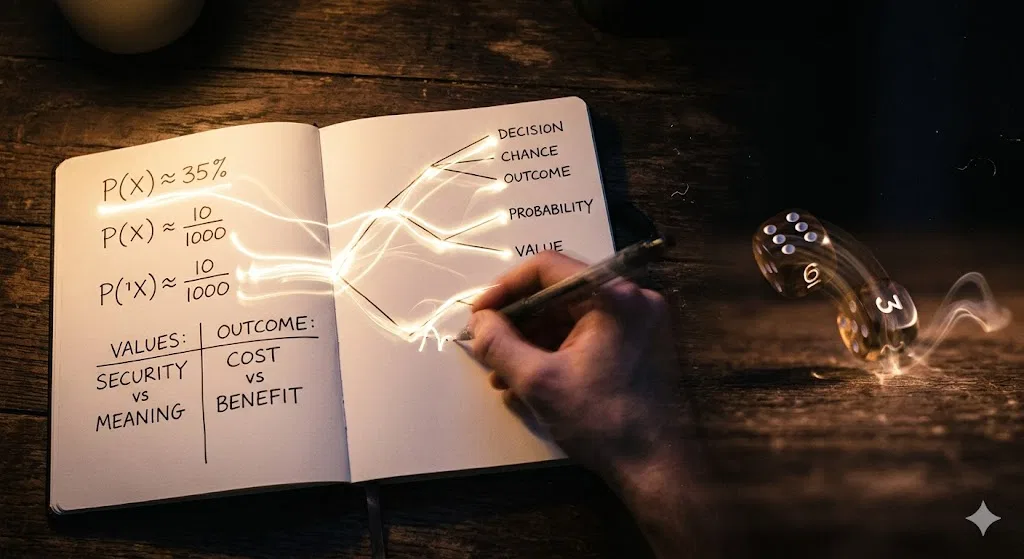
A probability question asks for a degree of belief, not a guarantee. “There is a risk the project overruns” is vague. “I think there is a 35% chance it overruns by more than two months” is much more useful, because it can be challenged, compared, updated and scored later. The number does not need to be perfect to be valuable; it forces the thinker to say whether they mean a remote possibility, a serious risk, or the most likely outcome.
Forecasting research makes this visible. The Good Judgment Project, led by Philip Tetlock and Barbara Mellers, studied large-scale geopolitical forecasting and found that accuracy improved through methods such as training, teaming, aggregation and repeated scoring. Open Philanthropy’s review of its own forecasting practice describes calibration curves: if a forecaster assigns many events 65–75% confidence, roughly that share should later come true if the forecaster is well calibrated in that range.[Good Judgment]goodjudgment.comOpen source on goodjudgment.com.
A useful probability habit is to begin with a base rate. Before asking whether this particular start-up will succeed, ask how often similar start-ups succeed. Before deciding whether one applicant will thrive in a role, ask what proportion of similar hires have done well. Before believing a dramatic diagnosis from a test result, ask how common the condition is in the tested population. Base rates do not settle the question, but they stop the most vivid detail from becoming the whole story.
Probability also becomes easier when expressed as counts rather than abstract percentages. Research on natural frequencies shows that people often reason better when a problem is framed as “10 out of 1,000” rather than “1%”, especially in Bayesian tasks such as interpreting medical test results. A 2015 paper found that natural frequency formats improved Bayesian inferences by medical students across more complex tasks by an average of 37 percentage points compared with probability formats.[PMC]pmc.ncbi.nlm.nih.govOpen source on nih.gov.
The reason is mechanical, not magical. Natural frequencies preserve the nested structure of the problem. If 1,000 people are tested, 10 have the disease, 9 of those test positive, and 99 people without the disease also test positive, the question becomes: out of all positive tests, how many are true positives? That is much easier to see than the same problem expressed as conditional probabilities.[cogsci.ucsd.edu]cogsci.ucsd.eduHow to Improve Bayesian Reasoning Without InstructionHow to Improve Bayesian Reasoning Without Instruction
For practical thinking, probability questions should be written in a way that could later be checked:
- “What is the chance this project exceeds £50,000 by 31 December?”
- “What is the chance this candidate is still performing well after one year?”
- “What is the chance this supplier misses the agreed delivery date?”
- “What is the chance this symptom resolves without treatment within two weeks?”
Each version defines the outcome, threshold and time frame. That prevents the common escape hatch of saying “I was basically right” after the fact.
Trade-Off Decisions: When the Hard Part Is Not the Probability
Some decisions are hard because probabilities are unknown. Others are hard because the values conflict. A job offer may be more secure but less meaningful. A policy may be cost-effective on average but unfairly distribute burdens. A medical treatment may improve survival odds but reduce quality of life. Analytical thinking for trade-offs does not pretend these conflicts vanish; it makes the exchange explicit.
Multi-criteria decision analysis, or MCDA, is one formal way to do this. The UK Civil Service describes MCDA as useful when decision-makers face multiple options with several conflicting objectives, mixed criteria that cannot be easily compared, or different stakeholder perspectives. The point is not to turn every value into a fake precision score. It is to clarify which criteria matter, how options perform against them, and where judgement rather than calculation is doing the work.[analysisfunction.civilservice.gov.uk]analysisfunction.civilservice.gov.ukan introductory guide to mcdaan introductory guide to mcda
A practical trade-off analysis usually has four parts. First, name the options. Second, name the criteria that genuinely matter. Third, decide which criteria are essential, important or merely nice to have. Fourth, test whether the preferred option changes when the weights change. If a decision flips whenever one assumption moves slightly, it is fragile. If it remains attractive across several reasonable assumptions, it is more robust.
The trap is to compare options only on the easiest-to-measure dimension. Money, time and headline risk often dominate because they are visible. Less visible factors, such as reversibility, reputation, learning value, stress, fairness, resilience and option value, may matter just as much. A lower-cost option that locks you into a brittle path may be worse than a more expensive option that preserves flexibility.
Trade-offs also require noticing opportunity cost: what you give up by choosing one path over another. The real cost of saying yes to a demanding project is not only the hours it consumes, but the other projects, recovery time, relationships or learning opportunities those hours can no longer support. Analytical thinking improves when the rejected alternative is made visible rather than treated as an absence.
Expected Value Is Useful, but It Is Not the Whole Decision
Expected value is one of the most useful tools for uncertainty. It multiplies each possible outcome by its probability, then adds the results. If there is a 50% chance of gaining £100 and a 50% chance of gaining nothing, the expected value is £50. This is powerful because it prevents rare but vivid outcomes from overwhelming the average, and it helps compare options with different mixes of probability and reward.
Yet expected value is not the same as “the right answer”. A high expected-value choice can still be unacceptable if the downside would be ruinous, irreversible or unfairly borne by someone else. A founder may rationally reject a gamble with a positive expected return if failure would bankrupt the household. A hospital may reject a cost-saving policy if the worst-case patient harm is too severe. The Green Book’s emphasis on risk appetite reflects this point: a high-reward but high-risk option may not be best value if decision-makers are especially risk-averse for that proposal.[GOV.UK]assets.publishing.service.gov.ukOpen source on service.gov.uk.
The more useful question is: “Expected value for whom, over what time horizon, with what downside tolerance?” A large organisation can take many small positive-expectation bets because losses are spread across a portfolio. An individual may face a single-shot decision where one bad outcome is life-changing. The same probability table can therefore support different choices depending on capacity to absorb loss.
This is where decision trees help. A decision tree lays out choices, chance events, probabilities and consequences, making it easier to calculate expected values and spot where the decision is most sensitive. Sensitivity analysis then asks what happens if a probability, cost or benefit estimate is wrong. In public appraisal, sensitivity testing and explicit optimism-bias adjustment are recommended precisely because costs, benefits and delivery times are often estimated too confidently.[GOV.UK]assets.publishing.service.gov.ukOpen source on service.gov.uk.
Confidence and Uncertainty: Knowing How Much to Trust Your Own Estimate
Confidence is not the same as probability. A probability says how likely an outcome is. Confidence says how much trust to place in that probability estimate. “I think there is a 60% chance, based on years of comparable data” is different from “I think there is a 60% chance, based on a hunch and two anecdotes.” The number is the same; the reliability is not.
Calibration is the skill of matching confidence to reality. A well-calibrated person who says “70%” many times should be right about 70% of the time. Overconfidence means the stated confidence runs ahead of accuracy. Underconfidence means the person is too cautious even when the evidence supports stronger claims. Open Philanthropy’s explanation of calibration curves is useful because it treats confidence as something that can be measured after many predictions, not just felt in the moment.[Coefficient Giving]openphilanthropy.orghow accurate are our predictionsoverconfident vs. underconfident. If a forecaster is well-calibrated for…Read more…
One way to improve confidence judgement is to make predictions in advance and review them later. This works because memory is generous. After events resolve, people often remember having been less surprised than they really were. A prediction log removes that escape route. It records the claim, probability, reasoning, date and resolution condition before the outcome is known.
Confidence should fall when evidence is thin, incentives are distorted, the situation is unusual, or the decision-maker has not seen enough similar cases. It should rise when the estimate is grounded in a strong base rate, multiple independent sources, clear feedback and a track record of similar predictions. The aim is not to sound uncertain about everything. It is to make certainty earned.
Why Human Judgement Distorts Probabilities and Trade-Offs
People do not naturally weigh probabilities and outcomes like neutral calculators. Prospect theory, developed by Daniel Kahneman and Amos Tversky, showed that people often evaluate outcomes as gains or losses relative to a reference point, with losses typically felt more strongly than equivalent gains. The theory also describes how people use decision weights rather than treating probabilities linearly.[JSTOR]jstor.orgProspect Theory: An Analysis of Decision under RiskProspect Theory: An Analysis of Decision under Risk
That matters for trade-offs because framing can change the apparent decision. A treatment described as having a 90% survival rate may feel different from one described as having a 10% mortality rate, even when the information is equivalent. A business option framed as “protecting what we have” may receive more support than the same option framed as “missing growth”. Analytical thinking asks whether the frame is doing hidden work.
Probability weighting creates another problem. People may overreact to small probabilities when the outcome is emotionally vivid, such as a rare disaster, while underreacting to larger but duller risks, such as gradual cost overrun. They may also treat “possible” as if it meant “likely enough to dominate the decision”. That can lead either to paralysis or to reckless dismissal, depending on which outcome is most emotionally available.
Good analysis counters this by translating frames. Look at absolute risk as well as relative risk. Convert percentages into frequencies. State both survival and mortality. Ask what the decision looks like from the gain frame and the loss frame. Consider the average case, plausible bad case and break-glass worst case separately. None of these moves removes emotion, but they reduce the chance that emotion secretly chooses the frame.

A Practical Way to Think Through an Uncertain Choice
For a real decision, the most useful process is usually shorter than a formal model but more disciplined than a pros-and-cons list. The goal is to create just enough structure to expose the key probabilities, trade-offs and confidence limits.
Start by writing the decision in one sentence. “Should I accept this job?” is too broad. “Should I accept this job despite the longer commute and lower flexibility because it offers better training and salary growth over the next two years?” is better. The clearer version already shows the trade-offs.
Then separate the decision into components:
- Options: What are the real alternatives, including waiting, negotiating, piloting or reversing later?
- Outcomes: What could happen under each option?
- Probabilities: How likely are the main outcomes, using base rates where available?
- Values: Which outcomes matter most: money, time, health, learning, fairness, autonomy, reputation, security?
- Downside tolerance: Which losses would be inconvenient, serious or unacceptable?
- Information value: What could you learn before deciding, and is that information worth the delay?
- Confidence: Which estimates are evidence-based, and which are guesses?
The information-value question is often neglected. More research is worthwhile when it is likely to change the decision, cheap enough to obtain, and available before the deadline. It is not worthwhile when it merely makes the decision-maker feel busier while the central trade-off remains unchanged. Decision-analysis literature treats the expected value of information as a way to ask whether reducing uncertainty is itself worth paying for.[arXiv]arxiv.orgarXiv Efficient Estimation of the Value of Information in Monte Carlo ModelsarXiv Efficient Estimation of the Value of Information in Monte Carlo Models
Finally, test the decision against a few scenarios. What would make the preferred option clearly wrong? What assumption is carrying the most weight? What would an informed critic say? What would you choose if you had to explain the decision publicly? These questions make hidden dependencies visible.
Common Failure Modes
The most common mistake is false precision: assigning numbers that look scientific but rest on weak foundations. A probability estimate can be useful even when rough, but it should not be dressed up as measurement if it is really judgement. Use ranges when the evidence does not support a point estimate.
A second mistake is single-factor optimisation. People often optimise the most measurable factor and call it rationality. Cheapest, fastest, safest or highest expected return can each be the wrong answer if the decision has several objectives. MCDA exists because real choices often involve conflicting criteria that cannot be reduced honestly to one dimension.[analysisfunction.civilservice.gov.uk]analysisfunction.civilservice.gov.ukan introductory guide to mcdaan introductory guide to mcda
A third mistake is ignoring correlation. Several risks may look tolerable one by one but become dangerous together. A household might be able to handle a mortgage increase, or a job loss, or a major repair, but not all three in the same year. A project might survive a supplier delay or a staffing gap, but not both at once.
A fourth mistake is treating confidence as a personality trait. Strong delivery can make weak evidence sound convincing. Hesitant delivery can make strong evidence sound uncertain. The analytical question is not “Who sounds sure?” but “Whose estimates have been tested, calibrated and exposed to disconfirming evidence?”
A fifth mistake is judging the decision only after the outcome. This encourages hindsight bias and punishes sensible risk-taking. A better review asks: given what was known at the time, were the probabilities reasonable, were the trade-offs explicit, and were the downside risks acceptable?
The Payoff: Better Decisions Without Pretending to Know the Future
Analytical thinking for probabilities and trade-offs improves judgement by changing the shape of the question. Instead of demanding certainty, it asks for a clear estimate. Instead of hiding values inside a recommendation, it names the competing objectives. Instead of treating confidence as a feeling, it tests calibration. Instead of choosing the option with the best story, it asks which option survives reasonable changes in the assumptions.
The result is not robotic decision-making. Human values still decide what matters. Judgement is still needed when evidence is incomplete. But the judgement becomes easier to inspect. A good uncertain decision can be explained as: “Here are the options, here are the likely outcomes, here is what we care about, here is what could go wrong, here is how confident we are, and here is why this trade-off is acceptable.” That is the practical value of thinking probabilistically: not knowing the future, but making choices that are honest about not knowing it.

eBay marketplace picks
Marketplace Samples
Example marketplace items related to this page. Use the search link to explore similar finds on eBay.
Endnotes
1.
Source: pmc.ncbi.nlm.nih.gov
Link:https://pmc.ncbi.nlm.nih.gov/articles/PMC4604268/
2.
Source: analysisfunction.civilservice.gov.uk
Title: an introductory guide to mcda
Link:https://analysisfunction.civilservice.gov.uk/policy-store/an-introductory-guide-to-mcda/
3.
Source: GOV.UK
Title: the green book 2026
Link:https://www.gov.uk/government/publications/the-green-book-appraisal-and-evaluation-in-central-government/the-green-book-2026
4.
Source: assets.publishing.service.gov.uk
Link:https://assets.publishing.service.gov.uk/media/698dbcd17da91680ad7f4308/The_Green_Book_2026.pdf
5.
Source: cogsci.ucsd.edu
Title: How to Improve Bayesian Reasoning Without Instruction
Link:https://cogsci.ucsd.edu/~coulson/203/GG_How_1995.pdf
6.
Source: assets.publishing.service.gov.uk
Link:https://assets.publishing.service.gov.uk/media/5a74dae740f0b65f61322c72/Optimism_bias.pdf
7.
Source: jstor.org
Title: Prospect Theory: An Analysis of Decision under Risk
Link:https://www.jstor.org/stable/1914185
8.
Source: arxiv.org
Title: arXiv Efficient Estimation of the Value of Information in Monte Carlo Models
Link:https://arxiv.org/abs/1302.6794
9.
Source: GOV.UK
Title: the green book appraisal and evaluation in central government
Link:https://www.gov.uk/government/publications/the-green-book-appraisal-and-evaluation-in-central-government
10.
Source: btu.edu.ge
Link:https://btu.edu.ge/wp-content/uploads/2023/08/Lesson-13_-Decision-Analysis.pdf
11.
Source: data.london.gov.uk
Title: the green book 2026 updates following the 2025 review
Link:https://data.london.gov.uk/blog/the-green-book-2026-updates-following-the-2025-review/
12.
Source: openphilanthropy.org
Title: how accurate are our predictions
Link:https://www.openphilanthropy.org/research/how-accurate-are-our-predictions/
Source snippet
overconfident vs. underconfident. If a forecaster is well-calibrated for...Read more...
13.
Source: goodjudgment.com
Link:https://goodjudgment.com/about/the-science-of-superforecasting/
14.
Source: pmc.ncbi.nlm.nih.gov
Title: PMCA framework for sensitivity analysis of decision trees
Link:https://pmc.ncbi.nlm.nih.gov/articles/PMC5767274/
15.
Source: openphilanthropy.org
Title: efforts to improve the accuracy of our judgments and forecasts
Link:https://www.openphilanthropy.org/research/efforts-to-improve-the-accuracy-of-our-judgments-and-forecasts/
16.
Source: openphilanthropy.org
Title: how feasible is long range forecasting
Link:https://www.openphilanthropy.org/research/how-feasible-is-long-range-forecasting/
17.
Source: openphilanthropy.org
Title: macroeconomic policy
Link:https://www.openphilanthropy.org/research/cause-reports/macroeconomic-policy?q=%2Fprint%2Fresearch%2Fcause-reports%2Fmacroeconomic-policy
18.
Source: openphilanthropy.org
Title: new report on consciousness and moral patienthood
Link:https://www.openphilanthropy.org/research/new-report-on-consciousness-and-moral-patienthood/
19.
Source: openphilanthropy.org
Title: potential risks from advanced artificial intelligence
Link:https://www.openphilanthropy.org/research/potential-risks-from-advanced-artificial-intelligence/
20.
Source: openphilanthropy.org
Title: how much computational power does it take to match the human brain
Link:https://www.openphilanthropy.org/research/how-much-computational-power-does-it-take-to-match-the-human-brain/
21.
Source: goodjudgment.com
Link:https://goodjudgment.com/
22.
Source: pmc.ncbi.nlm.nih.gov
Link:https://pmc.ncbi.nlm.nih.gov/articles/PMC3871726/
23.
Source: pmc.ncbi.nlm.nih.gov
Link:https://pmc.ncbi.nlm.nih.gov/articles/PMC12730000/
24.
Source: pmc.ncbi.nlm.nih.gov
Link:https://pmc.ncbi.nlm.nih.gov/articles/PMC3375992/
25.
Source: pmc.ncbi.nlm.nih.gov
Link:https://pmc.ncbi.nlm.nih.gov/articles/PMC10189590/
26.
Source: pmc.ncbi.nlm.nih.gov
Link:https://pmc.ncbi.nlm.nih.gov/articles/PMC4544539/
27.
Source: pubmed.ncbi.nlm.nih.gov
Link:https://pubmed.ncbi.nlm.nih.gov/21614719/
28.
Source: pmc.ncbi.nlm.nih.gov
Link:https://pmc.ncbi.nlm.nih.gov/articles/PMC8338842/
29.
Source: pmc.ncbi.nlm.nih.gov
Link:https://pmc.ncbi.nlm.nih.gov/articles/PMC4475789/
30.
Source: youtube.com
Link:https://www.youtube.com/watch?v=pedNak4S9IE
31.
Source: ppp.worldbank.org
Title: The Green Book
Link:https://ppp.worldbank.org/sites/default/files/2022-05/The_Green_Book.pdf
32.
Source: goodjudgment.substack.com
Title: books superforecasting
Link:https://goodjudgment.substack.com/p/books-superforecasting
33.
Source: Wikipedia
Title: The Good Judgment Project
Link:https://en.wikipedia.org/wiki/The_Good_Judgment_Project
34.
Source: Wikipedia
Title: Prospect theory
Link:https://en.wikipedia.org/wiki/Prospect_theory
Additional References
35.
Source: youtube.com
Link:https://www.youtube.com/watch?v=SdAAn-n_muE
Source snippet
Decision-making Tools for Healthcare Managers - YouTube Decision-making Tools for Healthcare Managers - YouTube...
36.
Source: youtube.com
Title: Superforecasting: How to [Predict]({{ ‘predict/’ | relative_url }}) the Future
Link:https://www.youtube.com/watch?v=rV5Gicb66WA
Source snippet
Payoff tables + Risk Preference + Maximax, Maximin & Minimax Regret [Eng]...
37.
Source: youtube.com
Title: ‘Superforecasting’: The people that predict the future – BBC REEL
Link:https://www.youtube.com/watch?v=SAzTP2A634g
Source snippet
Why Leadership begins with Real-World Experiences | Inside the Georgia MBA Series...
38.
Source: youtube.com
Title: Payoff tables + Risk Preference + Maximax, Maximin & Minimax Regret [Eng]
Link:https://www.youtube.com/watch?v=szy7nfiXYtY
Source snippet
'Superforecasting': The people that predict the future – BBC REEL...
39.
Source: nature.com
Link:https://www.nature.com/nature-index/topics/l4/numeracy-and-risk-communication-in-healthcare-decision-making
40.
Source: researchgate.net
Link:https://www.researchgate.net/figure/Gigerenzer-Hoffrage-Natural-frequencies-chances-normalized-frequencies-and_fig3_5881620
41.
Source: researchgate.net
Link:https://www.researchgate.net/publication/282876100_Natural_frequencies_improve_Bayesian_reasoning_in_simple_and_complex_inference_tasks
42.
Source: support.pstnet.com
Link:https://support.pstnet.com/hc/en-us/articles/360047972473-STEP-The-Calibration-and-Resolution-of-Confidence-in-Perceptual-Judgements-1994-35037
43.
Source: researchgate.net
Link:https://www.researchgate.net/publication/376405744_A_GENERAL_ASSESSMENT_ON_THE_ROLE_OF_OPPORTUNITY_COST_IN_DECISION_MAKING_UNDER_RISK_AND_UNCERTAINTY
44.
Source: regulatoryreform.com
Link:https://regulatoryreform.com/wp-content/uploads/2015/02/UK-Appraisal-and-Evaluation-in-Central-Governmentgreen_book_complete.pdf
Topic Tree