Within Confirmation Bias
When Research Becomes a Search Trap
Searching only for reasons to proceed can make a decision feel researched while hiding the strongest reasons it might fail.
On this page
- Supportive searches versus failure searches
- Why one sided research feels convincing
- Search prompts that uncover contrary evidence
Page outline Jump by section
Introduction
Researching an important personal decision can feel rigorous simply because it involves many searches, reviews and conversations. Yet the quantity of information gathered is often less important than the direction of the search. A common trap is selective search: looking mainly for evidence that supports the option you already favour while overlooking information that could change your mind. The result is not necessarily deliberate self-deception. Rather, the research process gradually becomes a way of defending an emerging preference instead of testing whether it deserves to survive. Psychological research identifies this as one of the most practical forms of confirmation bias because it shapes what information reaches you before you ever evaluate it.[UC San Diego Pages]pages.ucsd.eduUC San Diego Pages Confirmation Bias: A Ubiquitous Phenomenon in ManyUC San Diego PagesConfirmation Bias: A Ubiquitous Phenomenon in Many…October 6, 2004 — by RS Nickerson · 1998 · Cited by 12455 — Confi…
 In everyday choices—whether buying a home, accepting a job, starting a business or choosing a university—the difference between asking “Why is this a good idea?” and “Under what conditions does this become a bad idea?” can determine whether research improves judgement or merely reinforces enthusiasm.
When Research Becomes a Search Trap
Selective search happens before evidence is weighed. It begins with the questions people ask.
Someone excited about moving to a new city may search for “best neighbourhoods”, “things to do”, and “why people love living there”. A prospective employee may spend hours reading positive company stories while dismissing critical accounts as isolated complaints. A buyer considering an expensive product may repeatedly search for positive reviews while avoiding discussions of reliability problems.
None of these searches is unreasonable on its own. The problem arises when they become the entire research strategy.
Raymond Nickerson’s review of confirmation bias distinguishes between impartially gathering evidence to reach a conclusion and unintentionally building a case for a conclusion that already feels attractive. In personal decisions, selective search often reflects the latter without people recognising that they are doing it.[UC San Diego Pages]pages.ucsd.eduUC San Diego Pages Confirmation Bias: A Ubiquitous Phenomenon in ManyUC San Diego PagesConfirmation Bias: A Ubiquitous Phenomenon in Many…October 6, 2004 — by RS Nickerson · 1998 · Cited by 12455 — Confi…
Supportive Searches Versus Failure Searches
The easiest way to recognise selective search is to compare two different styles of information gathering.
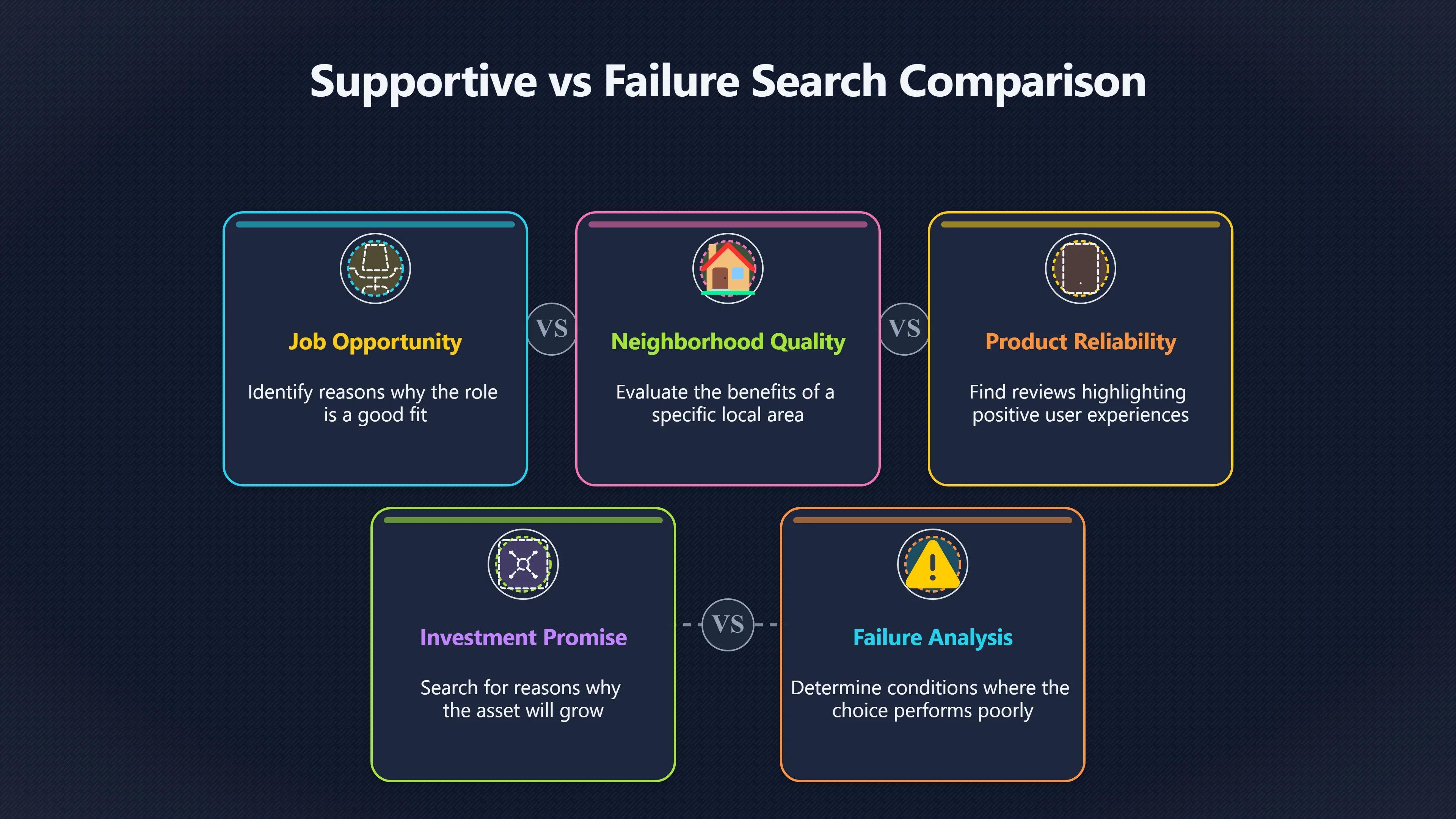
Supportive searchFailure search”Why should I take this job?”“Why do people regret taking this job?”“Is this neighbourhood good?”“What problems do long-term residents report?”“Which reviews recommend this product?”“What failures appear after two years of ownership?”“Why is this investment promising?”“What assumptions would have to be wrong for this investment to lose value?”
Supportive searches ask whether an appealing option has advantages. Failure searches ask how the option breaks down, who is dissatisfied, or under what circumstances it performs poorly.
Both forms of search have value. The danger comes from relying almost entirely on the first.
Research by Joshua Klayman and Young-Won Ha helps explain why. They argued that people naturally adopt a positive test strategy, looking at situations where their current idea is expected to succeed. This strategy is often efficient, but it becomes misleading when it is used alone because it fails to distinguish between an idea that merely sounds plausible and one that survives serious attempts to disprove it.[Stats.org.uk]stats.org.ukConfirmation, Disconfirmation, and Information in Hypothesis…by J Klayman · Cited by 3328 — This strategy is not equivalent to confirm…
Why One-Sided Research Feels Convincing
Selective search creates an illusion of confidence through several reinforcing mechanisms.
First, every confirming result makes the preferred option appear more common than it really is. Search engines, recommendation systems and social media can quickly produce long sequences of agreeing information once your initial queries indicate a preference. This is partly a consequence of selective exposure: people naturally gravitate towards information consistent with their current beliefs.[Wikipedia]WikipediaConfirmation biasConfirmation bias
Second, finding confirming evidence feels productive. Every favourable review, encouraging anecdote or expert endorsement creates the impression that the case is becoming stronger, even if little genuinely diagnostic evidence has been collected.
Third, contrary information often requires more effort to interpret. Negative experiences may involve unusual circumstances, conflicting explanations or uncomfortable trade-offs. Because these require additional thinking, it is psychologically easier to continue collecting simple confirming examples.
The outcome is that confidence increases faster than understanding.
Search Prompts That Uncover Contrary Evidence
The most effective safeguard is not avoiding supportive searches but deliberately balancing them with questions designed to expose weaknesses.
Useful prompts include:
- “Why do some people regret this decision?”
- “Who should not make this choice?”
- “What assumptions am I making that might be false?”
- “If this turns out badly, what will probably have caused it?”
- “What evidence would genuinely change my mind?”
- “What do critics agree on, even if supporters disagree?”
- “What happened to people who made a similar decision five years ago?”
These questions are valuable because they search for information capable of changing the conclusion rather than merely enlarging the supporting file.
Notice that these prompts seek diagnostic evidence—information that can separate a good decision from a poor one—not simply additional opinions.
A Practical Example
Imagine someone deciding whether to leave a secure job for a start-up.
A selective search strategy might include:
- success stories from founders;
- articles about rapid career growth;
- testimonials from enthusiastic employees;
- salary comparisons.
A balanced strategy would deliberately add:
- employee turnover rates;
- reasons former staff left;
- financial stability indicators;
- accounts from people whose move damaged their career;
- warning signs that distinguish successful start-ups from unsuccessful ones.
The second approach does not make failure more likely. It simply produces a more realistic picture before commitment.
How to Build a Better Research Habit
One practical way to resist selective search is to separate research into two distinct phases.
First, gather reasons why the option could succeed. This ensures legitimate benefits are not ignored.
Then deliberately switch goals. Pretend your task is to persuade a cautious friend not to make the same decision. Search specifically for the strongest objections, credible failure cases and situations where the choice performs badly.
A few additional habits strengthen this process:
- Set a target ratio, such as reading one substantial critical source for every supportive one.
- Search for long-term experiences rather than first impressions.
- Look for independent evidence instead of multiple articles repeating the same claim.
- Write down the conditions that would make you reject the option before continuing your research.
- Delay making the final decision until both the supportive and contrary evidence have been reviewed together.
These techniques reduce the chance that research becomes advocacy for an option already chosen emotionally.

The Goal Is Better Testing, Not Permanent Doubt
The purpose of contrary searching is not to become cynical or endlessly indecisive. Every decision eventually requires commitment.
The aim is simpler: ensure that confidence comes from surviving meaningful challenges rather than from avoiding them.
Well-researched personal decisions are rarely those with the greatest volume of supporting information. They are usually the ones that have been exposed to the strongest available counterarguments and still remain the best choice. Research that can only confirm an existing preference increases certainty. Research that actively tries to falsify it is far more likely to improve judgement. UC San Diego Pages+2Stats.org.uk[pages.ucsd.edu]pages.ucsd.eduUC San Diego Pages Confirmation Bias: A Ubiquitous Phenomenon in ManyUC San Diego PagesConfirmation Bias: A Ubiquitous Phenomenon in Many…October 6, 2004 — by RS Nickerson · 1998 · Cited by 12455 — Confi…
Amazon book picks
Further Reading
Books and field guides related to When Research Becomes a Search Trap. Use these as the next step if you want deeper reading beyond the article.
Mistakes Were Made (but Not by Me)
Explores self-justification, confirmation bias, and why people ignore contradictory evidence.
The Scout Mindset
Directly teaches readers how to seek disconfirming evidence instead of defending existing beliefs.
Thinking, Fast and Slow
Explains confirmation bias, intuitive thinking, and why selective evidence gathering leads to poor decisions.
Decisive
Provides practical methods for widening research, testing assumptions, and avoiding narrow evidence searches.
eBay marketplace picks
Marketplace Samples
Example marketplace items related to this page. Use the search link to explore similar finds on eBay.



Endnotes
1.
Source: stats.org.uk
Link:https://stats.org.uk/statistical-inference/KlaymanHa1987.pdf
Source snippet
Confirmation, Disconfirmation, and Information in Hypothesis...by J Klayman · Cited by 3328 — This strategy is not equivalent to confirm...
2.
Source: Wikipedia
Title: Confirmation bias
Link:https://en.wikipedia.org/wiki/Confirmation_bias
3.
Source: Wikipedia
Title: Selective exposure theory
Link:https://en.wikipedia.org/wiki/Selective_exposure_theory
4.
Source: pages.ucsd.edu
Title: UC San Diego Pages Confirmation Bias: A Ubiquitous Phenomenon in Many
Link:https://pages.ucsd.edu/~mckenzie/nickersonConfirmationBias.pdf
Source snippet
UC San Diego PagesConfirmation Bias: A Ubiquitous Phenomenon in Many...October 6, 2004 — by RS Nickerson · 1998 · Cited by 12455 — Confi...
Published: October 6, 2004
Additional References
5.
Source: thedecisionlab.com
Link:https://thedecisionlab.com/biases/confirmation-bias
Source snippet
Confirmation BiasConfirmation bias describes our underlying tendency to notice, focus on, and provide greater credence to evidence that f...
6.
Source: researchgate.net
Link:https://www.researchgate.net/publication/232524779_Confirmation_disconfirmation_and_information_in_hypothesis_testing
Source snippet
(PDF) Confirmation, Disconfirmation, and Information in...This strategy is not equivalent to confirmation bias in the first sense; we sh...
7.
Source: pmc.ncbi.nlm.nih.gov
Link:https://pmc.ncbi.nlm.nih.gov/articles/PMC11561113/
Source snippet
by V Berthet · 2024 · Cited by 26 — When they are asked to test a given hypothesis, individuals tend to be biased towards confirming e...
8.
Source: scispace.com
Link:https://scispace.com/pdf/hypothesis-testing-preferences-in-research-decision-making-2kywsozv.pdf
Source snippet
have strong motivation to reach a particular conclusion and selectively search...Read more...
9.
Source: youtube.com
Link:https://www.youtube.com/watch?v=CEAR5Zsld6g
Source snippet
Confirmation Bias How Your Brain Tricks You into Believing What You Want to Believe...
10.
Source: youtube.com
Title: Lightbulb Moment | Gary Klein | TEDx Dayton
Link:https://www.youtube.com/watch?v=n5OO9L67jL4
Source snippet
Selective exposure confirmation bias information gathering decision making psychology Confirmation Bias How Your Brain Tricks You into Be...
11.
Source: youtube.com
Link:https://www.youtube.com/watch?v=GGtSAu-b3j8
Source snippet
Mastering [Pre Mortems]({{ 'pre-mortems/' | relative_url }}): Avoid Decision Disaster...
12.
Source: youtube.com
Title: Confirmation Bias in Trading: Why Your Brain Lies to You (And How to Fix It)
Link:https://www.youtube.com/watch?v=hFzI1V3dtwk
Source snippet
Lightbulb Moment | Gary Klein | TEDxDayton...
13.
Source: youtube.com
Title: Mastering Pre Mortems: Avoid Decision Disaster
Link:https://www.youtube.com/watch?v=GQk0G7eU-nQ
Source snippet
Confirmation Bias in Trading: Why Your Brain Lies to You (And How to Fix It)...
Topic Tree