Within Objections
Why Did the Plan Fail Already?
A pre-mortem asks people to imagine failure has already happened so hidden risks become easier to name.
On this page
- Turn confidence into a failure story
- Collect risks people avoid saying aloud
- Convert failure paths into tests
Page outline Jump by section
Introduction
A pre-mortem is a structured decision-making exercise that asks a team to imagine that a plan has already failed and then explain, in detail, why it failed. Rather than asking, “What might go wrong?”, participants assume failure is a fact and work backwards to identify its causes. This small shift in perspective often makes it easier to notice overlooked risks, challenge optimistic assumptions, and raise concerns that might otherwise remain unspoken. The technique is especially valuable before launching products, policies, major projects, or strategic decisions, when changing course is still relatively inexpensive. Rather than replacing ordinary risk analysis, a pre-mortem strengthens it by exposing hidden failure paths before they become real.[Harvard Business Review]Decide which risks deserve preventive action, additional evidence or revised assumptions before proceeding. Harvard Business Review+2strategyunitwm.nhs.ukOpen source on hbr.org.
 Within the broader practice of seeking strong objections before making decisions, a pre-mortem serves a specific purpose: it converts confidence into a realistic failure story that can be tested and improved.
Why imagine failure before anything has gone wrong?
Many planning discussions suffer from a predictable imbalance. Teams devote most of their energy to explaining why a plan will succeed, while treating doubts as obstacles to overcome rather than evidence to investigate. Optimism, commitment to previous work, and social pressure can all make criticism feel disloyal, particularly when senior people have already expressed enthusiasm.
A pre-mortem changes the social rules. Instead of asking participants to attack the plan directly, it tells them that the failure has already happened. Their task is no longer to oppose colleagues but to explain an established outcome. Gary Klein, who developed the method, argued that this legitimises concerns that knowledgeable people often hesitate to voice during conventional planning meetings. Daniel Kahneman has similarly described the technique as valuable because it gives doubt an accepted place in the decision process rather than forcing it to compete with group optimism.[Harvard Business Review]Decide which risks deserve preventive action, additional evidence or revised assumptions before proceeding. Harvard Business Review+2strategyunitwm.nhs.ukOpen source on hbr.org.
The psychological mechanism is often described as prospective hindsight: mentally placing yourself in a future where the outcome is already known, then reasoning backwards to discover its causes. Earlier research on prospective hindsight found that this perspective improves people’s ability to generate plausible explanations for future events compared with ordinary forecasting.[Wikipedia]WikipediaOpen source on wikipedia.org.
Turn confidence into a failure story
A useful pre-mortem is deliberately concrete. Participants should imagine that the launch, investment, policy or project failed spectacularly six or twelve months later. They then write down specific reasons for that failure before discussion begins.
An effective sequence is:
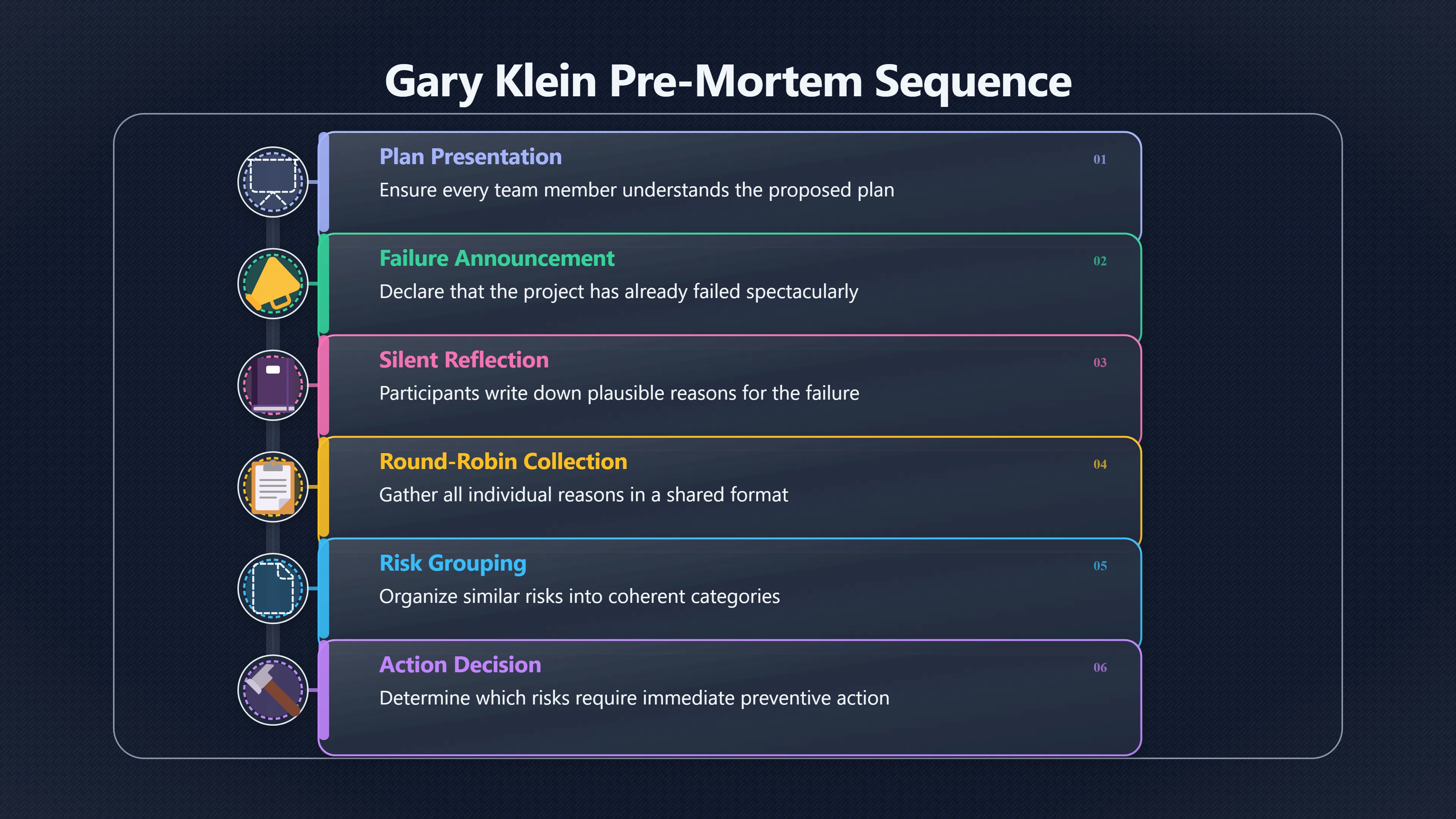
- Present the proposed plan and ensure everyone understands it.
- Announce that the project has already failed.[theuncertaintyproject.org]theuncertaintyproject.orgPre-MortemIt is based on 'prospective hindsight' – imagining that the project has already failed and then generating plausible reasons fo…
- Ask each participant to spend several minutes silently writing every plausible reason for the failure.
- Collect reasons in a round-robin format so every participant contributes.
- Group similar risks together.
- Decide which risks deserve preventive action, additional evidence or revised assumptions before proceeding. Harvard Business Review+2strategyunitwm.nhs.uk
The initial period of independent writing is important. If discussion starts immediately, early speakers often shape everyone else’s thinking. Individual reflection allows quieter participants and technical specialists to identify risks that dominant voices might overlook.
The resulting list should describe mechanisms rather than vague anxieties. Compare these examples:
- Weak: “Customers might not like it.”
- Better: “Early customers misunderstand the pricing, producing negative reviews that damage trust before customer support has prepared standard responses.”
The second explanation points directly to something that can be investigated or tested.
Collect risks people avoid saying aloud
One of the greatest strengths of a pre-mortem is not simply generating more risks but uncovering the kinds of concerns people often suppress.
These commonly include:
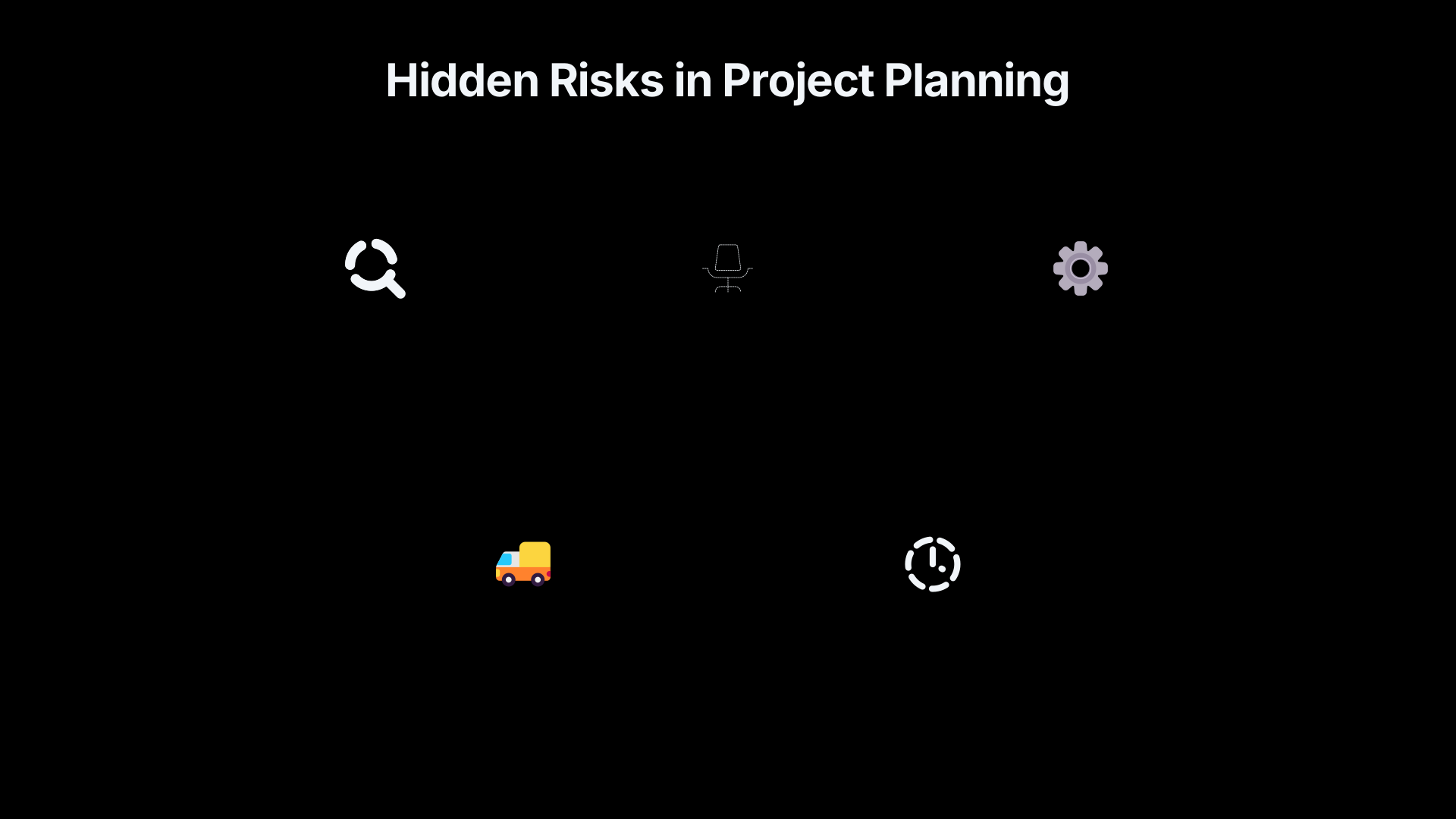
- Assumptions that everyone privately doubts but believes others accept.
- Political concerns about challenging senior leaders.
- Operational weaknesses that appear embarrassing.
- Dependencies on suppliers, regulators or partners that receive too little attention.
- Overly optimistic schedules created by external pressure rather than realistic estimates.
Research and practitioner experience repeatedly suggest that teams frequently possess scattered fragments of warning information before failures occur. The difficulty is often not ignorance but reluctance to assemble those fragments into an explicit challenge to the preferred plan. A pre-mortem temporarily changes the incentive structure by making criticism part of the assigned task rather than an act of opposition. Harvard Business Review+2CIPD
This depends on psychological safety—the shared expectation that people can raise concerns without punishment or ridicule. Without that environment, participants may still censor themselves even when asked to imagine failure. The exercise therefore works best when leaders visibly welcome uncomfortable observations instead of immediately defending the existing plan. CIPD
Convert failure paths into tests
The value of a pre-mortem lies in what happens afterwards. Producing a long list of possible disasters is useful only if those scenarios become practical changes.
For each identified failure path, ask:
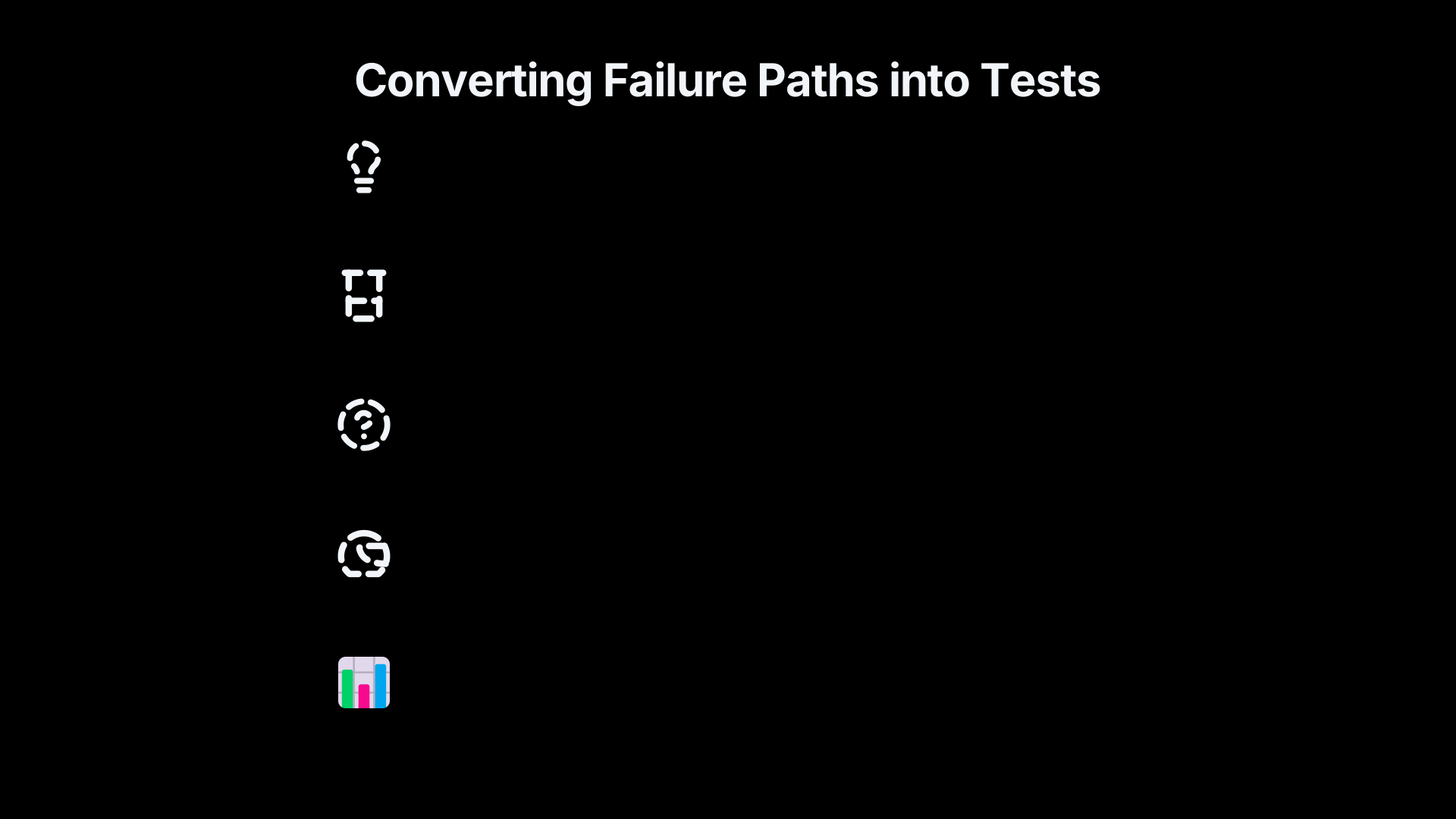
- Which assumption would have to be true for this failure to occur?
- Can we test that assumption before launch?
- Can we reduce the likelihood of this failure?
- Can we reduce its consequences if it happens anyway?
- What evidence would convince us to delay or redesign the plan?
For example:
Failure storyUseful follow-up testCustomer demand was overestimated.Run a limited pilot with real purchasing behaviour rather than relying only on surveys.Support staff became overwhelmed after launch.Stress-test staffing assumptions using projected peak demand.Critical supplier missed delivery dates.Develop alternative suppliers or contingency inventory before launch.New users abandoned the product after registration.Conduct usability testing focused on onboarding before public release.
The objective is to convert imagined failures into measurable questions. Instead of arguing abstractly about optimism or pessimism, the discussion becomes evidence-driven.
Common mistakes that weaken pre-mortems
Although simple, the technique is often applied poorly.
A frequent mistake is treating the exercise as a routine brainstorming session. If participants merely list generic risks such as “budget problems” or “poor communication”, they gain little beyond an ordinary project review.
Another mistake is allowing managers to rebut each concern immediately. Once people see objections being defended against rather than investigated, they quickly stop offering their strongest reservations.
Teams also weaken the exercise by attempting to eliminate every conceivable risk. A pre-mortem is not intended to produce exhaustive catalogues of unlikely scenarios. Its purpose is to identify the few realistic failure mechanisms that deserve immediate attention before commitment.
Finally, organisations sometimes conduct a pre-mortem because governance procedures require it, then proceed without modifying the plan. The exercise only improves decisions if identified risks alter priorities, testing, sequencing or launch criteria.
Where pre-mortems are most valuable
Pre-mortems are particularly useful when:
- Decisions are expensive to reverse.
- Teams are highly confident or enthusiastic.
- Senior leaders have publicly endorsed the proposal.
- Projects involve substantial uncertainty rather than routine execution.
- Launches depend upon several assumptions succeeding simultaneously.
They are less valuable for highly routine activities where risks are already well understood and standard operating procedures capture previous experience. In those situations, conventional checklists may provide greater benefit than speculative failure analysis.
How pre-mortems complement other decision tools
A pre-mortem should not replace forecasting, risk registers or post-project reviews. Each answers a different question.
- Forecasting estimates what is likely to happen.
- Risk registers catalogue known threats and assign owners.
- Pre-mortems generate hidden failure mechanisms before commitment.
- Post-mortems explain failures after events have occurred.
Used together, these methods create a learning cycle. Forecasts establish expectations, pre-mortems challenge assumptions before action, implementation tests the revised plan, and post-mortems improve future judgement by comparing expectations with reality.
Within the broader discipline of improving analytical thinking, the distinctive contribution of the pre-mortem is that it creates an organised moment when strong objections are expected rather than resisted. By imagining that failure has already happened, teams often discover weaknesses while they are still inexpensive—and politically possible—to fix.
Amazon book picks
Further Reading
Books and field guides related to Why Did the Plan Fail Already?. Use these as the next step if you want deeper reading beyond the article.
Seeing What Others Don't
Explains insight, decision-making, and the thinking behind pre-mortems.
Thinking, Fast and Slow
Provides the psychological foundation for why pre-mortems work.
Sources of Power
Provides the practical decision framework from which pre-mortem thinking emerged.
eBay marketplace picks
Marketplace Samples
Example marketplace items related to this page. Use the search link to explore similar finds on eBay.

Endnotes
1.
Source: Wikipedia
Link:https://en.wikipedia.org/wiki/Pre-mortem
2.
Source: strategyunitwm.nhs.uk
Link:https://www.strategyunitwm.nhs.uk/sites/default/files/2018-12/SU%20guide%20to…the%20premortem.pdf
Source snippet
The Pre-MortemStep 2: 1) Imagine that the project has failed spectacularly! 2) Individually, write down every possible reason for the fai...
3.
Source: gary-klein.com
Title: garykleinpre-mortem method of risk assessment
Link:https://www.gary-klein.com/premortem
Source snippet
As a team, everyone contributes to an exercise where potential threats...Read more...
4.
Source: cipd.org
Link:https://www.cipd.org/globalassets/media/knowledge/knowledge-hub/evidence-reviews/2024-pdfs/8542-psych-safety-trust-practice-summary.pdf
Source snippet
Trust and psychological safety: An evidence reviewIt refers to how people perceive potential threats or rewards when they take interp...
5.
Source: Wikipedia
Title: Gary (The Bear episode)
Link:https://en.wikipedia.org/wiki/Gary_%28The_Bear_episode%29
Source snippet
Gary (The Bear episode)"Gary" is a special episode of the American comedy-drama series The Bear, written by and starring cast members...
7.
Source: linkedin.com
Title: Prospective Hindsight
Link:https://www.linkedin.com/pulse/prospective-hindsight-critical-leadership-life-practice-todd-zipper
Source snippet
A Critical Leadership and Life...... manager imagines that a project has failed, then works backward to determine what could potentially...
8.
Source: my.chartered.college
Link:https://my.chartered.college/research-hub/introduction-to-research-premortems-and-avoiding-the-avoidable/
Source snippet
Harvard Business Review 85(9): 18-19. Klein G (2007b) The Power of Intuition: How to use your [gut feelings]({{ 'gut-feelings/' | relative_url }}) to...Read more...
9.
Source: hbr.org
Link:https://hbr.org/archive-toc/BR0709
Source snippet
From the Magazine (September 2007)September 2007. Performing a Project Premortem. Magazine Article. Gary Klein. Reprint: F0709A. In a pre...
Published: September 2007
Additional References
10.
Source: researchgate.net
Link:https://www.researchgate.net/publication/3229642_Performing_a_Project_Premortem
Source snippet
(PDF) Performing a Project PremortemPre-mortem analysis-whereby management teams systematically project failure scenarios before approvin...
11.
Source: researchgate.net
Link:https://www.researchgate.net/publication/355070855_Project_Pre-mortem_using_Prospective_Hindsight_An_Unexplored_Tool_to_address_Healthcare_Projects_Implementation_barriers
Source snippet
(PDF) Project Pre-mortem using Prospective HindsightJun 20, 2021 — The Targeted Premortem (TPM) is a variant of Klein's Premortem Techniq...
12.
Source: linkedin.com
Link:https://www.linkedin.com/posts/byrdkw_gary-kleins-pre-mortem-a-simple-yet-effective-activity-7051246764724518912-nnnt
Source snippet
Kyle Byrd's PostGary Klein's Pre-Mortem: A simple, yet effective technique to help prepare for future [outcomes]({{ 'outcomes/' | relative_url }}). "Prospective hindsight—im...
13.
Source: theuncertaintyproject.org
Link:https://www.theuncertaintyproject.org/tools/pre-mortem
Source snippet
Pre-MortemIt is based on 'prospective hindsight' – imagining that the project has already failed and then generating plausible reasons fo...
14.
Source: mcpmarket.com
Link:https://mcpmarket.com/tools/skills/pre-mortem-risk-analysis-4
Source snippet
Pre-Mortem Risk Analysis Skill for Claude CodeThis skill empowers teams to perform rigorous pre-mortem risk analysis by simulating a futu...
15.
Source: psychsafety.com
Link:https://psychsafety.com/about-psychological-safety/
Source snippet
What is Psychological Safety?When people feel safe to speak up, ask for help, admit mistakes, and challenge ideas, organisations learn fa...
16.
Source: medium.com
Link:https://medium.com/%40rafaelvsouza/you-should-use-pre-mortem-c0f3eea0cdff
Source snippet
You should use pre-mortemA pre-mortem strategy, also known as “prospective hindsight”, is a proactive risk management technique that help...
17.
Source: youtube.com
Link:https://www.youtube.com/watch?v=G-m6dKMS3kc
Source snippet
For on mitigating cognitive bias, watch how Nobel Laureate Daniel Kahneman explains the pre-mortem technique as an essential...
18.
Source: medium.com
Title: premortem a powerful tool to minimize failure a39a1ff8dbe6
Link:https://medium.com/%40vansarksyan/premortem-a-powerful-tool-to-minimize-failure-a39a1ff8dbe6
Source snippet
Premortem, A Powerful Tool To Minimize FailureHarvard Business Review, Performing a Project Premortem by Gary Klein, September 2007; Thin...
Published: September 2007
19.
Source: aevitium.com
Title: operationalising psychological safety risk lifecycle
Link:https://www.aevitium.com/post/operationalising-psychological-safety-risk-lifecycle
Source snippet
Embedding Psychological Safety into the Risk Lifecycle26 Apr 2025 — Psychological safety, the ability to speak up without fear of blame o...
Topic Tree