Within Metacognition
Are You Progressing, or Just Continuing?
Mid-task monitoring helps you notice when you are spending time without making real progress.
On this page
- Signs that the current approach has stopped working
- Questions that detect confusion, fluency, and drift
- How to switch strategies without random flailing
Page outline Jump by section
Introduction
A common reason people fail on complex tasks is not that they lack ability, but that they continue using a strategy that has quietly stopped fitting the problem. During-task checks for strategy drift are short, deliberate moments of metacognitive monitoring that ask whether the current approach is still producing meaningful progress. Rather than waiting until the end of a task to discover that hours were spent unproductively, these checks create a feedback loop: monitor what is happening, compare it with the goal, and adjust if necessary. Research on metacognition consistently shows that effective learners and problem-solvers monitor their progress and use those observations to regulate their behaviour rather than simply working harder with the same method.[Sanlab+2NSW Education]sanlab.psych.ucla.eduSanlab Self‐regulated Learning: Beliefs, Techniques, and IllusionsSelf‐regulated Learning: Beliefs, Techniques, and IllusionsJanuary 3, 2013 — by N Kornell · Cited by 1 — As Nelson and Narens (1990…
 Unlike broad reflection before or after a task, drift checks happen while the work is unfolding. Their purpose is not to interrupt concentration constantly, but to prevent persistence from turning into stubbornness.
What strategy drift looks like
Strategy drift occurs when your actions no longer match the demands of the task, yet you continue because the current routine feels familiar. The danger is that familiarity often creates a false sense of progress.
Drift commonly develops in subtle ways:
- continuing to gather information when enough evidence already exists to decide;
- repeatedly rereading difficult material instead of testing whether it can be recalled or explained;
- refining small details before the main argument or solution is established;
- applying a technique that worked earlier even though the problem has changed;
- spending increasing time without reducing uncertainty or producing useful output.
The defining feature is not effort but diminishing returns. Time continues to pass, yet each additional minute contributes less towards the objective.
Metacognitive research describes this as a breakdown between monitoring and control. Monitoring should detect that progress has slowed or stopped. Control should then alter the strategy. When monitoring is weak, people often mistake continued activity for genuine advancement.[Cambridge University Press & Assessment+2Sanlab]cambridge.orgUniversity Press & Assessment Metacognition (Chapter 4more…
Signs that the current approach has stopped working
One useful principle is to judge a strategy by its outputs rather than by how busy it makes you feel.
Warning signs include:
- The same obstacle keeps reappearing. You repeatedly solve the wrong sub-problem or return to the same confusion.
- Confidence rises without stronger evidence. Material feels increasingly familiar, yet you cannot explain it independently or solve a fresh example.
- Progress becomes mechanical. You continue because stopping would require deciding what to do next.
- New information changes nothing. Additional reading, calculations or notes fail to influence your understanding or decisions.
- The goal becomes blurred. You remember what you are doing but lose sight of why you are doing it.
These signals matter because people are often poor judges of learning when relying on feelings alone. Fluency—the sense that information is easy to process—can be mistaken for genuine understanding, even when later recall or transfer is weak. Research on self-regulated learning repeatedly identifies this gap between subjective confidence and actual performance as a major reason why learners persist with ineffective strategies.[Sanlab+2PMC]sanlab.psych.ucla.eduSanlab Self‐regulated Learning: Beliefs, Techniques, and IllusionsSelf‐regulated Learning: Beliefs, Techniques, and IllusionsJanuary 3, 2013 — by N Kornell · Cited by 1 — As Nelson and Narens (1990…
Questions that expose confusion, fluency and drift
Good drift checks rely on concrete questions rather than vague impressions. They should produce evidence that the current strategy is either working or failing.
Detecting confusion
Ask questions that reveal whether you know where the difficulty lies.
Examples include:
- What exactly is preventing progress?
- Can I identify the specific missing piece?
- Am I solving the intended problem or an easier substitute?
Being able to name the obstacle is itself useful information. A vague feeling of being stuck often becomes manageable once the obstacle is defined.
Detecting false fluency
Instead of asking, “Does this make sense?”, ask questions that require demonstration.
Examples include:
- Could I explain this without looking?
- Could I predict the next step before seeing it?
- Could I solve a similar problem from scratch?
These questions replace familiarity with retrieval or application, both of which provide more reliable evidence of understanding.[Sanlab+2jasonfinley.com]sanlab.psych.ucla.eduSanlab Self‐regulated Learning: Beliefs, Techniques, and IllusionsSelf‐regulated Learning: Beliefs, Techniques, and IllusionsJanuary 3, 2013 — by N Kornell · Cited by 1 — As Nelson and Narens (1990…
Detecting strategy drift
Finally, ask whether the current method is still justified.
Useful prompts include:
- If I were starting this task now, would I choose this approach?
- What evidence says this strategy is still productive?
- What has changed since I began?
- If another person watched my last twenty minutes, would they describe genuine progress or repetition?
- What result should I have produced by now if this method were working?
Notice that these questions focus on observable outcomes rather than motivation. They ask whether the strategy deserves to continue.
How to switch strategies without random flailing
Recognising drift does not mean abandoning a task at the first sign of difficulty. Effective metacognition balances persistence with adaptation.
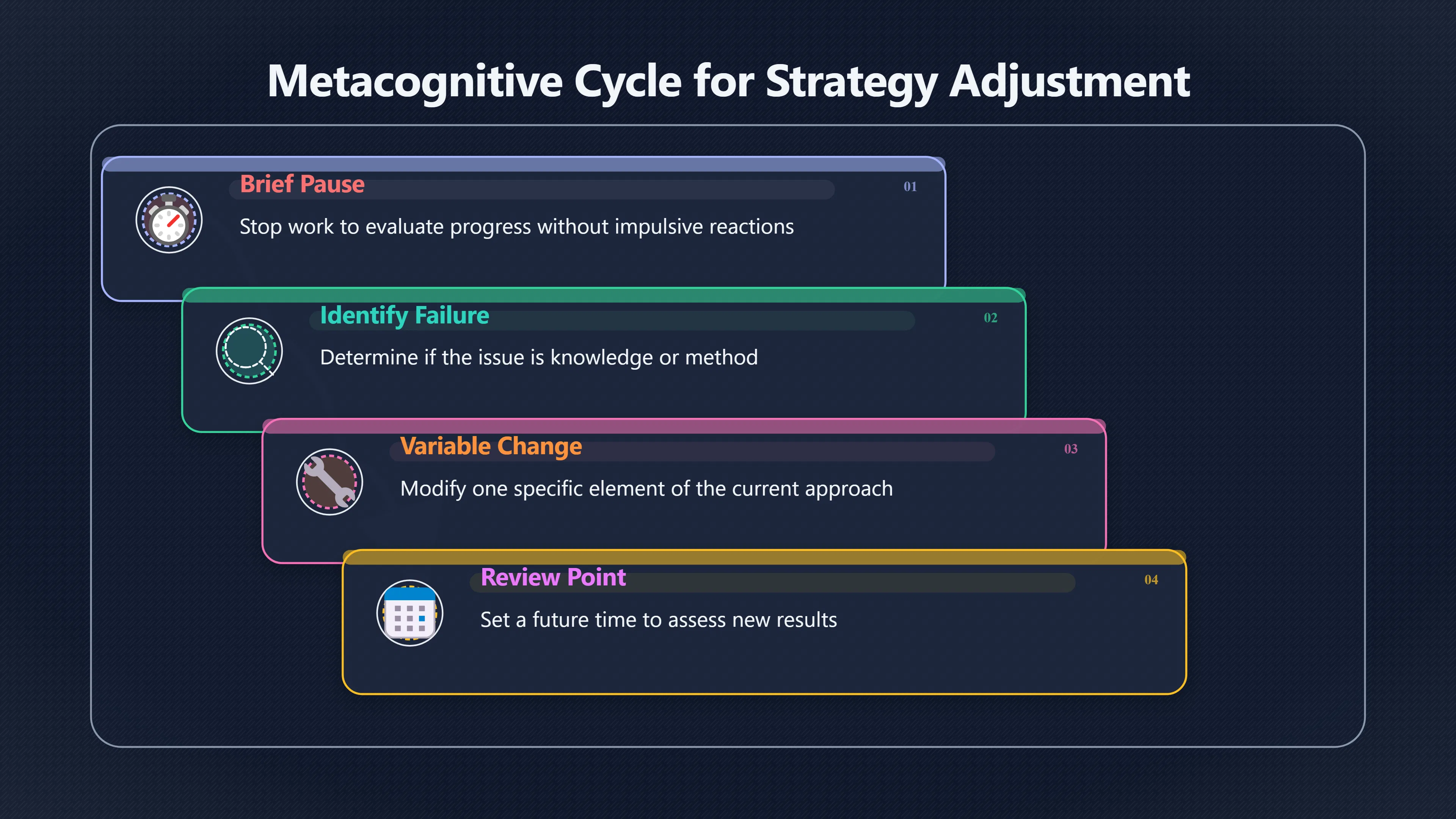
A practical sequence is:
- Pause briefly. Stop long enough to evaluate rather than reacting impulsively.
- Identify the failure mode. Is the problem missing knowledge, an unsuitable method, excessive detail, or a misunderstanding of the goal?
- Change one important variable. For example:
move from passive reading to self-testing; sketch a diagram instead of reasoning verbally; generate an example before reading another explanation; seek disconfirming evidence instead of supporting evidence; break the task into smaller checkpoints.
- Set a short review point. Decide in advance when to assess whether the new approach is producing measurable improvement.
Changing only one major feature makes it easier to determine whether the adjustment helped. Switching everything simultaneously makes success or failure difficult to interpret.
This reflects the metacognitive cycle described in educational research: plan, monitor, evaluate, then regulate behaviour based on the information obtained rather than habit alone.[EEF+2EEF]educationendowmentfoundation.org.ukEEFMetacognition and Self-Regulated LearningTeachers should support pupils to plan, monitor, and evaluate their learning through explicit…

A simple example of drift detection
Imagine analysing a research paper.
For forty minutes you have highlighted sentences and written detailed notes. You feel productive because the pages are becoming colourful.
A drift check asks different questions:
- Can I state the paper’s central claim from memory?
- What evidence supports that claim?
- Could I explain why the authors preferred this method?
- Have my notes improved my understanding, or merely recorded the text?
If you cannot answer those questions, highlighting has become disconnected from the goal. A better strategy might be to stop annotating temporarily and write a short summary from memory, then compare it with the paper to locate genuine gaps.
The task has not changed, but the strategy has.
Building drift checks into demanding work
Strategy checks are most effective when they occur at natural transition points rather than every few minutes.
Examples include:
- after completing a section of reading;
- after solving one problem before attempting the next;
- every fixed period during extended analytical work;
- whenever progress feels unusually effortless or unusually frustrating;
- immediately before committing to a major decision.
These checkpoints reduce the risk that hours of work become locked into an increasingly ineffective approach.
Research on metacognition emphasises that monitoring alone is insufficient. The value comes from linking monitoring to control—using the information gathered during the task to change actions while there is still time for those changes to improve the outcome.[Cambridge University Press & Assessment+2NSW Education]cambridge.orgUniversity Press & Assessment Metacognition (Chapter 4more…
Amazon book picks
Further Reading
Books and field guides related to Are You Progressing, or Just Continuing?. Use these as the next step if you want deeper reading beyond the article.
Make It Stick
Covers self-testing, monitoring learning, and replacing ineffective study strategies.
Thinking, Fast and Slow
Explains cognitive biases, monitoring errors, and when to reconsider an approach.
How We Learn
Explores evidence-based learning strategies and recognizing when current methods are no longer effective.
The Art of Learning
Focuses on adapting strategies, self-awareness, and improving performance during challenging tasks.
eBay marketplace picks
Marketplace Samples
Example marketplace items related to this page. Use the search link to explore similar finds on eBay.




Endnotes
1.
Source: educationendowmentfoundation.org.uk
Link:https://educationendowmentfoundation.org.uk/education-evidence/guidance-reports/metacognition
Source snippet
EEFMetacognition and Self-Regulated LearningTeachers should support pupils to plan, monitor, and evaluate their learning through explicit...
2.
Source: cambridge.org
Title: University Press & Assessment Metacognition (Chapter 4)
Link:https://www.cambridge.org/core/books/cambridge-handbook-of-the-learning-sciences/metacognition/B670B062FF21016A7CFEB4EACB81D72C
Source snippet
more...
3.
Source: pmc.ncbi.nlm.nih.gov
Link:https://pmc.ncbi.nlm.nih.gov/articles/PMC12387543/
Source snippet
the Prompt: Investigating Retrieval-Based Monitoring...by M Wu · 2025 — Metacognitive monitoring plays a crucial role in self-regulated...
4.
Source: jasonfinley.com
Link:https://www.jasonfinley.com/pubs/FinleyTullisBenjamin_6-30-09_msAPA.pdf
Source snippet
toring is to delay judgments until some time after study, rather than making them immediately following.Read more...
5.
Source: educationendowmentfoundation.org.uk
Link:https://educationendowmentfoundation.org.uk/education-evidence/teaching-learning-toolkit/metacognition-and-[self-regulation
Source snippet
Metacognition and self-regulationThe research evidence indicates that explicitly teaching strategies to help pupils to plan, monitor and...
6.
Source: sanlab.psych.ucla.edu
Title: Sanlab Self‐regulated Learning: Beliefs, Techniques, and Illusions
Link:https://sanlab.psych.ucla.edu/wp-content/uploads/sites/13/2016/07/RBjork_Dunlosky_Kornell_2012.pdf
Source snippet
Self‐regulated Learning: Beliefs, Techniques, and IllusionsJanuary 3, 2013 — by N Kornell · Cited by 1 — As Nelson and Narens (1990...
Published: January 3, 2013
7.
Source: education.nsw.gov.au
Link:https://education.nsw.gov.au/content/dam/main-education/teaching-and-learning/education-for-a-changing-world/media/documents/Metacognition_Full_Report_FINAL.pdf
Source snippet
NSW EducationMetacognition: a key to unlocking learningMetacognitive monitoring assesses how well a certain strategy is going, and evalua...
8.
Source: educationendowmentfoundation.org.uk
Title: updated eef guide to metacognition and self regulation
Link:https://educationendowmentfoundation.org.uk/news/updated-eef-guide-to-metacognition-and-self-regulation
Source snippet
The updated EEF guide to metacognition and self-regulation.14 Nov 2025 — Helping pupils plan, monitor, and evaluate learning through meta...
9.
Source: educationendowmentfoundation.org.uk
Link:https://educationendowmentfoundation.org.uk/news/how-do-we-teach-metacognition
Source snippet
We know that metacognition is important, but how do...25 Nov 2025 — Metacognition is the ability to be aware of, reflect upon, and direc...
10.
Source: educationendowmentfoundation.org.uk
Title: promoting metacognitive talk in the classroom
Link:https://educationendowmentfoundation.org.uk/news/promoting-metacognitive-talk-in-the-classroom
Source snippet
EEF4 Mar 2026 — Helping pupils plan, monitor, and evaluate learning through metacognitive strategies. Corinne Settle. 2 minutes.Read more...
11.
Source: educationendowmentfoundation.org.uk
Title: metacognition and self regulation guidance report
Link:https://educationendowmentfoundation.org.uk/education-evidence/evidence-reviews/metacognition-and-self-regulation-guidance-report
Source snippet
Metacognition and self-regulation evidence review9 Sept 2024 — Review of the evidence commissioned by the EEF to inform the Metacognition...
12.
Source: educationendowmentfoundation.org.uk
Title: updated resource supporting independence through questioning a planning tool
Link:https://educationendowmentfoundation.org.uk/news/updated-resource-supporting-independence-through-questioning-a-planning-tool
Source snippet
Updated resource: Supporting independence through...14 Mar 2023 — This editable planning tool could be useful for teachers when consider...
13.
Source: educationendowmentfoundation.org.uk
Link:https://educationendowmentfoundation.org.uk/education-evidence/teaching-learning-toolkit/metacognition-and-self-regulation/technical-appendix
Source snippet
Metacognition and self-regulation: Technical AppendixMetacognition and self-regulation approaches to teaching support pupils to think abo...
14.
Source: educationendowmentfoundation.org.uk
Title: eef blog mobilising metacognition a starter kit to support teacher understanding
Link:https://educationendowmentfoundation.org.uk/news/eef-blog-mobilising-metacognition-a-starter-kit-to-support-teacher-understanding
Source snippet
Mobilising Metacognition – A starter kit to support… | EEF18 Apr 2023 — This starter kit proves helpful for schools seeking to develop pu...
15.
Source: evidenceforlearning.org.au
Link:https://evidenceforlearning.org.au/education-evidence/guidance-reports/metacognition
Source snippet
regulated learning...
16.
Source: alexquigley.co.uk
Link:https://alexquigley.co.uk/metacognition-new-and-updated/
Source snippet
New and Updated22 Nov 2025 — I think guidance on metacognition and self-regulation can also help to build a clearer notion of how childre...
Additional References
17.
Source: linkedin.com
Link:https://www.linkedin.com/posts/glosresearchsch_coming-soon-from-the-education-endowment-activity-7392184361896353793-x-zr
Source snippet
EEF to release updated metacognition guidance on Nov 13...This refreshed report draws on 355 studies and offers clear, practical guidanc...
18.
Source: researchgate.net
Link:https://www.researchgate.net/publication/344496444_The_relation_between_metacognitive_monitoring_and_control
Source snippet
The relation between metacognitive monitoring and controlThere is a growing theoretical and practical interest in the topic of metacognit...
19.
Source: dera.ioe.ac.uk
Link:https://dera.ioe.ac.uk/id/eprint/31617/1/EEF_Metacognition_and_self-regulated_learning.pdf
Source snippet
Report METACOGNITION AND SELF-REGULATED...By metacognitive strategies, we mean the strategies we use to monitor or control our cognition...
20.
Source: libguides.derby.ac.uk
Title: derby.ac.uk Metacognition: Plan, Monitor and Evaluate
Link:https://libguides.derby.ac.uk/develop-at-derby/self-direction-and-planning/metacognition-plan-monitor-and-evaluate
Source snippet
derby.ac.ukMetacognition: Plan, Monitor and Evaluate - Self-Direction...by G Baker · 2025 — By being aware of how you learn, you can pla...
21.
Source: twinkl.co.uk
Title: Metacognition and Self-Regulation EEF Guidance
Link:https://www.twinkl.co.uk/resource/quick-look-metacognition-and-self-regulation-eef-guidance-summary-t-slt-1320
Source snippet
SummaryThis is a brief and insightful summary of the recommendations made by the Education Endowment Foundation, on improving pupils' met...
22.
Source: d2tic4wvo1iusb.cloudfront.net
Title: Metacognition and Self-Regulated Learning
Link:https://d2tic4wvo1iusb.cloudfront.net/production/eef-guidance-reports/metacognition/metacognition-and-self-regulated-learning_guidance-report.v.2.4.0.pdf
Source snippet
Guidance reportTeachers should support pupils to plan, monitor, and evaluate their learning through explicitly teaching, modelling, and s...
23.
Source: d2tic4wvo1iusb.cloudfront.net
Title: Metacognition and Self-regulated Learning
Link:https://d2tic4wvo1iusb.cloudfront.net/production/eef-guidance-reports/metacognition/Metacognition-and-Self-regulated-Learning_guidance-report_v.1.2.0.pdf
Source snippet
Cloudfront.net12 Nov 2025 — By metacognitive strategies, we mean the strategies we use to monitor or control our cognition, such as check...
24.
Source: researchschool.org.uk
Title: metacognition still as impactful as ever
Link:https://researchschool.org.uk/aspirer/news/metacognition-still-as-impactful-as-ever
Source snippet
Metacognition: Still as Impactful as Ever | Aspirer...26 Jan 2026 — How the updated EEF report provides practical insights and simple tw...
25.
Source: structural-learning.com
Link:https://www.structural-learning.com/post/metacognitive-monitoring-fixing-student
Source snippet
Structural LearningMetacognitive Monitoring: Fixing Learner Overconfidence4 Mar 2026 — Researchers found that prediction tasks improved l...
26.
Source: youtube.com
Link:https://www.youtube.com/watch?v=xaNCDcUV8Io
Source snippet
Signs You Have Metacognitive IQ (The Rarest Type of Intelligence)...
Topic Tree