Within Confirmation Bias
When Symptoms Seem to Confirm Your Fear
Fear or hope can make one explanation feel obvious, so serious health decisions need clear counterevidence questions and second-opinion triggers.
On this page
- How early diagnoses shape later evidence
- Questions that reopen the differential
- When uncertainty justifies another opinion
Page outline Jump by section
Introduction
When a new symptom appears, the mind naturally searches for a story that explains it. That first explanation may be frightening (“this must be cancer”), reassuring (“it’s only stress”), or simply familiar (“I always get migraines”). The danger is not having an initial idea—it is becoming too confident in it before the evidence justifies that confidence. This is confirmation bias applied to health: once a diagnosis feels right, people often notice information that supports it while discounting signs that point elsewhere. The result can be unnecessary anxiety, delayed treatment, or persistence with an incorrect explanation even as new evidence emerges. Research on diagnostic reasoning shows that both patients and clinicians are vulnerable to cognitive shortcuts, particularly when working under uncertainty or time pressure. PMC+2Royal College of Physicians of Edinburgh[pmc.ncbi.nlm.nih.gov]pmc.ncbi.nlm.nih.govCognitive biases in diagnosis and decision making during…by CS Webster · 2021 · Cited by 86 — Cognitive bias is typically defined a…
 Within the broader topic of confirmation bias in personal decisions, health is especially important because symptoms are emotionally charged. Fear can make serious diseases seem more likely than they are, while hope can make reassuring explanations seem more convincing than the evidence supports.
How an early diagnosis shapes later evidence
An initial diagnosis often becomes an anchor for everything that follows. Once a person thinks, “I know what this is,” new symptoms are interpreted through that lens. A headache becomes proof of a brain tumour after reading alarming stories online, or persistent fatigue is repeatedly attributed to work stress despite new warning signs.
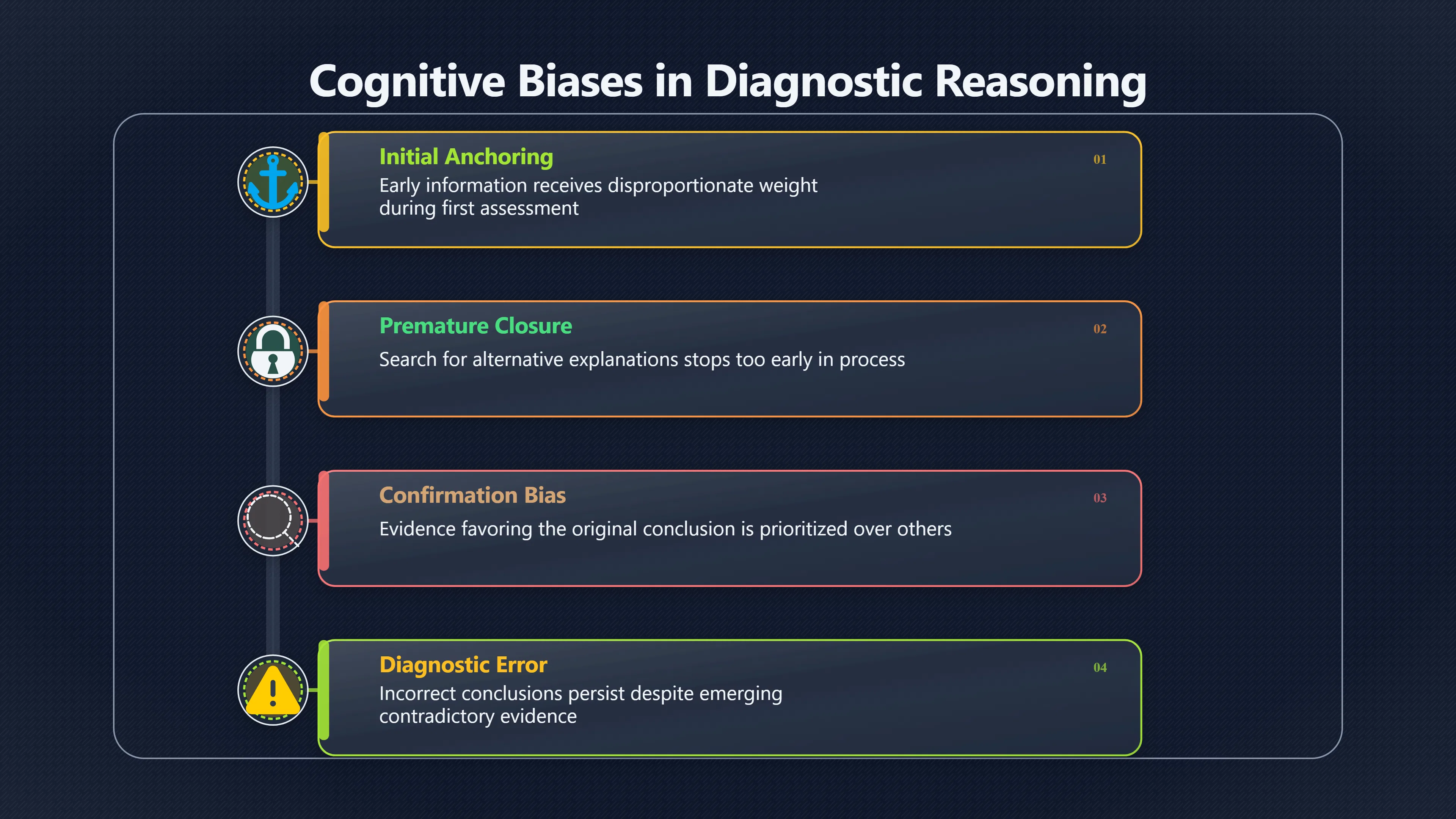
Psychologists describe this as a combination of confirmation bias, anchoring and premature closure. Anchoring occurs when early information receives disproportionate weight. Premature closure happens when the search for alternative explanations stops too soon. Confirmation bias then reinforces the process by favouring evidence that supports the original conclusion while overlooking conflicting information. These biases are well documented in medical decision-making and are recognised contributors to diagnostic error. PMC+2Royal College of Physicians of Edinburgh[pmc.ncbi.nlm.nih.gov]pmc.ncbi.nlm.nih.govCognitive biases in diagnosis and decision making during…by CS Webster · 2021 · Cited by 86 — Cognitive bias is typically defined a…
This pattern affects patients as well as clinicians. A patient who strongly believes they have one condition may selectively report symptoms that fit their theory or search online using highly specific terms that reinforce it. Equally, a clinician who forms an early impression may unconsciously ask questions that confirm rather than challenge that impression, especially when consultations are brief or information arrives in a particular order.[American Medical Association+2catalogofbias.org]ama-assn.orgLearn with the AMA about strategies to neutralize themAmerican Medical Association4 widespread cognitive biases and how doctors can…4 Feb 2021 — Cognitive biases can cause diagnostic and t…
Why fear and reassurance both distort judgement
Confirmation bias does not only make people imagine the worst. It can also make them dismiss genuine problems.
Fear-driven bias may involve:
- interpreting common symptoms as evidence of rare illnesses;
- giving excessive weight to dramatic personal stories found online;
- treating every new sensation as further confirmation of a feared diagnosis.
Reassurance-driven bias works in the opposite direction:
- assuming symptoms are “just getting older”;
- repeatedly attributing recurring symptoms to stress without reconsideration;
- ignoring changes because they conflict with a preferred explanation.
Neither direction reflects objective reasoning. Instead, emotional preferences influence how evidence is collected and interpreted. Research on motivated reasoning suggests that people tend to apply lower standards of evidence to conclusions they want to believe and higher standards to conclusions they would rather avoid.[PMC]pmc.ncbi.nlm.nih.govCognitive biases in diagnosis and decision making during…by CS Webster · 2021 · Cited by 86 — Cognitive bias is typically defined a…
Questions that reopen the differential
A useful safeguard against confirmation bias is deliberately reopening the differential diagnosis—the list of plausible alternative explanations rather than assuming the first answer is correct.
Instead of asking, “What confirms my diagnosis?”, ask questions such as:
- What findings would make this explanation less likely?
- What common conditions could produce the same symptoms?
- Have any new symptoms appeared that no longer fit my original explanation?
- If someone else presented exactly these symptoms, would I reach the same conclusion?
- Am I relying mainly on internet anecdotes rather than clinical evidence?
These questions do not require medical expertise. Their purpose is to interrupt the natural tendency to defend an initial conclusion and instead encourage genuine comparison between competing explanations.
Medical education increasingly teaches similar reflective strategies. Studies suggest that structured reflection—actively considering alternative diagnoses and examining evidence against one’s first impression—can improve diagnostic reasoning, particularly in difficult cases. American Medical Association+2Royal College of Physicians of Edinburgh[ama-assn.org]ama-assn.orgLearn with the AMA about strategies to neutralize themAmerican Medical Association4 widespread cognitive biases and how doctors can…4 Feb 2021 — Cognitive biases can cause diagnostic and t…
How online information can strengthen false certainty
Searching the internet for symptoms is not inherently harmful, but confirmation bias changes how people search.
Someone worried about a neurological disease may repeatedly search combinations of symptoms that assume the feared illness is present. Search engines and social media can then present increasingly similar material, creating the impression that many independent sources support the same conclusion.
Another problem is selective reading. People often:
- stop searching once they find a diagnosis that matches their fears or hopes;
- ignore information about how common alternative conditions are;
- pay greater attention to memorable personal stories than to population-level evidence.
Recent research on online self-diagnosis also highlights how exposure to emotionally resonant health content can increase availability bias, making dramatic illnesses feel more probable simply because they are easier to remember. Confirmation bias then reinforces those impressions.[arXiv]arxiv.orgMining Evidence about Your Symptoms: Mitigating Availability Bias in Online Self-DiagnosisJanuary 25, 2025…
When uncertainty justifies another opinion
Seeking another medical opinion should not be viewed as rejecting professional expertise. It is often an appropriate response when genuine uncertainty remains.
Situations where another opinion deserves consideration include:
- symptoms persist despite treatment based on the original diagnosis;
- important symptoms remain unexplained;
- different test results appear inconsistent;
- treatment carries significant risks or irreversible consequences;
- the diagnosis depends largely on subjective interpretation rather than objective findings;
- multiple reasonable diagnoses remain possible.
Second opinions can reduce the influence of what researchers call previous opinion bias, where later clinicians are unintentionally influenced by earlier diagnostic labels. One practical recommendation is that the consulting clinician first evaluates the patient with as little leading information as practical before reviewing previous conclusions, allowing a more independent assessment.[catalogofbias.org]catalogofbias.orgPrevious opinion biasPrevious opinion bias describes how the diagnostic process may be influenced by an investigator who is aware of prev…
Balancing confidence with uncertainty
Good health decisions rarely require perfect certainty, but they do require appropriate confidence. Premature diagnostic confidence is problematic because it can end the search for relevant evidence before the evidence is complete.
A more reliable mindset is to treat an early diagnosis as a working hypothesis rather than a settled fact. That means being willing to update beliefs when symptoms change, tests disagree with expectations, or new information emerges. Holding a diagnosis with appropriate uncertainty is not indecision—it is a practical defence against confirmation bias.
In personal health decisions, analytical thinking does not mean distrusting every diagnosis or endlessly seeking alternatives. It means resisting the temptation to confuse the first explanation that feels convincing with the explanation that has been most thoroughly tested.
Amazon book picks
Further Reading
Books and field guides related to When Symptoms Seem to Confirm Your Fear. Use these as the next step if you want deeper reading beyond the article.
How Doctors Think
Focuses on diagnostic errors, cognitive shortcuts, second opinions, and uncertainty in medicine.
Thinking, Fast and Slow
Explains confirmation bias, anchoring, and overconfidence that influence how people interpret symptoms.
The Art of Thinking Clearly
Covers confirmation bias and related mental traps that affect health judgments.
Being Mortal
Encourages thoughtful medical decision-making, realistic assessment of evidence, and productive clinician-patient conversations.
eBay marketplace picks
Marketplace Samples
Example marketplace items related to this page. Use the search link to explore similar finds on eBay.
Endnotes
1.
Source: pmc.ncbi.nlm.nih.gov
Link:https://pmc.ncbi.nlm.nih.gov/articles/PMC8520040/
Source snippet
Cognitive biases in diagnosis and decision making during...by CS Webster · 2021 · Cited by 86 — Cognitive bias is typically defined a...
2.
Source: catalogofbias.org
Link:https://catalogofbias.org/biases/previous-opinion-bias/
Source snippet
Previous opinion biasPrevious opinion bias describes how the diagnostic process may be influenced by an investigator who is aware of prev...
3.
Source: arxiv.org
Link:https://arxiv.org/abs/2501.15028
Source snippet
Mining Evidence about Your Symptoms: Mitigating Availability Bias in Online Self-DiagnosisJanuary 25, 2025...
Published: January 25, 2025
4.
Source: rcpe.ac.uk
Title: jrcpe 48 3 osullivan
Link:https://www.rcpe.ac.uk/sites/default/files/jrcpe_48_3_osullivan.pdf
Source snippet
Royal College of Physicians of EdinburghCognitive bias in clinical medicineby ED O’Sullivan · 2018 · Cited by 475 — This paper describes...
5.
Source: ama-assn.org
Title: Learn with the AMA about strategies to neutralize them
Link:https://www.ama-assn.org/about/ethics/4-widespread-cognitive-biases-and-how-doctors-can-overcome-them
Source snippet
American Medical Association4 widespread cognitive biases and how doctors can...4 Feb 2021 — Cognitive biases can cause diagnostic and t...
Additional References
6.
Source: youtube.com
Link:https://www.youtube.com/watch?v=kEHCOLGR_hM
Source snippet
Diagnostic error cognitive bias premature closure medicine confirmation bias Cognitive Biases Doctors Should Watch Out For | Pitfalls in...
7.
Source: alliedacademies.org
Link:https://www.alliedacademies.org/articles/cognitive-bias-in-healthcare-impacts-on-diagnosis-and-patient-care-32607.html
Source snippet
ure of differential diagnosis or refusal to seek second opinions.Once a diagnosis...
8.
Source: online.ucpress.edu
Title: Anchoring Confirmation and Confidence Bias Among
Link:https://online.ucpress.edu/collabra/article/10/1/126223/203998/Anchoring-Confirmation-and-Confidence-Bias-Among
Source snippet
ucpress.eduAnchoring, Confirmation and Confidence Bias Among Medical...12 Dec 2024 — Clinicians who feel confident about their diagnosti...
9.
Source: deltapsychology.com
Title: clinical decision cognitive biases
Link:https://www.deltapsychology.com/articles-for-doctors/clinical-decision-cognitive-biases
Source snippet
Cognitive Biases in Clinical Decision-Making20 Mar 2025 — This article explores common cognitive biases in medical decision-making, how t...
10.
Source: youtube.com
Title: Your Brain is Lying to You: Cognitive Biases in Clinical Judgment
Link:https://www.youtube.com/watch?v=BvCWKy2DtS8
Source snippet
[Teaching]({{ 'teaching/' | relative_url }}) Diagnostic (Cognitive) Error Prevention to Medical Students and Residents: Part One...
11.
Source: youtube.com
Title: Cognitive Biases Doctors Should Watch Out For | Pitfalls in Decision Making
Link:https://www.youtube.com/watch?v=dnudvXTpoJA
Source snippet
Understanding and Preventing Cognitive Errors in Healthcare...
12.
Source: youtube.com
Title: Understanding and Preventing Cognitive Errors in Healthcare
Link:https://www.youtube.com/watch?v=OXcGciywtgM
Source snippet
Your Brain is Lying to You: Cognitive Biases in Clinical Judgment...
13.
Source: cdn-uat.mdedge.com
Link:https://cdn-uat.mdedge.com/files/s3fs-public/Document/May-2018/JFP06706366.PDF
Source snippet
Cognitive bias: Its influence on clinical diagnosisby T Yuen · 2018 · Cited by 30 — This article reviews the current under- standing of t...
14.
Source: youtube.com
Title: Premature Closure in Medicine
Link:https://www.youtube.com/watch?v=EspwZf3lmDM
Source snippet
Cognitive Biases Doctors Should Watch Out For | Pitfalls in Decision Making...
15.
Source: link.springer.com
Link:https://link.springer.com/article/10.1186/s13049-025-01415-1
Source snippet
Three articles reported on a single bias and...
Topic Tree