Within Transfer
Can a Checklist Make Better Thinking Show Up?
A short checklist can help thinking skills appear when pressure, confidence or familiarity would otherwise hide the need for them.
On this page
- Why decision moments need visible cues
- What a useful thinking checklist includes
- Where checklists fail or become mechanical
Page outline Jump by section
Introduction
A thinking checklist is not a substitute for judgement. Its value is that it increases the chance that good judgement appears at the moment it is needed. Under time pressure, familiarity, confidence or routine, people often fail to recognise that a decision deserves deliberate analysis. A short, well-designed checklist acts as a visible cue that interrupts automatic thinking long enough to trigger questions such as “What evidence supports this?”, “What alternatives have I ignored?” or “What would change my mind?”. Research across aviation, healthcare and other high-risk fields suggests that checklists are most effective when they are designed as decision prompts rather than bureaucratic paperwork, helping experts remember critical thinking steps instead of replacing expertise.[PMC+2PubMed]pmc.ncbi.nlm.nih.govPMCThe Checklist Manifesto: How to Get Things RightNIHby L Nasir · 2010 · Cited by 13 — Going through a checklist at the beginning of a multi-faceted process empowers a process for e…
 Within the broader challenge of transferring thinking skills into everyday life, this matters because many failures are recognition failures rather than reasoning failures. People often know how to think critically but do not notice when to apply those skills. A checklist changes the environment so that the decision itself reminds the person to think.
Why decision moments need visible cues
Most mistakes in complex work do not happen because people have never learned the relevant principle. They happen because attention narrows, memory becomes overloaded, or the situation feels so familiar that important questions are skipped.
Psychologists studying transfer of learning have long distinguished between possessing a skill and recognising when it should be used. A decision checklist bridges that gap by embedding a reminder directly into the workflow. Rather than expecting someone to remember a lesson from training weeks or months later, the checklist presents the cue exactly when a choice must be made.[Taylor & Francis Online]tandfonline.comTaylor & Francis OnlineIdentifying obstacles to transfer of critical thinking skillsby LM van Peppen · 2022 · Cited by 39 — To illustrate…
This explains why checklists have become common in domains where expertise alone is insufficient:
- Pilots pause before critical flight stages despite extensive training.
- Surgical teams conduct brief safety checks immediately before procedures.
- Emergency clinicians increasingly use cognitive aids during rare or stressful situations.
- Industrial operators pause before irreversible actions affecting safety or quality.[PMC+2PMC]pmc.ncbi.nlm.nih.govHow to WHO: lessons from aviation in checklists and debriefsby IA Guy · 2022 · Cited by 26 — This exploration of attitudes and logisti…
In each case, the checklist is designed to trigger thinking at a predictable decision point rather than to teach the underlying knowledge from scratch.
A related idea in cognitive psychology is the “cognitive forcing strategy”: a deliberately learned question or routine that interrupts common reasoning errors. Instead of relying on intuition alone, the decision-maker forces themselves to consider overlooked possibilities before committing.[PubMed]pubmed.ncbi.nlm.nih.govCognitive forcing strategies in clinical decisionmakingby P Croskerry · 2003 · Cited by 618 — Three levels of cognitive forcing str…
What a useful thinking checklist includes
A thinking checklist differs from a procedural checklist. A procedural checklist ensures that actions are completed in the correct order. A thinking checklist prompts reflection before choosing among alternatives.
The most useful versions are remarkably short because long lists are unlikely to be used under pressure.
Typical prompts include:
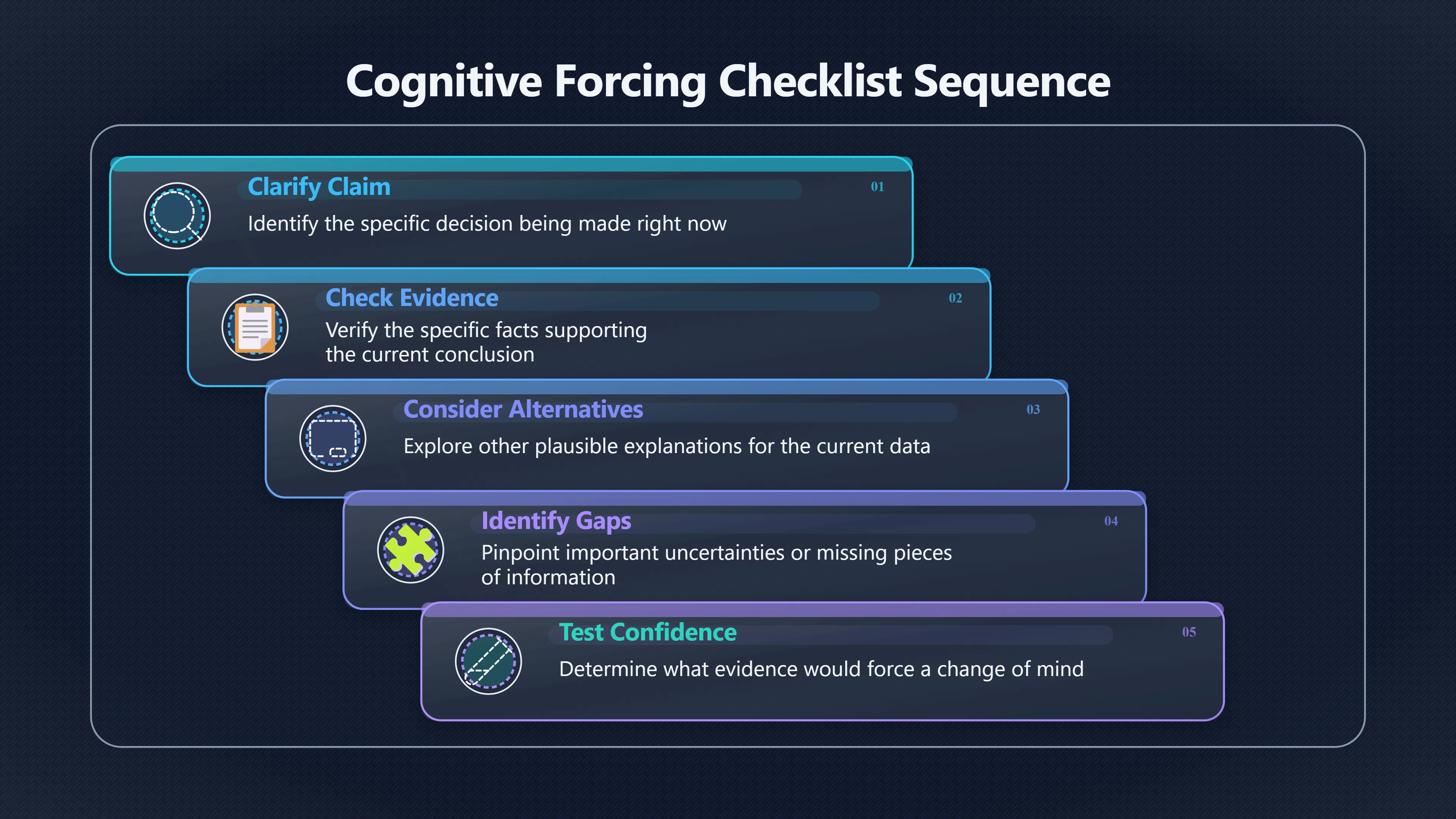
- Clarify the claim. What decision am I actually making?
- Check the evidence. What facts support this conclusion?
- Consider alternatives. What is another plausible explanation?
- Look for missing information. What important uncertainty remains?
- Test confidence. What evidence would make me change my mind?
- Check consequences. Is this decision reversible, or should I slow down?
These questions deliberately interrupt common thinking traps such as confirmation bias, premature closure and overconfidence. Rather than telling someone what to conclude, they increase the likelihood that the conclusion has been examined properly.[PubMed]pubmed.ncbi.nlm.nih.govCognitive forcing strategies in clinical decisionmakingby P Croskerry · 2003 · Cited by 618 — Three levels of cognitive forcing str…
Another important design principle is choosing the right pause point. A checklist used after the decision has effectively been made has little value. Effective implementations define clear trigger moments—for example, before approving a large purchase, before diagnosing a difficult case, before publishing an important report, or before committing a project plan.[exida]exida.comcan checklists prevent human errorCan Checklists Prevent Human Error?8 Jul 2021 — DO-CONFIRM checklist – team members perform tasks from memory and then stop to revie…
Why short checklists often outperform long ones
Research and practical experience consistently favour concise checklists that support memory instead of overwhelming it. Their purpose is not to document every possibility but to highlight the few questions that people are most likely to overlook.
Successful checklists usually share several characteristics:
- They contain only the highest-value prompts.
- They are written in plain language.
- They fit naturally into existing workflows.
- They identify a specific moment when they should be used.
- They encourage discussion where teams are involved.
Atul Gawande’s work on medical and aviation-inspired checklists emphasises that good checklists leave room for professional judgement. They reduce routine omissions so that experts can concentrate on genuinely difficult decisions rather than basic procedural errors.[Atul Gawande]atulgawande.comAtul Gawande The Checklist ManifestoAtul GawandeThe Checklist Manifesto - Atul GawandeThe book's main point is simple: no matter how expert you may be, well-designed check l…
Where checklists fail or become mechanical
Checklists are not universally beneficial. Used badly, they become another form to complete without improving thinking.
One common failure is tick-box compliance. When organisations reward completion rather than reflection, people learn to satisfy the paperwork instead of engaging with the questions. The checklist remains visible, but the thinking disappears. Studies of checklist implementation repeatedly note that organisational culture and communication matter as much as the checklist itself.[PMC+2BJA Anaesthesia]pmc.ncbi.nlm.nih.govHow to WHO: lessons from aviation in checklists and debriefsby IA Guy · 2022 · Cited by 26 — This exploration of attitudes and logisti…
Another problem is excessive length. Every additional item competes for attention. In urgent situations, overly detailed lists are more likely to be skipped altogether or followed mechanically without considering whether they fit the current circumstances.[exida]exida.comcan checklists prevent human errorCan Checklists Prevent Human Error?8 Jul 2021 — DO-CONFIRM checklist – team members perform tasks from memory and then stop to revie…
Checklists also struggle with novel situations. They work best for recurring decision points where certain thinking failures are predictable. They cannot anticipate every unusual circumstance, and they should never replace expertise, situational awareness or deeper reasoning.[BJA Anaesthesia]bjanaesthesia.org.ukBJA AnaesthesiaChecklists, cognitive aids, and the future of patient safetyby CS Webster · 2017 · Cited by 42 — A systematic review of th…
Finally, some evidence suggests that cognitive checklists are most effective when users can revisit observations, reconsider evidence and revise their judgement. If circumstances make reflection impossible, simply presenting a checklist may have little effect.[Royal College of Physicians of Edinburgh]rcpe.ac.ukRoyal College of Physicians of Edinburgh Cognitive bias in clinical medicineRoyal College of Physicians of EdinburghCognitive bias in clinical medicineSeptember 5, 2018 — by ED O’Sullivan · 2018 · Cited by 475 — c…
Designing checklists that support transfer
For improving thinking and analytical skills, the central design question is not “What should people know?” but “What reminder will make them use what they already know?”
A practical thinking checklist therefore aims to trigger recognition rather than deliver instruction. It should be attached to a real decision point, focus on a handful of high-value questions, and encourage people to pause just long enough to examine assumptions before acting. When implemented this way, the checklist becomes an environmental cue that helps transfer thinking skills from training into everyday decisions, especially when pressure, routine or confidence would otherwise prevent those skills from appearing.[PubMed+2PMC]pubmed.ncbi.nlm.nih.govCognitive forcing strategies in clinical decisionmakingby P Croskerry · 2003 · Cited by 618 — Three levels of cognitive forcing str…
Amazon book picks
Further Reading
Books and field guides related to Can a Checklist Make Better Thinking Show Up?. Use these as the next step if you want deeper reading beyond the article.
The Checklist Manifesto
Directly explains how checklists improve performance and judgement in complex real-world environments.
Thinking in Bets
Supports the page’s focus on prompting better decisions before certainty hardens.
Noise
Explains why structured processes and decision hygiene can outperform unaided judgement.
Decisive: How to Make Better Choices in Life and Work
Offers practical decision prompts that function much like thinking checklists.
eBay marketplace picks
Marketplace Samples
Live-tested eBay searches with available results related to this page.

Top pick
critical thinking game
Open a targeted eBay search for items related to this topic.
Browse eBay
Related search
critical thinking card game
Open a targeted eBay search for items related to this topic.
Browse eBay

Related search
make memorabilia
Open a targeted eBay search for items related to this topic.
Browse eBayEndnotes
1.
Source: pmc.ncbi.nlm.nih.gov
Title: PMCThe Checklist Manifesto: How to Get Things Right
Link:https://pmc.ncbi.nlm.nih.gov/articles/PMC3960713/
Source snippet
NIHby L Nasir · 2010 · Cited by 13 — Going through a checklist at the beginning of a multi-faceted process empowers a process for e...
2.
Source: pmc.ncbi.nlm.nih.gov
Link:https://pmc.ncbi.nlm.nih.gov/articles/PMC9246552/
Source snippet
How to WHO: lessons from aviation in checklists and debriefsby IA Guy · 2022 · Cited by 26 — This exploration of attitudes and logisti...
3.
Source: exida.com
Title: can checklists prevent human error
Link:https://www.exida.com/Blog/can-checklists-prevent-human-error
Source snippet
Can Checklists Prevent Human Error?8 Jul 2021 — DO-CONFIRM checklist – team members perform tasks from memory and then stop to revie...
4.
Source: pubmed.ncbi.nlm.nih.gov
Link:https://pubmed.ncbi.nlm.nih.gov/12514691/
Source snippet
Cognitive forcing strategies in clinical decisionmakingby P Croskerry · 2003 · Cited by 618 — Three levels of cognitive forcing str...
5.
Source: tandfonline.com
Link:https://www.tandfonline.com/doi/full/10.1080/20445911.2021.1990302
Source snippet
Taylor & Francis OnlineIdentifying obstacles to transfer of critical thinking skillsby LM van Peppen · 2022 · Cited by 39 — To illustrate...
6.
Source: bjanaesthesia.org.uk
Link:https://www.bjanaesthesia.org.uk/article/S0007-0912%2817%2933281-6/fulltext
Source snippet
BJA AnaesthesiaChecklists, cognitive aids, and the future of patient safetyby CS Webster · 2017 · Cited by 42 — A systematic review of th...
7.
Source: annemergmed.com
Link:https://www.annemergmed.com/article/S0196-0644%2802%2984945-9/fulltext
Source snippet
Transfer of learning is a critical concept in education theory. It describes the...Read more...
8.
Source: atulgawande.com
Title: Atul Gawande The Checklist Manifesto
Link:https://atulgawande.com/book/the-checklist-manifesto/
Source snippet
Atul GawandeThe Checklist Manifesto - Atul GawandeThe book's main point is simple: no matter how expert you may be, well-designed check l...
9.
Source: Wikipedia
Link:https://en.wikipedia.org/wiki/Checklist
10.
Source: rcpe.ac.uk
Title: Royal College of Physicians of Edinburgh Cognitive bias in clinical medicine
Link:https://www.rcpe.ac.uk/sites/default/files/jrcpe_48_3_osullivan.pdf
Source snippet
Royal College of Physicians of EdinburghCognitive bias in clinical medicineSeptember 5, 2018 — by ED O’Sullivan · 2018 · Cited by 475 — c...
Published: September 5, 2018
11.
Source: pmc.ncbi.nlm.nih.gov
Link:https://pmc.ncbi.nlm.nih.gov/articles/PMC8562433/
Source snippet
errors and their prevention in healthcare - PMC - NIHby V Sameera · 2021 · Cited by 196 — Cognitive aids are suggested to aid memory and...
12.
Source: teesche.com
Title: atul gawande the checklist manifesto
Link:https://www.teesche.com/bookshelf/atul_gawande_the_checklist_manifesto
Source snippet
'The Checklist Manifesto' by Atul Gawande Review16 Mar 2023 — 'The Checklist Manifesto' chronicles the journey of introducing checklists...
Additional References
13.
Source: researchgate.net
Title: Research Gate(PDF) A cognitive forcing tool to mitigate cognitive bias
Link:https://www.researchgate.net/publication/330233522A_cognitive_forcing_tool_to_mitigate_cognitive_bias-_a_randomised_control_trial
Source snippet
reasoning, decisional aids and mnemonic checklists can foster [metacognition]({{ 'metacognition/' | relative_url }}) and critical thinking in medical reasoning [60][61][62][63][6...
14.
Source: deming.org
Title: using checklists to reduce process variation and improve results
Link:https://deming.org/using-checklists-to-reduce-process-variation-and-improve-results/
Source snippet
Using Checklists to Reduce Process Variation and Improve...1 Dec 2016 — The core of checklists is to improve processes in order to achie...
15.
Source: researchgate.net
Link:https://www.researchgate.net/publication/10961642_Cognitive_forcing_strategies_in_clinical_decisionmaking
Source snippet
A proposed contributor is this: To most deciders, decision quality entails myriad of...Read more...
16.
Source: danpalmer.me
Title: The Checklist Manifesto – Atul Gawande
Link:https://danpalmer.me/2019-09-22-checklist-manifesto/
Source snippet
Dan Palmer22 Sep 2019 — Checklists need to be simple and “automate” the easy things, so that we as experts in our fields, can use our ski...
17.
Source: focusu.com
Title: The Checklist Manifesto Book Review
Link:https://focusu.com/blog/book-learning-the-checklist-manifesto-by-atul-gwande/
Source snippet
7 Mar 2024 — Start Small & Iterate: Pilot a checklist on one specific, high risk process. Measure the results (e.g., error reductio...
18.
Source: statmodeling.stat.columbia.edu
Title: the checklist manifesto and beyond
Link:https://statmodeling.stat.columbia.edu/2020/04/12/the-checklist-manifesto-and-beyond/
Source snippet
Statistical ModelingThe checklist manifesto and beyond12 Apr 2020 — Checklists are one way to work toward two inter-related aims: educati...
19.
Source: insightful.io
Title: the checklist manifesto
Link:https://www.insightful.io/blog/the-checklist-manifesto
Source snippet
Reduce Staff Errors via the Checklist Manifesto &...6 Aug 2024 — Learn how to use the Checklist Manifesto to prevent errors, avoid sizab...
20.
Source: academia.edu
Title: interventional thinking strategies.Read more
Link:https://www.academia.edu/109849319/Cognitive_forcing_strategies_in_clinical_decisionmaking
Source snippet
Cognitive forcing strategies in clinical decisionmakingobserve it, and to recognize opportunities for using Clinicians need cognitive aid...
21.
Source: scholar.google.com
Link:https://scholar.google.com/citations?citation_for_view=naDXmZMAAAAJ%3A_xSYboBqXhAC&hl=en&user=naDXmZMAAAAJ&view_op=view_citation
Source snippet
google.com[https://scholar.google.com/citations?view_op=view_...No](https://scholar.google.com/citations?view_op=view_...No) information is available for this page...
22.
Source: youtube.com
Title: A Free
Link:https://www.youtube.com/watch?v=8CIOLEZb9ew
Source snippet
Thinking Inside the Box: Checklist-Driven Development by Andrew Ek...
Topic Tree