Within Online Claims
Does the Source Correct Its Mistakes?
Visible corrections do not make a source perfect, but they show whether mistakes are treated as public responsibilities.
On this page
- Why correction behaviour matters
- What transparent fact checking policies reveal
- How to read corrections without blind trust
Page outline Jump by section
Introduction
A source that corrects its mistakes is not necessarily more accurate than one that never appears to make them. However, visible correction behaviour is one of the strongest practical signals that a publisher treats accuracy as an ongoing responsibility rather than a one-off claim. In journalism and fact-checking, new evidence emerges, witnesses change their accounts, official records are amended, and reporters discover errors. The important question is not whether mistakes happen—they inevitably do—but whether the organisation acknowledges them openly, explains what changed, and preserves a trustworthy record of the update. Transparent corrections therefore serve as evidence-quality signals: they reveal how a source responds when reality conflicts with what it previously published.

Why correction behaviour matters
Reliable information systems are designed to improve over time. A correction policy recognises that published information is provisional in the sense that it remains open to revision if stronger evidence appears. Rather than weakening credibility, a clear correction can strengthen it by demonstrating accountability.
By contrast, organisations that quietly edit articles without explanation, delete incorrect posts without acknowledgement, or leave known errors uncorrected make it much harder for readers to judge whether the published record can be trusted. When changes are invisible, readers cannot distinguish between genuine improvement and attempts to erase mistakes.
Professional news organisations typically describe corrections as part of their editorial standards. Reuters, for example, states that it corrects errors “promptly, clearly and comprehensively” and explicitly says corrections should not be hidden inside later updates. Accuracy is treated as more important than speed, even in fast-moving news coverage.[Reuters Agency]reutersagency.comOpen source on reutersagency.com.
The principle extends beyond individual stories. A correction policy communicates that:
- factual claims remain open to review;
- readers have a way to report possible errors;
- editors accept responsibility for mistakes;
- the publication values an accurate historical record rather than protecting appearances.
What transparent fact-checking policies reveal
A published corrections policy provides insight into how an organisation governs evidence. It shows not simply that corrections are possible, but how decisions are made when evidence changes.
Strong policies commonly include several features.
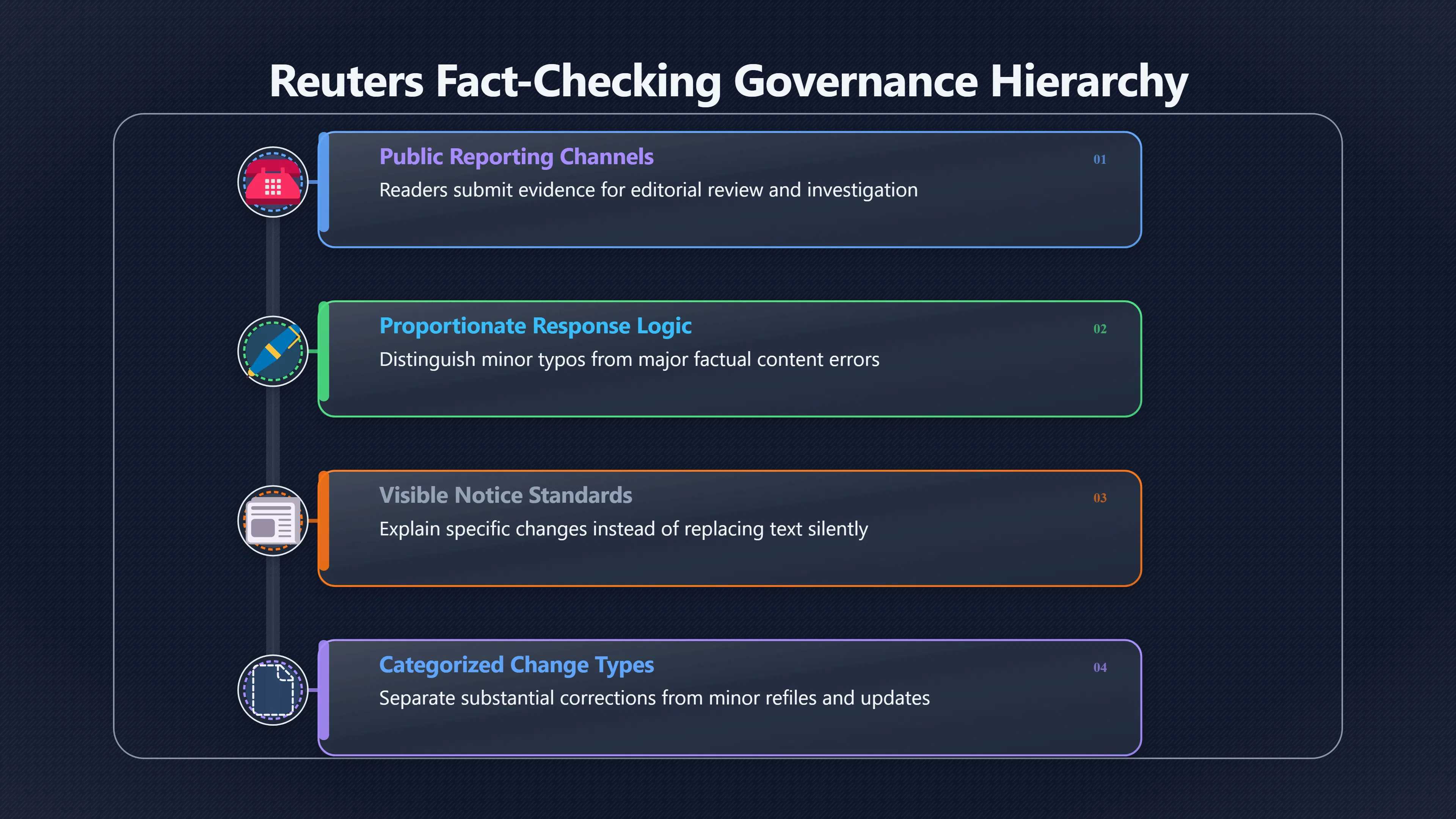
Clear distinction between different kinds of changes. Many organisations separate substantial factual corrections from minor typographical fixes or contextual updates. Reuters’ fact-checking operation, for example, distinguishes between corrections, refiles and updates depending on whether the underlying factual assessment has changed. Major corrections receive explanatory notices placed prominently within the article rather than silent edits.[Reuters]reuters.comAbout Reuters Fact CheckReuters ha establecido una unidad de fact-checking que revisa material visual y declaraciones en redes sociales. Los hallazgos se publica…
Visible notices. Reliable publishers generally explain what changed instead of replacing text without comment. Readers should not have to compare archived versions to discover that an important claim was altered.
Public reporting channels. Many editorial policies invite readers to submit evidence of possible errors. This does not mean every complaint results in a correction, but it demonstrates that challenges can enter the editorial process rather than being ignored.[Reuters]reuters.comAbout Reuters Fact CheckReuters ha establecido una unidad de fact-checking que revisa material visual y declaraciones en redes sociales. Los hallazgos se publica…
Proportionate responses. Good policies distinguish between insignificant mistakes, such as spelling errors, and errors that materially affect the meaning, evidence or conclusions of a story. More significant errors deserve more prominent corrections.
These governance practices are valuable because they make editorial reasoning observable rather than hidden.
How to read corrections without blind trust
Finding a correction should not lead either to automatic distrust or automatic confidence. Instead, treat it as another piece of evidence about the publication’s editorial standards.
Useful questions include:
- Was the correction easy to find? A correction buried deep in an article carries less accountability than one clearly identified at the top.
- Does it explain what changed? Vague statements such as “updated for clarity” are less informative than descriptions of the specific factual error.
- Was the headline corrected if necessary? If the headline still communicates the original mistake, the correction may not adequately repair the public record.
- Is the original publication date preserved alongside the correction date? This helps readers understand the sequence of events.
- Does the correction reflect new evidence or simply improve wording? The distinction matters when evaluating whether the underlying claim has changed.
A transparent correction should allow readers to reconstruct what happened without requiring them to guess.
The warning signs of poor correction practices
Some editorial behaviours should reduce confidence, particularly when they appear repeatedly.
These include:
- deleting incorrect material without acknowledgement;
- making substantial edits with no explanation;
- refusing to correct demonstrable factual errors;
- removing criticism while leaving inaccurate claims in place;
- publishing corrections only after sustained public pressure despite clear evidence;
- repeatedly making similar factual mistakes without changing editorial practice.
One particularly concerning practice is the “stealth correction”: altering published content without leaving any visible indication that a change occurred. Similar concerns have been raised in scientific publishing, where undisclosed post-publication changes can undermine confidence in the integrity of the published record because readers cannot tell that earlier versions were inaccurate.[arXiv]arxiv.orgThe existence of stealth corrections in scientific literature – a threat to scientific integritySeptember 10, 2024…
Silent edits are not always inappropriate—for example, correcting an obvious typing error may not require a formal notice—but substantive factual changes should normally leave an audit trail.
Corrections are evidence of accountability, not proof of accuracy
A common misunderstanding is that a source with many corrections must be less reliable than one with few or none. The opposite may sometimes be true.
Large news organisations often publish thousands of stories every day. A newsroom with rigorous monitoring and a visible corrections process may accumulate more public correction notices simply because it actively identifies and records mistakes. Meanwhile, a publisher that rarely admits errors may appear cleaner while actually correcting less.
Research on audience attitudes suggests that people expect news organisations to correct mistakes promptly and transparently, although corrections alone do not automatically restore trust for every reader. Existing trust influences how corrections are interpreted, making transparency necessary but not sufficient for maintaining credibility.[ResearchGate]researchgate.netResearchGate(PDF) Do Not Stand Corrected: Transparency and Users…June 23, 2016 — In this study, we investigate Swedish citizens' attit…
For this reason, correction policies should be interpreted alongside other evidence-quality signals such as sourcing, attribution, independence, and the ability to trace claims back to original evidence.
The practical takeaway
When assessing news or online claims, do not ask only whether a source has ever made mistakes. Ask what happens after mistakes are discovered.
A trustworthy source makes corrections public, explains what changed, distinguishes between minor edits and substantive factual revisions, and preserves a visible record of those changes. Such behaviour cannot guarantee that every report is correct, but it provides evidence that the organisation treats accuracy as a continuing obligation rather than a marketing claim. In evidence evaluation, that commitment to an honest and transparent record is itself an important signal of quality.
Amazon book picks
Further Reading
Books and field guides related to Does the Source Correct Its Mistakes?. Use these as the next step if you want deeper reading beyond the article.
Factfulness
Encourages evidence-based thinking and updating beliefs when better information emerges.
The Skeptics' Guide to the Universe
Strong coverage of how to assess evidence, reliability, and self-correction in knowledge sources.
Blur
Directly addresses evaluating news sources, transparency, and editorial reliability.
Calling Bullshit
Explains practical methods for judging claims, transparency, and trustworthy evidence.
eBay marketplace picks
Marketplace Samples
Example marketplace items related to this page. Use the search link to explore similar finds on eBay.



Endnotes
1.
Source: reuters.com
Title: About Reuters Fact Check
Link:https://www.reuters.com/fact-check/about/
Source snippet
Reuters ha establecido una unidad de fact-checking que revisa material visual y declaraciones en redes sociales. Los hallazgos se publica...
2.
Source: arxiv.org
Link:https://arxiv.org/abs/2409.06852
Source snippet
The existence of stealth corrections in scientific literature -- a threat to scientific integritySeptember 10, 2024...
Published: September 10, 2024
3.
Source: researchgate.net
Link:https://www.researchgate.net/publication/304356966_Do_Not_Stand_Corrected_Transparency_and_Users_Attitudes_to_Inaccurate_News_and_Corrections_in_Online_Journalism
Source snippet
ResearchGate(PDF) Do Not Stand Corrected: Transparency and Users...June 23, 2016 — In this study, we investigate Swedish citizens' attit...
Published: June 23, 2016
4.
Source: reutersagency.com
Link:https://reutersagency.com/about/standards-values/
5.
Source: mediareform.org.uk
Link:https://www.mediareform.org.uk/wp-content/uploads/2015/12/Reuters_Handbook_of_Journalism.pdf
Source snippet
Sourcing. Accuracy entails honesty in sourcing. Our reputation for that accuracy, and for freedom from bias...Read more...
6.
Source: britannica.com
Title: corrections policy
Link:https://www.britannica.com/topic/corrections-policy
Source snippet
Corrections policies in journalism | Overview, History...31 May 2026 — Media organizations use corrections policies to fix and explain p...
Published: May 2026
Additional References
7.
Source: healthjournalism.org
Link:https://healthjournalism.org/about/principles-and-policies/corrections-policy/
Source snippet
Corrections PolicyCorrections will be made only for errors that significantly impact the accuracy of the article. Corrections will be mad...
8.
Source: ethicsandjournalism.org
Link:https://ethicsandjournalism.org/resources/best-practices/best-practices-corrections/
Source snippet
Best Practices: CorrectionsIn this post, we are exploring the topic of corrections and how journalists and newsrooms should navigate writ...
9.
Source: ap.org
Link:https://www.ap.org/about/news-values-and-principles/telling-the-story/
Source snippet
Telling the Story | The Associated PressJournalists at The Associated Press utilize a set of standards and practices that safeguards AP s...
10.
Source: ethics.sjmc.wisc.edu
Title: correcting the record experts weigh in on ethical news corrections
Link:https://ethics.sjmc.wisc.edu/2024/12/13/correcting-the-record-experts-weigh-in-on-ethical-news-corrections/
Source snippet
the record: Experts weigh in on ethical news...13 Dec 2024 — NewsGuard Senior Editor Peggy Ackerman said good corrections simply state t...
11.
Source: youtube.com
Link:https://www.youtube.com/watch?v=nc0z27QdsyA
Source snippet
Reaching beyond political junkies: Election coverage for news avoiders...
12.
Source: youtube.com
Title: What Is The SPJ Code Of Ethics?
Link:https://www.youtube.com/watch?v=g5n24xeocoE
Source snippet
Disinformation & The Public: How journalists can champion news literacy & empower their communities...
13.
Source: youtube.com
Title: Reaching beyond political junkies: Election coverage for news avoiders
Link:https://www.youtube.com/watch?v=lj33me4TvCg
14.
Source: youtube.com
Title: CIVIX Explains: Journalism Standards
Link:https://www.youtube.com/watch?v=ep5cAiPMkQU
Source snippet
What Is The SPJ Code Of Ethics?...
15.
Source: youtube.com
Title: What are Journalism Ethics?
Link:https://www.youtube.com/watch?v=Tgt2FmVhNtw
Source snippet
CIVIX Explains: Journalism Standards...
Topic Tree