Within Deliberate Practice
What kind of wrong was it?
An error log turns being wrong into useful data by naming the kind of mistake and the correction to practise next.
On this page
- Turning mistakes into categories instead of shame
- Common reasoning error patterns to track
- Designing the next practice task from the log
Page outline Jump by section
Introduction
An error log is a structured record of reasoning mistakes that turns being wrong into usable feedback. Instead of asking, “Did I get the answer right?”, it asks, “What kind of wrong was this, why did it happen, and what should I practise next?” That shift is important because reasoning rarely improves through repetition alone. Improvement depends on recognising recurring failure patterns, monitoring one’s own thinking, and deliberately targeting weak points with new practice. Research on self-regulated learning consistently shows that planning, monitoring and evaluating one’s own performance are central to developing higher-level thinking skills.[PMC]pmc.ncbi.nlm.nih.govSelf-regulated learning (SRL) includes the cognitive, metacognitive, behavioral, motivational, and emotional/affective aspects of learnin…
 Within deliberate practice, an error log is therefore not a diary of failures. It is a diagnostic tool. Its purpose is to convert isolated mistakes into categories that reveal stable habits, allowing each future exercise to address a specific reasoning weakness rather than hoping that experience alone will produce improvement.
Turning mistakes into categories instead of shame
People often treat errors as evidence of ability. Deliberate practice treats them as evidence about process.
Suppose two people reach the same incorrect conclusion. One misunderstood the evidence, while the other ignored an alternative explanation because they became overconfident after recognising a familiar pattern. Although the outcome is identical, the training need is completely different. An effective error log separates these cases instead of recording only that the answer was “wrong”.
The key principle is that every entry should identify the reasoning failure, not merely the incorrect conclusion. Useful questions include:
- What assumption proved false?
- Which step first departed from good reasoning?
- What evidence should have changed my mind?
- Was the mistake due to missing knowledge or poor reasoning with available knowledge?
- Would I make this mistake again under similar conditions?
These questions encourage metacognitive regulation—the ability to monitor and evaluate one’s own thinking—which educational research identifies as a core component of effective self-regulated learning.[PMC]pmc.ncbi.nlm.nih.govSelf-regulated learning (SRL) includes the cognitive, metacognitive, behavioral, motivational, and emotional/affective aspects of learnin…
The emotional effect also matters. When errors become classified observations rather than personal failures, they become easier to inspect honestly. The goal is diagnosis, not self-judgement.
What kind of wrong was it?
A useful reasoning error log contains relatively few categories that are broad enough to reveal patterns but specific enough to suggest a corrective exercise.
Common categories include:
Error categoryDiagnostic questionTypical next practiceMisread the evidenceDid I misunderstand what the information actually showed?Summarise evidence before drawing conclusions.Unsupported assumptionWhat did I treat as true without justification?Explicitly list assumptions before solving similar problems.Missing alternative explanationsDid I stop after the first plausible answer?Force yourself to generate at least three competing explanations.OverconfidenceHow certain was I before checking?Record confidence estimates before receiving feedback.Weak causal reasoningDid I mistake correlation or sequence for causation?Compare rival causal models using the same evidence.Incomplete searchDid I stop gathering information too early?Practise structured evidence searches with stopping rules.Arithmetic or procedural slipWas the reasoning sound but execution careless?Slow down verification rather than relearning concepts.Ambiguous interpretationDid multiple meanings exist that I failed to distinguish?Restate the problem in different words before answering.
These categories are examples rather than fixed standards. The important feature is consistency. If the same label appears repeatedly, the learner has identified a trainable weakness instead of treating each mistake as unrelated.
Common reasoning-error patterns worth tracking
Over time, an error log becomes valuable because repeated entries expose habits that are difficult to notice in individual exercises.
Several recurring patterns deserve particular attention.
Premature closure. The learner accepts the first explanation that appears satisfactory instead of continuing to search for alternatives. This often produces confident but fragile conclusions.
Evidence neglect. Information that contradicts an initial judgement is overlooked, discounted or forgotten. The error frequently appears when someone forms an opinion before carefully examining available evidence.
Confidence calibration errors. The confidence assigned to a conclusion does not match its actual reliability. Recording confidence before receiving feedback makes these errors visible and allows calibration to improve over repeated practice.
Strategy mismatch. The learner applies an otherwise useful reasoning method to the wrong type of problem—for example, relying on intuition where systematic analysis is required, or over-analysing a task that depends on recognising a familiar pattern.
Transfer failures. A reasoning strategy works in one context but is not recognised as applicable elsewhere. Logging both successful and unsuccessful transfers helps identify missing generalisation rather than missing knowledge.
Rather than treating these as isolated mistakes, the log asks whether one pattern repeatedly dominates performance. That recurring pattern becomes the highest-priority target for deliberate practice.

Recording confidence makes mistakes more informative
An unusually powerful addition to an error log is a confidence rating made before checking the answer.
This separates two very different situations:
- low confidence followed by an incorrect answer, suggesting recognised uncertainty;
- high confidence followed by an incorrect answer, revealing a misconception or serious calibration problem.
Research on the hypercorrection effect shows that high-confidence errors are often especially memorable once corrected because the conflict between expectation and reality captures attention. However, this benefit depends on receiving accurate corrective feedback rather than simply discovering that an answer was wrong.[Wikipedia]WikipediaHypercorrection (psychologyHypercorrection (psychology
For reasoning practice, the lesson is practical: do not record only whether you were correct. Record how certain you were before checking.
A simple confidence scale from 0–100% is often sufficient to reveal systematic overconfidence or excessive caution across many exercises.
Designing the next practice task from the log
An error log only becomes deliberate practice if it changes what happens next.
Each category should lead directly to a targeted exercise rather than another general problem set.
For example:
- Repeated unsupported assumptions → complete exercises where every assumption must be written before solving.
- Repeated failure to consider alternatives → require three competing explanations before selecting one.
- Frequent evidence neglect → practise distinguishing observations from interpretations using short articles or case studies.
- Persistent overconfidence → estimate probabilities before revealing answers and review calibration weekly.
- Frequent procedural slips → introduce deliberate verification checklists rather than additional conceptual study.
This principle mirrors broader research on deliberate practice: feedback is useful only when it identifies the next performance target rather than merely evaluating past performance.[PMC]pmc.ncbi.nlm.nih.govSelf-regulated learning (SRL) includes the cognitive, metacognitive, behavioral, motivational, and emotional/affective aspects of learnin…
Using AI without weakening the error log
Generative AI can provide rapid feedback, suggest alternative arguments or identify overlooked evidence. However, if it supplies corrections before the learner has analysed the mistake independently, it may reduce the metacognitive work that the error log is intended to strengthen.
Recent educational research has suggested that while AI can improve immediate task performance, excessive dependence may reduce active monitoring and evaluation of one’s own reasoning if learners simply accept AI-generated corrections.[ResearchGate]researchgate.netResearch Gate Beware of metacognitive laziness: Effects of generativeBeware of metacognitive laziness: Effects of generative…December 10, 2024 — 10 Feb 2025 — We found that AI technologies su…
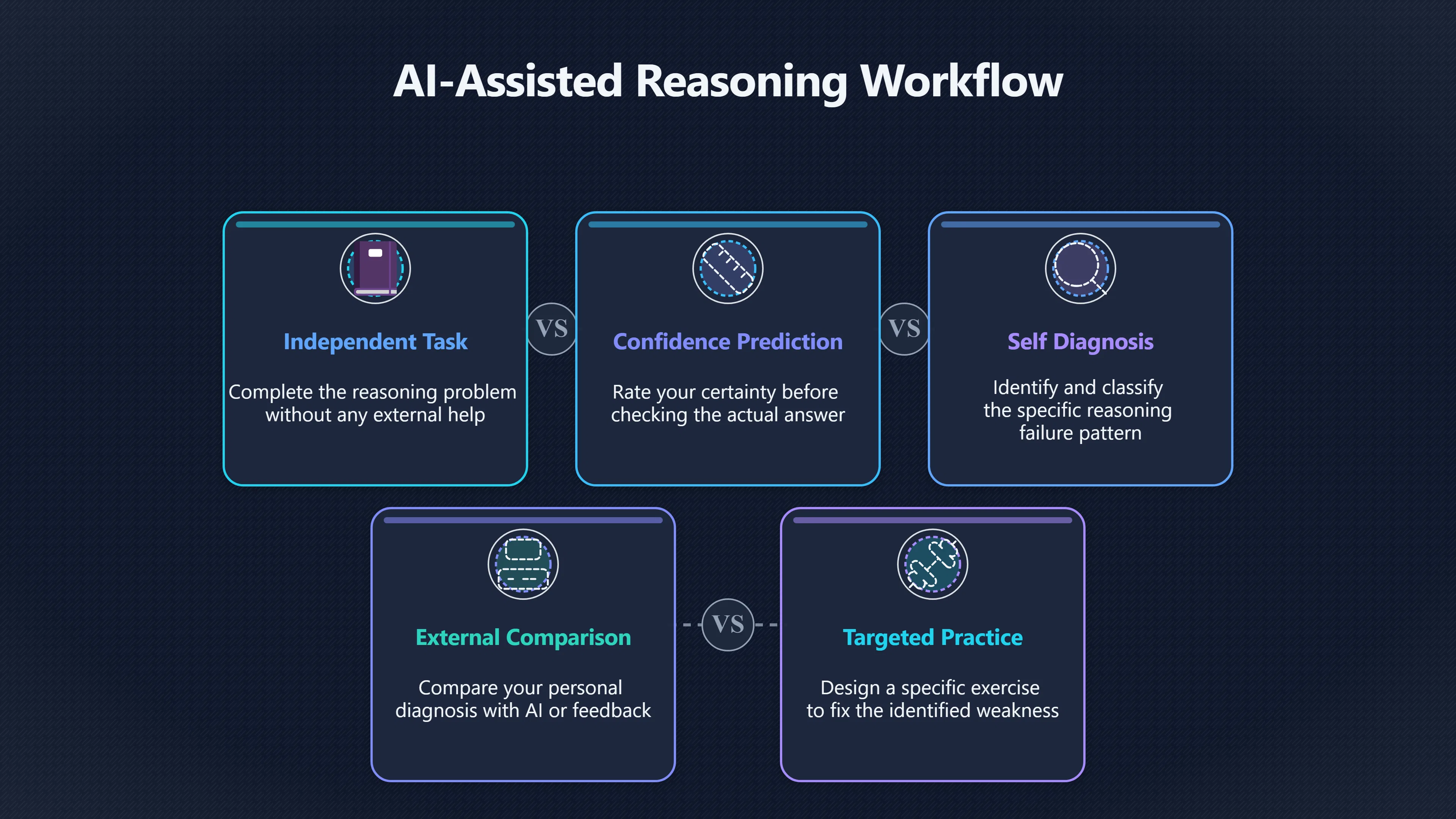
A better sequence is:
- Complete the reasoning task independently.
- Predict confidence.
- Identify and classify the likely error yourself.
- Compare your diagnosis with external feedback or AI assistance.
- Design the next targeted practice exercise.
In this workflow, AI supplements diagnosis rather than replacing it.
A compact error log template
An effective reasoning error log can remain brief while still supporting meaningful improvement.
For each attempt, record:
- Task: What reasoning problem was attempted?
- Initial answer: What conclusion did I reach?
- Confidence: How certain was I before checking?
- Actual outcome: What was correct?
- Error category: Which reasoning pattern best explains the mistake?
- Root cause: Why did that pattern occur?
- Correct reasoning: What should have happened instead?
- Next deliberate practice: What single exercise would reduce this specific error?
After several weeks, review the log for frequency rather than memorable failures. The most common category—not the most dramatic mistake—is usually the best guide to the next stage of deliberate practice.
Amazon book picks
Further Reading
Books and field guides related to What kind of wrong was it?. Use these as the next step if you want deeper reading beyond the article.
Thinking, Fast and Slow
Explains recurring thinking errors that an error log is designed to identify and reduce.
How We Learn
Covers evidence-based learning strategies that complement tracking errors and improving practice.
The Art of Learning
Focuses on learning from setbacks, refining performance, and building better practice habits.
Super Thinking
Provides mental models that help classify and prevent recurring reasoning mistakes.
eBay marketplace picks
Marketplace Samples
Example marketplace items related to this page. Use the search link to explore similar finds on eBay.

Endnotes
1.
Source: Wikipedia
Link:https://en.wikipedia.org/wiki/[Metacognition
2.
Source: Wikipedia
Title: Hypercorrection (psychology)
Link:https://en.wikipedia.org/wiki/Hypercorrection_%28psychology%29
3.
Source: researchgate.net
Title: Research Gate Beware of metacognitive laziness: Effects of generative
Link:https://www.researchgate.net/publication/386649880_Beware_of_metacognitive_laziness_Effects_of_generative_artificial_intelligence_on_learning_motivation_processes_and_performance
Source snippet
Beware of metacognitive laziness: Effects of generative...December 10, 2024 — 10 Feb 2025 — We found that AI technologies su...
Published: December 10, 2024
4.
Source: pmc.ncbi.nlm.nih.gov
Link:https://pmc.ncbi.nlm.nih.gov/articles/PMC5408091/
Source snippet
Self-regulated learning (SRL) includes the cognitive, metacognitive, behavioral, motivational, and emotional/affective aspects of learnin...
Additional References
5.
Source: oecd.org
Link:https://www.oecd.org/content/dam/oecd/en/publications/reports/2023/04/innovating-assessments-to-measure-and-support-complex-skills_b0255009/e5f3e341-en.pdf
Source snippet
and communication skills to evaluate and make sense of new information and...Read more...
6.
Source: youtube.com
Link:https://www.youtube.com/watch?v=rkYWwbjj7Yw
Source snippet
Metacognitive regulation error logs improving critical thinking reasoning mistakes Metacognition: The Skill That Promotes Advanced Learni...
7.
Source: kirschnered.nl
Link:https://www.kirschnered.nl/2025/07/15/deliberate-learning-and-errors/
Source snippet
t error is not simply a sign of failure; that it...Read more...
8.
Source: youtube.com
Link:https://www.youtube.com/watch?v=R-sVnmmw6WY
Source snippet
Thinking About Thinking: How to Challenge & Change Metacognitive Beliefs | Katy O'Brien | TEDxUGA...
9.
Source: arxiv.org
Link:https://arxiv.org/html/2606.15601v1
Source snippet
SCAN: A Decision-Making Framework for Effective Task...14 Jun 2026 — We introduce SCAN—a human-centric decision-making framework to faci...
10.
Source: youtube.com
Title: Metacognition: The Skill That Promotes Advanced Learning
Link:https://www.youtube.com/watch?v=elZFL4FLVLE
Source snippet
Cognition - How Your Mind Can Amaze and Betray You: Crash Course Psychology #15...
11.
Source: papers.ssrn.com
Link:https://papers.ssrn.com/sol3/Delivery.cfm/43599f50-2b89-4dbe-baa4-c49c46e5fe6d-MECA.pdf?abstractid=6718761&mirid=1
Source snippet
and Miscalibrated Self-Regulated LearningSpecifically, we leverage behavioral log data from students' interactions in a digital learning...
12.
Source: youtube.com
Link:https://www.youtube.com/watch?v=79oUxaLaYJI
Source snippet
How Do You Use a GMAT Error Log?...
13.
Source: youtube.com
Title: How Do You Use a GMAT Error Log?
Link:https://www.youtube.com/watch?v=AqMxQoeb0GM
Source snippet
Metacognition: The Skill That Promotes Advanced Learning...
14.
Source: dl.acm.org
Link:https://dl.acm.org/doi/10.1145/3772318.3791355
Source snippet
Using a behavioral measure of awareness (...Read more...
Topic Tree