Within Probabilities
Why Positive Tests Can Mislead
Natural frequencies can make false positives and true positives easier to compare than percentages alone.
On this page
- The test result problem in plain counts
- How false positives change the answer
- Why natural frequencies reduce confusion
Page outline Jump by section
Introduction
Natural frequencies are one of the simplest tools for thinking clearly about medical test results. Instead of presenting information as percentages or conditional probabilities, they describe what happens in a fixed group of real people—for example, “out of every 1,000 people tested”. This small change makes it much easier to judge what a positive result actually means, especially when the disease is uncommon. Rather than asking readers to mentally combine prevalence, sensitivity and false-positive rates, natural frequencies let them compare true positives and false positives directly. This reduces common reasoning errors and improves decision-making for patients, doctors and students alike.[MPG.PuRe]pure.mpg.dePu Re Gigerenzer, G2011). What are natural frequencies? DoctorsJanuary 16, 2024 — by G Gigerenzer · 2011 · Cited by 137 — As shown in the figure, natural f…
The Test-Result Problem in Plain Counts
A positive test result is often interpreted as meaning that a person almost certainly has the condition. In reality, that depends on how common the condition is and how often the test gives false alarms.
Consider a screening test with the following characteristics:
- The disease affects 1% of the population.
- The test detects 90% of people who truly have the disease.
- The test incorrectly produces a positive result in 9% of healthy people.
These figures can sound reassuring until they are translated into natural frequencies.[researchgate.net]researchgate.netWhat are natural frequencies?Request PDFNatural Frequencies Improve Public Understanding of Medical Test Results: An Experimental Study on Various Bayesian Inferenc…
Imagine testing 1,000 people:
- 10 actually have the disease.
- Of those 10, 9 receive a positive result.
- 990 do not have the disease.
- Of those 990 healthy people, about 89 still receive a positive result.
That means there are 98 positive tests altogether, but only 9 belong to people who genuinely have the disease. A person with a positive result therefore has roughly a 9 in 98 chance—about 9%—of actually having the condition. Around nine out of ten positive results are false positives in this example.[MPG.PuRe]pure.mpg.dePu Re Gigerenzer, G2011). What are natural frequencies? DoctorsJanuary 16, 2024 — by G Gigerenzer · 2011 · Cited by 137 — As shown in the figure, natural f…
The percentages and the natural-frequency version describe exactly the same evidence. The difference is that the second version makes the comparison immediately visible.
How False Positives Change the Answer
The surprising feature of many screening tests is not that they make mistakes, but that even a relatively low false-positive rate can dominate the results when the disease itself is rare.
Suppose a disease affects only 1 in 1,000 people. Even an excellent test may examine hundreds or thousands of healthy people for every person who truly has the condition. A small percentage of false alarms among this much larger healthy group can therefore outnumber the genuine positive results.
This is why it is important to distinguish between two different questions:
- How good is the test at detecting disease? (Sensitivity)
- If my result is positive, what is the chance I actually have the disease? (Positive predictive value)
These are not the same quantity. People—including experienced clinicians—often confuse them when information is presented only as conditional probabilities. Studies have repeatedly shown that physicians frequently overestimate the probability that a positive screening result indicates real disease when prevalence is low.[Department of Statistics]stat.berkeley.eduhealth statsDepartment of StatisticsHelping Doctors and Patients Make Sense of Health Statisticsby G Gigerenzer · Cited by 1853 — The calculation usi…
Natural frequencies expose this difference because they preserve the actual counts of people in each group instead of hiding them inside percentages.
Why Natural Frequencies Reduce Confusion
Natural frequencies help because they match the structure of the question people are trying to answer.
Instead of asking someone to combine several percentages mentally, they simply ask:
“Among everyone who tested positive, how many actually have the disease?”
Once the information is arranged as counts, the answer becomes a straightforward comparison.
Researchers have shown several reasons this works:
- The base rate (how common the disease is) remains visible rather than disappearing inside percentages.
- The relevant groups can be counted directly.
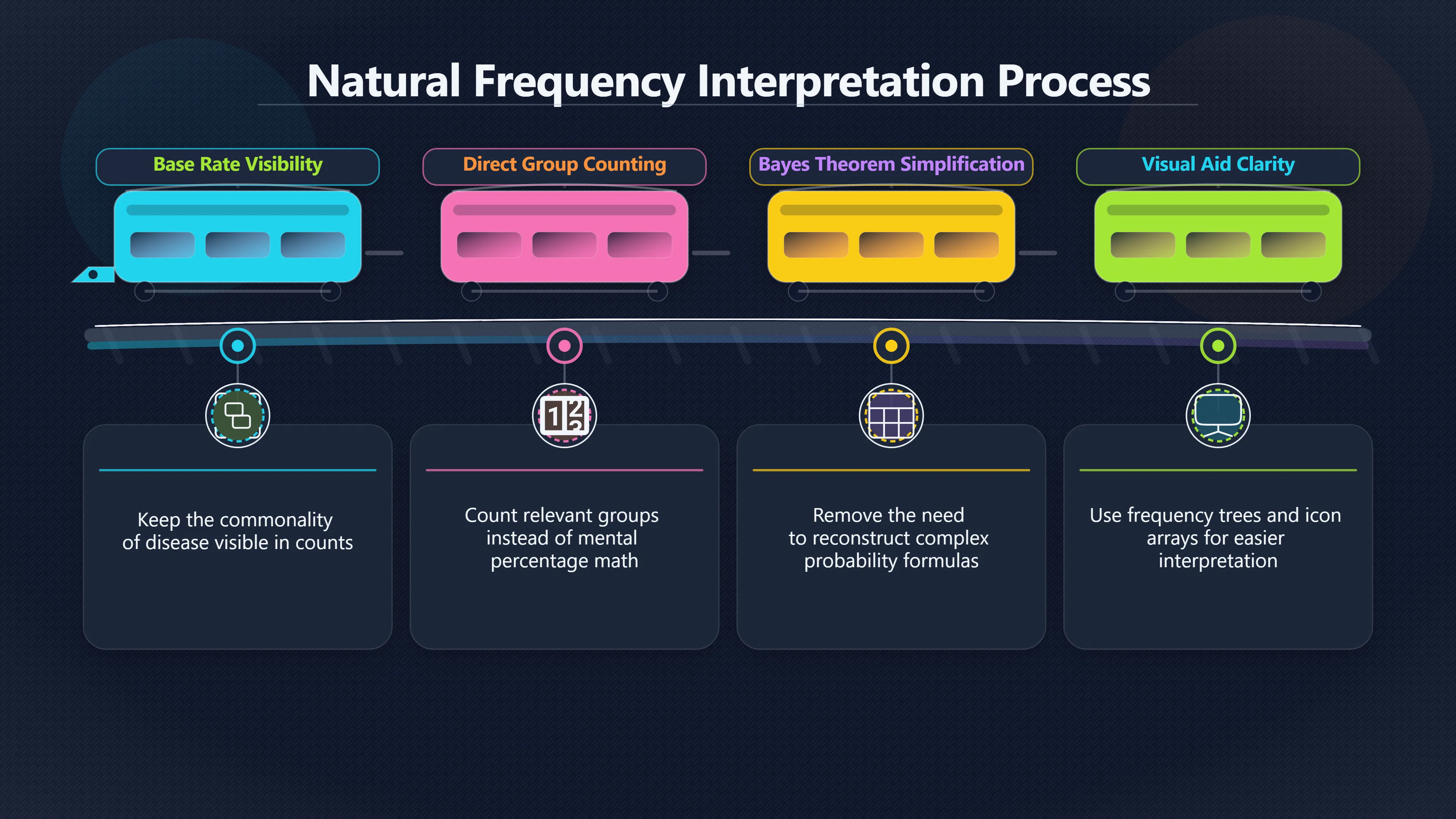
- The calculation no longer requires mentally reconstructing Bayes’ theorem from separate conditional probabilities.
- Visual aids such as frequency trees or icon arrays become much easier to interpret.[MPG.PuRe+2PMC]pure.mpg.dePu Re Gigerenzer, G2011). What are natural frequencies? DoctorsJanuary 16, 2024 — by G Gigerenzer · 2011 · Cited by 137 — As shown in the figure, natural f…
The improvement is not merely theoretical. Experiments have found that both members of the public and health professionals answer diagnostic questions more accurately—and often more quickly—when identical information is expressed as natural frequencies instead of conditional probabilities.[PMC]pmc.ncbi.nlm.nih.govSimple tools for understanding risks: from innumeracy to insightby G Gigerenzer · 2003 · Cited by 1095 — Presenting information in nat…
Evidence That the Format Matters
One influential line of research asked doctors to interpret the result of a mammography screening test.
When presented with probabilities, many substantially overestimated the chance that a woman with a positive result actually had breast cancer. In one study described by Gerd Gigerenzer, most of 160 practising gynaecologists estimated the probability at around 80–90%, when the correct answer for the example was roughly 9%. After brief instruction in converting the information into natural frequencies, the vast majority were able to calculate the correct positive predictive value.[MPG.PuRe]pure.mpg.dePu Re Gigerenzer, G2011). What are natural frequencies? DoctorsJanuary 16, 2024 — by G Gigerenzer · 2011 · Cited by 137 — As shown in the figure, natural f…
Similar findings have been reported across studies involving medical students, clinicians and members of the public. The benefit is robust enough that natural-frequency representations have become a widely recommended tool in risk communication and medical education.[PMC+2BMJ Decision Trees]pmc.ncbi.nlm.nih.govSimple tools for understanding risks: from innumeracy to insightby G Gigerenzer · 2003 · Cited by 1095 — Presenting information in nat…
More recent research also suggests that natural frequencies remain the best format for understanding single diagnostic test results, although additional approaches—such as likelihood ratios—may be useful in more complex situations involving multiple sequential tests.[Springer Nature Link]link.springer.comHowever, they may be less suitable in…Read more…
Practical Lessons When Reading a Positive Test Result
Natural frequencies encourage a more careful interpretation of medical evidence.[researchgate.net]researchgate.netWhat are natural frequencies?Request PDFNatural Frequencies Improve Public Understanding of Medical Test Results: An Experimental Study on Various Bayesian Inferenc…
When looking at any diagnostic test, it helps to ask questions such as:
- Out of 1,000 people like me, how many actually have the condition?
- How many true positives does the test produce?
- How many false positives occur?
- Among everyone who tests positive, how many genuinely have the disease?
Many medical organisations now encourage presenting screening information in absolute numbers alongside percentages because patients generally understand these formats better and make more informed decisions.[BMJ Decision Trees]dtb.bmj.commore…
Natural frequencies do not make a test more or less accurate. They make the evidence easier to interpret, helping people avoid one of the most common reasoning mistakes in medicine: assuming that a positive test result automatically means the disease is highly likely. Within analytical thinking about probabilities and trade-offs, they provide a concrete example of how changing the representation of information can improve judgement without changing the underlying facts.[MPG.PuRe]pure.mpg.dePu Re Gigerenzer, G2011). What are natural frequencies? DoctorsJanuary 16, 2024 — by G Gigerenzer · 2011 · Cited by 137 — As shown in the figure, natural f…
eBay marketplace picks
Marketplace Samples
Example marketplace items related to this page. Use the search link to explore similar finds on eBay.

Endnotes
1.
Source: pure.mpg.de
Title: Pu Re Gigerenzer, G
Link:https://pure.mpg.de/rest/items/item_2099208_9/component/file_3562683/content
Source snippet
(2011). What are natural frequencies? DoctorsJanuary 16, 2024 — by G Gigerenzer · 2011 · Cited by 137 — As shown in the figure, natural f...
Published: January 16, 2024
2.
Source: pmc.ncbi.nlm.nih.gov
Link:https://pmc.ncbi.nlm.nih.gov/articles/PMC200816/
Source snippet
Simple tools for understanding risks: from innumeracy to insightby G Gigerenzer · 2003 · Cited by 1095 — Presenting information in nat...
3.
Source: dtb.bmj.com
Link:https://dtb.bmj.com/content/dtb/57/8/119.full.pdf
Source snippet
more...
4.
Source: link.springer.com
Link:https://link.springer.com/article/10.1186/s12909-025-06990-6
Source snippet
However, they may be less suitable in...Read more...
5.
Source: youtube.com
Title: gerd gigerenzer
Link:https://www.youtube.com/watch?v=1jOBRkr3f1Y
Source snippet
Simple tools for understanding risks: from innumeracy to insight...
6.
Source: stat.berkeley.edu
Title: health stats
Link:https://www.stat.berkeley.edu/~aldous/157/Papers/health_stats.pdf
Source snippet
Department of StatisticsHelping Doctors and Patients Make Sense of Health Statisticsby G Gigerenzer · Cited by 1853 — The calculation usi...
7.
Source: researchgate.net
Title: What are natural frequencies?
Link:https://www.researchgate.net/publication/51721375_What_are_natural_frequencies
Source snippet
Request PDFNatural Frequencies Improve Public Understanding of Medical Test Results: An Experimental Study on Various Bayesian Inferenc...
8.
Source: frontiersin.org
Link:https://www.frontiersin.org/journals/psychology/articles/10.3389/fpsyg.2015.01473/full
Source snippet
Natural frequencies improve Bayesian reasoning in simple...by U Hoffrage · 2015 · Cited by 140 — The positive effect of natural frequenc...
Additional References
9.
Source: scispace.com
Link:https://scispace.com/pdf/using-natural-frequencies-to-improve-diagnostic-inferences-s5412j8huv.pdf
Source snippet
Düsseldorf to determine the positive predictive values. (PPVs) of four diagnostic tests. Information presented in.Read more...
10.
Source: academia.edu
Link:https://www.academia.edu/70392562/What_are_natural_frequencies
Source snippet
hat confuse many, including healthcare professionals.Read more...
11.
Source: youtube.com
Link:https://www.youtube.com/watch?v=oc0LWUvjlL4
Source snippet
Sensitivity and Specificity Explained Clearly (Biostatistics)...
12.
Source: youtube.com
Title: Sensitivity and Specificity Explained Clearly (Biostatistics)
Link:https://www.youtube.com/watch?v=Z5TtopYX1Gc
Topic Tree