Within Predictions
Do you know when you are wrong?
Predicting your score before checking answers turns correction into calibration data, not just a pass-fail moment.
On this page
- How to predict a score before checking
- What overconfidence and underconfidence reveal
- How to review shaky correct answers
Page outline Jump by section
Introduction
Checking an answer key is usually treated as the end of a task. A more useful approach is to turn it into a calibration exercise by predicting not only your answers but also how well you think you performed before you look at the solutions. The comparison between expected performance and actual performance reveals whether your confidence matches reality. That skill—known as calibration—is a core part of good judgement because it helps you recognise both unwarranted certainty and unnecessary doubt. Rather than asking only, “Was I right?”, you also ask, “Did I know how likely I was to be right?” Research on confidence calibration shows that well-calibrated people make more reliable decisions because their confidence better reflects their true level of knowledge.[BIT]bi.teamTThe UK is overconfidentTThe UK is overconfidentAugust 22, 2024 — When you test people's knowledge and check how confident they are in their answers, they tend…

How to predict a score before checking
Before revealing the answer key, make a quick estimate of your expected performance. This should take less than a minute and should rely on your memory of the task rather than a second attempt at solving it.
A practical routine is:
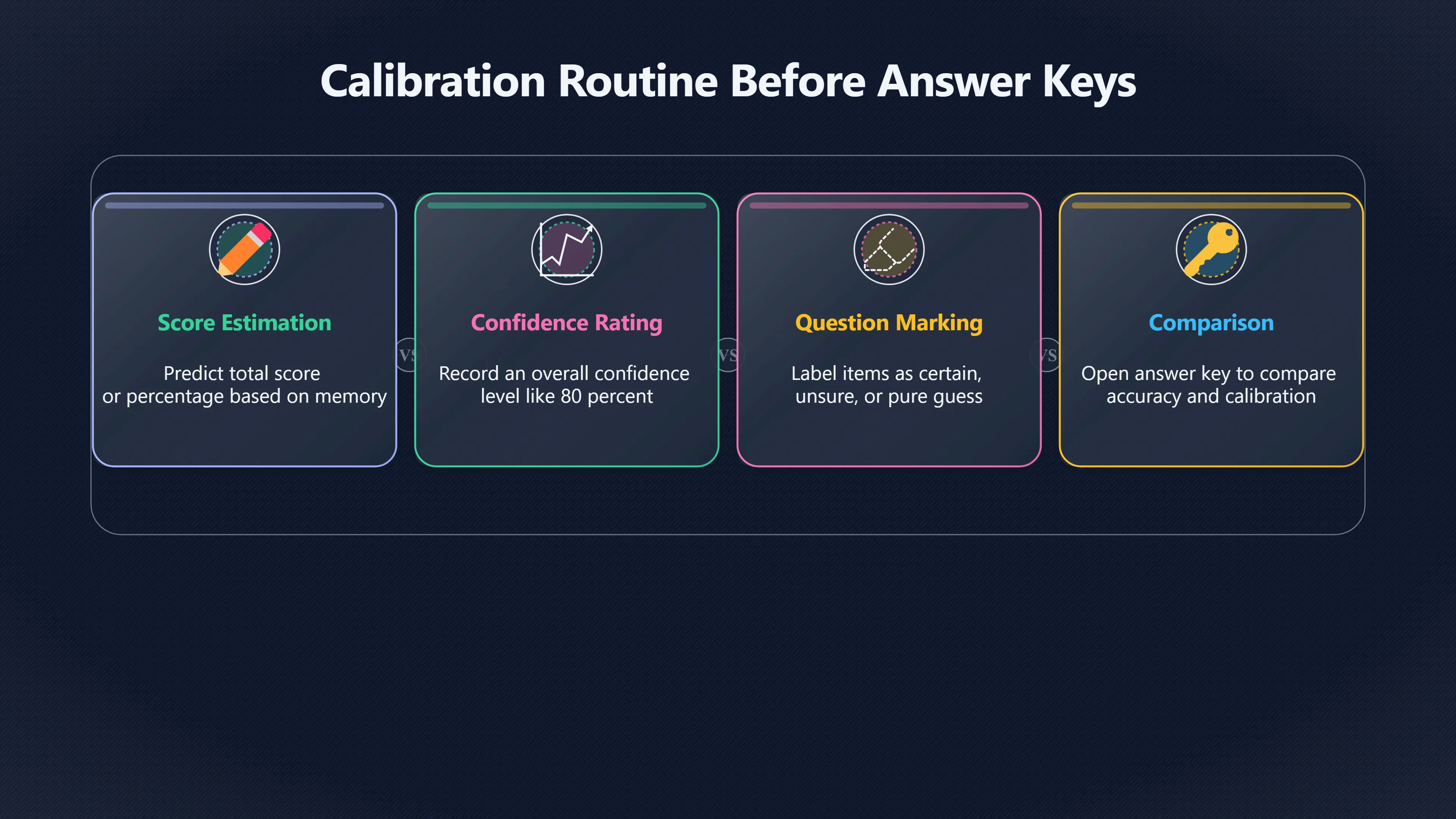
- Estimate your total score or percentage (for example, “I think I scored about 16 out of 20”).
- Record an overall confidence level, such as 60%, 80% or 95%.
- Mark individual questions as:
Certain Probably correct Unsure Pure guess
- Only then open the answer key.
This creates two useful records:
- Accuracy: how many answers were actually correct.
- Calibration: whether your confidence matched that accuracy.
For example, if you expected 90% but scored 65%, you were overconfident. If you expected 60% but scored 85%, you were underconfident. Either mismatch contains more information than the score alone because it identifies an error in self-evaluation rather than simply an error in knowledge.[BIT]bi.teamTThe UK is overconfidentTThe UK is overconfidentAugust 22, 2024 — When you test people's knowledge and check how confident they are in their answers, they tend…
Over time, these predictions become surprisingly informative. Many learners discover consistent patterns, such as overestimating performance in familiar-looking topics or underestimating themselves on more technical problems that they actually solve well.
What overconfidence and underconfidence reveal
The goal is not to eliminate confidence but to align it with reality.
When confidence is higher than accuracy
Overconfidence often comes from recognising familiar ideas without fully understanding them, relying too heavily on a single clue, or stopping reasoning too early. Calibration studies consistently find that people frequently express more certainty than their actual success rate justifies, although the size of this effect depends on the task and how confidence is measured.[BIT]bi.teamTThe UK is overconfidentTThe UK is overconfidentAugust 22, 2024 — When you test people's knowledge and check how confident they are in their answers, they tend…
Repeated overconfidence usually points to habits such as:
- answering before considering alternatives
- failing to check assumptions
- confusing familiarity with mastery
- overlooking missing evidence
Research also suggests that explicitly considering what you might not know can reduce unwarranted confidence by shifting attention towards gaps in your knowledge instead of only supporting evidence.[Marketing Department]marketing.wharton.upenn.eduMarketing Department Known Unknowns: A Critical Determinant of ConfidenceMarketing DepartmentKnown Unknowns: A Critical Determinant of Confidence…June 30, 2016 — by DJ Walters · Cited by 94 — We propose that…
When accuracy is higher than confidence
Underconfidence is less discussed but equally important.
If you regularly score higher than you predicted, you may:
- discard correct reasoning too quickly
- assume difficult questions must have trick answers
- hesitate to trust partial knowledge
- spend unnecessary time changing correct answers
Persistent underconfidence reduces decision quality because correct ideas receive too little weight. In analytical work, this can lead to excessive checking, delayed decisions or unnecessary deference to others even when your reasoning is sound.
The aim is not maximum confidence but appropriate confidence: being highly certain when the evidence supports it and openly uncertain when it does not.
Review the answers you got right but nearly doubted
Most people focus exclusively on mistakes. A calibration review should also examine correct answers that felt uncertain.
These “shaky correct answers” often reveal fragile understanding.
After checking your answers, separate correct responses into two groups:
- Confident and correct — genuine strengths.
- Unsure but correct — areas where your reasoning worked but your confidence lagged behind.
For each shaky correct answer, ask:
- Why did I almost reject this answer?
- Which clue actually led me to the correct conclusion?
- Would I recognise the same pattern again?
This review prevents an important mistake: assuming every uncertain answer was merely lucky. Sometimes uncertainty reflects incomplete confidence rather than incomplete understanding.
Strengthening confidence where your reasoning is already reliable improves future judgement just as much as correcting factual mistakes.
Pay special attention to confident mistakes
High-confidence errors deserve the closest review.
These are answers you were almost certain about but that turned out to be wrong. Although they can feel frustrating, research on the hypercorrection effect shows that confidently held errors are often especially memorable once corrected because the surprise captures attention and strengthens later learning.[Wikipedia]WikipediaHypercorrection (psychologyHypercorrection (psychology
When reviewing a confident mistake, avoid simply memorising the correct answer. Instead identify:
- the assumption that failed
- the misleading cue you trusted
- the alternative evidence you ignored
- the rule that would have corrected your reasoning earlier
This transforms correction into model revision rather than rote memorisation.

Build a simple calibration record
Calibration improves through repeated measurement rather than occasional reflection.
After each quiz, practice session or problem set, record only three numbers:
MeasureExamplePredicted score78%Actual score72%Average confidence85%
Alongside these numbers, note one sentence describing your largest surprise.
After several sessions, patterns become visible:
- confidence consistently exceeds performance
- confidence consistently trails performance
- certain topics produce better calibration than others
- guessing becomes easier to distinguish from genuine knowledge
The objective is gradual convergence between predicted and actual performance. When someone who predicts an 80% chance of being correct is actually right about 80% of the time, they are well calibrated—a hallmark of effective judgement rather than simple optimism.[BIT]bi.teamTThe UK is overconfidentTThe UK is overconfidentAugust 22, 2024 — When you test people's knowledge and check how confident they are in their answers, they tend…
The real value of confidence checks
An answer key tells you whether your solution was correct. A confidence check tells you whether you understood the limits of your own knowledge.
That distinction matters because analytical skill depends on more than producing correct answers. It depends on knowing when to trust your reasoning, when to question it and when additional evidence is needed. By predicting your score before looking at the answers and reviewing both confident mistakes and uncertain successes, every correction becomes feedback about the quality of your thinking as well as the quality of your knowledge.
eBay marketplace picks
Marketplace Samples
Live-tested eBay searches with available results related to this page.


Endnotes
1.
Source: bi.team
Title: TThe UK is overconfident
Link:https://www.bi.team/wp-content/uploads/2024/08/WPS-7-1.pdf
Source snippet
TThe UK is overconfidentAugust 22, 2024 — When you test people's knowledge and check how confident they are in their answers, they tend...
Published: August 22, 2024
2.
Source: Wikipedia
Title: Overconfidence effect
Link:https://en.wikipedia.org/wiki/Overconfidence_effect
3.
Source: Wikipedia
Title: Hypercorrection (psychology)
Link:https://en.wikipedia.org/wiki/Hypercorrection_%28psychology%29
4.
Source: marketing.wharton.upenn.edu
Title: Marketing Department Known Unknowns: A Critical Determinant of Confidence
Link:https://marketing.wharton.upenn.edu/wp-content/uploads/2015/04/WALTERS-DANIELS-JMP.pdf
Source snippet
Marketing DepartmentKnown Unknowns: A Critical Determinant of Confidence...June 30, 2016 — by DJ Walters · Cited by 94 — We propose that...
Published: June 30, 2016
5.
Source: kevindorst.com
Link:https://www.kevindorst.com/stranger_apologies/overconfidence
Source snippet
How (Not) to Test for Overconfidence18 Feb 2020 — We can represent this and other discrepancies in a graph—called a calibration curve—whe...
Additional References
6.
Source: researchgate.net
Link:https://www.researchgate.net/publication/8685888_Overconfidence_in_Interval_Estimates
Source snippet
(PDF) Overconfidence in Interval EstimatesThe authors show that overconfidence in interval estimates can result from variability in setti...
7.
Source: ejmste.com
Link:https://www.ejmste.com/download/whats-about-the-calibration-between-confidence-and-accuracy-findings-in-probabilistic-problems-from-7780.pdf
Source snippet
What's about the Calibration between Confidence and...by M Agus · 2019 · Cited by 9 — The purpose of this research is to investigate the...
8.
Source: philarchive.org
Link:https://philarchive.org/archive/DOROIOv5
Source snippet
Overconfidence in OverconfidenceThey have run calibration studies in which they ask people a variety of questions, and then test whether...
9.
Source: cogn-iq.org
Link:https://www.cogn-iq.org/learn/theory/overconfidence-bias/
Source snippet
Overconfidence Bias — The Three Types, Calibration &...Overconfidence is quantified through calibration — the correspondence between sta...
10.
Source: youtube.com
Title: Mastering Metacognition: Learn How to Learn and Become Your Own Teacher
Link:https://www.youtube.com/watch?v=4PqFy5gAHSU
Source snippet
Behaviors That Reveal You Have "Metacognitive IQ" (Only 1% Possess It)...
11.
Source: youtube.com
Title: Behaviors That Reveal You Have “Metacognitive IQ” (Only 1% Possess It)
Link:https://www.youtube.com/watch?v=8ev8RLr_kGo
Source snippet
Overconfidence: The Most Dangerous Bias in Decision Making...
12.
Source: youtube.com
Title: 5 Signs You Have Metacognitive Intelligence
Link:https://www.youtube.com/watch?v=QfK3PwI1OUw
Source snippet
Mastering Metacognition: Learn How to Learn and Become Your Own Teacher...
13.
Source: youtube.com
Title: Why People Are So Confident When They’re Wrong
Link:https://www.youtube.com/watch?v=9M_QK4stCJU
Source snippet
5 Signs You Have Metacognitive Intelligence...
14.
Source: pmc.ncbi.nlm.nih.gov
Link:https://pmc.ncbi.nlm.nih.gov/articles/PMC5978695/
Source snippet
Contrary to stereotypes that young people are more overconfident.Read more...
15.
Source: youtube.com
Title: Overconfidence: The Most Dangerous Bias in Decision Making
Link:https://www.youtube.com/watch?v=ei_zP4saqPs
Topic Tree