Within Retrieval
Testing Yourself Without Turning It Into Pressure
Retrieval practice is most useful when it feels diagnostic rather than punitive, so small ungraded quizzes can support learning without constant judgement.
On this page
- Why stakes change how retrieval feels
- How delayed quizzes support retention
- How to keep practice diagnostic and repeatable
Page outline Jump by section
Introduction
Retrieval practice works best when learners treat a quiz as a way to discover what they know rather than to prove their ability. That distinction is more important than it first appears. A low-stakes quiz is not simply a smaller version of an exam. Its purpose is to strengthen memory, reveal gaps in understanding and guide the next round of study without attaching meaningful consequences to mistakes. When learners expect judgement, rankings or penalties, attention can shift from improving understanding to protecting self-esteem or chasing marks. Used thoughtfully, frequent, ungraded quizzes help keep retrieval focused on learning instead of performance. Research consistently shows that this approach can improve retention while, in many settings, reducing rather than increasing test anxiety.[ResearchGate+2Center for Teaching and Learning]researchgate.netlow-stakes testing may be an effective method of reducing test anxiety.Read moreDo Practice Tests (Quizzes) Reduce or Provoke…Aug 25, 2023 — A Meta-Analytic Review | Practice testing is a powerful tool to…

Why stakes change how retrieval feels
The same act of recalling information can feel completely different depending on what is attached to the result. A learner answering five questions in a private notebook experiences a different psychological task from a learner answering the same five questions that determine a grade or public ranking.
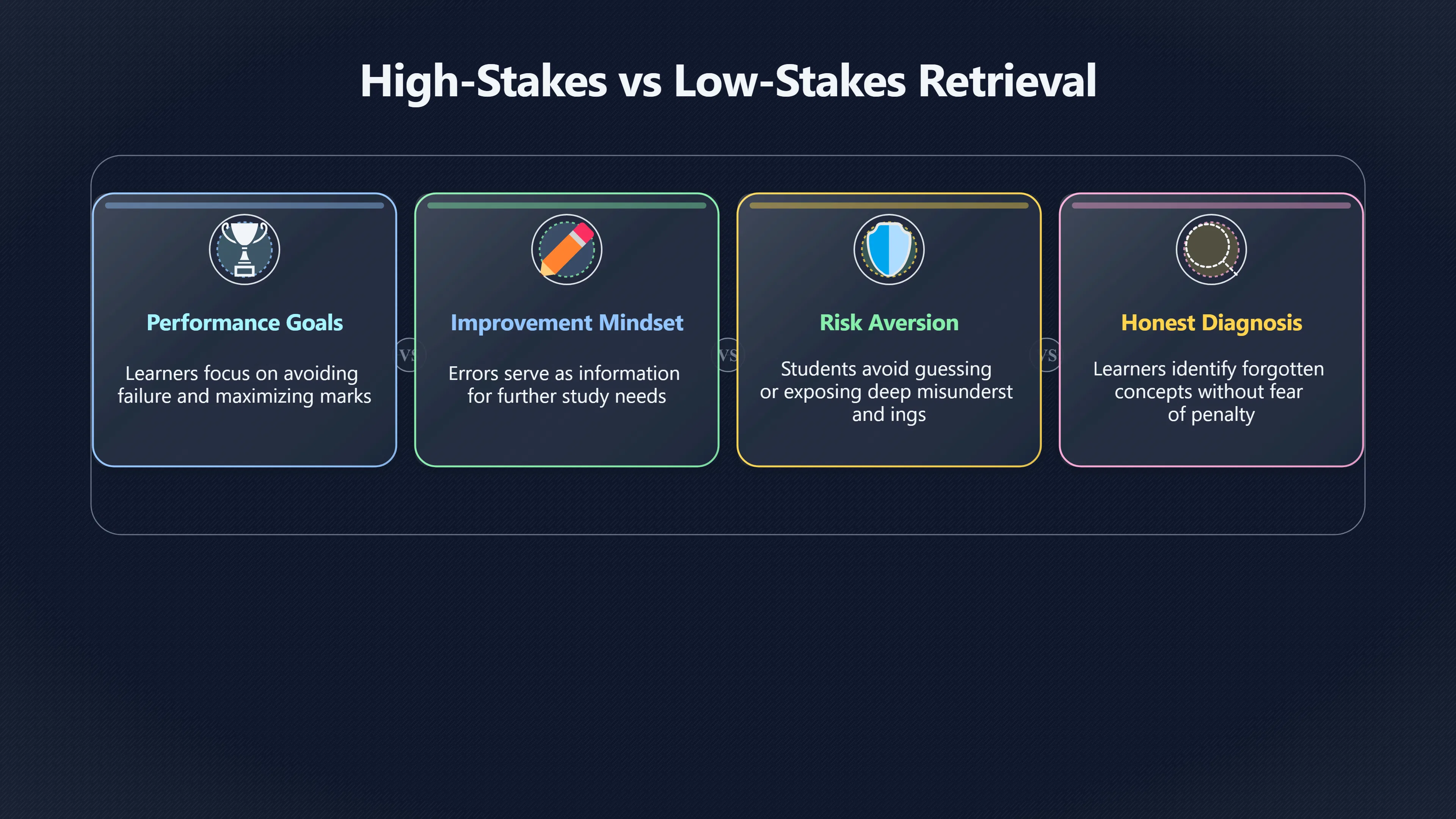
High-stakes assessments naturally encourage performance goals: avoiding failure, protecting reputation or maximising marks. These goals are appropriate in formal examinations, but they can interfere with everyday learning because learners become less willing to guess, expose misunderstandings or attempt difficult questions. Low-stakes quizzes instead encourage an improvement mindset. Errors become information about what needs further work rather than evidence of personal ability.[My College+2EEF]my.chartered.collegelow stakes but desirable difficulty how do we balance the twoMy CollegeLow stakes but desirable difficulty – how do we balance the two?20 Sept 2022 — There is a balance in creating something that is…
This distinction also explains why retrieval practice should not be confused with constant testing. The educational benefit comes from the effort of recalling information and receiving useful feedback, not from repeatedly judging performance.
How delayed quizzes support retention
One of the most useful features of low-stakes quizzes is that they can be delayed. Instead of testing immediately after studying, learners revisit ideas hours, days or weeks later, when recall requires genuine reconstruction rather than short-term familiarity.
That delay introduces what cognitive psychologists describe as a “desirable difficulty”: retrieval becomes effortful enough to strengthen long-term memory without becoming impossible. The temporary struggle is part of the learning process, provided the learner eventually receives corrective feedback.[Formative Action+2PMC]formative-action.comdesirable difficulties no pain no gainFormative ActionNo pain, no gain – on desirable difficulties13 May 2024 — Examples of desirable difficulties are retrieval practice (retr…
Because there is little penalty for forgetting, delayed quizzes encourage honest diagnosis:
- forgotten concepts become visible before major assessments;
- partial understanding is easier to identify;
- learners discover which topics require another review;
- successful recall becomes progressively easier over repeated sessions.
The quiz therefore becomes part of the learning cycle rather than its endpoint.
How to keep practice diagnostic and repeatable
The design of the quiz matters as much as its frequency. Low-stakes retrieval is most effective when it continually generates information that learners can act upon.
Useful features include:
- No meaningful grade. Completion credit, participation marks or no marks at all reduce pressure while maintaining engagement.
- Immediate or prompt feedback. Learners should compare their answers with correct explanations before misconceptions become reinforced.
- Short quizzes. Two to ten questions are often enough to identify strengths and weaknesses without creating exam-like fatigue.
- Regular repetition. Small quizzes repeated across weeks generally produce better long-term learning than occasional large tests.
- Mixed content. Including questions from earlier topics helps prevent forgetting and encourages connections across ideas.
- Private reflection. Learners benefit when incorrect answers become personal feedback rather than public embarrassment. My College+3Center for Teaching and Learning+3Georgia Online Learning & Development[ctl.wustl.edu]ctl.wustl.eduQuizzes can be free response, multiple choice, or another format. In-class…Read more…
Importantly, diagnostic quizzes should answer the question, “What should I study next?” rather than, “How good am I?”

Can low-stakes quizzes reduce exam anxiety?
A common concern is that more quizzes simply create more stress. The available evidence suggests that this depends heavily on how the quizzes are implemented.
Classroom research involving more than 1,400 secondary school students found that retrieval-practice programmes not only improved learning but also reduced reported test anxiety for many students. Later reviews and a meta-analysis similarly concluded that practice testing does not inevitably provoke anxiety and that genuinely low-stakes implementation may reduce it overall.[Evidence Based Education+2ResearchGate]evidencebased.educationEvidence Based EducationRetrieval Practice and Student Wellbeingby K Jones — Kate Jones exlains the importance of retrieval practice stud…
Several mechanisms may explain this pattern:
- repeated exposure makes recall feel more familiar;
- learners gain more accurate knowledge of what they know;
- uncertainty decreases because weaknesses are identified early;
- success accumulates through repeated practice rather than relying on one major examination.
However, these benefits are not guaranteed. Students with high existing test anxiety sometimes avoid self-testing altogether because retrieval itself feels threatening. This creates an unfortunate cycle: the students who might benefit most from diagnostic retrieval may engage with it least unless teachers or learners deliberately keep the experience supportive and non-punitive.[Evidence Based Education]evidencebased.educationEvidence Based EducationRetrieval Practice and Student Wellbeingby K Jones — Kate Jones exlains the importance of retrieval practice stud…
The main risk: low stakes can become “secretly high stakes”
Not every quiz labelled “low stakes” actually feels low stakes.
Practice quizzes begin to resemble examinations when they are:
- heavily weighted towards final grades;
- publicly ranked or compared;
- used primarily to identify weaker students;
- too long or too infrequent;
- accompanied by social pressure or embarrassment after mistakes.
Research on assessment motivation also shows that reducing consequences too far can lower effort. If learners believe a quiz has absolutely no purpose, they may not engage seriously enough to produce useful retrieval. The practical challenge is therefore balance: enough importance that students try to recall honestly, but not enough that fear of failure dominates attention.[PMC+2My College]pmc.ncbi.nlm.nih.govPMCEffort in Low-Stakes AssessmentsNIHby Y Attali · 2016 · Cited by 59 — Past research supports the assumption that tests with no personal consequences, that is, low…
Making retrieval part of thinking rather than judging
For improving thinking and analytical skills, the value of low-stakes quizzes lies less in measuring knowledge than in exposing reasoning. Questions that ask learners to explain a concept, justify a conclusion, distinguish similar ideas or predict an outcome encourage retrieval that goes beyond memorising isolated facts.
After attempting an answer, learners should compare their reasoning with the correct explanation and ask:
- Which part of my reasoning was missing?
- Which concept did I confuse?
- Could I explain this without the original notes?
- Would I recognise this mistake in a different problem?
Used this way, retrieval practice becomes an ongoing conversation with one’s own understanding. The quiz is no longer a miniature examination but a diagnostic tool that makes thinking visible, guides future study and steadily builds confidence through repeated, manageable success.
Amazon book picks
Further Reading
Books and field guides related to Testing Yourself Without Turning It Into Pressure. Use these as the next step if you want deeper reading beyond the article.
Make It Stick
Explains retrieval practice, low-stakes testing, and durable learning using evidence-based research.
Powerful Teaching
Provides accessible strategies for retrieval practice, formative quizzes, and reducing pressure around testing.
How We Learn
Discusses retrieval, spacing, testing, and other memory techniques in an approachable style.
Small Teaching
Shows how frequent low-stakes learning activities improve retention and engagement.
eBay marketplace picks
Marketplace Samples
Example marketplace items related to this page. Use the search link to explore similar finds on eBay.
Endnotes
1.
Source: researchgate.net
Title: low-stakes testing may be an effective method of reducing test anxiety.Read more
Link:https://www.researchgate.net/publication/373413232_Do_Practice_Tests_Quizzes_Reduce_or_Provoke_Test_Anxiety_A_Meta-Analytic_Review
Source snippet
Do Practice Tests (Quizzes) Reduce or Provoke...Aug 25, 2023 — A Meta-Analytic Review | Practice testing is a powerful tool to...
2.
Source: formative-action.com
Title: desirable difficulties no pain no gain
Link:https://formative-action.com/desirable-difficulties-no-pain-no-gain/
Source snippet
Formative ActionNo pain, no gain – on desirable difficulties13 May 2024 — Examples of desirable difficulties are retrieval practice (retr...
Published: May 2024
3.
Source: pmc.ncbi.nlm.nih.gov
Link:https://pmc.ncbi.nlm.nih.gov/articles/PMC4480221/
Source snippet
assessment of Bjork's (1994) desirable difficulty account.Read more...
4.
Source: pmc.ncbi.nlm.nih.gov
Title: PMCEffort in Low-Stakes Assessments
Link:https://pmc.ncbi.nlm.nih.gov/articles/PMC5965611/
Source snippet
NIHby Y Attali · 2016 · Cited by 59 — Past research supports the assumption that tests with no personal consequences, that is, low...
5.
Source: researchgate.net
Link:https://www.researchgate.net/publication/352867336Low-Stakes_Quizzes_Improve_Learning_and_Reduce[Overconfidence
Source snippet
meta-analysis to examine...Read more...
6.
Source: researchgate.net
Link:https://www.researchgate.net/publication/261803994_Retrieval_Sometimes_Enhances_Learning_Performance_Pressure_Reduces_the_Benefits_of_Retrieval_Practice
Source snippet
fficulty of retrieval during practice increased, final test performance increased...Read more...
7.
Source: ctl.wustl.edu
Link:https://ctl.wustl.edu/resources/using-retrieval-practice-to-increase-student-learning/
Source snippet
Quizzes can be free response, multiple choice, or another format. In-class...Read more...
8.
Source: my.chartered.college
Title: low stakes but desirable difficulty how do we balance the two
Link:https://my.chartered.college/impact_article/low-stakes-but-desirable-difficulty-how-do-we-balance-the-two/
Source snippet
My CollegeLow stakes but desirable difficulty – how do we balance the two?20 Sept 2022 — There is a balance in creating something that is...
9.
Source: evidencebased.education
Link:https://evidencebased.education/resource/retrieval-practice-and-student-wellbeing/
Source snippet
Evidence Based EducationRetrieval Practice and Student Wellbeingby K Jones — Kate Jones exlains the importance of retrieval practice stud...
10.
Source: kognity.com
Title: retrieval practice
Link:https://kognity.com/resources/retrieval-practice/
Source snippet
How Low-Stakes Quizzes Can Help...Feb 18, 2020 — Retrieval practice is the act in which you allow your brain to struggle to come up with...
Additional References
11.
Source: innerdrive.co.uk
Link:https://www.innerdrive.co.uk/blog/test-anxiety-retrieval-practice/
Source snippet
Do students with test anxiety use Retrieval Practice?The results indicated that students with high levels of test anxiety are more likely...
12.
Source: visiblelearningmetax.com
Link:https://www.visiblelearningmetax.com/influences/view/practice_testing
Source snippet
Practice testing DetailsThe aim of practice testing is to support long-term retention and increase access to retrieving the "to-be-rememb...
13.
Source: aigne.ucc.ie
Link:https://aigne.ucc.ie/index.php/aigne/article/download/4481/6791/13055
Source snippet
Reflection to Action: The Role of Retrieval Practice in...This article explores retrieval and memory theory, the concept of desirable di...
14.
Source: tips.uark.edu
Link:https://tips.uark.edu/the-power-of-low-stakes-testing-in-the-college-classroom-engaging-students-boosting-learning/
Source snippet
uark.eduLow-Stakes Testing in Higher Ed8 Oct 2024 — One effective method is low-stakes testing, providing a way to test students' knowled...
15.
Source: youtube.com
Link:https://www.youtube.com/watch?v=0ns7LIdsHkw
Source snippet
Low Stakes Quizzing and Retrieval PracticeDiscover key ideas about academic research on retrieval practice and how teachers translate thi...
16.
Source: teachertoolkit.co.uk
Title: the surprising link between retrieval quizzes and exam anxiety
Link:https://www.teachertoolkit.co.uk/2023/09/04/the-surprising-link-between-retrieval-quizzes-and-exam-anxiety/
Source snippet
The Surprising Link Between Retrieval Quizzes and Exam...4 Sept 2023 — Recent research suggests that practice testing, often seen as a s...
17.
Source: iatrox.com
Title: retrieval practice desirable difficulty revision science
Link:https://www.iatrox.com/blog/retrieval-practice-desirable-difficulty-revision-science
Source snippet
Retrieval Practice, Desirable Difficulty, and Why the Best...25 May 2026 — Retrieval practice and desirable difficulty explain why effor...
Published: May 2026
18.
Source: teachertoolkit.co.uk
Title: low stakes quizzing and its impact on class performance
Link:https://www.teachertoolkit.co.uk/2024/02/28/low-stakes-quizzing-and-its-impact-on-class-performance/
Source snippet
Low-Stakes Quizzing and its Impact on Class Performance28 Feb 2024 — A meta-analysis of frequent low-stakes testing and class performance...
19.
Source: linkedin.com
Link:https://www.linkedin.com/pulse/low-stakes-quizzes-how-combine-research-behind-spaced-north-landesman
Source snippet
formative assessment and accountability into five minutes to start a class.Read more...
20.
Source: theeffortfuleducator.com
Title: retrieval practices impact on test anxiety and stress
Link:https://theeffortfuleducator.com/2019/05/14/retrieval-practices-impact-on-test-anxiety-and-stress/
Source snippet
Retrieval Practices' Impact on Test Anxiety and Stress14 May 2019 — In an article published in 2014, retrieval practice had quite the pos...
Published: May 2019
Topic Tree