Within Teach It
Can You Show the Missing Middle?
A plain explanation improves when it replaces vague claims like 'X affects Y' with the steps in between.
On this page
- How causal gaps appear in explanations
- Turning abstractions into step by step examples
- Where to stop without oversimplifying
Page outline Jump by section
Introduction
A plain-English explanation becomes genuinely useful when it does more than state that one thing influences another. It shows the missing middle: the sequence of changes that connects a cause to its effect. This is the essence of a causal-chain explanation. Instead of saying, “Stress reduces performance,” a stronger explanation identifies what changes first, what changes next, and why those intermediate steps matter. Building these chains is one of the most reliable ways to test your own understanding because it forces you to replace vague associations with a concrete mechanism. Research on the illusion of explanatory depth shows that people often believe they understand a process until they are asked to explain its causal steps in detail.[PMC]pmc.ncbi.nlm.nih.govby L Rozenblit · 2002 · Cited by 1504 — We argue that the illusion of depth seen with explanatory knowledge is a separate phenomenon f…
 Within the broader practice of explaining ideas in plain English, causal chains answer a specific question: Can you show how the outcome happens, rather than merely asserting that it does?
How causal gaps appear in explanations
Many explanations sound convincing because they connect two ideas with words such as causes, leads to, affects, or results in. Those words often hide a missing mechanism.
Compare these explanations:
- Weak: “Exercise improves mood.”
- Stronger: “Exercise raises heart rate and stimulates the release of signalling chemicals associated with reward and stress regulation. It also improves sleep and creates repeated experiences of competence, all of which can contribute to improved mood over time.”
The second explanation is not simply longer. It identifies intermediate changes instead of treating cause and effect as adjacent events.
The same pattern appears in everyday reasoning:
- “Higher prices reduce demand.”
- “Feedback improves learning.”
- “Competition increases innovation.”
Each statement may often be true, but none explains why. Until the intermediate steps are supplied, the explanation remains incomplete.
Research on the illusion of explanatory depth demonstrates that this is exactly where overconfidence appears. People frequently believe they understand mechanisms because they recognise familiar labels or outcomes. Only when asked to explain each step do they discover that several links in the chain are missing.[PMC]pmc.ncbi.nlm.nih.govby L Rozenblit · 2002 · Cited by 1504 — We argue that the illusion of depth seen with explanatory knowledge is a separate phenomenon f…
A useful warning sign is any explanation that could replace the words “causes” or “affects” with “somehow”. If the sentence still sounds grammatically acceptable, the mechanism may not yet be understood.
Turning abstractions into step-by-step examples
The simplest way to improve an explanation is to replace a direct arrow with a sequence of smaller changes.
Instead of writing:
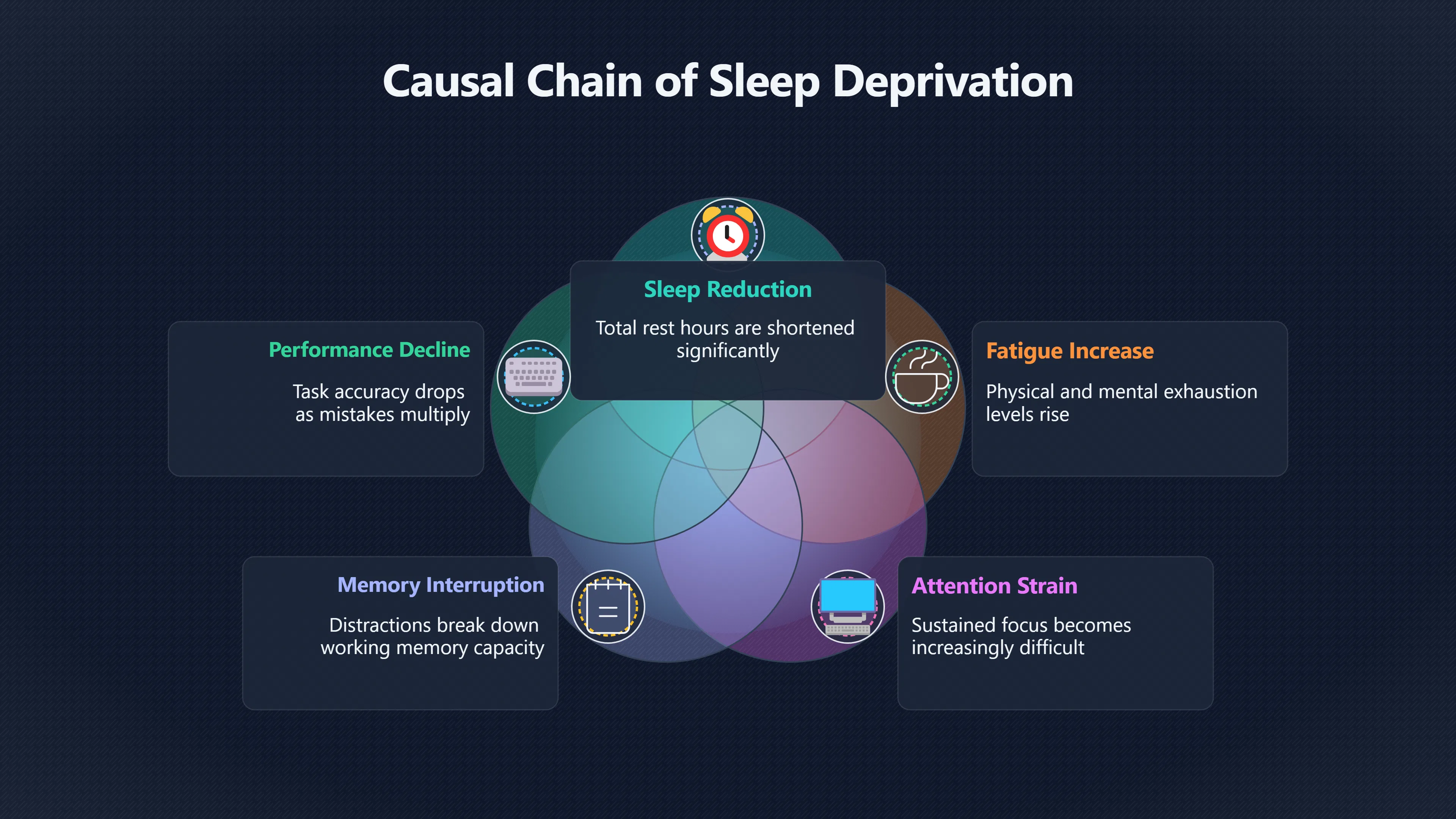
Lack of sleep reduces concentration.
Expand it into a causal chain:
- Sleep is shortened.
- Fatigue increases.
- Sustained attention becomes harder.
- More distractions interrupt working memory.
- Mistakes become more frequent.
- Performance on concentration-heavy tasks declines.
Every step should answer the question, “What changed between the previous stage and the next?”
The same approach works for abstract concepts.
Example: Why does compound interest become powerful?
A weak explanation says:
Compound interest makes savings grow faster.
A causal-chain explanation shows the mechanism:[plato.stanford.edu]plato.stanford.educausal explanation scienceFor a discussion of earlier accounts of explanationRead more…
- Interest is added to the original savings.
- Future interest is calculated on both the original savings and previously earned interest.
- The amount generating interest therefore becomes larger after each period.
- As the base grows, each future increase becomes larger than the last.
The explanation has shifted from a slogan to a process.
Example: Why does misinformation spread quickly?
Rather than saying:[jonwilliamson.uk]jonwilliamson.uks a tool that helps us to predict, explain and control our world, rather than as a relation.Read more…
Social media spreads misinformation.
A mechanism-based explanation might be:
- A surprising claim attracts attention.
- More users react and share it.
- Recommendation systems detect high engagement.
- The content is shown to more people.
- Greater exposure creates additional sharing.
- The cycle repeats before careful verification catches up.
Notice that each stage describes an observable change. The explanation becomes testable because each link could, in principle, be examined separately.
Building explanations one link at a time
A useful discipline is to imagine that every arrow in a diagram must be replaced with a sentence.
Instead of:
A → B
Ask:
- What changes first?
- What does that change directly affect?
- Why does that produce the next change?
- Which step depends on assumptions rather than evidence?
Often one sentence becomes four or five.
For example:
Better education increases economic growth.
might become:
- People acquire more knowledge and skills.
- Workers perform tasks more efficiently.
- Firms can produce more output with similar resources.
- Higher productivity supports greater incomes.
- Greater income contributes to overall economic growth.
Whether every link is equally strong is a separate question. The important point is that the reasoning has become visible instead of remaining hidden inside a single verb.
This mirrors how mechanistic explanations are treated in many scientific disciplines: understanding improves by identifying the intermediate processes that connect an intervention to an outcome, rather than treating cause and effect as isolated facts.[Stanford Encyclopedia of Philosophy]plato.stanford.educausal explanation scienceFor a discussion of earlier accounts of explanationRead more…
Where to stop without oversimplifying
A common concern is that every explanation could be expanded indefinitely. That is true. Every mechanism eventually contains smaller mechanisms.
The goal is therefore not to explain everything. It is to explain enough that each step feels understandable without requiring another unexplained leap.
A practical stopping point is reached when:
- each transition follows naturally from the previous one;
- specialised terms have either been avoided or briefly explained;
- no step depends on “and then it happens”;
- the remaining details belong to a lower level of explanation than your audience currently needs.
For example, explaining why a bridge stays upright usually requires discussing forces and load distribution. It does not require deriving the equations of material science unless the audience is studying engineering.
Good explanations therefore match the depth of the reader while preserving the integrity of the causal chain.
Common mistakes when explaining mechanisms
Several habits create the illusion of explanation without providing one.
Replacing mechanisms with labels. Saying “because of motivation”, “because of inflation”, or “because of neural activity” often substitutes a category name for an explanation. The next question should be, “How does that produce the outcome?”
Skipping invisible transitions. Many explanations jump from an initial event to a distant consequence, leaving several causal links implicit.
Confusing correlation with mechanism. Two variables may regularly occur together without one producing the other. Showing a causal chain requires explaining the process, not merely reporting the association.
Packing multiple changes into one sentence. Long explanations sometimes hide several independent causal steps inside a single clause. Separating them often reveals assumptions that deserve closer examination.
Using causal chains as a thinking test
When teaching yourself or someone else, a simple exercise can reveal hidden gaps.
Choose one statement you believe you understand, such as:
“Remote working increases productivity.”
Then repeatedly ask:
- What changes immediately?
- What changes because of that?
- What happens next?
- Which link is weakest?
- Could another mechanism produce the same outcome?
If you reach a point where you can only repeat the original claim in different words, you have probably found the boundary of your understanding rather than the end of the explanation.
This habit aligns closely with research on explanatory understanding. Being forced to generate mechanisms reduces misplaced confidence because it distinguishes recognising an outcome from understanding the process that creates it.[PMC+2jsaw.lib.lehigh.edu]pmc.ncbi.nlm.nih.govby L Rozenblit · 2002 · Cited by 1504 — We argue that the illusion of depth seen with explanatory knowledge is a separate phenomenon f…
eBay marketplace picks
Marketplace Samples
Live-tested eBay searches with available results related to this page.

Endnotes
1.
Source: pmc.ncbi.nlm.nih.gov
Link:https://pmc.ncbi.nlm.nih.gov/articles/PMC3062901/
Source snippet
by L Rozenblit · 2002 · Cited by 1504 — We argue that the illusion of depth seen with explanatory knowledge is a separate phenomenon f...
2.
Source: plato.stanford.edu
Title: causal explanation science
Link:https://plato.stanford.edu/entries/causal-explanation-science/
Source snippet
For a discussion of earlier accounts of explanationRead more...
3.
Source: jsaw.lib.lehigh.edu
Link:https://jsaw.lib.lehigh.edu/campbell/Wilson.pdf
Source snippet
wledge when asked to explain a phenomenon able to be carried over to other phenomena and over time...Read more...
4.
Source: Wikipedia
Title: Illusion of explanatory depth
Link:https://en.wikipedia.org/wiki/Illusion_of_explanatory_depth
Source snippet
Illusion of explanatory depthThe illusion of explanatory depth (IOED) is cognitive bias or an illusion where people tend to believe th...
Additional References
5.
Source: thedecisionlab.com
Link:https://thedecisionlab.com/biases/the-illusion-of-explanatory-depth
Source snippet
The Illusion of Explanatory DepthThe illusion of explanatory depth (IOED) describes our belief that we understand more about the world th...
6.
Source: jonwilliamson.uk
Link:https://jonwilliamson.uk/documents/ECitSS.pdf
Source snippet
s a tool that helps us to [predict]({{ 'predict/' | relative_url }}), explain and control our world, rather than as a relation.Read more...
7.
Source: douglaswise.co.uk
Title: illusion explanatory depth
Link:https://www.douglaswise.co.uk/blog/illusion-explanatory-depth
Source snippet
The Illusion of Explanatory Depth4 Feb 2021 — The 'illusion of explanatory depth' is a cognitive bias that leads people to believe that t...
8.
Source: youtube.com
Title: Cause-and-Effect in Risk: A Smarter Way to Analyze Failures
Link:https://www.youtube.com/watch?v=XkBIpCsgmew
Source snippet
How we think causally: David Lagnado (University College London)...
9.
Source: link.springer.com
Link:https://link.springer.com/article/10.1007/s42113-026-00271-1
Source snippet
of Understanding in the Sciences - Springer Natureby R Shiffrin · 2026 · Cited by 15 — The illusion of explanatory depth is the belief th...
10.
Source: youtube.com
Title: The Causal-Mechanical Model
Link:https://www.youtube.com/watch?v=Lw6aQdgrp1M
Source snippet
Cause-and-Effect in Risk: A Smarter Way to Analyze Failures...
11.
Source: cogdevlab.yale.edu
Title: annurev psych explan
Link:https://cogdevlab.yale.edu/sites/default/files/files/annurev_psych_explan.pdf
Source snippet
This bias, the “illusion of explanatory depth” or IOED (Rozenblit &...Read more...
12.
Source: youtube.com
Title: Cause, Mechanism and Effect
Link:https://www.youtube.com/watch?v=HybAi1NV5oU
Source snippet
The Causal-Mechanical Model - Scientific Explanation 3...
13.
Source: youtube.com
Title: How we think causally: David Lagnado (University College London)
Link:https://www.youtube.com/watch?v=Um0lkCA6Evk
14.
Source: youtube.com
Title: How to Master Causal Thinking
Link:https://www.youtube.com/watch?v=9TaG4msX9MY
Source snippet
Cause, Mechanism and Effect...
Topic Tree