Within Teach It
A Fast Way To Test One Idea
A short teaching exercise can quickly show which parts of an idea are clear, vague, missing, or assumed.
On this page
- Choosing a claim small enough to test
- Explaining to a specific beginner audience
- Marking weak spots and revising once
Page outline Jump by section
Introduction
A ten-minute plain-English test is a quick way to discover whether you genuinely understand one idea or merely recognise its terminology. Instead of trying to teach an entire subject, you choose a single, narrow claim, explain it in everyday language to an imagined beginner, and note every point where your explanation becomes vague, incomplete, or dependent on jargon. The goal is not to produce a polished lesson. It is to expose the hidden gaps that ordinary reading, highlighting, or recognising definitions often fail to reveal. Research on self-explanation, retrieval practice, teach-back, and the illusion of explanatory depth all point to the same practical lesson: attempting to explain an idea from memory is a far more reliable test of understanding than simply feeling familiar with it.[Department of Education+2PMC]education-ni.gov.ukDepartment of Education Retrieval PracticeDepartment of EducationRetrieval Practice:April 29, 2025 — Retrieval Practice has consistently been found to be one of the most effective…

Choosing a claim small enough to test
The most common reason this exercise fails is that the chosen topic is too broad. A ten-minute session cannot meaningfully test your understanding of “economics”, “artificial intelligence”, or “evolution”. It can test a single explanatory claim.
Good examples include:
- Why higher interest rates usually reduce inflation.
- Why overfitting causes a machine learning model to perform poorly on new data.
- Why compound interest grows faster over long periods.
- Why a vaccine can protect someone without giving them the disease.
Poor choices include:
- Economics.
- Biology.
- Climate change.
- Programming.
A useful rule is that the claim should answer one “why” or “how” question. If you find yourself needing several pages of notes before you can begin, the scope is too large. Reducing the size of the claim makes it much easier to identify the precise point where your understanding becomes uncertain rather than simply overwhelming yourself with complexity.
Explaining to one specific beginner
The exercise works best when you imagine a real audience instead of “the general public”. Choose someone with no specialist background but enough everyday knowledge to follow ordinary conversation—for example, a curious teenager, a colleague from another profession, or a relative who enjoys learning new things.
Explain without consulting notes. This retrieval step matters because recalling knowledge from memory exposes weaknesses that remain hidden when the source material is open in front of you. Research on retrieval practice consistently shows that actively recalling information improves both learning and the ability to detect missing knowledge better than passive review alone.[Department of Education]education-ni.gov.ukDepartment of Education Retrieval PracticeDepartment of EducationRetrieval Practice:April 29, 2025 — Retrieval Practice has consistently been found to be one of the most effective…
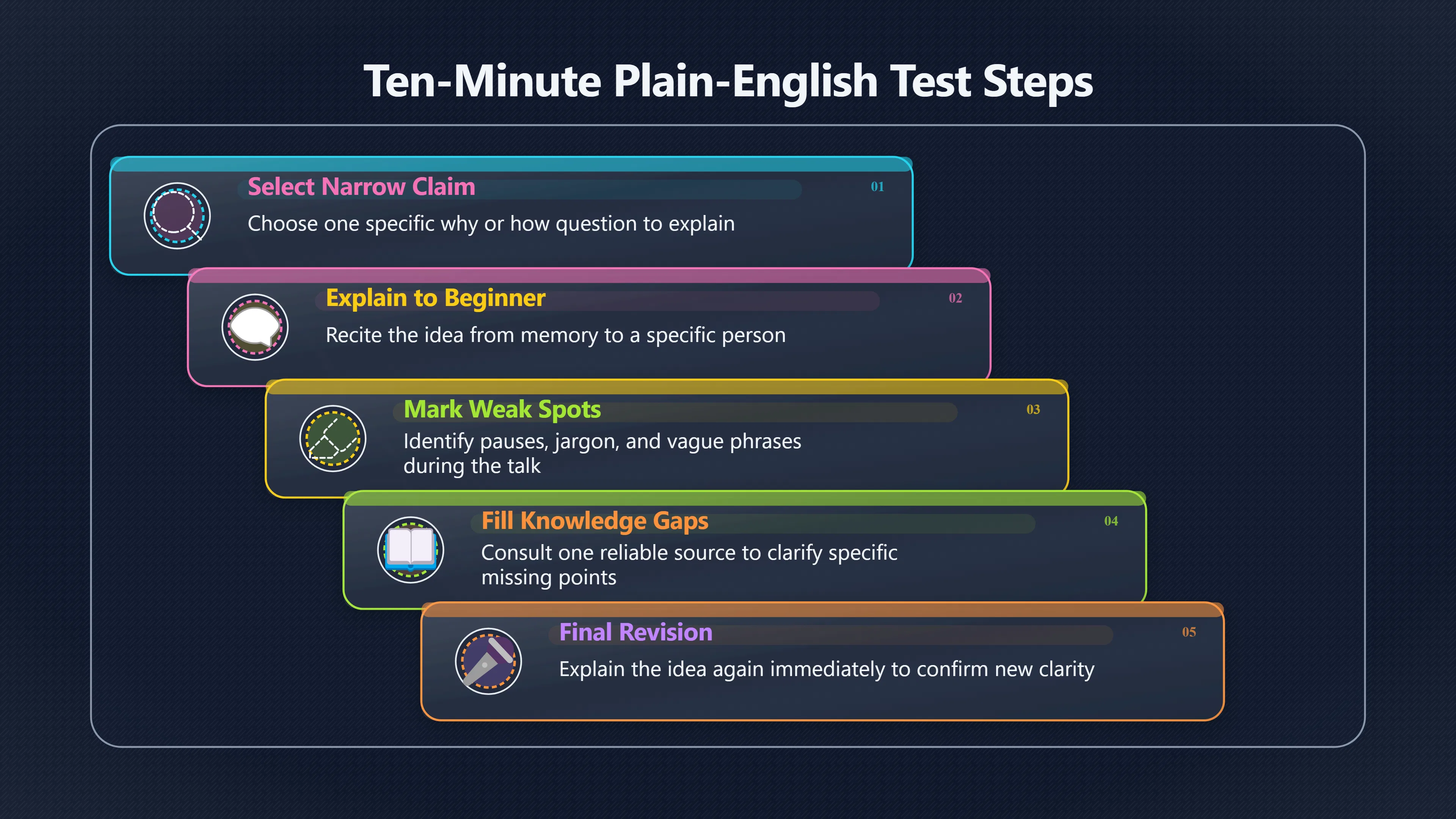
Aim for a simple structure:
- State what the idea is.
- Explain why it matters.
- Describe what happens step by step.
- Give one concrete example.
- Mention one important limitation or exception if it is central to understanding.
This structure naturally forces causal thinking instead of encouraging lists of definitions.
Marking weak spots instead of hiding them
The value of the exercise comes from recording failures rather than avoiding them.
While explaining, mark every place where you:
- pause for several seconds;
- use a technical term without defining it;
- replace explanation with phrases such as “basically”, “it’s just”, or “obviously”;
- skip directly from cause to conclusion without describing what happens in between;
- realise you cannot answer a likely beginner’s question.
These are not mistakes to erase. They are evidence showing exactly where further learning should be focused.
Healthcare’s teach-back approach follows a similar principle. Instead of asking whether someone understands instructions, clinicians ask them to explain the information in their own words. Any misunderstanding is treated as feedback about the explanation rather than as personal failure, allowing clarification before moving on.[PMC]pmc.ncbi.nlm.nih.govEvaluation of teach-back and plain language acceptability…by AA Sleiman · 2025 · Cited by 1 — This study advances clinician-patient…
Revise only once
A common temptation is to keep rewriting until the explanation sounds elegant. That is not the purpose of a ten-minute test.
Instead:
- identify the missing knowledge;
- consult one reliable source to fill only those gaps;
- explain the same idea again immediately;
- stop after one revision.
Keeping the cycle short prevents the exercise from becoming ordinary note-taking. It also creates a clear comparison between the first explanation and the second, making improvements visible.
Educational research on retrieval and feedback suggests that recalling information first and then correcting errors produces stronger learning than repeatedly rereading material without testing yourself.[Department of Education]education-ni.gov.ukDepartment of Education Retrieval PracticeDepartment of EducationRetrieval Practice:April 29, 2025 — Retrieval Practice has consistently been found to be one of the most effective…
A worked example
Suppose the claim is:
“Price ceilings can create shortages.”
A weak explanation might be:
“Prices are kept low, which affects supply and demand.”
Although technically correct, it leaves almost every important mechanism unexplained.
After revision, the explanation becomes:
“If the government sets the maximum price below what many buyers are willing to pay, more people want to buy the product because it is cheaper. At the same time, some producers make less because selling becomes less profitable. More buyers and fewer sellers mean demand becomes greater than supply, so some people cannot buy the product even though they want it.”
The improvement comes from adding the missing causal chain rather than introducing more specialist vocabulary.

Signs the test is working
The exercise is succeeding when you notice yourself changing how you think, not merely polishing how you speak.
Typical indicators include:
- replacing abstract words with concrete actions;
- identifying assumptions you had not realised you were making;
- discovering that two ideas you treated as identical are actually different;
- finding questions you cannot yet answer;
- reducing the explanation while increasing its precision.
Paradoxically, many people feel less confident after the first attempt because they discover how much they do not yet understand. Research on the illusion of explanatory depth suggests this reduction in overconfidence is often a sign that self-assessment has become more accurate.[Department of Education]education-ni.gov.ukDepartment of Education Retrieval PracticeDepartment of EducationRetrieval Practice:April 29, 2025 — Retrieval Practice has consistently been found to be one of the most effective…
Common mistakes
Several habits reduce the value of the exercise:
- Choosing a topic that is too large. Narrow claims reveal specific weaknesses.
- Checking notes while explaining. This measures reading ability rather than understanding.
- Replacing explanation with terminology. Naming a concept is not the same as explaining its mechanism.
- Trying to sound expert. The purpose is clarity, not sophistication.
- Rewriting indefinitely. One focused revision is usually enough to reveal whether the explanation has genuinely improved.
Why this short exercise improves analytical thinking
The ten-minute plain-English test works because it turns understanding into something observable. Instead of asking whether an idea feels familiar, it asks whether you can reconstruct the reasoning in your own words, connect each step, and survive simple questions from a beginner. By limiting the exercise to one narrowly defined claim and one revision, it remains practical enough to repeat regularly while providing immediate evidence about what you know, what you only recognise, and what still needs careful thought.
eBay marketplace picks
Marketplace Samples
Live-tested eBay searches with available results related to this page.


Endnotes
1.
Source: education-ni.gov.uk
Title: Department of Education Retrieval Practice
Link:https://www.education-ni.gov.uk/sites/default/files/2025-04/May%20Newsletter%20-%20Retrieval%20Practice%20%20What%20it%20is%2C%20Why%20it%20Works%20and%20How%20to%20Do%20It%20Better.PDF
Source snippet
Department of EducationRetrieval Practice:April 29, 2025 — Retrieval Practice has consistently been found to be one of the most effective...
Published: April 29, 2025
2.
Source: pmc.ncbi.nlm.nih.gov
Link:https://pmc.ncbi.nlm.nih.gov/articles/PMC12681931/
Source snippet
Evaluation of teach-back and plain language acceptability...by AA Sleiman · 2025 · Cited by 1 — This study advances clinician-patient...
Additional References
3.
Source: fs.blog
Link:https://fs.blog/feynman-learning-technique/
Source snippet
Farnam StreetThe Feynman Learning TechniqueThe Feynman Technique is the best way to supercharge your learning. And it works no matter the...
4.
Source: instagram.com
Link:https://www.instagram.com/reel/Cs49a0KokkC/?hl=en
Source snippet
UNDERSTAND ANYTHING. The Feynman technique involves...The Feynman technique involves the process of simplifying and explaining complex c...
5.
Source: revaldoai.com
Link:https://revaldoai.com/es/feynman_info
Source snippet
words without looking at your notes, (3) identify the gaps in your explanation...Read more...
6.
Source: facebook.com
Link:https://www.facebook.com/TheNarayanaGroup/posts/%F0%9D%97%A7%F0%9D%97%B5%F0%9D%97%B2-%F0%9D%97%99%F0%9D%97%B2%F0%9D%98%86%F0%9D%97%BB%F0%9D%97%BA%F0%9D%97%AE%F0%9D%97%BB-%F0%9D%97%A7%F0%9D%97%B2%F0%9D%97%B0%F0%9D%97%B5%F0%9D%97%BB%F0%9D%97%B6%F0%9D%97%BE%F0%9D%98%82%F0%9D%97%B2-%F0%9D%97%B6%F0%9D%98%80-%F0%9D%98%80%F0%9D%97%B6%F0%9D%97%BA%F0%9D%97%BD%F0%9D%97%B9%F0%9D%97%B2learn-explain-%EF%B8%8F-identify-gaps-relearn-try-this-af/1177652777869873/
Source snippet
The Feynman Technique challenges you to explain complex concepts in simple words. If you can explain it clearly, you understand it.Read more...
7.
Source: voicescriber.com
Title: feynman technique learning by explaining
Link:https://voicescriber.com/feynman-technique-learning-by-explaining
Source snippet
The Feynman Technique: Learn Anything by Explaining It...8 Feb 2026 — The Feynman Technique is a study method where you explain a topic...
8.
Source: sheilabrobinson.com
Title: Sheila B Robinson The Feynman Technique
Link:https://www.sheilabrobinson.com/the-feynman-technique-retrieval-practice-at-its-best/
Source snippet
The Feynman Technique - Retrieval Practice at its BestRetrieval practice is essentially practicing your learning, calling information bac...
9.
Source: youtube.com
Title: You Don’t Know Anything
Link:https://www.youtube.com/watch?v=_ak0k7GNCjM
Source snippet
The Illusion of Explanatory Depth...illusion of explanatory depth. This explains our inability to explain things we think we know a lot...
10.
Source: youtube.com
Title: The Feynman Technique — Stop Memorizing, Start Understanding
Link:https://www.youtube.com/watch?v=NYSe2Ln0Tf4
Source snippet
How to Use the Feynman Technique - Study Tips - YouTube...
11.
Source: youtube.com
Title: Study Strategies: Retrieval Practice
Link:https://www.youtube.com/watch?v=Pjrqc6UMDKM
Source snippet
How can you learn more efficiently? (with Scott Young) - ClearerThinking.org Podcast...
12.
Source: youtube.com
Title: How to Use the Feynman Technique
Link:https://www.youtube.com/watch?v=q-16DPh_VWw
Source snippet
Study Strategies: Retrieval Practice - YouTube...
Topic Tree