Within Fluency Trap
Why Rereading Feels Better Than It Works
Rereading can make material feel easier without proving you can recall or use it when the page is gone.
On this page
- How fluency creates false confidence
- What rereading can and cannot prove
- A better after reading check
Page outline Jump by section
Introduction
Rereading feels productive because it makes information easier to process. Sentences become familiar, key terms seem obvious, and the overall structure no longer feels confusing. That improvement in ease is real, but it is not the same as durable learning. The critical question is not whether material looks familiar while it is in front of you, but whether you can recall, explain, or apply it after the page has been closed. Cognitive psychology consistently shows that people often mistake this growing sense of fluency for genuine understanding, leading them to stop studying before knowledge is stable enough to use independently. [Cognition and Learning Lab]learninglab.psych.purdue.edu2009 Karpicke Butler RoedigerCognition and Learning LabDo students practise retrieval when they study on their own?1 May 2009 — We propose that many students experien…
How fluency creates false confidence
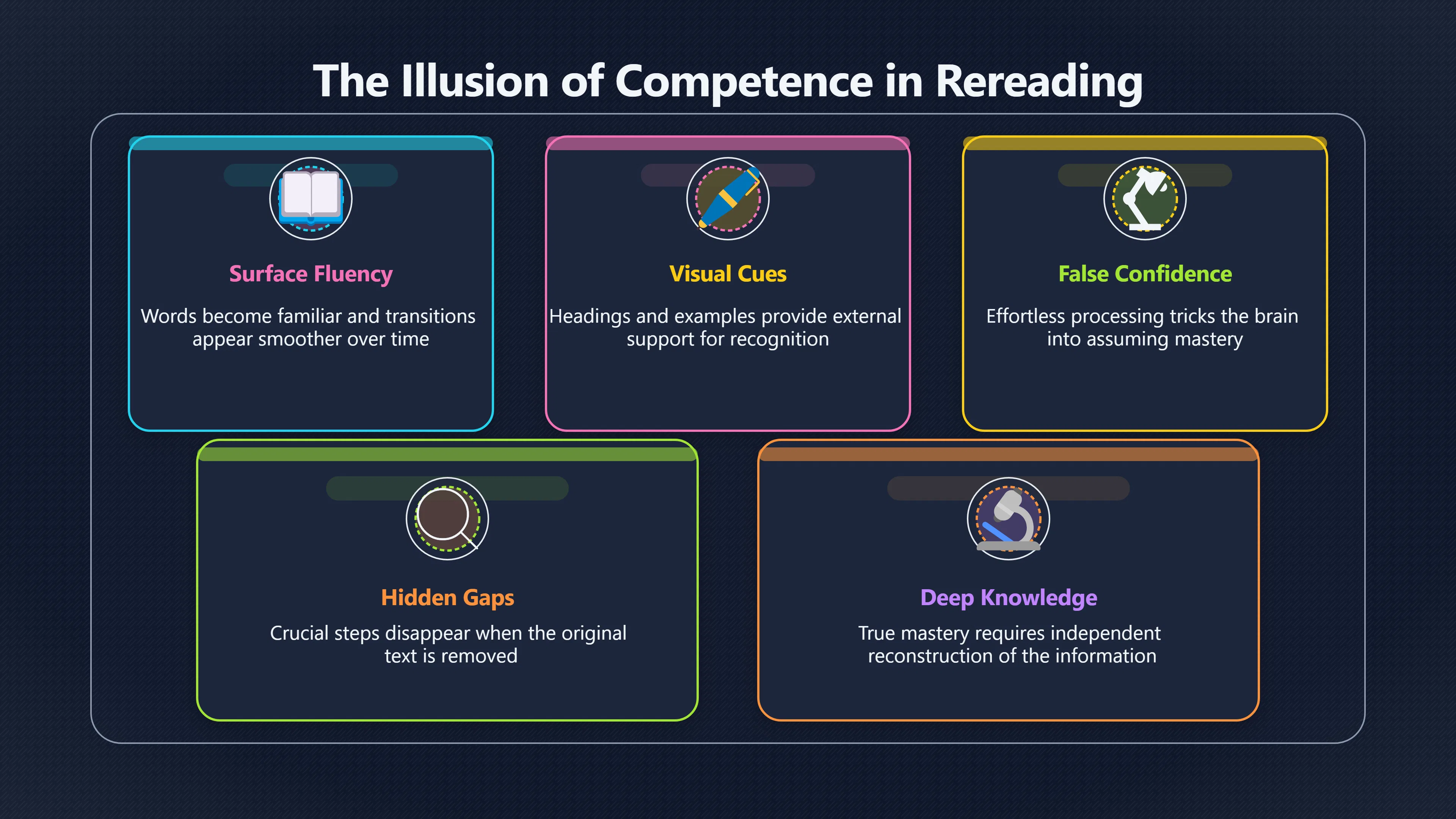
Rereading changes the experience of reading. On the second or third pass, words are recognised more quickly, transitions seem smoother, and arguments appear easier to follow. The brain naturally interprets this effortless processing as evidence that learning has occurred.
The problem is that the page is still doing much of the work. The original wording, sequence, headings and examples remain visible, so recognition replaces reconstruction. You are not necessarily retrieving ideas from memory; you are responding to cues that are already present. Once those cues disappear, performance often falls much more than confidence predicted. [Bjork Learning and Forgetting Lab]bjorklab.psych.ucla.eduEBjork RBjork 2011Bjork Learning and Forgetting LabCreating Desirable Difficulties to Enhance Learningby EL Bjork · Cited by 2237 — At a theoretical level…
Researchers describe this as an illusion of competence. Surveys of students repeatedly find that rereading is one of the most popular study strategies even though relatively few learners regularly test themselves. Because rereading feels smooth, learners often conclude that it is effective and continue choosing it over methods that produce stronger long-term retention. [Cognition and Learning Lab]learninglab.psych.purdue.edu2009 Karpicke Butler RoedigerCognition and Learning LabDo students practise retrieval when they study on their own?1 May 2009 — We propose that many students experien…
This illusion becomes especially misleading in analytical work. Reading the same explanation several times can create the impression that you understand an argument, causal mechanism or mathematical proof. Yet when asked to reproduce the reasoning without the original text, many of the crucial steps are missing.
What rereading can and cannot prove
Rereading is not useless. It serves several legitimate purposes, but these are narrower than many learners assume.
Rereading can help you:
- Refresh your memory of material studied earlier.
- Notice details or connections missed on the first reading.
- Build initial familiarity with difficult terminology.
- Prepare for deeper study or active practice.
What it cannot reliably prove is that you can:
- Recall the information without prompts.
- Explain the underlying mechanism in your own words.
- Solve a new problem using the idea.
- Transfer the knowledge to a different situation.
- Detect where your own understanding is incomplete.
This distinction explains why students sometimes leave a study session feeling highly confident yet struggle in an exam or discussion. Recognition during review is a much easier task than independent retrieval.
Classic experiments comparing repeated study with retrieval practice illustrate this difference. Learners who repeatedly reread material often perform well immediately afterwards because the material remains highly accessible. However, after a delay, participants who spent more time actively retrieving information generally retain substantially more than those who relied mainly on restudying. [Wikipedia]WikipediaTesting effectTesting effect
Robert and Elizabeth Bjork’s work on “desirable difficulties” offers an explanation. Activities that feel slightly harder during learning—such as recalling information, spacing practice, or answering questions from memory—often produce stronger long-term learning precisely because they require rebuilding knowledge rather than simply recognising it. [Bjork Learning and Forgetting Lab]bjorklab.psych.ucla.eduEBjork RBjork 2011Bjork Learning and Forgetting LabCreating Desirable Difficulties to Enhance Learningby EL Bjork · Cited by 2237 — At a theoretical level…

Why familiarity disappears when the page is gone
The weakness of rereading becomes obvious when external support is removed.
Imagine reading an explanation of how inflation affects interest rates three times. While the page is open, every step seems clear. If someone then asks you to explain the process from memory, you may discover that you remember isolated facts but cannot connect them into a coherent causal chain.
The same pattern appears across many domains:
- A programming tutorial makes perfect sense until you try to write the code without looking.
- A mathematical proof seems obvious until you reproduce each step independently.
- A historical argument appears convincing until you explain why the evidence supports the conclusion rather than an alternative interpretation.
In each case, rereading strengthened recognition more than reconstruction.
This is closely related to the illusion of explanatory depth: people often believe they understand how something works until they attempt a detailed explanation. Producing an explanation exposes gaps that passive review leaves hidden. [Wikipedia]WikipediaIllusion of explanatory depthIllusion of explanatory depth
A better after-reading check
A simple change after finishing a section of reading provides a much more reliable estimate of learning.
Instead of immediately reading the same pages again:
- Close the book or notes.
- Write down everything you can remember.
- Explain the main idea aloud in your own words.
- Draw the process or argument from memory.
- Compare your reconstruction with the original and identify what was missing.
The important signal is not how easy this feels. In fact, successful learning often feels less fluent because retrieval exposes uncertainty. That temporary difficulty is informative: it reveals what still requires attention instead of hiding weaknesses behind repeated exposure. [PMC]pmc.ncbi.nlm.nih.govPMCThe Use of Retrieval Practice in the Health Professionsby MJ Serra · 2025 · Cited by 15 — Retrieval practice, or the active recall of information from memory, is a highly effective learning…
The practical lesson
Rereading is most useful as preparation for thinking, not as evidence that thinking has already happened. It increases familiarity, reduces the feeling of novelty and can improve orientation within a topic, but these benefits are easily mistaken for genuine mastery.
If your goal is stronger thinking and analytical skill, the decisive question after reading is not, “Does this look familiar?” It is, “Can I recreate the idea, explain why it works, and use it when the original words are no longer in front of me?” Active retrieval answers that question; repeated rereading usually does not. [Cognition and Learning Lab+2Wikipedia]learninglab.psych.purdue.edu2009 Karpicke Butler RoedigerCognition and Learning LabDo students practise retrieval when they study on their own?1 May 2009 — We propose that many students experien…
eBay marketplace picks
Marketplace Samples
Topic-anchored marketplace searches for visual, collectible, or second-hand items related to this page.




Endnotes
-
Source: Wikipedia
Title: Testing effect
Link: https://en.wikipedia.org/wiki/Testing_effect -
Source: Wikipedia
Title: Illusion of explanatory depth
Link: https://en.wikipedia.org/wiki/Illusion_of_explanatory_depth -
Source: pmc.ncbi.nlm.nih.gov
Title: PMCThe Use of Retrieval Practice in the Health Professions
Link: https://pmc.ncbi.nlm.nih.gov/articles/PMC12292765/Source snippet
by MJ Serra · 2025 · Cited by 15 — Retrieval practice, or the active recall of information from memory, is a highly effective learning...
-
Source: learninglab.psych.purdue.edu
Title: 2009 Karpicke Butler Roediger
Link: https://learninglab.psych.purdue.edu/downloads/2009/2009_Karpicke_Butler_Roediger.pdfSource snippet
Cognition and Learning LabDo students practise retrieval when they study on their own?1 May 2009 — We propose that many students experien...
Published: May 2009
-
Source: bjorklab.psych.ucla.edu
Title: EBjork RBjork 2011
Link: https://bjorklab.psych.ucla.edu/wp-content/uploads/sites/13/2016/04/EBjork_RBjork_2011.pdfSource snippet
Bjork Learning and Forgetting LabCreating Desirable Difficulties to Enhance Learningby EL Bjork · Cited by 2237 — At a theoretical level...
-
Source: pmc.ncbi.nlm.nih.gov
Link: https://pmc.ncbi.nlm.nih.gov/articles/PMC12372469/Source snippet
Bjork, 2005). This “illusion of competence” leads to faster but less accurate re-readings, thus preventing the strengthening of memory...
Additional References
-
Source: researchgate.net
Link: https://www.researchgate.net/publication/24268097_Metacognitive_strategies_in_student_learning_Do_students_practise_retrieval_when_they_study_on_their_ownSource snippet
Do students practise retrieval when they study on their own?We propose that many students experience illusions of competence while studyi...
-
Source: researchgate.net
Link: https://www.researchgate.net/publication/364586997Desirable_Difficulties_in_Applied_Learning_Settings[MechanismsSource snippet
(PDF) Desirable Difficulties in Applied Learning Settings21 Oct 2022 — practicing test questions has been found to outperform restudy ret...
-
Source: nko.nl
Link: https://www.nko.nl/sites/nro/files/migrate/411-10-910-010-Proefschrift_Reijners.pdfSource snippet
Karpicke & Grimaldi, 2012) which means that retrieval practice through...Read more...
-
Source: structural-learning.com
Link: https://www.structural-learning.com/post/fluency-illusions-students-think-they-knowSource snippet
Fluency Illusions: Why Students Think They Know More29 Dec 2025 — Karpicke's research showed re-reading helps learners less than retrieva...
-
Source: wsj.com
Title: The Wall Street Journal Want to Remember More?
Link: https://www.wsj.com/science/biology/want-to-remember-more-make-more-mistakes-2d195a6fSource snippet
Make More MistakesThe article discusses the importance of making mistakes in the learning process, highlighting the concept of error-driv...
-
Source: structural-learning.com
Title: testing effect retrieval practice
Link: https://www.structural-learning.com/post/testing-effect-retrieval-practiceSource snippet
The Testing Effect: Why Retrieval Practice Works29 Dec 2025 — Testing helps learners recall facts, according to Bjork (1994)...
-
Source: assets.markallengroup.com
Title: 8 Competence References
Link: https://assets.markallengroup.com/article-images/246201/8-CompetenceReferences.pdfSource snippet
A. (2005) Illusions of competence in monitoring one's knowledge during study. Journal of Experimental Psychology: Learning...Read more...
-
Source: structural-learning.com
Title: robert bjork teachers guide desirable
Link: https://www.structural-learning.com/post/robert-bjork-teachers-guide-desirableSource snippet
Roediger and Karpicke (2006) found recall beats re-reading for learning. This "testing effect" shows retrieval...
-
Source: youtube.com
Title: Memorize Anything So Fast It’s Almost Unfair | Hello! Seiiti Arata 426
Link: https://www.youtube.com/watch?v=VbRrvq3alcsSource snippet
The Insanely Flawed Learning System of the Priest Who Tried to Know Everything...
-
Source: youtube.com
Title: THE INTELLIGENCE TRAP (The Mistake Smart People Make When Learning)
Link: https://www.youtube.com/watch?v=sXwpQlKdCckSource snippet
Memorize Anything So Fast It's Almost Unfair | Hello! Seiiti Arata 426...
Topic Tree