Within Sharper Thinking
How Do You Stay Open Without Drifting?
Good thinking is not doubting everything; it is being willing to revise beliefs when the evidence changes.
On this page
- Humility versus indecision
- Updating beliefs
- Reasonable confidence
Page outline Jump by section
Introduction
Intellectual humility is the habit of treating your own beliefs as strong, weak or revisable in proportion to the evidence behind them. It is not cynicism, which distrusts everything, nor indecision, which avoids commitment. A humble thinker can say, “I am confident about this,” while also knowing what kind of evidence would make that confidence shrink. That balance matters because good analysis depends on two abilities that often pull against each other: holding a view firmly enough to act, and holding it lightly enough to update when reality pushes back. Research commonly defines intellectual humility as recognising the limits of one’s knowledge and accepting that one’s beliefs may be wrong; reviews link it with better evidence evaluation, lower dogmatism and more constructive disagreement.[PMC]pmc.ncbi.nlm.nih.govPMCPredictors and consequences of intellectual humilityby T Porter · 2022 · Cited by 359 — Intellectual humility involves acknowledging the limitations of one's knowledge and that one's bel…
The practical mechanism is simple but demanding: separate confidence from ego. When a belief becomes part of personal identity, changing it can feel like losing status, loyalty or self-respect. Intellectual humility keeps the belief available for inspection. It asks: How do I know? How strong is the evidence? What would I expect to see if I were mistaken? That is very different from drifting into “nothing is knowable”. The point is not to doubt everything, but to make confidence answerable to evidence.
Humility Is Not Indecision
A common misunderstanding is that intellectual humility means always hedging, refusing to take a side, or treating every claim as equally plausible. That would make thinking worse, not better. Many decisions require action before certainty is possible: choosing a medical treatment, hiring someone, voting, investing time in a project, or deciding whether a source is trustworthy. Humility does not remove the need to decide; it improves the way confidence is formed.
The useful distinction is between uncertainty about your knowledge and paralysis about your judgement. A person can recognise incomplete evidence and still make a provisional conclusion. In fact, the strongest forms of humility usually make reasoning more decisive, because they reduce the emotional need to defend a first impression. Reviews of intellectual humility describe it as an awareness of intellectual limitations, not as a blanket refusal to believe anything; it is associated with being more attentive to evidence quality and more willing to reconsider when evidence changes.[John Templeton Foundation]templeton.orgJohn Templeton Foundation The Psychology of Intellectual HumilityJohn Templeton Foundation The Psychology of Intellectual Humility
A humble judgement often sounds like this:
- “I am fairly confident, because the evidence is direct and consistent.”
- “I am uncertain, because the evidence is indirect or comes from interested parties.”
- “I used to think X, but Y evidence makes me revise that.”
- “I still reject that claim, but I may have been too quick to dismiss the person making it.”
The last example is especially important. Intellectual humility does not require giving every idea equal weight. Philosophers discussing extremist or demonstrably false views argue that a person can own their own limitations without being open to revising well-supported beliefs that those views are false. In that account, humility may mean avoiding lazy assumptions about the people who hold a view, while still refusing to treat the view itself as a live possibility.[Cambridge University Press & Assessment]cambridge.orgOpen source on cambridge.org.
That boundary protects humility from sliding into performative neutrality. In serious thinking, “both sides” is not a principle; it is sometimes a useful starting question. When the evidence is uneven, intellectual humility may require saying so.

How Beliefs Actually Update
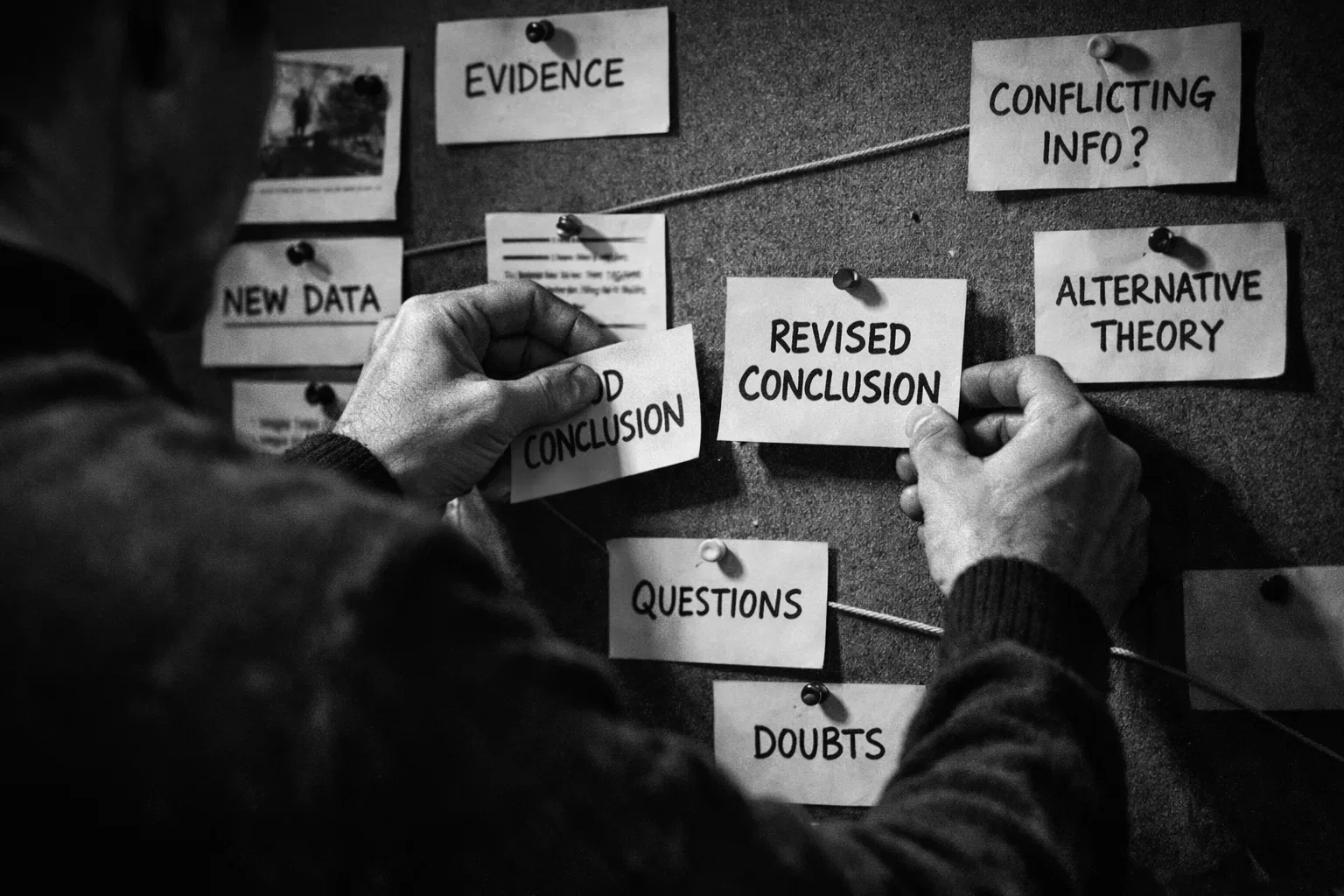
Belief updating is not just adding new information to an empty container. People interpret evidence through prior assumptions, identity, trust, emotion and social context. That is why two people can see the same fact and move in different directions. Intellectual humility works by making that updating process more visible.
One mechanism is metacognition, meaning the ability to think about your own thinking. Rather than asking only “Is this claim true?”, the humble thinker also asks, “What is my basis for believing it?” and “Am I more confident than my evidence warrants?” The Greater Good Science Center describes intellectual humility as recognising that one’s beliefs may be fallible because evidence can be limited, flawed or hard to evaluate.[Greater Good]greatergood.berkeley.eduwhat does intellectual humility look likewhat does intellectual humility look like
A second mechanism is active open-mindedness. Psychologist Keith Stanovich’s work on actively open-minded thinking measures habits such as considering alternative views, noticing evidence that contradicts current beliefs and postponing closure when the evidence is still weak. Such measures are associated with better performance on reasoning and bias tasks, and with lower endorsement of superstitious and conspiracy beliefs.[PMC]pmc.ncbi.nlm.nih.govPMCActively Open-Minded Thinking and Its MeasurementPMCActively Open-Minded Thinking and Its Measurement
A third mechanism is evidence-weighting. New information should not move every belief by the same amount. Strong evidence from a reliable method should change confidence more than a rumour, a single anecdote or an argument from someone with a clear persuasive agenda. Research on belief updating under ambiguity makes a related point: when new information arrives, people should retain conditional beliefs in which they have stronger confidence and relinquish weaker ones first.[IDEAS/RePEc]ideas.repec.orgIDEAS/Re PEc Updating Confidence in BeliefsIDEAS/Re PEc Updating Confidence in Beliefs
In practice, belief updating can be treated as a sequence:
- Name the belief. Vague beliefs are hard to revise. “This policy is bad” is less updateable than “This policy is likely to increase waiting times in the first year.”
- State current confidence. Use rough levels: low, moderate, high. The exact number matters less than noticing that confidence has a size.
- Identify the evidence type. Is it direct measurement, expert consensus, personal experience, analogy, testimony, or inference?
- Look for disconfirming evidence. Not to prove yourself wrong, but to test whether the belief survives contact with the best available objections.
- Update by degree. Most evidence should shift confidence, not flip belief from 0 to 100.
This is where humility differs from cynicism. Cynicism often treats new evidence as just another attempt to manipulate. Humility asks whether the evidence is strong, relevant and independent enough to deserve a change in confidence.
Why Cynicism Feels Sophisticated but Weakens Analysis
Cynicism can masquerade as intelligence because it sounds guarded. It avoids naivety by assuming hidden motives, institutional failure or bad faith. Sometimes those suspicions are warranted. But as a thinking style, cynicism has a major flaw: it can become unfalsifiable. If every source is dismissed in advance, evidence can no longer correct the belief.
Intellectual humility is more demanding because it does not let either trust or distrust run automatically. It asks for discrimination. Which source has relevant expertise? Which claim is supported by independent evidence? Which part of the story is well established, and which part is speculation? That selective attention is why humility can improve misinformation discernment rather than simply making people cautious about everything.
A 2024 study by Toby Prike found that intellectual humility was associated with better ability to distinguish true from false news headlines, and that the effect was not merely a general tendency to call everything false or withhold judgement. Participants higher in intellectual humility showed greater misinformation discernment and metacognitive insight, not just blanket scepticism.[Advances.in]advances.inOpen source on advances.in.
A related 2024 meta-analysis reported that intellectual humility was consistently associated with lower receptivity to misinformation across 54 studies. That finding matters because it cuts against the idea that being open-minded makes people gullible. The better interpretation is that humility improves the filter: it weakens overconfident attachment to false claims while preserving the ability to accept credible ones.[Advances.in]advances.inIntellectual humility and misinformation receptivityIntellectual humility and misinformation receptivity
This difference can be seen in everyday information checks:
- Cynical response: “All media lies, so I’ll trust what feels plausible to me.”
- Naive response: “This source looks professional, so it is probably true.”
- Humble response: “What is the claim, what evidence supports it, and how reliable is the source for this specific question?”
The humble response is slower, but not endlessly slow. It gives doubt a job: to improve judgement, not to protect the thinker from ever being corrected.
Updating Without Losing Yourself
Some beliefs are easy to update because they are peripheral. If someone shows that a restaurant has closed, a statistic has changed or a remembered date is wrong, revision costs little. Other beliefs are harder because they connect to identity, group loyalty, moral commitments or professional status. Research on the relationship between intellectual humility and open-mindedness suggests that belief revision varies depending on how central a belief is to the person; people may be generally humble yet much less open about views they see as core to who they are.[ResearchGate]researchgate.netResearch Gate Links Between Intellectual Humility and Open-MindednessResearch Gate Links Between Intellectual Humility and Open-Mindedness
That does not mean core beliefs should be casually abandoned. Some convictions are supported by deep evidence, moral reflection and lived experience. The problem arises when identity prevents even modest revision: not changing a conclusion when the evidence is weak, not admitting exceptions, not correcting exaggerated claims, or not acknowledging uncertainty in the parts of the belief that genuinely are uncertain.
A useful distinction is between the centre and the edges of a belief. The centre may remain stable while the edges update. For example, someone might keep a strong moral commitment to free expression while revising their view about a specific platform rule, legal threshold or real-world risk. Someone might remain committed to climate action while updating their estimate of which policy is most cost-effective. Someone might keep confidence in a scientific consensus while changing their mind about a particular study, prediction or communication strategy.
This is often the healthiest form of belief revision. It avoids two bad choices: total rigidity and total collapse. Intellectual humility lets the thinker say, “The main conclusion still stands, but I overstated this part,” or “My value has not changed, but my factual assumption has.”

Reasonable Confidence Has a Shape
Reasonable confidence is not a mood. It has a structure. It depends on how much evidence there is, how good that evidence is, how directly it bears on the claim, how independent the sources are, and how well rival explanations have been tested.
A practical way to build this structure is to attach confidence to evidence conditions:
- High confidence: multiple independent sources, direct evidence, clear methods, successful predictions, and serious attempts to rule out alternatives.
- Moderate confidence: plausible evidence, some expert support, but remaining uncertainty about measurement, incentives, generalisability or missing data.
- Low confidence: anecdotes, single-source claims, weak analogy, unclear methods, strong emotional appeal, or evidence that mainly confirms what you already wanted to believe.
This is not a formal scientific scale, but it trains a vital habit: confidence should be earned. Work on intellectual humility repeatedly links the trait with noticing one’s own knowledge limits, being less defensive, and paying closer attention to evidence strength.[John Templeton Foundation]templeton.orgOpen source on templeton.org.
Reasonable confidence also includes knowing when not to reopen a question. Some doubts are productive; others are exaggerated. Tenelle Porter’s 2025 guidance on practising intellectual humility explicitly warns that people need help distinguishing reasonable doubt from exaggerated doubt, excessive self-criticism and “vicious scepticism”.[Taylor & Francis Online]tandfonline.comOpen source on tandfonline.com.
That warning is central to avoiding cynicism. A person who constantly reopens settled questions may look humble, but they may actually be refusing the discipline of proportion. If a claim has been tested repeatedly and alternatives have failed, humility may support confidence. The humble move is not “maybe everything is wrong”; it is “my confidence should match the state of the evidence.”
Disagreement Is a Test of Humility
Disagreement reveals whether intellectual humility is real. It is easy to endorse fallibility in the abstract; it is harder when someone corrects you in public, challenges a cherished view, or points out a blind spot. The first bodily reaction may be heat, defensiveness or contempt. That reaction is not proof of failure. The key question is what happens next.
Research and public-facing psychology writing often connect intellectual humility with lower defensiveness, better conflict management and more constructive relationships. Reporting in The Guardian, drawing on psychologists who study humility and rigidity, describes intellectually humble people as more able to acknowledge limits, admit gaps in knowledge and avoid overconfidently clinging to beliefs when contradicted.[The Guardian]theguardian.comThe Guardian Why it's good to admit when you're wrongIntellectual humility can be evaluated by observing one's responses to contradiction or disruption. Being defensive may signal low humili…
In political disagreement, the stakes are higher because beliefs often signal group membership. Studies on affective polarisation have found that intellectual humility is negatively associated with political hostility and can lead people to view political outgroups more favourably.[American Psychological Association]apa.orgpsp pspi0000462psp pspi0000462
But humility in disagreement does not mean pretending the other person is equally right. It means improving the quality of contact between belief and evidence. In a hard conversation, that may involve three separate moves:
- Understand the claim before attacking it. Misstating a view makes your rebuttal weaker, even when your conclusion is right.
- Separate the person from the proposition. A false belief does not justify lazy assumptions about the person’s intelligence, motives or worth.
- Ask what evidence would matter. If neither side can name evidence that would change anything, the conversation is no longer an inquiry.
This helps explain why humility can reduce polarisation without requiring bland agreement. It keeps the door open to learning where learning is possible, while preserving the right to reject claims that remain unsupported or harmful.
The Failure Modes: Gullibility, False Balance and Overcorrection
Intellectual humility has risks when misunderstood. The first is gullibility: mistaking openness for equal trust. A humble thinker listens, but does not suspend source evaluation. Expertise, track record, method and incentives still matter.
The second is false balance: treating unequal evidence as if fairness requires equal weight. In public debates, this can make weak claims seem stronger than they are. Humility should make a person more careful about overstatement, but it should not erase real differences in evidence quality.
The third is overcorrection. After discovering an error, people sometimes swing too far: “I was wrong about that, so I cannot trust my judgement at all.” That is not humility; it is global self-distrust. Research by Neil Levy argues that inducing humility can sometimes make people lower confidence in beliefs that are actually justified for them, which is a reminder that humility needs calibration, not just reduction of confidence.[PMC]pmc.ncbi.nlm.nih.govPMCToo humble for wordsPMCToo humble for words
A fourth failure mode is identity-protective humility: being humble only about safe, low-stakes beliefs while remaining rigid about the beliefs that most need inspection. This can look like admirable nuance in trivial matters and complete defensiveness in central ones. The remedy is not to attack core beliefs indiscriminately, but to test their factual supports, edge cases and practical consequences.
A useful self-check is: “Where am I most likely to call myself reasonable while refusing the kind of evidence I would demand from someone else?” That question keeps humility from becoming a decorative virtue.
How to Practise It in Real Thinking
Intellectual humility becomes useful when it is built into ordinary reasoning routines. It should appear before major decisions, during research, after mistakes, and whenever a topic triggers a strong identity reaction.
One effective practice is the confidence sentence: before arguing for a claim, write one sentence that states both the belief and its strength. For example: “I am moderately confident that this project will miss its deadline because two dependencies are unresolved and the team has missed similar estimates before.” That sentence exposes the evidence chain and makes later updating easier.
Another practice is the disconfirming search. Do not merely search for “why my view is right”. Search for the strongest version of the opposing argument, the best evidence against your claim, and the conditions under which your claim would fail. This aligns with active open-minded thinking: considering alternatives and attending to evidence that contradicts current beliefs.[PMC]pmc.ncbi.nlm.nih.govPMCActively Open-Minded Thinking and Its MeasurementPMCActively Open-Minded Thinking and Its Measurement
A third practice is the mistake review. When you were wrong, ask whether the error came from missing data, bad source judgement, emotional reasoning, overgeneralising from experience, or trusting a familiar pattern too quickly. The aim is not self-punishment; it is improving the next update.
For everyday use, the following prompts are enough:
- What exactly do I believe?
- How confident am I?
- What evidence is doing most of the work?
- What would I expect to see if I were wrong?
- Am I dismissing this because it is weak, or because it is uncomfortable?
- Am I accepting this because it is strong, or because it is convenient?
- Which part of my view could change without destroying the whole view?
These questions turn humility into a mechanism. They create a pause between impulse and conclusion, but they do not require endless doubt.
The Payoff for Better Thinking
The value of intellectual humility is not that it makes people sound modest. Its value is that it improves the contact between belief and reality. It makes confidence more earned, disagreement more informative, mistakes less identity-threatening, and updating less humiliating.
Within analytical thinking, that changes the whole posture of inquiry. Instead of asking, “How can I defend my view?”, the better question becomes, “What level of confidence does the evidence justify now?” Sometimes the answer will be strong confidence. Sometimes it will be uncertainty. Sometimes it will be a small but important revision.
That is humility without cynicism: open enough to learn, disciplined enough to reject weak claims, and confident enough to act when the evidence warrants it.
Amazon book picks
Further Reading
Books and field guides related to How Do You Stay Open Without Drifting?. Use these as the next step if you want deeper reading beyond the article.
Think Again
Teaches how to revise beliefs, stay flexible, and avoid identity-protective certainty.
Being Wrong
Explores why being wrong is normal and how to hold beliefs less defensively.
The Scout Mindset
Frames good thinking as wanting to see what is true rather than defending what feels right.
Superforecasting
Shows how good forecasters update beliefs, use probabilities, and stay open to evidence.
eBay marketplace picks
Marketplace Samples
Example marketplace items related to this page. Use the search link to explore similar finds on eBay.




Endnotes
1.
Source: pmc.ncbi.nlm.nih.gov
Title: PMCPredictors and consequences of intellectual humility
Link:https://pmc.ncbi.nlm.nih.gov/articles/PMC9244574/
Source snippet
by T Porter · 2022 · Cited by 359 — Intellectual humility involves acknowledging the limitations of one's knowledge and that one's bel...
2.
Source: templeton.org
Title: John Templeton Foundation The Psychology of Intellectual Humility
Link:https://www.templeton.org/wp-content/uploads/2020/08/JTF_Intellectual_Humility_final.pdf
3.
Source: cambridge.org
Link:https://www.cambridge.org/core/journals/episteme/article/intellectual-humility-without-openmindedness-how-to-respond-to-extremist-views/2FB33B15521127B2EB763FE24D73B394
4.
Source: pmc.ncbi.nlm.nih.gov
Title: PMCActively Open-Minded Thinking and Its Measurement
Link:https://pmc.ncbi.nlm.nih.gov/articles/PMC9966223/
5.
Source: ideas.repec.org
Title: IDEAS/Re PEc Updating Confidence in Beliefs
Link:https://ideas.repec.org/p/ebg/heccah/1338.html
6.
Source: advances.in
Link:https://advances.in/psychology/10.56296/aip00025/
7.
Source: researchgate.net
Link:https://www.researchgate.net/publication/384032606_Intellectual_humility_is_associated_with_greater_misinformation_discernment_and_metacognitive_insight_but_not_response_bias
8.
Source: advances.in
Title: Intellectual humility and misinformation receptivity
Link:https://advances.in/psychology/10.56296/aip00026/
9.
Source: researchgate.net
Title: Research Gate Links Between Intellectual Humility and Open-Mindedness
Link:https://www.researchgate.net/publication/372577153_Links_Between_Intellectual_Humility_and_Open-Mindedness_Does_Strength_of_Belief_Matter
10.
Source: templeton.org
Link:https://www.templeton.org/discoveries/intellectual-humility
11.
Source: pmc.ncbi.nlm.nih.gov
Title: PMCToo humble for words
Link:https://pmc.ncbi.nlm.nih.gov/articles/PMC10541816/
12.
Source: researchgate.net
Link:https://www.researchgate.net/publication/258194201_Open-mindedness_and_Intellectual_Humility
13.
Source: researchgate.net
Title: 319023953 Intellectual humility and openness to the opposing view
Link:https://www.researchgate.net/publication/319023953_Intellectual_humility_and_openness_to_the_opposing_view
14.
Source: researchgate.net
Title: 383981843 Intellectual Humility On Recognizing Our Limits
Link:https://www.researchgate.net/publication/383981843_Intellectual_Humility_On_Recognizing_Our_Limits
15.
Source: researchgate.net
Link:https://www.researchgate.net/publication/399121090_Epistemic_Humility_and_Epistemic_Confidence_Competing_Ethical_Forces_in_Clinical_Medicine
16.
Source: researchgate.net
Link:https://www.researchgate.net/publication/359133100_Clarifying_the_Relations_between_Intellectual_Humility_and_Pseudoscience_Beliefs_Conspiratorial_Ideation_and_Susceptibility_to_Fake_News
17.
Source: researchgate.net
Link:https://www.researchgate.net/publication/298427449_Knowing_what_you_know_Intellectual_humility_and_judgments_of_recognition_memory
18.
Source: advances.in
Link:https://advances.in/psychology/10.56296/tag/intellectual-humility/
19.
Source: world.edu
Link:https://world.edu/the-curious-joy-of-being-wrong-intellectual-humility-means-being-open-to-new-information-and-willing-to-change-your-mind/
20.
Source: greatergood.berkeley.edu
Link:https://greatergood.berkeley.edu/topic/humility/definition
21.
Source: greatergood.berkeley.edu
Title: what does intellectual humility look like
Link:https://greatergood.berkeley.edu/article/item/what_does_intellectual_humility_look_like
22.
Source: ggsc.berkeley.edu
Link:https://ggsc.berkeley.edu/what_we_do/major_initiatives/intellectual_humility/introduction_intellectual_humility_research
23.
Source: tandfonline.com
Link:https://www.tandfonline.com/doi/full/10.1080/15427609.2025.2594925
24.
Source: theguardian.com
Title: The Guardian Why it’s good to admit when you’re wrong
Link:https://www.theguardian.com/wellness/2025/jun/23/admitting-youre-wrong-relationships-intellectual-humility
Source snippet
Intellectual humility can be evaluated by observing one's responses to contradiction or disruption. Being defensive may signal low humili...
25.
Source: apa.org
Title: psp pspi0000462
Link:https://www.apa.org/pubs/journals/releases/psp-pspi0000462.pdf
26.
Source: pubmed.ncbi.nlm.nih.gov
Link:https://pubmed.ncbi.nlm.nih.gov/38739170/
27.
Source: pmc.ncbi.nlm.nih.gov
Link:https://pmc.ncbi.nlm.nih.gov/articles/PMC10535625/
28.
Source: pmc.ncbi.nlm.nih.gov
Link:https://pmc.ncbi.nlm.nih.gov/articles/PMC10960008/
29.
Source: pmc.ncbi.nlm.nih.gov
Link:https://pmc.ncbi.nlm.nih.gov/articles/PMC12543301/
30.
Source: pmc.ncbi.nlm.nih.gov
Link:https://pmc.ncbi.nlm.nih.gov/articles/PMC12681921/
31.
Source: tandfonline.com
Link:https://www.tandfonline.com/doi/full/10.1080/14703297.2026.2629481
32.
Source: tandfonline.com
Link:https://www.tandfonline.com/doi/full/10.1080/17439760.2024.2394447
33.
Source: tandfonline.com
Link:https://www.tandfonline.com/doi/pdf/10.1080/15427609.2025.2594925
34.
Source: chiefscientist.gov.au
Link:https://www.chiefscientist.gov.au/sites/default/files/2026-04/NSTC%20Information%20resilience%20-%20how%20misinformation%20undermines%20social%20cohesion%2C%20trust%20and%20democracy%20%281%29.docx
35.
Source: brandonblankenship.com
Title: intellectual humility
Link:https://www.brandonblankenship.com/intellectual-humility/
36.
Source: drcharlesmrusso.substack.com
Title: intellectual humility
Link:https://drcharlesmrusso.substack.com/p/intellectual-humility
37.
Source: cipp.ug.edu.pl
Link:https://cipp.ug.edu.pl/Intellectual-humility-an-old-problem-in-a-new-psychological-perspective%2C136534%2C0%2C2.html
Additional References
38.
Source: youtube.com
Title: The Power of Intellectual Humility | Farah Nasser | TEDx Don Mills
Link:https://www.youtube.com/watch?v=2vjXw_iFOMc
Source snippet
When Is It OK to Be Wrong? (w/ Tenelle Porter) | How to Be a Better Human | TED...
39.
Source: youtube.com
Title: When Is It OK to Be Wrong? (w/ Tenelle Porter) | How to Be a Better Human | TED
Link:https://www.youtube.com/watch?v=UbzsTXDvhAQ
Source snippet
December 2025 UMN Grand Rounds - Dr. Rick Hoyle, PhD...
Published: December 2025
40.
Source: youtube.com
Title: Intellectual humility: the rewards of being willing to change your mind
Link:https://www.youtube.com/watch?v=GUnIWyUwi6g
Source snippet
Intellectual Humility: The Rare Psychology of True Wisdom...
41.
Source: youtube.com
Title: Intellectual Humility: The Rare Psychology of True Wisdom
Link:https://www.youtube.com/watch?v=5Ip_rz7WPzc
Source snippet
The Power of Intellectual Humility | Farah Nasser | TEDxDonMills...
42.
Source: academia.edu
Link:https://www.academia.edu/21797047/Open_Mindedness_and_Intellectual_Humility
43.
Source: wp.nyu.edu
Link:https://wp.nyu.edu/motivationlab/wp-content/uploads/sites/6235/2024/06/British-J-Social-Psychol-2024-Gollwitzer-Intellectual-humility-as-a-tool-to-combat-false-beliefs-An-individual%E2%80%90based.pdf
44.
Source: funblocks.net
Link:https://www.funblocks.net/thinking-matters/classic-mental-models/epistemic-humility
45.
Source: openreview.net
Link:https://openreview.net/forum?id=JfiwaTxhI8
46.
Source: linkedin.com
Link:https://www.linkedin.com/pulse/finding-confidence-humility-amid-uncertainty-marc-lesser
47.
Source: skepticalinquirer.org
Link:https://skepticalinquirer.org/2020/09/intellectual-humility-a-guiding-principle-for-the-skeptical-movement/
Topic Tree