Within Project Failure
When Green Milestones Hide Real Project Risk
A project can look on schedule while the hardest work of making systems, teams and users fit together is still unresolved.
On this page
- Why milestone completion can mislead
- Integration tests that reveal real progress
- Questions that expose hidden work
Page outline Jump by section
Introduction
A project can appear healthy because every milestone on the dashboard is green, yet still be heading towards delay or failure. The reason is simple: many milestones measure the completion of individual tasks rather than proving that the finished pieces work together. The greatest uncertainty in complex projects often lies not in building separate components but in integrating technologies, organisations, processes and users into a functioning whole.
 For anyone seeking to improve their analytical thinking, this is an important lesson. A green milestone is evidence that something was completed. It is not necessarily evidence that the overall system is ready. The critical question is therefore not “Have we finished each part?” but “Have we demonstrated that the parts work together under realistic conditions?”
Why milestone completion can mislead
Traditional project plans divide work into manageable packages: a software module is coded, a station is constructed, equipment is installed or documentation is approved. These events are easy to measure and report. Integration is different. It depends on relationships between completed items rather than the items themselves.
This creates an important asymmetry. Individual teams can legitimately report success even while the overall project remains unable to function. Every supplier may deliver its contractual obligations, yet the combined system may still fail because interfaces, assumptions or operational procedures do not match.
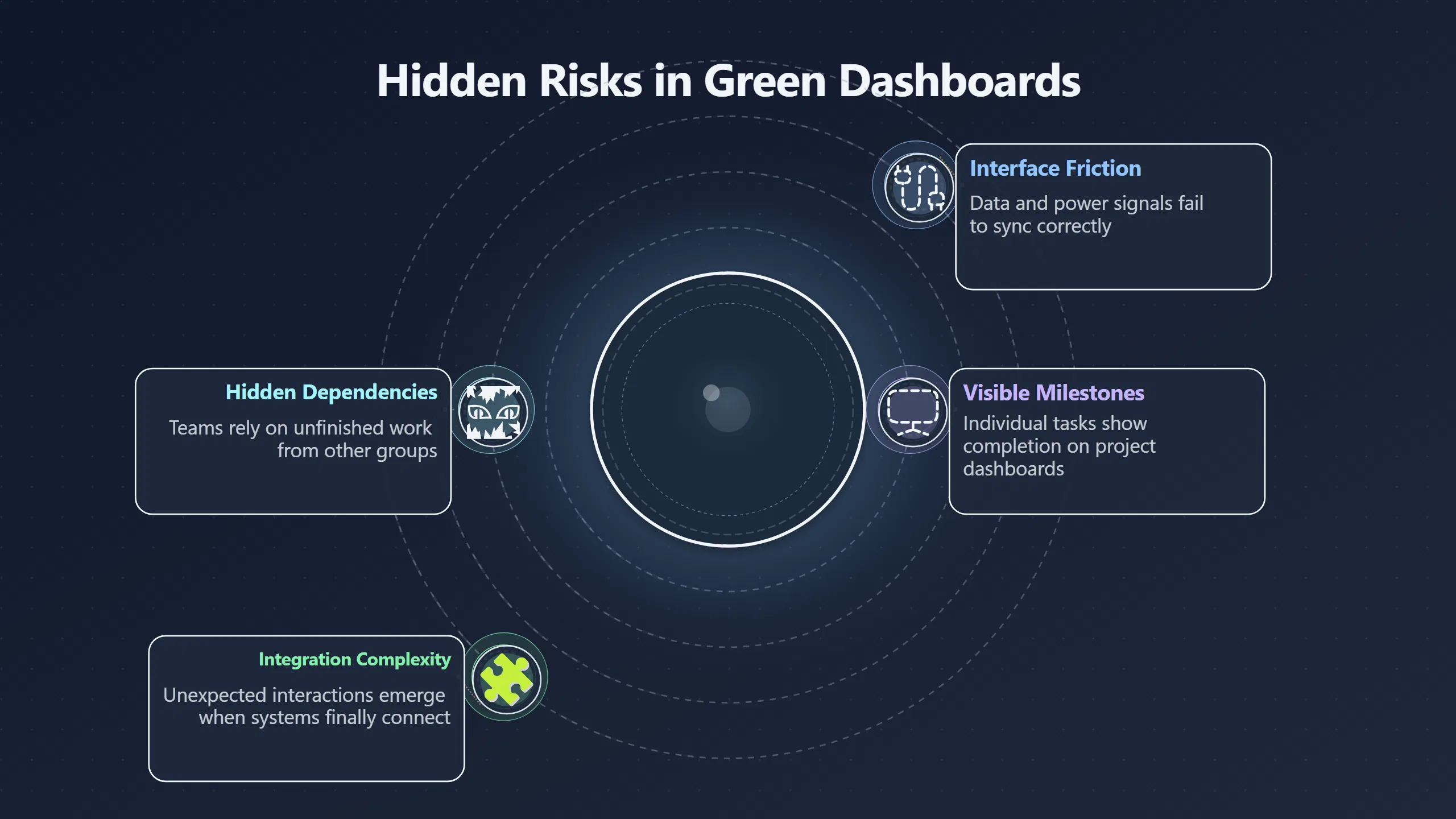
Several mechanisms contribute to this illusion:
- Milestones measure outputs rather than outcomes. Finishing construction, writing software or installing equipment does not prove the complete service works.
- Dependencies remain hidden. One team may depend on another’s unfinished work, but both report progress independently.
- Interface problems emerge late. Separate components often appear correct until they exchange data, power, signals or operational responsibilities.
- Success is easier to verify locally than globally. Local testing usually happens before full-system testing, leaving the most difficult problems until the end.
This explains why project reporting frequently shows steady progress followed by a sudden crisis during commissioning or deployment. The apparent deterioration is often not caused by new failures but by previously invisible integration risks becoming visible.
Why integration is usually the hardest work
Integration is frequently underestimated because it involves uncertainty rather than production. Teams know roughly how long it takes to manufacture a component or write a feature. They cannot predict with the same confidence how many unexpected interactions will emerge once independent systems begin working together.
Complex projects often require integration across several dimensions simultaneously:
- Technical compatibility between systems.
- Operational procedures used by different organisations.
- Data standards and communications.
- Safety assurance and regulatory approval.
- User behaviour and training.
- Maintenance and support arrangements.
Each interface increases the number of possible failure paths. As the number of interfaces grows, integration effort often expands faster than the number of individual components.
Experience from the Crossrail programme illustrates this point. Later reviews emphasised that successful system integration required technical integration, operational integration and organisational integration throughout the project lifecycle, rather than treating integration as a final activity before opening. The programme also highlighted the importance of testing at the right stage—too early and components are immature, too late and defects cannot be resolved without major schedule impacts.[Crossrail Learning Legacy]learninglegacy.crossrail.co.ukCrossrail Learning LegacyCrossrail System Integration – The Practicalities of Integrating…Successful system integration (SI) on Crossr…
Why dashboards stay green until late
Many reporting systems unintentionally reward optimism.
If milestone status is based on whether planned deliverables have been completed, managers have little incentive to delay declaring success while awaiting evidence that interfaces function correctly. A completed work package becomes “green” even if downstream teams cannot yet use it.
This creates a reporting pattern sometimes described as “watermelon status”: green on the outside, red inside. Although the metaphor is informal, the underlying mechanism is well recognised in project governance.
Several organisational pressures reinforce it:
- Teams are evaluated on delivering their own scope.
- Schedule commitments become psychologically difficult to challenge.
- Escalating uncertainty may be interpreted as poor performance.
- Integration responsibility is often shared, making ownership unclear.
- Executives receive summary indicators that hide unresolved dependencies.
As a result, dashboards may communicate confidence while the most difficult engineering and organisational work remains unfinished.
Crossrail: when construction progress hid integration risk
Crossrail provides a well-documented example of how visible progress can conceal unfinished integration work.
Much of the railway infrastructure, stations and physical construction advanced substantially before the programme entered its most difficult phase. However, opening the railway required far more than completed assets. Hundreds of thousands of physical assets had to be supported by extensive assurance documentation, multiple signalling environments, operational procedures, software, testing and safety certification before passenger service could begin.[National Audit Office (NAO)]nao.org.ukNational Audit Office (NAO)Crossrail – a progress updateJuly 8, 2021 — 9 Jul 2021 — When complete, the railway will be around 73 miles (118 kilometres) long, stopping at 41 stations, including…
Subsequent reviews concluded that the challenge was not simply construction delay but insufficient appreciation of system integration complexity. The National Audit Office found that previous management continued believing ambitious opening dates remained achievable despite repeated missed milestones and an unrealistic completion plan.[National Audit Office (NAO)]nao.org.ukNational Audit Office (NAO)Crossrail – a progress updateJuly 8, 2021 — 9 Jul 2021 — When complete, the railway will be around 73 miles (118 kilometres) long, stopping at 41 stations, including…
Parliamentary evidence after the delay highlighted another important lesson. Officials argued that the project had not reoriented quickly enough from construction management towards systems integration. They also described a broader culture of optimism in which years of successful construction encouraged stakeholders to believe remaining work would progress similarly smoothly, even though the character of the project had fundamentally changed.[UK Parliament Committees]committees.parliament.ukUK Parliament Committees Oral evidenceUK Parliament CommitteesOral evidence - Crossrail: progress review - 6 Mar 20196 Mar 2019 — What we saw in the final stages of this proje…
Later lessons learned from the recovery emphasised that project baselines should include not only physical construction but also testing, integration testing, rework and assurance activities, because these become the dominant work during the final stages of complex programmes.[APM]apm.org.ukCrossrail Project 2019-2023 - Completing the Elizabeth LineApril 6, 2023 — 23 Mar 2023 — The baseline must reflect all work: physical…
Integration tests that reveal real progress
The most informative milestones are not those showing that components exist but those demonstrating that they operate successfully together.
Examples include:
- End-to-end operational testing. A complete workflow succeeds under realistic operating conditions rather than within isolated subsystems.
- Interface verification. Every connection between organisations, software, equipment or processes performs correctly.
- Failure scenario testing. Recovery from faults is demonstrated instead of assuming ideal conditions.
- Operational readiness reviews. Users, maintainers and support teams can actually operate the delivered system.
- Integrated commissioning. Multiple components perform together for sustained periods rather than during isolated demonstrations.
These milestones are harder to achieve because they expose hidden assumptions. A project that passes integrated testing has generated stronger evidence of progress than one that merely completes individual deliverables.
Engineering guidance developed from large infrastructure programmes similarly stresses testing “integration threads” across multiple systems at key milestones, allowing assumptions and interface risks to be discovered before they become schedule-critical.[AtkinsRéalis]atkinsrealis.comAtkinsRéalisManaging Project Risk Through Railway IntegrationTesting the configuration and maturity of an integration thread at key miles…
Questions that expose hidden work
When evaluating project reports, several questions reveal whether green milestones represent genuine progress or merely completed paperwork.
- What has actually been demonstrated, rather than simply completed?
- Which interfaces have been tested under realistic operating conditions?
- What assumptions remain unverified?
- Which organisations are still waiting on one another?
- How much work remains in testing, assurance and operational acceptance?
- If every remaining activity succeeded first time, would the schedule still be credible?
- Where are the highest-risk integrations, and have they already been exercised?
These questions shift attention from percentage completion towards evidence that the whole system functions.
A better mental model
A useful way to think about project status is to distinguish three different kinds of progress.
Type of progressWhat it showsWhat it does not proveComponent completionIndividual pieces existThat they work togetherIntegration completionInterfaces function correctlyThat the system performs reliably in operationOperational readinessThe complete system delivers its intended valueOnly ongoing use can confirm long-term performance
Analytical thinking improves when these categories are kept separate. Milestone completion should be treated as evidence about one level of progress, not as proof that the overall project is healthy.
In complex programmes, the final stages are often the least predictable precisely because they replace isolated achievement with system behaviour. Green milestones therefore deserve a simple follow-up question: what evidence shows that the completed parts now work together as one system? That question often reveals more about true project health than the dashboard colour itself.
Amazon book picks
Further Reading
Books and field guides related to When Green Milestones Hide Real Project Risk. Use these as the next step if you want deeper reading beyond the article.
Project Management: A Systems Approach to Planning Scheduling...
Covers integration, milestones and project control.
eBay marketplace picks
Marketplace Samples
Example marketplace items related to this page. Use the search link to explore similar finds on eBay.
Endnotes
1.
Source: committees.parliament.uk
Title: UK Parliament Committees Oral evidence
Link:https://committees.parliament.uk/oralevidence/9075/html/
Source snippet
UK Parliament CommitteesOral evidence - Crossrail: progress review - 6 Mar 20196 Mar 2019 — What we saw in the final stages of this proje...
2.
Source: apm.org.uk
Link:https://www.apm.org.uk/media/10vnyi1q/crossrail-project-2019-to-2023-completing-the-elizabeth-line-apm-journal.pdf
Source snippet
Crossrail Project 2019-2023 - Completing the Elizabeth LineApril 6, 2023 — 23 Mar 2023 — The baseline must reflect all work: physical...
Published: April 6, 2023
3.
Source: learninglegacy.crossrail.co.uk
Link:https://learninglegacy.crossrail.co.uk/documents/crossrail-system-integration-the-practicalities-of-integrating-europes-most-complex-rail-project/
Source snippet
Crossrail Learning LegacyCrossrail System Integration – The Practicalities of Integrating...Successful system integration (SI) on Crossr...
4.
Source: nao.org.uk
Title: National Audit Office (NAO)Crossrail – a progress update
Link:https://www.nao.org.uk/wp-content/uploads/2021/07/Crossrail-a-progress-update-2.pdf
Source snippet
July 8, 2021 — 9 Jul 2021 — When complete, the railway will be around 73 miles (118 kilometres) long, stopping at 41 stations, including...
Published: July 8, 2021
5.
Source: atkinsrealis.com
Link:https://www.atkinsrealis.com/en/engineering-better-future/beyond-engineering/managing-project-risk-through-railway-integration
Source snippet
AtkinsRéalisManaging Project Risk Through Railway IntegrationTesting the configuration and maturity of an integration thread at key miles...
Additional References
6.
Source: assets.publishing.service.gov.uk
Link:https://assets.publishing.service.gov.uk/media/664b0afebd01f5ed32793e3e/crossrail-lessons-learned-report.pdf
Source snippet
a Major Project The Crossrail ExperienceCrossrail is one of the most transformational infrastructure projects ever delivered in the UK, a...
7.
Source: majorprojects.org
Link:https://majorprojects.org/resources/crossrail-a-progress-update/
8.
Source: GOV.UK
Title: annual update on crossrail 2019
Link:https://www.gov.uk/government/speeches/annual-update-on-crossrail-2019
Source snippet
update on Crossrail 201923 Jul 2019 — Provides an update on actions, challenges and achievements, alongside an annual statement on fundin...
9.
Source: youtu.be
Title: Check out more episodes of Resilient Foundations
Link:https://youtu.be/XrYFesIn3M8
Source snippet
"How Leaders Make Decisions Under [Pressure]({{ 'pressure/' | relative_url }}): [https://youtu.be/41wc9aghTSk](https://youtu.be/41wc9aghTSk) What Makes a Situation High Stakes? [https://youtu.be/Gpudb3kWhkE..."](https...
10.
Source: youtube.com
Title: The “Watermelon” Project: Why Your “Green” Status Reports Are Actually Failing
Link:https://www.youtube.com/watch?v=Qz9Vzf2xIIM
Source snippet
Governing the Chaos of Project Management | Author Interview with Steve Kelly...
11.
Source: youtube.com
Title: System Thinking in Project Management
Link:https://www.youtube.com/watch?v=e-GWj_f7JRA
Source snippet
This selection highlights The "Watermelon" Project: Why Your "Green" Status Reports Are Actually Failing because it addresses the exact s...
12.
Source: content.tfl.gov.uk
Title: elc 20210318 agenda
Link:https://content.tfl.gov.uk/elc-20210318-agenda.pdf
Source snippet
Meeting: Elizabeth Line Committee Date18 Mar 2021 — The paper provided an update on the risk management approach in. Crossrail, assurance...
13.
Source: youtube.com
Title: Governing the Chaos of Project Management | Author Interview with Steve Kelly
Link:https://www.youtube.com/watch?v=iOzT7_OGiDw
Source snippet
Master the Process Domain for PMP Success...
14.
Source: youtu.be
Link:https://youtu.be/41wc9aghTSk
Source snippet
"What Makes a Situation High Stakes? [https://youtu.be/Gpudb3kWhkE..."](https://youtu.be/Gpudb3kWhkE...")...
15.
Source: youtube.com
Title: Master the Process Domain for PMP Success!
Link:https://www.youtube.com/watch?v=sVSd7ZdvXnI
Source snippet
Systems Thinking for Leaders: Designing Solutions That Work...
Topic Tree