Within Transfer
Why Good Thinking Lessons Do Not Stick
People often learn the surface cues of a lesson, not the deeper pattern needed to use the skill in messy real situations.
On this page
- Surface cues versus deep structure
- Why real problems do not label the skill
- How varied examples make recognition easier
Page outline Jump by section
Introduction
Many critical thinking lessons succeed inside the classroom yet fail to change how people reason in everyday life. The main reason is not that learners forget the material. Instead, they often learn the surface cues of a lesson rather than the deeper reasoning pattern that should apply across different situations. A student who can identify a weak argument in a textbook may not notice the same flaw in a news article, workplace proposal or social media post because the context looks different. Research on learning transfer consistently shows that applying knowledge in unfamiliar settings is far more difficult than applying it to similar examples, and that this transfer rarely happens automatically.[The Learning Scientists+2Jay McTighe]learningscientists.orgThe Learning Scientists Depth Structure and Transfer in Critical ThinkingThe Learning ScientistsDepth Structure and Transfer in Critical Thinking…September 23, 2021 — 23 Sept 2021 — How do this recognition o…
 Understanding this transfer gap explains why many well-designed critical thinking courses produce disappointing real-world results. The problem is less about teaching reasoning itself than about helping learners recognise when the same reasoning should be used.
Surface Cues Versus Deep Structure
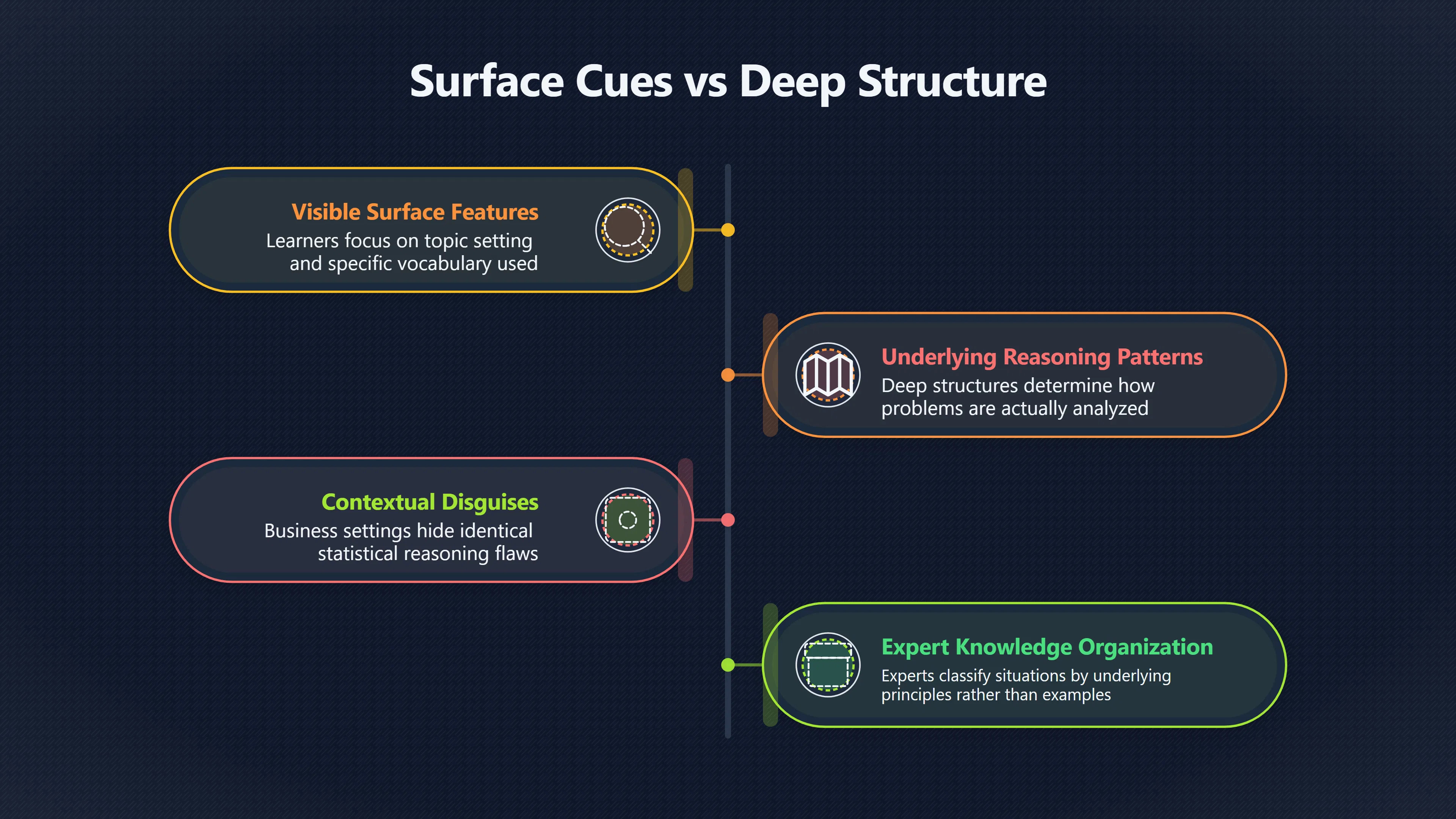
The central mechanism behind failed transfer is the difference between surface features and deep structure.
Surface features are the visible details of a problem: the topic, setting, vocabulary or people involved. Deep structure is the underlying pattern of reasoning that determines how the problem should be analysed. In many experiments, learners successfully solve a taught problem but fail to recognise another problem that shares the same logical structure because its surface details have changed.[Vanderbilt CDN Dev]cdn-dev.vanderbilt.eduSeeing Deep Structure From the Interactions of Surface FeaturesVanderbilt CDN DevSeeing-Deep-Structure-From-the-Interactions-of-Surface-…by MTH Chi · 2012 · Cited by 374 — Transfer is typically tho…
For example, someone may correctly explain in class that correlation does not prove causation when discussing health research. Later, the same person may accept a claim that a company’s profits rose immediately after a management change and therefore the new manager must be responsible. The statistical reasoning required is essentially identical, but the business context disguises the shared structure.
Experts differ from novices partly because they organise knowledge around these deeper principles rather than around memorable examples. Research on expertise has repeatedly found that experienced problem-solvers classify situations according to underlying principles, whereas beginners tend to classify them by obvious surface similarities.[Vanderbilt CDN Dev]cdn-dev.vanderbilt.eduSeeing Deep Structure From the Interactions of Surface FeaturesVanderbilt CDN DevSeeing-Deep-Structure-From-the-Interactions-of-Surface-…by MTH Chi · 2012 · Cited by 374 — Transfer is typically tho…
This explains why simply memorising lists of logical fallacies or cognitive biases rarely produces flexible reasoning. Learners remember labels attached to familiar examples rather than developing mental models that travel across contexts.
Why Real Problems Do Not Label the Skill
Classroom exercises usually announce which thinking skill is required. Everyday decisions almost never do.
A textbook chapter titled “Confirmation Bias” tells students what kind of mistake to look for before they begin. Outside education there is no such prompt. A colleague confidently presents sales figures, a friend forwards a health claim, or an online discussion becomes emotionally charged. Before reasoning can begin, the learner must first recognise that a familiar analytical strategy is relevant.
This recognition step is often the weakest link. Researchers describe spontaneous transfer—the unprompted application of previously learned knowledge—as uncommon unless instruction deliberately prepares learners for it. Simply knowing a principle does not guarantee that it will be retrieved when circumstances change.[The Learning Scientists]learningscientists.orgThe Learning Scientists Depth Structure and Transfer in Critical ThinkingThe Learning ScientistsDepth Structure and Transfer in Critical Thinking…September 23, 2021 — 23 Sept 2021 — How do this recognition o…
Several factors make recognition especially difficult:
- Real situations combine many competing signals rather than presenting neatly isolated problems.
- Decisions often involve time pressure, emotion or social consequences that compete for attention.
- Everyday claims rarely resemble the carefully simplified examples used during instruction.
- People naturally focus on the content of an argument before noticing its underlying structure.
As a result, the obstacle is frequently not poor reasoning but failure to notice that reasoning should begin.
Why Familiar Examples Can Become a Trap
Worked examples are valuable for introducing new ideas, but they can unintentionally encourage context-bound learning.
Suppose every classroom discussion of confirmation bias involves political examples. Learners may gradually associate the concept with politics rather than with selective evidence in general. When they later evaluate investment decisions, hiring choices or medical advice, they may fail to recognise the same cognitive pattern because it appears in an unfamiliar setting.
Educational psychologists have long observed that knowledge becomes tied to the circumstances in which it was learned. When instruction repeatedly pairs one reasoning principle with one type of example, learners build a narrow association instead of an abstract concept.[Jay McTighe]jaymctighe.comJay McTigheTransfer of Learning by Perkins and SalomonTransfer of learning occurs when learning in one context or with one set of materia…
This does not mean examples are harmful. The problem arises when learners encounter too few different examples to separate the principle from the surrounding context.
How Varied Examples Make Recognition Easier
One of the strongest evidence-based ways to improve transfer is to expose learners to problems that look different on the surface but share the same underlying reasoning.
Instead of teaching a principle through one domain, instructors can deliberately compare examples drawn from unrelated fields. A lesson on evaluating evidence might pair:
- a medical study,
- a marketing campaign,
- a historical explanation, and
- a workplace performance report.
Although the subjects differ, each requires asking similar questions about evidence quality, alternative explanations and causal inference.
Research refers to this as helping learners compare problems with different surface structures but common deep structures. Such comparison encourages abstraction: learners begin noticing the reasoning pattern itself rather than the surrounding story. Explicit discussion of similarities between examples further strengthens later recognition in new contexts.[The Learning Scientists+2Vanderbilt CDN Dev]learningscientists.orgThe Learning Scientists Depth Structure and Transfer in Critical ThinkingThe Learning ScientistsDepth Structure and Transfer in Critical Thinking…September 23, 2021 — 23 Sept 2021 — How do this recognition o…
The goal is not simply more practice, but more varied practice. Diversity of context helps separate the principle from the example.
Why Knowing Is Different From Recognising
Critical thinking is often described as a collection of skills, but effective transfer depends just as much on retrieval.
A learner may genuinely understand probabilistic reasoning, evidence evaluation or hypothesis testing. Yet unless those ideas are activated at the right moment, behaviour will look no different from someone who never learned them.
This distinction explains why people sometimes perform impressively on examinations while making poor real-world decisions. Classroom assessment frequently measures whether students can apply a skill immediately after being told which skill is relevant. Everyday life measures whether they can identify the need for that skill independently.
Educational research therefore increasingly emphasises “teaching for transfer” rather than assuming transfer will emerge naturally. Learners benefit from explicitly reflecting on where else a principle could apply, comparing apparently unrelated problems, and explaining the shared reasoning that connects them.[The Learning Scientists+2Jay McTighe]learningscientists.orgThe Learning Scientists Depth Structure and Transfer in Critical ThinkingThe Learning ScientistsDepth Structure and Transfer in Critical Thinking…September 23, 2021 — 23 Sept 2021 — How do this recognition o…
What This Means for Improving Analytical Thinking
The transfer gap changes how successful critical thinking instruction should be judged. A learner’s ability to solve familiar classroom exercises is only an early milestone. The more important test is whether the same reasoning appears spontaneously in unfamiliar, messy situations.
Instruction is therefore more likely to produce lasting improvements when it helps learners:
- focus on underlying reasoning rather than memorable examples;
- compare multiple contexts that share the same analytical pattern;
- practise recognising when a thinking strategy is needed, not just how to perform it;
- reflect explicitly on where a principle might transfer beyond the original lesson.
The strongest critical thinking lessons do more than teach analytical techniques. They teach learners to recognise the deeper structure hidden beneath changing surface details, making those techniques available when real decisions provide no obvious prompt.[The Learning Scientists+2Vanderbilt CDN Dev]learningscientists.orgThe Learning Scientists Depth Structure and Transfer in Critical ThinkingThe Learning ScientistsDepth Structure and Transfer in Critical Thinking…September 23, 2021 — 23 Sept 2021 — How do this recognition o…
Amazon book picks
Further Reading
Books and field guides related to Why Good Thinking Lessons Do Not Stick. Use these as the next step if you want deeper reading beyond the article.
Make It Stick
Explains why lessons fail to transfer and how to improve retention and application.
How People Learn
Directly discusses transfer, deep understanding and flexible learning.
Why Don't Students Like School?
Explains how understanding differs from memorization and why knowledge often fails to transfer.
eBay marketplace picks
Marketplace Samples
Live-tested eBay searches with available results related to this page.

Top pick
critical thinking game
Open a targeted eBay search for items related to this topic.
Browse eBay
Related search
critical thinking card game
Open a targeted eBay search for items related to this topic.
Browse eBay

Related search
good memorabilia
Open a targeted eBay search for items related to this topic.
Browse eBayEndnotes
1.
Source: learningscientists.org
Title: The Learning Scientists Depth Structure and Transfer in Critical Thinking
Link:https://www.learningscientists.org/blog/2021/9/23-1
Source snippet
The Learning ScientistsDepth Structure and Transfer in Critical Thinking...September 23, 2021 — 23 Sept 2021 — How do this recognition o...
Published: September 23, 2021
2.
Source: jaymctighe.com
Link:https://jaymctighe.com/wp-content/uploads/2011/04/Transfer-of-Learning-Perkins-and-Salomon.pdf
Source snippet
Jay McTigheTransfer of Learning by Perkins and SalomonTransfer of learning occurs when learning in one context or with one set of materia...
3.
Source: cdn-dev.vanderbilt.edu
Title: Seeing Deep Structure From the Interactions of Surface Features
Link:https://cdn-dev.vanderbilt.edu/t2-my-dev/wp-content/uploads/sites/3104/2020/09/Seeing-Deep-Structure-From-the-Interactions-of-Surface-Features.pdf
Source snippet
Vanderbilt CDN DevSeeing-Deep-Structure-From-the-Interactions-of-Surface-...by MTH Chi · 2012 · Cited by 374 — Transfer is typically tho...
Additional References
4.
Source: researchgate.net
Link:https://www.researchgate.net/publication/2402396_Transfer_Of_Learning
Source snippet
(PDF) Transfer Of LearningResearch consistently demonstrates that transfer increases when learning contexts resemble application contexts...
5.
Source: improvingteaching.co.uk
Title: deep learning planning for knowledge transfer responsive teaching update
Link:https://improvingteaching.co.uk/2019/10/20/deep-learning-planning-for-knowledge-transfer-responsive-teaching-update/
Source snippet
Deep learning? Planning for knowledge transfer20 Oct 2019 — This update to Responsive Teaching considers ways to promote flexible knowled...
6.
Source: research.aston.ac.uk
Title: Learning critical thinking skills with online bite sized videos
Link:https://research.aston.ac.uk/files/201652664/Learning_critical_thinking_skills_with_online_bite-sized_videos.pdf
Source snippet
critical thinking skills with online bite-sized videosby AJY Tan · 2026 — These themes encapsulate students' experiences of learning crit...
7.
Source: wegrowteachers.com
Title: how to teach for surface deep and transfer learning
Link:https://wegrowteachers.com/how-to-teach-for-surface-deep-and-transfer-learning/
Source snippet
Deep (or deeper) learning is a complex process that involves the development of critical thinking and problem-solving skills.Read more...
8.
Source: structural-learning.com
Link:https://www.structural-learning.com/post/transfer-learning-complete-guide-teachers
Source snippet
Structural LearningTransfer of Learning: A Complete Guide5 days ago — Researchers Perkins and Salomon (1992) described this as high road...
9.
Source: pz.harvard.edu
Title: Learning that Matters
Link:https://pz.harvard.edu/sites/default/files/Learning%20that%20Matters.pdf
Source snippet
THAT MATTERS - Project ZeroThis is a general examination of dispositions not at all limited to work in which we have been involved, but m...
10.
Source: youtube.com
Title: Concept driven Learning that Transfers with Julie Stern
Link:https://www.youtube.com/watch?v=rzDWxW6uVk0
Source snippet
Thinking About Thinking: Using [Metacognition]({{ 'metacognition/' | relative_url }}) to Drive Learning Transfer | GWS Learning Guild...
11.
Source: youtube.com
Title: Conceptual Understanding and Learning Transfer
Link:https://www.youtube.com/watch?v=jdXH53EorFo
Source snippet
Concept driven Learning that Transfers with Julie Stern...
12.
Source: youtube.com
Title: What is ‘transfer of learning’? | Julie Stern
Link:https://www.youtube.com/watch?v=q3rH5mLQfRw
Source snippet
Conceptual Understanding and Learning Transfer...
13.
Source: youtube.com
Title: Daniel Willingham | Cognitive Psychology at the University of Virginia
Link:https://www.youtube.com/watch?v=oZmBoI9Lzl4
Source snippet
Cambridge University Press & Assessment...
Topic Tree