Within Objections
What Would You Look For If Wrong?
Considering the opposite means deliberately looking for evidence that would support the answer you first rejected.
On this page
- Reverse the first explanation
- Search for disconfirming evidence
- Use the test without endless doubt
Page outline Jump by section
Introduction
First impressions often feel like conclusions. A plausible explanation appears quickly, fits the facts you have noticed, and begins shaping what you look for next. The problem is that once an initial explanation takes hold, people naturally become better at finding evidence that supports it than evidence that challenges it. The “considering the opposite” technique is a practical way to interrupt that process. Instead of asking, “Why is my first explanation correct?”, it asks, “If this explanation were wrong, what would I expect to find instead?”
 This simple shift does not require abandoning your judgement or treating every possibility as equally likely. Its purpose is to prevent early impressions from hardening into unquestioned beliefs before the evidence has been properly tested. Psychological research has repeatedly shown that deliberately generating reasons why an initial conclusion might be false reduces several forms of confirmation bias more effectively than merely trying to “be objective”.[PubMed]pubmed.ncbi.nlm.nih.govConsidering the opposite: a corrective strategy for social…by CG Lord · 1984 · Cited by 1170 — Individuals who are induced to co…
What Would You Look For If Wrong?
The central mechanism is surprisingly straightforward.
When people form an early explanation, they usually begin interpreting new information through that explanation. Evidence that fits seems persuasive; evidence that conflicts is often dismissed as an exception or explained away. This does not usually happen through deliberate dishonesty. It is a normal feature of human reasoning.[UC San Diego Pages]pages.ucsd.eduUC San Diego Pages Confirmation Bias: A Ubiquitous Phenomenon in ManyUC San Diego PagesConfirmation Bias: A Ubiquitous Phenomenon in Many…October 6, 2004 — by RS Nickerson · 1998 · Cited by 12455 — Confi…
Considering the opposite deliberately reverses that sequence. Rather than asking how new evidence supports your preferred explanation, you ask what evidence would convince a reasonable person that another explanation is better.
That changes three parts of the thinking process at once:
- it expands the range of explanations under consideration;
- it encourages active searches for contradictory information instead of supportive information alone;
- it weakens the tendency to interpret every ambiguous fact as confirming the original belief.
The aim is not to replace one certainty with another. It is to delay commitment until competing explanations have received a fair test.
Reverse the First Explanation
First explanations are often generated rapidly because they are coherent, familiar or emotionally satisfying—not necessarily because they are the most accurate.
Imagine arriving at work and seeing a colleague who avoids eye contact and gives a brief reply. Your immediate explanation might be that they are annoyed with you. Once that interpretation forms, every later interaction may appear to confirm it.
The opposite test asks a different question:
“Suppose they are not annoyed. What else would explain exactly the same behaviour?”
Possible alternatives might include:
- they are under unusual time pressure;
- they have received worrying personal news;
- they are concentrating on another problem;
- they simply did not notice your greeting.
The important point is not that one of these alternatives must be correct. The value comes from forcing your mind to search beyond the first narrative that felt convincing.
Research by Charles Lord, Mark Lepper and Elizabeth Preston demonstrated that asking participants to consider explanations opposite to their current belief reduced biased evaluation of evidence more effectively than simply instructing them to be fair or unbiased.[PubMed]pubmed.ncbi.nlm.nih.govConsidering the opposite: a corrective strategy for social…by CG Lord · 1984 · Cited by 1170 — Individuals who are induced to co…
Search for Disconfirming Evidence
Considering the opposite only works if it changes what evidence you seek.
Instead of collecting additional examples that support your preferred explanation, deliberately ask what observations would weaken it.
Useful questions include:
- What evidence would surprise me?
- What observation would force me to revise my view?
- Which fact have I quietly assumed rather than verified?
- If another explanation were true, what would I expect to see that I have not yet checked?
For example, if you conclude that declining sales are caused by poor staff performance, confirming evidence is easy to find: missed tasks, slow service or customer complaints.
The opposite test asks whether the evidence also fits other explanations:
- Has customer traffic changed?
- Have competitors altered prices?
- Has the business relocated?
- Have seasonal patterns changed?
Searching for these possibilities increases the chance that genuinely diagnostic evidence—not merely supportive evidence—drives the decision.
This distinction is important because confirmation bias often operates through selective information gathering rather than outright misinterpretation. People naturally ask questions that are likely to confirm their current hypothesis instead of questions that best distinguish between competing hypotheses.[UC San Diego Pages]pages.ucsd.eduUC San Diego Pages Confirmation Bias: A Ubiquitous Phenomenon in ManyUC San Diego PagesConfirmation Bias: A Ubiquitous Phenomenon in Many…October 6, 2004 — by RS Nickerson · 1998 · Cited by 12455 — Confi…
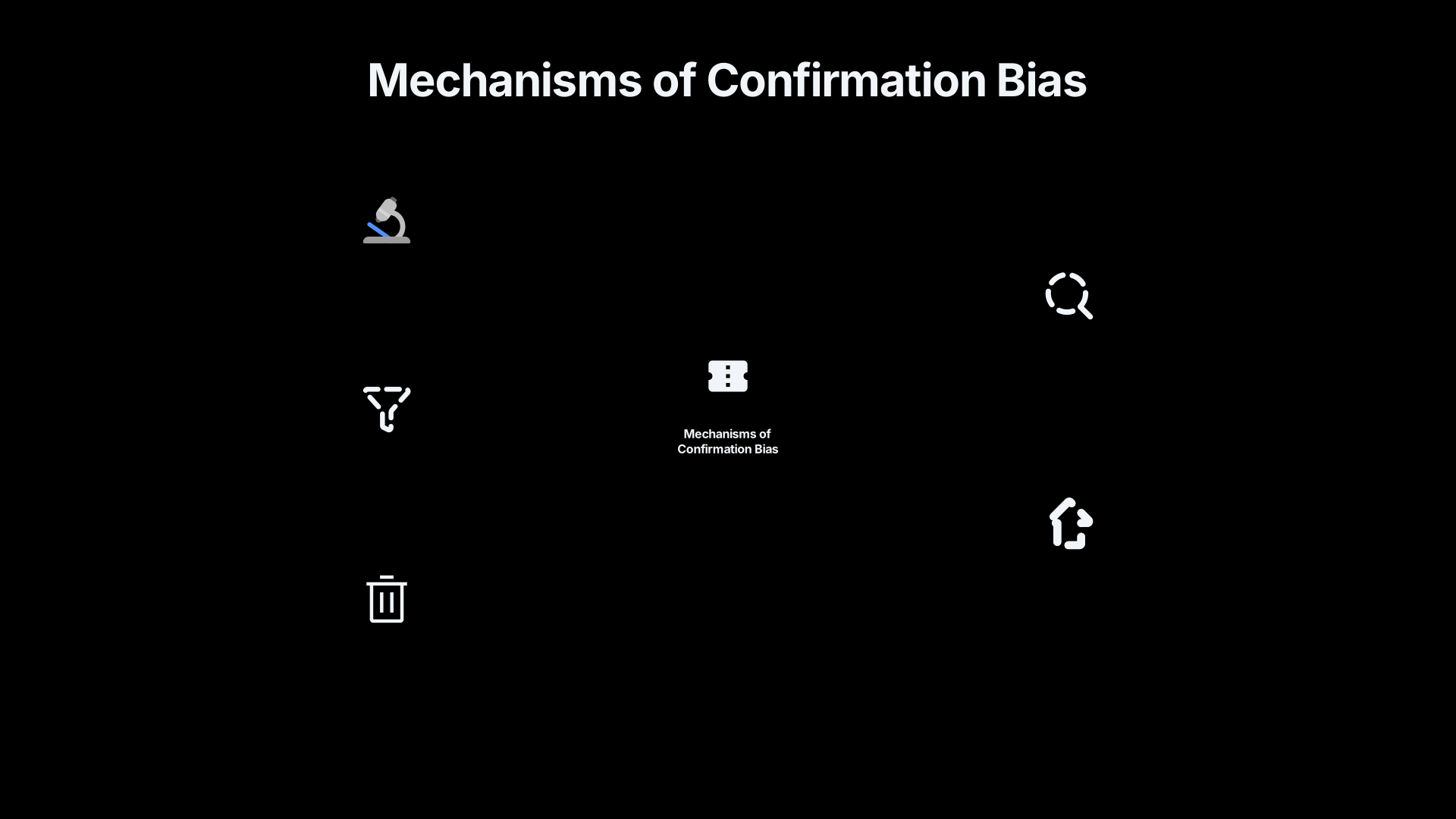
Why This Works Better Than Simply “Being Objective”
Many people respond to bias by telling themselves to stay open-minded.
Unfortunately, psychological evidence suggests that this instruction is often too vague to change reasoning.
The considering-the-opposite strategy is more effective because it replaces a general intention with a concrete cognitive task. Instead of trying not to be biased, you actively construct evidence for an alternative explanation.
That matters because generating an opposing explanation forces retrieval of information that would otherwise remain mentally unavailable. It interrupts the automatic tendency to strengthen the first interpretation simply because it came first.
Experiments comparing these approaches found that explicit opposite-generation reduced biased judgement more reliably than generic instructions to avoid bias.[PubMed]pubmed.ncbi.nlm.nih.govConsidering the opposite: a corrective strategy for social…by CG Lord · 1984 · Cited by 1170 — Individuals who are induced to co…
Use the Test Without Endless Doubt
Considering the opposite is not a licence for permanent scepticism.
There comes a point when enough evidence supports one explanation that further searching produces little additional value. The purpose is to improve decisions before commitment, not prevent commitment altogether.
A practical stopping rule is:
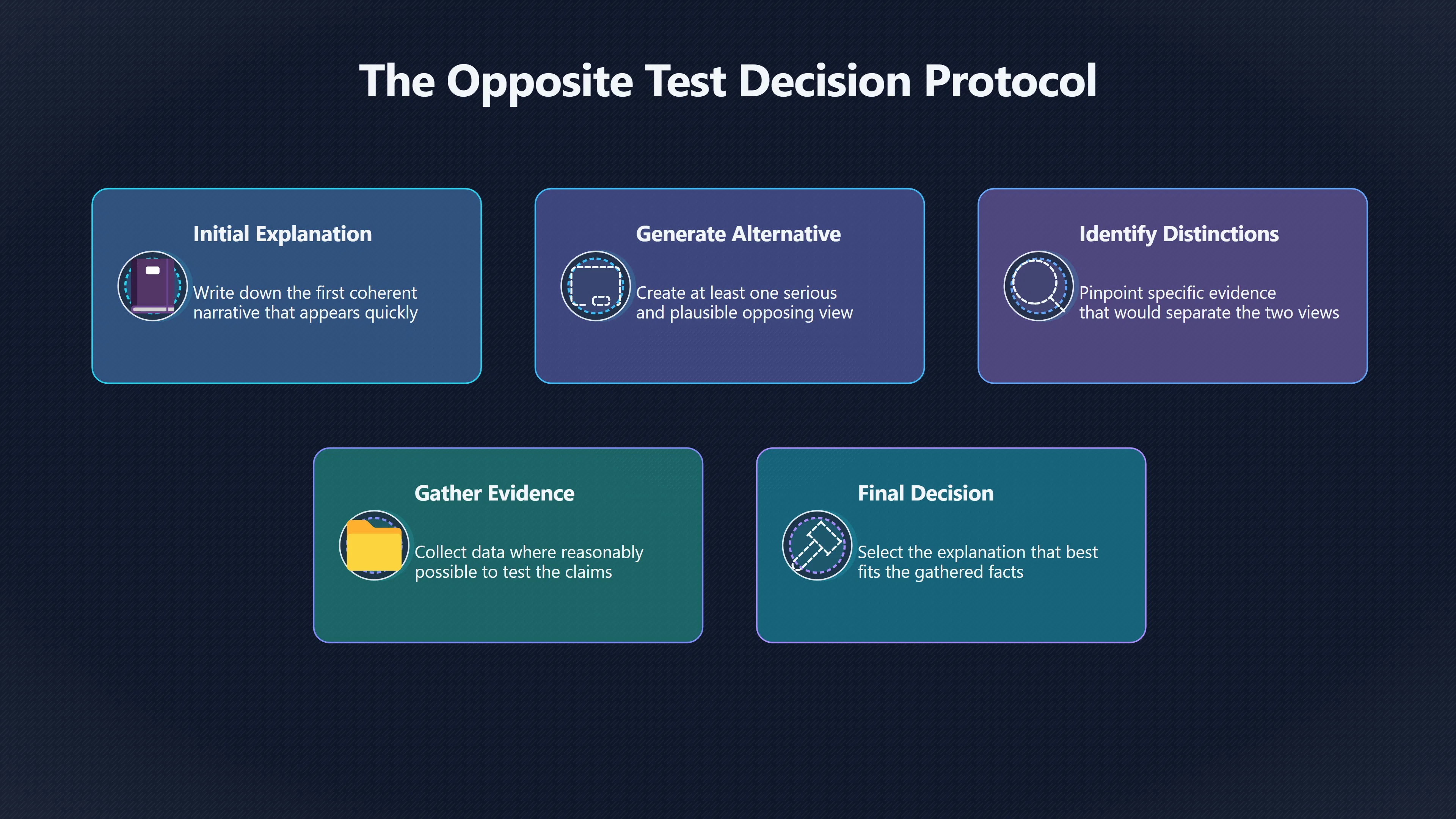
- Write down your initial explanation.
- Generate at least one serious alternative.
- Identify the evidence that would distinguish between them.
- Gather that evidence where reasonably possible.
- Decide using whichever explanation best fits the available facts.
Once genuinely discriminating evidence has been examined, continuing to invent increasingly unlikely alternatives usually creates delay without improving judgement.
The goal is disciplined testing rather than infinite uncertainty.
Common Mistakes
Several habits make the opposite test much less effective.
Inventing a weak alternative. If the competing explanation is obviously implausible, rejecting it teaches you nothing. The alternative should be one that an informed, reasonable person might genuinely believe.
Looking only for confirming examples. Simply imagining another possibility is insufficient if you continue collecting evidence only for your preferred explanation.
Treating every explanation as equally likely. Considering the opposite is about testing, not pretending that all ideas deserve equal confidence regardless of evidence.
Changing the standard of proof. A common form of confirmation bias is demanding much stronger evidence for ideas you dislike than for ideas you already favour. The opposite test only works if competing explanations are judged by comparable standards.[fbaum.unc.edu]unc.eduThey are apt to accept "con-.Read moreBiased Assimilation and Attitude Polarization: The Effects …February 2, 2005 — by CG Lord · 1979 · Cited by 7415 — People who hold stro…

Making It a Habit
The technique is especially useful whenever first impressions arrive unusually quickly or feel emotionally satisfying.
Before accepting your initial interpretation, pause long enough to ask one question:
“If I were wrong, what would I expect to find?”
That single question shifts attention from defending an impression to testing it. Within the broader practice of examining strong objections before making a decision, considering the opposite is one of the simplest and most reliable ways to reduce the influence of first impressions without falling into indecision. It encourages conclusions that survive genuine comparison rather than merely benefiting from being thought of first.
eBay marketplace picks
Marketplace Samples
Live-tested eBay searches with available results related to this page.



Endnotes
1.
Source: pubmed.ncbi.nlm.nih.gov
Link:https://pubmed.ncbi.nlm.nih.gov/6527215/
Source snippet
Considering the opposite: a corrective strategy for social...by CG Lord · 1984 · Cited by 1170 — Individuals who are induced to co...
2.
Source: pages.ucsd.edu
Title: UC San Diego Pages Confirmation Bias: A Ubiquitous Phenomenon in Many
Link:https://pages.ucsd.edu/~mckenzie/nickersonConfirmationBias.pdf
Source snippet
UC San Diego PagesConfirmation Bias: A Ubiquitous Phenomenon in Many...October 6, 2004 — by RS Nickerson · 1998 · Cited by 12455 — Confi...
Published: October 6, 2004
3.
Source: Wikipedia
Title: Confirmation bias
Link:https://en.wikipedia.org/wiki/Confirmation_bias
4.
Source: fbaum.unc.edu
Title: They are apt to accept “con-.Read more
Link:https://fbaum.unc.edu/[teaching
Source snippet
Biased Assimilation and Attitude Polarization: The Effects...February 2, 2005 — by CG Lord · 1979 · Cited by 7415 — People who hold stro...
Published: February 2, 2005
Additional References
5.
Source: fs.blog
Link:https://fs.blog/confirmation-bias/
Source snippet
Confirmation Bias And the Power of Disconfirming EvidenceConfirmation bias is our tendency to cherry-pick information that confirms our e...
6.
Source: thedecisionlab.com
Link:https://thedecisionlab.com/biases/confirmation-bias
Source snippet
Confirmation BiasConfirmation bias describes our underlying tendency to notice, focus on, and provide greater credence to evidence that f...
7.
Source: crest.science
Title: Science First Impressions Matter: A Model of Confirmatory Bias
Link:https://crest.science/wp-content/uploads/2020/03/Rabin-and-Schrag-First-Impressions.pdf
Source snippet
First Impressions Matter: A Model of Confirmatory Bias - CRESTby M Rabin · 1999 · Cited by 1595 — Psychological research indicates that p...
8.
Source: academia.edu
Link:https://www.academia.edu/3723863/Considering_the_opposite_A_corrective_strategy_for_social_judgment
Source snippet
first noted by Francis Bacon-to consider possibilities at odds with beliefs and...
9.
Source: youtube.com
Link:https://www.youtube.com/watch?v=d2r7Bk1NlgU
Source snippet
To deepen your understanding of cognitive [debiasing]({{ 'debiasing/' | relative_url }}), watch how the video Consider the Opposite - A Debiasing Strategy breaks down the exp...
10.
Source: semanticscholar.org
Link:https://www.semanticscholar.org/paper/Considering-the-opposite%3A-a-corrective-strategy-for-Lord-Lepper/e71bbae72f8ad78e97c54f5ec88c9af2c70759f2
Source snippet
onsider-the-opposite strategy had greater corrective effect than more...
11.
Source: researchgate.net
Link:https://www.researchgate.net/publication/16669522_Considering_the_Opposite_A_Corrective_Strategy_for_Social_Judgment
Source snippet
Considering the Opposite: A Corrective Strategy for Social...4 Oct 2015 — Individuals who are induced to consider the opposi...
12.
Source: youtube.com
Title: The Hidden Bias Controlling Your Thoughts (And How to Break Free!)
Link:https://www.youtube.com/watch?v=8az1IATBE7o
Source snippet
Introduction to Cognitive Bias: Crash Course Scientific Thinking #1...
13.
Source: youtube.com
Title: Consider the Opposite
Link:https://www.youtube.com/watch?v=ieVaeYVaOrc
Source snippet
Obstacles to Problem Solving (Intro Psych Tutorial #90)...
14.
Source: youtube.com
Title: How to Overcome Confirmation Bias
Link:https://www.youtube.com/watch?v=oWRhKPcZG_0
Source snippet
The Hidden Bias Controlling Your Thoughts (And How to Break Free!)...
Topic Tree