Within Online Claims
Why Smart Readers Leave the Page
A polished page is only a starting point; stronger source checks look outside the site for independent context and reputation.
On this page
- What lateral reading means in practice
- How outside checks beat surface credibility cues
- Common mistakes when judging unfamiliar websites
Page outline Jump by section
Introduction
A polished website, a confident author biography and an impressive logo can all create an illusion of credibility. Professional fact-checkers know this, which is why they often do something that surprises most readers: they leave the page almost immediately. Instead of judging a source by its appearance or self-description, they search for independent information about who is behind it, what others say about it, and whether its claims stand up elsewhere. This approach is known as lateral reading, and research consistently shows that it is one of the most effective ways to evaluate unfamiliar online sources.[Stanford Digital Repository]stacks.stanford.eduWineburg Mc Grew Lateral Reading and the Nature of Expertisepolitical fact-checking organizations. Eight…Read more…
 Lateral reading is especially valuable when you encounter a website, organisation or social media account you have never seen before. Rather than asking, “Does this page look trustworthy?”, you ask, “What does the wider web reveal about this source?” That shift changes the task from evaluating presentation to evaluating reputation and evidence.
What lateral reading means in practice
Traditional reading moves vertically through a page. You inspect the design, read the “About Us” section, look for contact information and examine the writing style. Those details can sometimes help, but they are also among the easiest features to imitate.
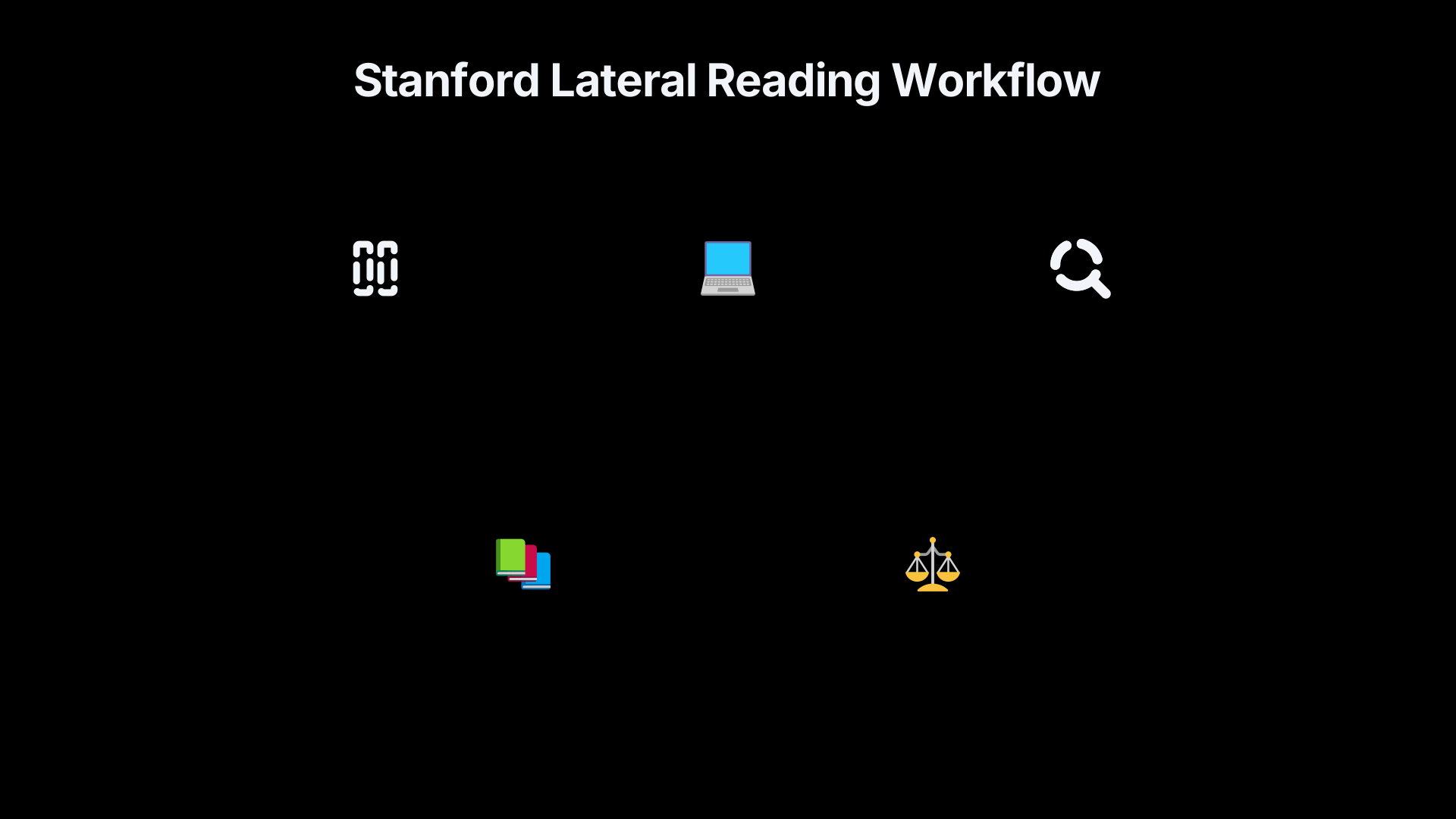
Lateral reading follows a different sequence:[scienceofboosting.org]scienceofboosting.orgLateral ReadingBoostingMay 4, 2023 — Lateral reading is a simple heuristic for online fact-checking: Open multiple tabs in your browser and search the W…
- Pause before accepting or sharing the claim.
- Open new browser tabs.[scienceofboosting.org]scienceofboosting.orgLateral ReadingBoostingMay 4, 2023 — Lateral reading is a simple heuristic for online fact-checking: Open multiple tabs in your browser and search the W…
- Search for the organisation, author or website by name.
- Look for reporting, academic references or independent discussion.
- Compare the claim with higher-quality or primary sources.
Researchers studying professional fact-checkers found that experts routinely left unfamiliar websites to investigate them elsewhere, while many students and even experienced historians remained on the original page and were more easily misled by professional-looking design and authoritative language.[Stanford Digital Repository]stacks.stanford.eduWineburg Mc Grew Lateral Reading and the Nature of Expertisepolitical fact-checking organizations. Eight…Read more…
The goal is not to distrust every new source. It is to gather enough outside context to understand what the source is before deciding how much confidence it deserves.
How outside checks beat surface credibility cues
Many online credibility cues are weak because they can be manufactured cheaply. A sophisticated layout, an official-sounding domain name or a lengthy mission statement says very little about whether claims are accurate.
Independent checks are stronger because they rely on evidence outside the source’s own control.
Check what others say about the source
Search for the organisation’s name alongside terms such as:
- review
- criticism
- fact check
- funding
- ownership
- controversy
Independent reporting may reveal whether the organisation has recognised expertise, a history of publishing corrections, undisclosed advocacy, or repeated factual errors. Equally important, you may discover that the source is widely respected within its field.
Look for expertise, not impressive titles
A source may describe itself as an institute, academy or research centre. Lateral reading asks different questions:
- Is it recognised by other experts?
- Has its work been cited independently?
- Does it have relevant expertise for this specific topic?
Someone may be highly qualified in one discipline but commenting outside their area of competence. Likewise, an advocacy group may accurately present some evidence while selectively omitting contrary findings.
Find better coverage
Sometimes the original page is not worth evaluating in depth because stronger reporting already exists.
If an unfamiliar website claims that a major scientific breakthrough has occurred, search directly for the underlying event rather than continuing to analyse the original article. If no reputable scientific institutions or established news organisations are reporting the same development, that absence itself becomes useful evidence.
This principle is central to Mike Caulfield’s SIFT framework, which encourages readers to “find better coverage” instead of becoming trapped evaluating a questionable source in isolation.[Hapgood]hapgood.usSIFT (The Four MovesSIFT (The Four Moves) - Hapgood19 Jun 2019 — key approach is the Stop, Investigate, Find and Trace (SIFT) technique, a fact-checki…
Trace claims back to their origin
Many online articles simply repeat earlier material.
When possible, locate:
- the original research paper
- the official report
- the court judgment
- the government dataset
- the complete speech or interview
Doing so often reveals missing qualifications, uncertainty or context that disappeared as the claim spread across multiple websites.
A practical example
Imagine you encounter an unfamiliar website claiming that a city has banned a common household product because of new scientific evidence.
A vertical reader might inspect the page carefully, notice references, see photographs and conclude that it appears professional.
A lateral reader would instead:
- search for the organisation behind the article
- look for reporting from established local news organisations
- check whether the city council or regulator has published an announcement
- search for the scientific study being cited
- compare how multiple independent sources describe the decision
Within a few minutes, it often becomes clear whether the claim is well supported, exaggerated or entirely fabricated.
Why reputation alone is not enough
Lateral reading is not simply replacing one authority with another.[scienceofboosting.org]scienceofboosting.orgLateral ReadingBoostingMay 4, 2023 — Lateral reading is a simple heuristic for online fact-checking: Open multiple tabs in your browser and search the W…
Finding that a source has a good reputation does not automatically validate every claim it makes. Likewise, discovering that an organisation has political views or commercial interests does not automatically invalidate everything it publishes.
Instead, reputation provides context for interpreting evidence.
The key questions remain:
- Does this source have relevant expertise?
- Can its claims be independently verified?
- Are primary sources available?
- Do multiple independent sources reach similar conclusions?
The method encourages proportional confidence rather than absolute trust.

Common mistakes when judging unfamiliar websites
Several habits repeatedly lead readers astray.
Reading too deeply before knowing the source. Spending ten minutes analysing an article from an unknown website before spending thirty seconds checking who produced it often wastes time.
Trusting appearance over reputation. Modern website templates allow almost anyone to create pages that resemble established institutions.
Reading only the “About” page. Organisations naturally present themselves positively. Independent descriptions provide a more balanced perspective.
Assuming search ranking equals credibility. Search engines optimise for many factors besides reliability. High placement is not evidence that claims are accurate.
Stopping after finding one confirming source. Reliable verification usually requires genuinely independent confirmation rather than multiple sites repeating the same original report.
Confusing criticism with disproof. A source may have critics yet still produce accurate work. The question is whether criticism concerns evidence, methodology or simply disagreement.
Building the habit
Lateral reading becomes faster with practice because most investigations take only a few targeted searches.
A useful routine is:
- Pause before reacting emotionally.
- Search the source before reading it deeply.
- Look for independent descriptions.
- Find stronger reporting on the same claim.
- Trace important evidence back to its original source.
Research suggests that even relatively short instruction in these techniques can substantially improve people’s ability to evaluate unfamiliar online information. Rather than teaching readers to scrutinise a webpage in isolation, successful programmes train them to move efficiently across the wider information ecosystem, much like professional fact-checkers do every day.[ed.stanford.edu+2journals.sagepub.com]ed.stanford.eduit doesn t take long learn how spot misinformation online stanford study findsIt doesn't take long to learn how to spot misinformation online…19 Apr 2022 — There may be new hope for helping young people – and any…
Amazon book picks
Further Reading
Books and field guides related to Why Smart Readers Leave the Page. Use these as the next step if you want deeper reading beyond the article.
The Skeptics' Guide to the Universe
Covers credibility checks and common reasoning pitfalls.
eBay marketplace picks
Marketplace Samples
Live-tested eBay searches with available results related to this page.

Top pick
critical thinking card game
Open a targeted eBay search for items related to this topic.
Browse eBay
Related search
critical thinking game
Open a targeted eBay search for items related to this topic.
Browse eBay
Related search
smart poster
Open a targeted eBay search for items related to this topic.
Browse eBay
Related search
smart memorabilia
Open a targeted eBay search for items related to this topic.
Browse eBayEndnotes
1.
Source: stacks.stanford.edu
Title: Wineburg Mc Grew Lateral Reading and the Nature of Expertise
Link:https://stacks.stanford.edu/file/druid%3Ayk133ht8603/Wineburg%20McGrew_Lateral%20Reading%20and%20the%20Nature%20of%20Expertise.pdf
Source snippet
political fact-checking organizations. Eight...Read more...
2.
Source: hapgood.us
Title: SIFT (The Four Moves)
Link:https://hapgood.us/2019/06/19/sift-the-four-moves/
Source snippet
SIFT (The Four Moves) - Hapgood19 Jun 2019 — key approach is the Stop, Investigate, Find and Trace (SIFT) technique, a fact-checki...
3.
Source: ed.stanford.edu
Title: it doesn t take long learn how spot misinformation online stanford study finds
Link:https://ed.stanford.edu/news/it-doesn-t-take-long-learn-how-spot-misinformation-online-stanford-study-finds
Source snippet
It doesn't take long to learn how to spot misinformation online...19 Apr 2022 — There may be new hope for helping young people – and any...
4.
Source: journals.sagepub.com
Link:https://journals.sagepub.com/doi/10.1177/23328584231176451
Source snippet
Civic Online Reasoning Across the Curriculum: Developing...by S McGrew · 2023 · Cited by 80 — From the January 6 insurrection to misinfo...
5.
Source: cor.inquirygroup.org
Title: Inquiry Group Teaching Lateral Reading
Link:https://cor.inquirygroup.org/curriculum/collections/teaching-lateral-reading/
Source snippet
Lateral Reading - Civic Online ReasoningThese lessons also introduce students to resources they can use when laterally reading: Wikipedia...
6.
Source: researchguides.csuohio.edu
Link:https://researchguides.csuohio.edu/democracy101/SIFT/investigate
Source snippet
It can be tempting to immediately begin to debate the merits of a claim that a source makes.Read more...
7.
Source: library.cod.edu
Link:https://library.cod.edu/evaluating/SIFT
Source snippet
(from Mike Caulfield) stands for: STOP. Pause and ask yourself if you recognize the...Read more...
8.
Source: scienceofboosting.org
Title: Lateral Reading
Link:https://www.scienceofboosting.org/project/lateral-reading/
Source snippet
BoostingMay 4, 2023 — Lateral reading is a simple heuristic for online fact-checking: Open multiple tabs in your browser and search the W...
Published: May 4, 2023
Additional References
9.
Source: researchgate.net
Link:https://www.researchgate.net/publication/375674630_Teaching_Lateral_Reading_Interventions_to_Help_People_Read_like_Fact_Checkers
Source snippet
Interventions to Help People Read like Fact CheckersOne widely studied approach is Lateral Reading, in which users leave a page to verify...
10.
Source: library.nwacc.edu
Link:https://library.nwacc.edu/lateralreading/videos
Source snippet
nwacc.eduLibGuides: Lateral Reading: Watch the Crash Course8 Apr 2026 — An introduction to lateral reading skills and techniques to help...
11.
Source: aft.org
Link:https://www.aft.org/ae/spring2025/caulfield_wineburg
Source snippet
he Digital Inquiry Group's “Civic Online Reasoning”...Read more...
12.
Source: pressbooks.pub
Title: students and disinformation
Link:https://pressbooks.pub/introtocollegeresearch/chapter/students-and-disinformation/
Source snippet
Web Evaluation Skills: A “Bleak” Track RecordIn 2017, the Stanford History Education Group conducted a study, “Lateral Reading: Reading L...
13.
Source: openoregon.pressbooks.pub
Title: Open Oregon The SIFT Method –
Link:https://openoregon.pressbooks.pub/findinginfo/chapter/four-moves/
Source snippet
When investigating a source, fact-checkers read “laterally” across many websites. That is, they don't spend much time on the source...
14.
Source: cor.inquirygroup.org
Link:https://cor.inquirygroup.org/
Source snippet
Civic Online Reasoning are using the lessons and assessments to engage students in combating misinformation and to provide a skill set to...
15.
Source: events.sunyla.org
Title: SIFTing Infographics
Link:https://events.sunyla.org/sunyla2021/wp-content/uploads/2021/06/SIFTing-Infographics.pdf
Source snippet
InfographicsStudents use SIFT tactics to determine whether a news headline or social media post is credible as quickly as possible. Show...
16.
Source: youtube.com
Link:https://www.youtube.com/watch?v=GoQG6Tin-1E
Source snippet
Intro to Lateral Reading - Teaching Online Fact-Checking...
17.
Source: barbarafister.net
Link:https://barbarafister.net/libraries/lateral-reading-and-information-systems-in-the-age-of-distrust/
Source snippet
Lateral Reading and Information Systems in the Age of...22 Sept 2021 — This Stanford group created a curriculum for civic online reasoni...
18.
Source: fosil.org.uk
Title: CRAA P and SIFT
Link:https://fosil.org.uk/forums/topic/craap-and-sift-is-there-something-better/
Source snippet
The Fosil GroupCRAAP and SIFT have their uses to engage students as a starting point when teaching how to evaluate websites but we should...
Topic Tree