Within Sharper Thinking
What Evidence Would Change Your Mind?
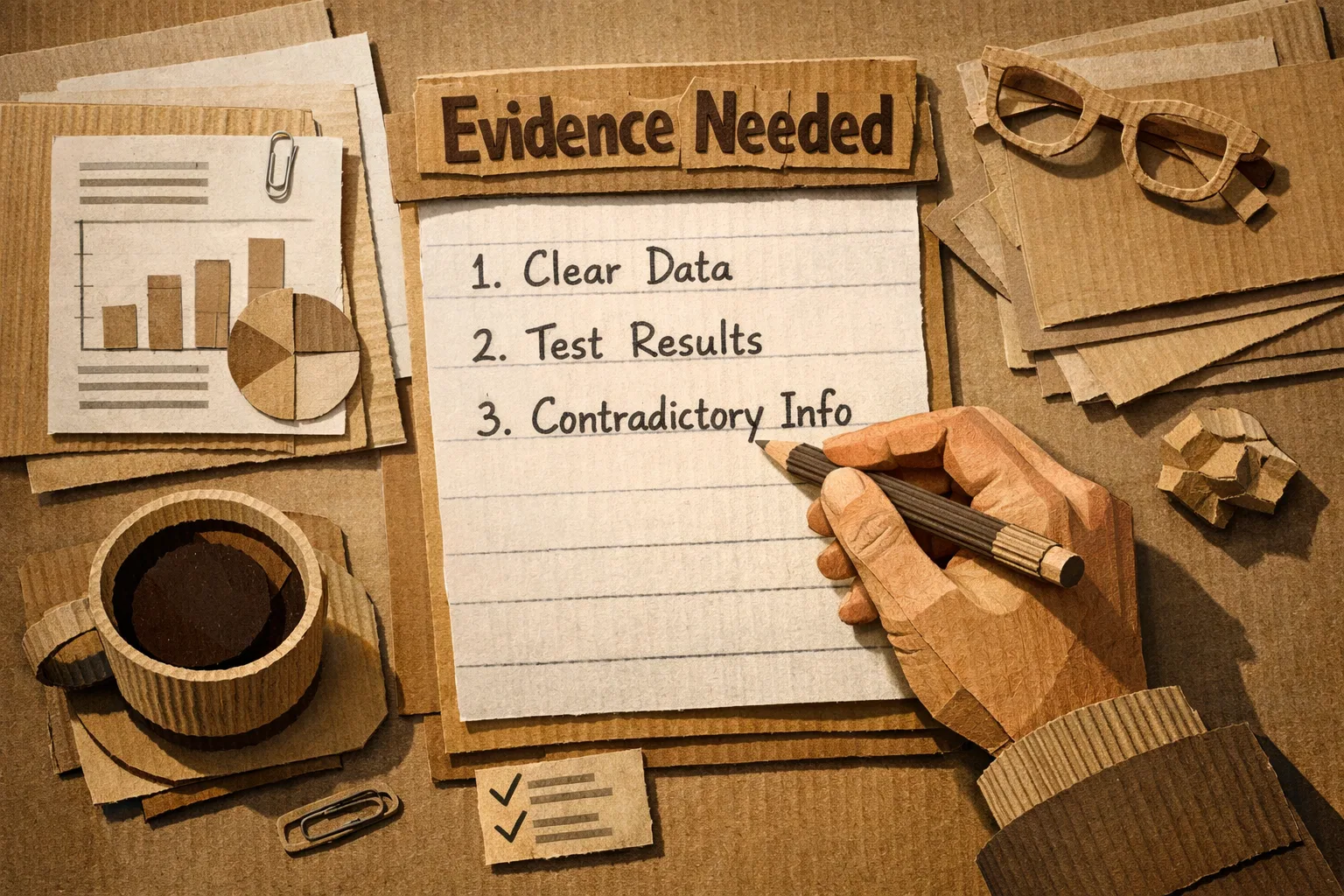
Asking what evidence would change your conclusion protects against reasoning that cannot be tested.
On this page
- Testable conclusions
- Disconfirming evidence
- Decision review triggers
Page outline Jump by section
Introduction
“What would change my mind?” is a small question with a large effect: it turns a conclusion from something you defend into something you can test. In practical thinking, the point is not to become endlessly doubtful or to abandon convictions at the first objection. It is to name, in advance, the evidence, observation, result, or failed prediction that would make you revise your view. That protects you from reasoning that cannot lose.
This question matters because people naturally search for, notice, and trust evidence that fits what they already believe. Psychologists call this confirmation bias: the tendency to give more weight to belief-consistent information and less weight to evidence that challenges it. A “change my mind” question interrupts that pattern by forcing the decision-maker to specify what would count against the current conclusion, not only what would support it.[The Decision Lab]thedecisionlab.comThe Decision LabConfirmation BiasConfirmation bias describes our underlying tendency to notice, focus on, and provide greater credence to…
Used well, it becomes a practical intervention for better judgement: define the claim, identify disconfirming evidence, set review triggers, and make belief revision feel like progress rather than defeat.
Why this question improves thinking
The question works because it changes the structure of the reasoning task. Instead of asking, “Can I find reasons I am right?”, it asks, “What would I expect to see if I were wrong?” That is a different cognitive move.
Peter Wason’s classic 2-4-6 rule-discovery experiment illustrates the problem. Participants were shown the sequence 2, 4, 6 and asked to discover the rule by proposing other number triples. Many tested examples that fitted their first guess, such as more even numbers increasing by two, rather than examples that could disprove it. The actual rule was broader: ascending numbers. Wason interpreted the pattern as a preference for confirmation over falsification.[bear.warrington.ufl.edu]bear.warrington.ufl.eduOn the failure to eliminate hypotheses in a conceptual taskOn the failure to eliminate hypotheses in a conceptual task
The lesson is not that people are foolish. It is that a confirming test often feels informative even when it is weak. If you believe a project is on track, asking team members to list reasons it might succeed will probably produce plausible answers. Asking what evidence would show it is not on track is more useful: missed milestones, rising defect rates, user drop-off, unresolved dependencies, budget burn, or repeated “temporary” workarounds.
In this sense, “What would change my mind?” is a testability device. It pushes a belief towards the same discipline that makes a scientific claim useful: a claim should forbid something, or at least expose itself to possible contradiction. Philosophers and scientists debate the limits of falsifiability as a full theory of knowledge, but the everyday version remains valuable: a view that cannot name any possible contrary evidence is not being seriously tested.[Wikipedia]WikipediaOpen source on wikipedia.org.
Turn conclusions into testable claims
The first implementation step is to translate a broad judgement into a claim that could be checked. “This strategy is good” is too vague. “This strategy will reduce customer churn among small-business users within two quarters without raising support costs” is much easier to test.
A useful change-my-mind question usually has three parts:
- Current conclusion: What do I currently believe or plan to do?
- Decision-relevant assumption: What must be true for that conclusion to hold?
- Revision condition: What evidence would make me lower confidence, change course, or stop?
For example, a team might believe: “We should launch the new onboarding flow to all users.” The change-my-mind version would be: “What evidence would make us delay or narrow the launch?” Good answers might include a statistically meaningful fall in activation among new users, a spike in support tickets from a specific segment, poor performance on mobile, or failed accessibility checks.
This is stronger than a general instruction to “be open-minded”. Research on actively open-minded thinking defines it in behavioural terms: considering alternative opinions, being sensitive to contradictory evidence, delaying premature closure, and recognising that one’s judgement can be wrong. The practical question gives those ideals a place to operate inside a real decision.[PMC]pmc.ncbi.nlm.nih.govPMCActively Open-Minded Thinking and Its MeasurementPMCActively Open-Minded Thinking and Its Measurement
The most important design rule is specificity. A trigger such as “if the data looks bad” leaves too much room for motivated interpretation. A trigger such as “if week-four retention falls by more than five percentage points for the treatment group, or if support tickets rise by more than 15 per cent for two consecutive weeks” is harder to explain away after the fact.

Look for disconfirming evidence, not just more evidence
More information does not automatically improve judgement. If the search is biased, more information may simply give a person more material with which to defend their existing position. That is why the question should be aimed at disconfirming evidence: the kind of finding that would make the current view less likely, not merely less comfortable.
Disconfirming evidence can take several forms:
- A failed prediction: “We expected referrals to rise after the campaign, but they did not.”
- A missing mechanism: “The proposed cause does not appear in the cases where it should appear.”
- A counterexample: “The policy works in one group but fails in the group it was mainly meant to help.”
- A better rival explanation: “The outcome can be explained by seasonality, not by our intervention.”
- A revealed trade-off: “The plan improves speed but damages quality enough to erase the benefit.”
The value of disconfirming evidence is clear in forecasting research. Studies of expert forecasting and the Good Judgment Project found that better forecasters update their beliefs more often as evidence changes, and that actively open-minded thinking is among the traits associated with better performance. The key habit is not dramatic reversal; it is incremental updating when the world gives new information.[Stanford University]stanford.eduOpen source on stanford.edu.
That distinction matters. Changing your mind does not have to mean flipping from “yes” to “no”. It can mean moving from 80 per cent confidence to 60 per cent, narrowing the scope of a claim, postponing a decision, running a smaller trial, or replacing one explanation with a better one. A good change-my-mind question allows partial revision.
Use the question before the decision hardens
The best time to ask “What would change my mind?” is before social, financial, or identity commitments make revision painful. Once a public position has been taken, a budget has been approved, or a team has invested months of effort, contrary evidence becomes easier to reinterpret as noise.
This is why the question pairs well with a premortem. Gary Klein’s premortem method asks a team to imagine that a project has already failed and then work backwards to explain why. Klein argued that this makes it safer for knowledgeable dissenters to voice concerns during planning, when those concerns can still change the plan.[Harvard Business Review]hbr.orgHarvard Business Review Performing a Project PremortemHarvard Business Review Performing a Project Premortem
A change-my-mind version of a premortem is especially practical:
- Assume the decision has failed.
- List the earliest signs that failure was becoming likely.
- Convert those signs into review triggers.
- Decide in advance what action each trigger will cause.
For a hiring decision, a trigger might be: “If the work-sample test contradicts the interview impression, we will give the work sample more weight.” For a product launch, it might be: “If early adopters use the feature once but do not return, we will treat excitement as curiosity rather than demand.” For a policy intervention, it might be: “If the programme helps the easiest-to-reach group but not the target group, we will redesign the delivery model rather than declare success.”
This turns dissent from a personality conflict into a planning tool. The question is no longer “Who is being negative?” but “Which evidence would tell us that our assumptions are failing?”
Decision review triggers make revision easier
A review trigger is a pre-agreed condition that reopens a decision. It protects a team from two common errors: changing course too quickly because of random noise, and refusing to change course because the original decision has become emotionally or politically costly.
Good triggers are observable, timely, and connected to the reason for the decision. They should not be so sensitive that every fluctuation causes panic, nor so vague that nothing ever qualifies.
A strong trigger usually specifies:
- Metric or observation: What exactly will be watched?
- Threshold: How much change is enough to matter?
- Time window: Over what period must the evidence appear?
- Action: What happens if the trigger is met?
- Owner: Who is responsible for calling the review?
For example: “If the pilot does not reach at least 70 per cent completion among eligible participants after eight weeks, the team will pause expansion and review recruitment, user burden, and eligibility rules.” That is a decision review trigger. It does not require panic. It requires attention.
This approach also improves group decision-making because it separates two conversations that are often confused. The first conversation is about what to do now. The second is about what would make the group reconsider. A team can commit to action while still admitting uncertainty.

What a good answer sounds like
A useful answer to “What would change your mind?” is concrete enough that another person could recognise the evidence when it appears. It does not have to be perfectly quantified, but it should reduce wiggle room.
Weak answers include:
- “I would change my mind if the evidence were convincing.”
- “I would change my mind if things got worse.”
- “I would change my mind if experts disagreed.”
- “I would change my mind if the plan clearly failed.”
These sound open-minded but are too elastic. They allow the person to move the standard later.
Stronger answers include:
- “I would change my mind if two independent datasets showed the effect disappearing after controlling for age and income.”
- “I would change my mind if the pilot improved satisfaction but did not improve repeat usage after one month.”
- “I would change my mind if the strongest alternative explanation predicted the result more accurately than my explanation.”
- “I would change my mind if people who disagree with me could forecast the next three outcomes better than I can.”
The last example is particularly useful in messy real-world disagreements. When evidence is complex, prediction can reveal which model is actually doing work. LessWrong’s discussion norms often encourage people to make concrete models, state predictions, and note what would change their minds; the useful part of that practice is that it moves disagreement from identity and rhetoric towards decision boundaries.[LessWrong]lesswrong.comOpen source on lesswrong.com.
When the question fails
The question is powerful, but it can be misused. Sometimes people answer it in a way that only pretends to be testable.
One failure mode is the impossible standard: “I would change my mind if there were absolute proof.” In most real decisions, absolute proof is unavailable. The better standard is proportionate evidence: enough to change confidence or action given the stakes.
Another failure mode is the moving target. A person names a condition, the condition occurs, and then they explain why it does not count. This is why it helps to write the condition down before the result is known.
A third failure mode is isolated fact-checking without model revision. Someone concedes one detail but protects the broader conclusion from any possible damage. Sometimes that is reasonable; one error need not destroy a whole view. But if every failed prediction is treated as irrelevant, the view is not being updated.
A fourth failure mode is performative open-mindedness. In public debate, “what would change your mind?” can become a challenge meant to embarrass the other person. Used that way, it may produce defensiveness rather than reflection. Evidence from persuasion and belief-change research suggests that people often resist facts that threaten identity, group belonging, or prior commitment; better thinking therefore depends not only on evidence quality, but also on whether the setting makes revision psychologically safe.[The New Yorker]newyorker.comThe New Yorker Why Facts Don't Change Our MindsCognitive biases, especially confirmation bias (termed "myside bias" by Mercier and Sperber), lead people to embrace information that sup…
The remedy is to use the question first on yourself. “What would change my mind?” is more credible when it is not only demanded of opponents.
A practical script for better decisions
The easiest way to use the question is to add it to any decision memo, meeting agenda, personal journal, or project review. It works best when it is written before the evidence arrives.
A compact decision script looks like this:
1. State the conclusion.
“We should proceed with the pilot.”
2. Name the core assumptions.
“This will work if the target users understand the offer, find the process easy enough, and receive the promised benefit quickly.”
3. Ask the change-my-mind question.
“What evidence would make us stop, redesign, or narrow the pilot?”
4. Define disconfirming signals.
“Low completion, repeated confusion at the same step, no measurable improvement for the intended group, or high delivery cost per successful case.”
5. Set review triggers.
“At week four and week eight, review completion, cost, user feedback, and outcome data. Pause expansion if two or more red flags cross the agreed thresholds.”
6. Pre-commit to the response.
“If the trigger is met, we will not explain it away as early noise until we have checked the assumption it challenges.”
This script is deliberately plain. Its value is not sophistication; it is that it makes reasoning visible. Once the revision conditions are visible, other people can challenge them, improve them, and hold the decision to them.
The deeper habit: make beliefs easier to update
The deepest benefit of “What would change my mind?” is cultural. It treats belief revision as a normal part of good judgement rather than a humiliating admission of failure. That matters in organisations, politics, science, personal decisions, and everyday disagreements.
A person who can answer the question well is doing several things at once: separating identity from belief, exposing assumptions, inviting contrary evidence, and building a bridge between confidence and humility. Research on actively open-minded thinking supports this general pattern: better reasoning is linked not to having no beliefs, but to being willing to seek and weigh evidence that may count against them.[PMC]pmc.ncbi.nlm.nih.govPMCActively Open-Minded Thinking and Its MeasurementPMCActively Open-Minded Thinking and Its Measurement
The practical standard is simple: before defending a conclusion, ask what would make it weaker. Before expanding a policy, ask what would show it is failing. Before trusting a story, ask what observation would surprise it. Before arguing harder, ask whether the disagreement has a test.
A conclusion that can survive that treatment is stronger. A conclusion that cannot may still be emotionally satisfying, but it is no longer doing the work of careful thought.
Amazon book picks
Further Reading
Books and field guides related to What Evidence Would Change Your Mind?. Use these as the next step if you want deeper reading beyond the article.
Thinking, Fast and Slow
Explains confirmation bias, belief revision, and better judgement.
How to Measure Anything
Encourages evidence-driven decisions and measurable revision criteria.
eBay marketplace picks
Marketplace Samples
Live-tested eBay searches with available results related to this page.




Endnotes
1.
Source: pmc.ncbi.nlm.nih.gov
Title: PMCActively Open-Minded Thinking and Its Measurement
Link:https://pmc.ncbi.nlm.nih.gov/articles/PMC9966223/
2.
Source: bear.warrington.ufl.edu
Title: On the failure to eliminate hypotheses in a conceptual task
Link:https://bear.warrington.ufl.edu/brenner/mar7588/Papers/wason-qjep1960.pdf
3.
Source: Wikipedia
Title: Confirmation bias
Link:https://en.wikipedia.org/wiki/Confirmation_bias
4.
Source: Wikipedia
Link:https://en.wikipedia.org/wiki/Falsifiability
5.
Source: stanford.edu
Link:https://stanford.edu/~knutson/jdm/mellers15.pdf
6.
Source: lesswrong.com
Link:https://www.lesswrong.com/posts/MqrzczdGhQCRePgqN/feedback-requested-draft-of-a-new-about-welcome-page-for
7.
Source: lesswrong.com
Title: finding cruxes help reality punch you in the face
Link:https://www.lesswrong.com/posts/wkDdQrBxoGLqPWh2P/finding-cruxes-help-reality-punch-you-in-the-face
8.
Source: lesswrong.com
Title: visionary arrogance and a criticism of lesswrong voting
Link:https://www.lesswrong.com/posts/8CJ5f2WT4M6BR64yh/visionary-arrogance-and-a-criticism-of-lesswrong-voting
9.
Source: lesswrong.com
Title: why don t you introduce really impressive people you
Link:https://www.lesswrong.com/posts/YmrFWphM3Gne29iLJ/why-don-t-you-introduce-really-impressive-people-you
10.
Source: lesswrong.com
Title: the least convenient possible world
Link:https://www.lesswrong.com/posts/neQ7eXuaXpiYw7SBy/the-least-convenient-possible-world
11.
Source: lesswrong.com
Title: moderation messaging container
Link:https://www.lesswrong.com/posts/zXJfH7oZ62Xojnrqs/lesswrong-moderation-messaging-container
12.
Source: lesswrong.com
Title: tools for deferring gracefully
Link:https://www.lesswrong.com/posts/zLG2DnJw6oEZqAgaE/tools-for-deferring-gracefully
13.
Source: lesswrong.com
Title: meta tations on moderation towards public archipelago
Link:https://www.lesswrong.com/posts/5Ym7DN6h877eyaCnT/meta-tations-on-moderation-towards-public-archipelago
14.
Source: lesswrong.com
Title: conversation on forecasting with vaniver and ozzie gooen
Link:https://www.lesswrong.com/posts/AG6PAqsN5sjQHmKfm/conversation-on-forecasting-with-vaniver-and-ozzie-gooen
15.
Source: lesswrong.com
Title: rant on problem factorization for alignment
Link:https://www.lesswrong.com/posts/tmuFmHuyb4eWmPXz8/rant-on-problem-factorization-for-alignment
16.
Source: Wikipedia
Title: Wason selection task
Link:https://en.wikipedia.org/wiki/Wason_selection_task
17.
Source: thedecisionlab.com
Link:https://thedecisionlab.com/biases/confirmation-bias
Source snippet
The Decision LabConfirmation BiasConfirmation bias describes our underlying tendency to notice, focus on, and provide greater credence to...
18.
Source: frontiersin.org
Link:https://www.frontiersin.org/journals/psychology/articles/10.3389/fpsyg.2025.1565928/full
19.
Source: hbr.org
Title: Harvard Business Review Performing a Project Premortem
Link:https://hbr.org/2007/09/performing-a-project-premortem
20.
Source: newyorker.com
Title: The New Yorker Why Facts Don’t Change Our Minds
Link:https://www.newyorker.com/magazine/2017/02/27/why-facts-dont-change-our-minds
Source snippet
Cognitive biases, especially confirmation bias (termed "myside bias" by Mercier and Sperber), lead people to embrace information that sup...
21.
Source: pmc.ncbi.nlm.nih.gov
Link:https://pmc.ncbi.nlm.nih.gov/articles/PMC9038198/
22.
Source: pmc.ncbi.nlm.nih.gov
Link:https://pmc.ncbi.nlm.nih.gov/articles/PMC11495861/
23.
Source: pmc.ncbi.nlm.nih.gov
Link:https://pmc.ncbi.nlm.nih.gov/articles/PMC11306497/
24.
Source: pmc.ncbi.nlm.nih.gov
Link:https://pmc.ncbi.nlm.nih.gov/articles/PMC12571896/
25.
Source: pmc.ncbi.nlm.nih.gov
Link:https://pmc.ncbi.nlm.nih.gov/articles/PMC10219317/
26.
Source: pmc.ncbi.nlm.nih.gov
Link:https://pmc.ncbi.nlm.nih.gov/articles/PMC11561113/
27.
Source: pmc.ncbi.nlm.nih.gov
Link:https://pmc.ncbi.nlm.nih.gov/articles/PMC12330140/
28.
Source: pmc.ncbi.nlm.nih.gov
Link:https://pmc.ncbi.nlm.nih.gov/articles/PMC7333631/
29.
Source: strategicdecisionsolutions.com
Title: premortem method
Link:https://strategicdecisionsolutions.com/premortem-method/
30.
Source: digitalhealth.blog.gov.uk
Title: pre mortem identifying opportunities and risks
Link:https://digitalhealth.blog.gov.uk/2018/09/20/pre-mortem-identifying-opportunities-and-risks/
31.
Source: britannica.com
Title: confirmation bias
Link:https://www.britannica.com/science/confirmation-bias
32.
Source: elearningspecialist.com
Title: Premortem method
Link:https://elearningspecialist.com/en/blog/premortem-method-a-simple-and-probably-effective-approach-to-strengthening-the-safety-culture/
33.
Source: cognitivebiaslab.com
Title: Confirmation Bias
Link:https://www.cognitivebiaslab.com/bias/bias-confirmation/
Additional References
34.
Source: oecd.org
Link:https://www.oecd.org/content/dam/oecd/en/topics/policy-issues/future-of-education-and-skills/learning-compass-constructs/OpenMind-set.pdf
35.
Source: youtube.com
Title: The Most Common Cognitive Bias
Link:https://www.youtube.com/watch?v=vKA4w2O61Xo
Source snippet
this is how to improve your critical thinking according to neuroscience | THE ONLY VIDEO THAT WORKS...
36.
Source: instagram.com
Link:https://www.instagram.com/reel/DZO1_GlDb8X/
37.
Source: researchgate.net
Link:https://www.researchgate.net/publication/355070855_Project_Pre-mortem_using_Prospective_Hindsight_An_Unexplored_Tool_to_address_Healthcare_Projects_Implementation_barriers
38.
Source: skepticalinquirer.org
Link:https://skepticalinquirer.org/1990/01/a-field-guide-to-critical-thinking/
39.
Source: aiimpacts.org
Link:https://aiimpacts.org/evidence-on-good-forecasting-practices-from-the-good-judgment-project/
40.
Source: sjdm.org
Link:https://sjdm.org/dmidi/Actively_Open-Minded_Thinking_Beliefs.html
41.
Source: goodjudgment.com
Link:https://goodjudgment.com/superforecasters-toolbox-beliefs/
42.
Source: cambridge.org
Link:https://www.cambridge.org/core/books/cognitive-science-of-belief/building-better-beliefs-through-actively-openminded-thinking/140F5F32706B3B2CBC5A83CC99F174A4
43.
Source: alliancefordecisioneducation.org
Link:https://alliancefordecisioneducation.org/resources/conducting-a-pre-mortem/
Topic Tree
Follow this branch
Parent topic
Sharper ThinkingRelated pages 29
- Confidence Updates Why Changing Your Mind Can Mean Changing Your Confidence
- Disconfirming Evidence Why Contradictory Evidence Is More Useful Than More Proof
- Premortems Can a Premortem Reveal When You Should Reconsider?
- Review Triggers How Review Triggers Make Changing Course Easier
- Revision Rules What Would Actually Make You Change Your Mind?
- +1 more in sidebar