Within Critical Thinking
What Counts as a Good Critical Judgement?
The Delphi Report gives critical thinking a practical standard: interpretation, analysis, evaluation, inference, and explanation.
On this page
- The core judgement skills in the Delphi definition
- Why explanation matters after inference
- How the ideal critical thinker behaves
Page outline Jump by section
Introduction
The American Philosophical Association’s Delphi Report remains one of the most influential attempts to define what counts as good critical judgement. Rather than treating critical thinking as intelligence, scepticism, or debate skill, the report defines it as purposeful, self-regulatory judgement aimed at deciding what to believe or what to do. That judgement is not a single mental act but a coordinated process involving interpretation, analysis, evaluation, inference, and explanation, guided by reflective self-correction. The definition emerged from a structured Delphi study in which experts from philosophy, education, psychology and related disciplines worked towards consensus on the skills and dispositions that should underpin critical-thinking education and assessment.[ERIC]files.eric.ed.govERICFebruary 20, 2011 — by PA Facione · 1990 · Cited by 1116 — We understand critical thinking to be purposeful, self-regulatory judgment…
 Within the broader idea of purposeful judgement, the Delphi standards are valuable because they make good thinking observable. Instead of asking whether someone is “a critical thinker”, they ask whether a judgement has been reached through identifiable reasoning processes and whether the reasoning can be explained and revised when necessary.
What Counts as a Good Critical Judgement?
The Delphi Report does not describe critical thinking as a collection of isolated techniques. It presents judgement as an integrated process in which several cognitive skills support one another. A strong judgement is one that is based on evidence, sensitive to context, open to revision, and capable of being justified to others.[ERIC]files.eric.ed.govERICFebruary 20, 2011 — by PA Facione · 1990 · Cited by 1116 — We understand critical thinking to be purposeful, self-regulatory judgment…
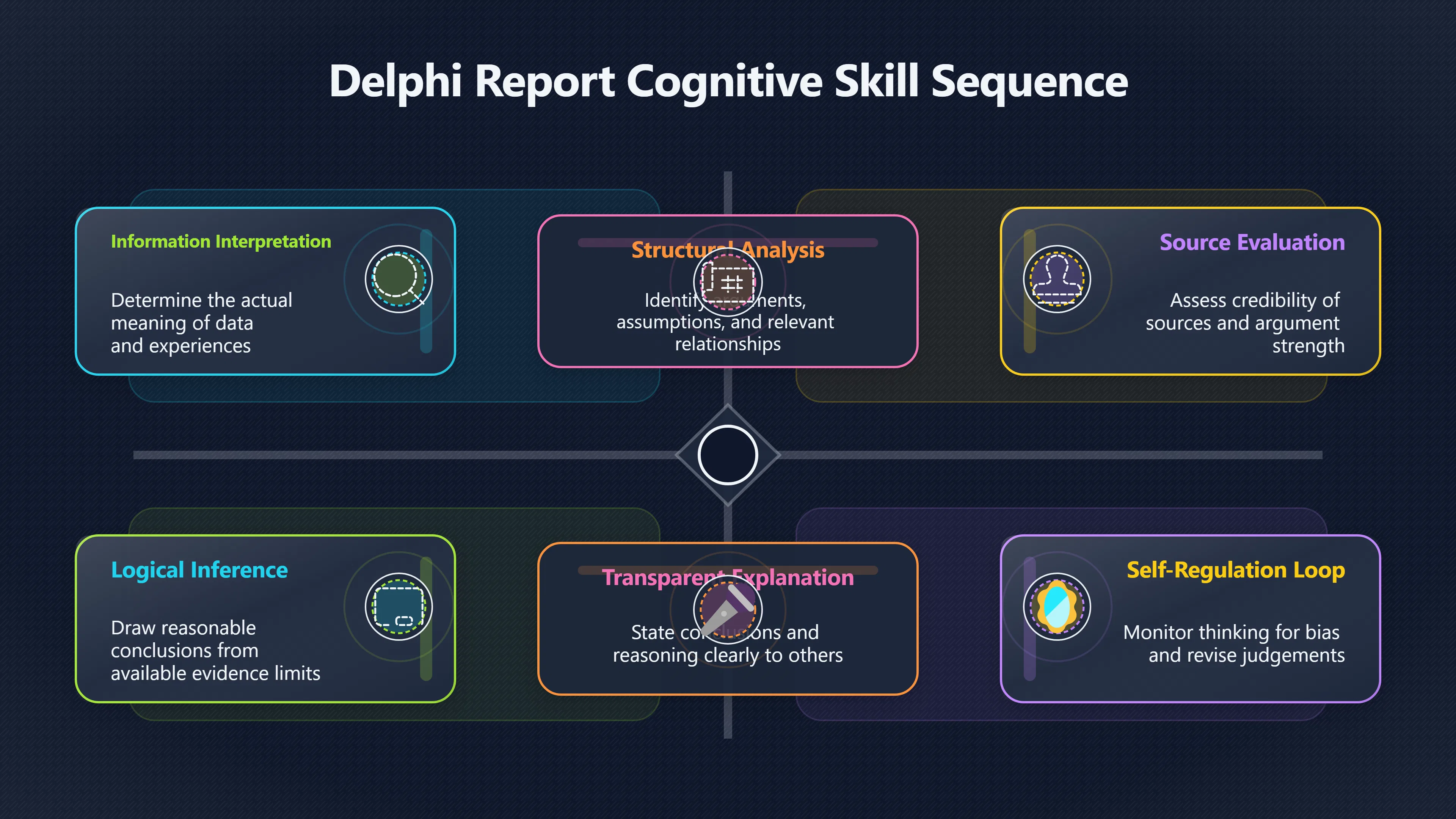
The report identifies six core cognitive skills.
- Interpretation – understanding the meaning of information, experiences, data or events. Before evaluating evidence, a thinker must first determine what is actually being claimed or observed.
- Analysis – identifying arguments, assumptions, relationships and reasons. Analysis separates conclusions from supporting evidence and distinguishes relevant from irrelevant information.
- Evaluation – assessing the credibility of sources and the strength of arguments. This includes judging whether evidence genuinely supports a conclusion and recognising weaknesses or uncertainty.
- Inference – drawing reasonable conclusions from available evidence while recognising the limits of what the evidence can justify.
- Explanation – clearly stating both the conclusion and the reasoning that produced it, including the evidence, methods and standards relied upon.
- Self-regulation – monitoring one’s own thinking, recognising possible bias or error, and revising judgements when new evidence warrants it. Although often highlighted separately in later summaries, reflective self-correction is built into the report’s overall definition of critical thinking.[ERIC+2Insight Assessment]files.eric.ed.govERICFebruary 20, 2011 — by PA Facione · 1990 · Cited by 1116 — We understand critical thinking to be purposeful, self-regulatory judgment…
These skills are intended to work together rather than in sequence. Interpretation informs analysis; analysis supports evaluation; evaluation shapes inference; explanation communicates the judgement; self-regulation continually checks every stage.
Why Explanation Matters After Inference
One of the Delphi Report’s distinctive contributions is its insistence that arriving at a conclusion is not enough. A judgement becomes intellectually accountable only when the thinker can explain why that conclusion follows from the available evidence.
The report therefore treats explanation as more than communication. Explanation requires identifying the evidential, conceptual, methodological, contextual or evaluative considerations that justify the judgement. If two people reach the same conclusion for entirely different reasons, the quality of their critical thinking may differ substantially because only one may be able to demonstrate sound reasoning.[ERIC]files.eric.ed.govERICFebruary 20, 2011 — by PA Facione · 1990 · Cited by 1116 — We understand critical thinking to be purposeful, self-regulatory judgment…
This emphasis has practical consequences.
- It exposes hidden assumptions.
- It allows others to evaluate the reasoning instead of merely accepting the conclusion.
- It makes disagreement more productive because people can compare reasons rather than simply opposing opinions.
- It supports learning, since weak reasoning becomes visible and therefore improvable.
In educational settings, this explains why assessments of critical thinking often ask students to justify answers rather than merely selecting the correct option. The explanation reveals the quality of judgement that the final answer alone cannot show.

The Ideal Critical Thinker Is More Than a Skilled Reasoner
The Delphi project did not stop with defining cognitive skills. The expert panel also described the personal dispositions associated with high-quality judgement. Their “ideal critical thinker” combines reasoning ability with habits of mind that encourage those abilities to be used consistently.[Insight Assessment]insightassessment.comInsight Assessment The Delphi ReportThis human cognitive process of reflectively deciding what to believe or what to do…Read more…
According to the consensus description, an ideal critical thinker is characterised by qualities such as:
- inquisitiveness and intellectual curiosity;
- being well informed while recognising the limits of one’s knowledge;
- trust in reasoned inquiry rather than impulse or authority alone;
- open-mindedness towards alternative viewpoints;
- flexibility when considering different possibilities;
- fairness in evaluating competing arguments;
- honesty about personal biases and assumptions;
- willingness to reconsider conclusions when evidence changes;
- precision where the situation demands it;
- persistence when problems are complex.
These characteristics matter because technical reasoning skills alone do not guarantee sound judgement. Someone may be highly capable of analysing arguments yet consistently ignore evidence that challenges existing beliefs. The Delphi panel therefore argued that effective critical thinking depends on both competence and disposition: knowing how to think critically and being willing to do so.[ERIC]files.eric.ed.govERICFebruary 20, 2011 — by PA Facione · 1990 · Cited by 1116 — We understand critical thinking to be purposeful, self-regulatory judgment…
Why the Delphi Standards Changed Critical-Thinking Education
Before the Delphi project, educators often agreed that critical thinking was important but disagreed about exactly what should be taught or assessed. The Delphi study used a structured expert-consensus method to identify shared principles across disciplines, producing a practical framework that could guide curriculum design and assessment.[PhilPapers]philpapers.orgPeter Facione, Critical Thinking: A Statement of Expert…by P Facione · 1990 · Cited by 6816 — This is the full version of th…
Its influence can be seen in several areas:
- university critical-thinking courses organised around identifiable reasoning skills;[faculty.uml.edu]faculty.uml.eduThe APA Delphi Report. Critical Thinking: A Statement of Expert. Consensus…Read more…
- assessment instruments designed to measure interpretation, analysis, evaluation and inference rather than factual recall alone;
- professional education, particularly in fields such as healthcare, where judgement under uncertainty is central to practice;
- later research that expanded the framework by examining both cognitive skills and thinking dispositions.[faculty.uml.edu+2Insight Assessment]faculty.uml.eduThe APA Delphi Report. Critical Thinking: A Statement of Expert. Consensus…Read more…
Although researchers continue to debate the best ways to measure or teach critical thinking, the Delphi definition remains a common reference point because it translates an abstract educational goal into observable components of judgement.

What the Standards Mean for Everyday Thinking
The Delphi standards shift attention away from whether a conclusion happens to be correct and towards whether it has been reached responsibly. A good critical judgement is not simply the “right answer”; it is a conclusion supported by careful interpretation, sound analysis, balanced evaluation, justified inference and transparent explanation, all subject to ongoing self-correction.
This perspective also encourages appropriate confidence. A critical thinker may conclude that the evidence strongly supports a claim, weakly supports it, or is currently insufficient. In each case, the quality of judgement depends less on certainty than on whether the reasoning faithfully reflects the available evidence. That focus on disciplined, explainable reasoning is what makes the Delphi Report’s standards a lasting foundation for understanding purposeful judgement as the heart of critical thinking.[ERIC+2Insight Assessment]files.eric.ed.govERICFebruary 20, 2011 — by PA Facione · 1990 · Cited by 1116 — We understand critical thinking to be purposeful, self-regulatory judgment…
Amazon book picks
Further Reading
Books and field guides related to What Counts as a Good Critical Judgement?. Use these as the next step if you want deeper reading beyond the article.
Asking the Right Questions
Covers interpretation, evaluation, inference, and explanation.
eBay marketplace picks
Marketplace Samples
Example marketplace items related to this page. Use the search link to explore similar finds on eBay.



Endnotes
1.
Source: faculty.uml.edu
Link:https://faculty.uml.edu/robert_gamache/85.503/Facione2006CriticalThinking.pdf
Source snippet
The APA Delphi Report. Critical Thinking: A Statement of Expert. Consensus...Read more...
2.
Source: philpapers.org
Link:https://philpapers.org/rec/FACCTA
Source snippet
Peter Facione, Critical Thinking: A Statement of Expert...by P Facione · 1990 · Cited by 6816 — This is the full version of th...
3.
Source: youtube.com
Title: 5 tips to improve your critical thinking
Link:https://www.youtube.com/watch?v=dItUGF8GdTw
Source snippet
Teach Critical Thinking...
4.
Source: youtube.com
Title: Teach Critical Thinking
Link:https://www.youtube.com/watch?v=KL_9DJI73Ho
Source snippet
What is Delphi Consensus?...
5.
Source: files.eric.ed.gov
Link:https://files.eric.ed.gov/fulltext/ED315423.pdf
Source snippet
ERICFebruary 20, 2011 — by PA Facione · 1990 · Cited by 1116 — We understand critical thinking to be purposeful, self-regulatory judgment...
Published: February 20, 2011
6.
Source: insightassessment.com
Title: Insight Assessment The Delphi Report
Link:https://insightassessment.com/iaresource/the-delphi-report-a-statement-of-expert-consensus-on-the-definition-of-critical-thinking/
Source snippet
This human cognitive process of reflectively deciding what to believe or what to do...Read more...
7.
Source: insightassessment.com
Title: CH+CT+&+CR++ +Facione+&+Facione
Link:https://insightassessment.com/var/ezflow_site/storage/pdf/CH%2B1%2BCT%2B%26%2BCR%2B%2B-%2BFacione%2B%26%2BFacione.pdf
Source snippet
Insight AssessmentCritical Thinking and Clinical Judgment - Insight Assessmentby NC Facione · Cited by 219 — "Critical thinking is the pr...
8.
Source: dictionary.cambridge.org
Link:https://dictionary.cambridge.org/dictionary/english/critical
Source snippet
English meaning - Cambridge Dictionary4 days ago — saying that someone or something is bad or wrong: a critical report, critical of, Sh...
9.
Source: youtube.com
Link:https://www.youtube.com/critical
Source snippet
I created this channel when I starting making music back in 2006, the content varies from music videos to cars, bikes, rap battles and in...
Additional References
10.
Source: merriam-webster.com
Link:https://www.merriam-webster.com/dictionary/critical
Source snippet
CRITICAL Definition & Meaning1. a: inclined to criticize severely and unfavorably Don't be so critical. This is just a first attempt. Th...
11.
Source: criticaldesign.nz
Link:https://criticaldesign.nz/
Source snippet
Critical. Cleanstone | 100% Recycled Plastic PanelsA stunning, sustainable, 100% recycled plastic panel that can elevate your next projec...
12.
Source: researchgate.net
Link:https://www.researchgate.net/publication/242279575_Critical_Thinking_A_Statement_of_Expert_Consensus_for_Purposes_of_Educational_Assessment_and_Instruction
Source snippet
Facione published Critical Thinking: A Statement of Expert Consensus for Purposes of Educational Assessment...
13.
Source: courseware.e-education.psu.edu
Link:https://courseware.e-education.psu.edu/downloads/geog882/Critical%20Thinking%20What%20it%20is%20and%20why%20it%20counts.pdf
Source snippet
Thinking: What It Is and Why It Countsby PA Facione · Cited by 8164 — “Critical thinking is the process of purposeful, self-regulatory ju...
14.
Source: scribd.com
Link:https://www.scribd.com/doc/38236691/09B456D6d01
Source snippet
Critical Thinking: What It Is and Why It Counts: 2010 Update“We understand critical thinking to be purposeful, self-regulatory judgment w...
15.
Source: researchgate.net
Title: 251303244 Critical Thinking What It Is and Why It Counts
Link:https://www.researchgate.net/publication/251303244_Critical_Thinking_What_It_Is_and_Why_It_Counts
Source snippet
Critical Thinking: What It Is and Why It CountsThis is in line with the Facione (2015) model of critical thinking that incorporates inter...
16.
Source: scribd.com
Link:https://www.scribd.com/document/162956383/Critical-Thinking
Source snippet
al thinking (Facione, 1990). Schraw et al. (2006) draw...Read more...
17.
Source: damiantgordon.com
Link:https://www.damiantgordon.com/EducationalModels/CriticalThinking/Facione/CriticalThinking-Facione-DelphiReport.pdf
Source snippet
gment. This means that critical thinking is not...Read more...
18.
Source: thesaurus.com
Title: CRITICA L Synonyms & Antonyms
Link:https://www.thesaurus.com/browse/critical
Source snippet
CRITICAL Synonyms & Antonyms - 184 wordsFind 184 different ways to say CRITICAL, along with antonyms, related words, and example sentence...
19.
Source: peterellerton.substack.com
Title: critical thinking explained
Link:https://peterellerton.substack.com/p/critical-thinking-explained
Source snippet
Thinking Explained - by Dr Peter Ellerton, PhDFacione “We understand critical thinking to be purposeful, self-regulatory judgment which r...
Topic Tree