Within Retrieval
What a Brain Dump Really Shows
A short brain dump can turn scattered recall into a map of missing steps, weak evidence and ideas that need repair.
On this page
- What to write in three to five minutes
- How to sort facts, claims and examples
- How to turn gaps into the next practice target
Page outline Jump by section
Introduction
A brain dump is one of the simplest forms of retrieval practice: you close your notes, set a short timer, and write everything you can remember about a topic from memory. Its value is not the amount you recall but the pattern of what appears, what is missing, and how ideas connect. That makes a brain dump especially useful for improving reasoning rather than merely memorising facts. Instead of asking, “Do I recognise this?”, it asks, “Can I reconstruct the argument without prompts?” Research on retrieval practice consistently shows that actively recalling information strengthens learning more effectively than passive review, while also revealing misconceptions and gaps that guide later study. Center for Teaching and Learning+2Cult of Pedagogy[ctl.wustl.edu]ctl.wustl.eduRetrieval practice is the strategy of recalling facts, concepts, or events from memory in order to enhance learning…
 Within a broader programme of retrieval practice, the brain dump serves as a diagnostic tool. It creates a visible record of your thinking before outside information influences it, allowing you to inspect the reasoning itself rather than your ability to recognise the correct answer afterwards. Pooja K. Agarwal, Ph.D.[retrievalpractice.org]retrievalpractice.orgPooja KAgarwal, Ph.D.Brain Dump: A small strategy with a big impact30 Nov 2017 — Retrieval practice can take 5 minutes or less. A few tips: Have…
What a brain dump really shows
Many learners assume a brain dump measures memory alone. In practice, it exposes the structure of understanding.
Someone may remember a conclusion perfectly but forget the evidence that supports it. Another person may recall several isolated facts yet fail to explain how they relate. A third may confidently define a concept but struggle to produce a concrete example. These are different kinds of learning problems, and each suggests a different next step.
Because the exercise happens before reopening notes, it also reduces the illusion of competence created by familiar-looking material. Instead of relying on recognition, the learner sees which parts of an explanation can genuinely be reconstructed from memory. This makes the exercise valuable for developing analytical thinking as well as long-term retention. Center for Teaching and Learning+2Structural Learning[ctl.wustl.edu]ctl.wustl.eduRetrieval practice is the strategy of recalling facts, concepts, or events from memory in order to enhance learning…
What to write in three to five minutes
The exercise works best when it is deliberately brief. A short time limit encourages recall rather than perfection.
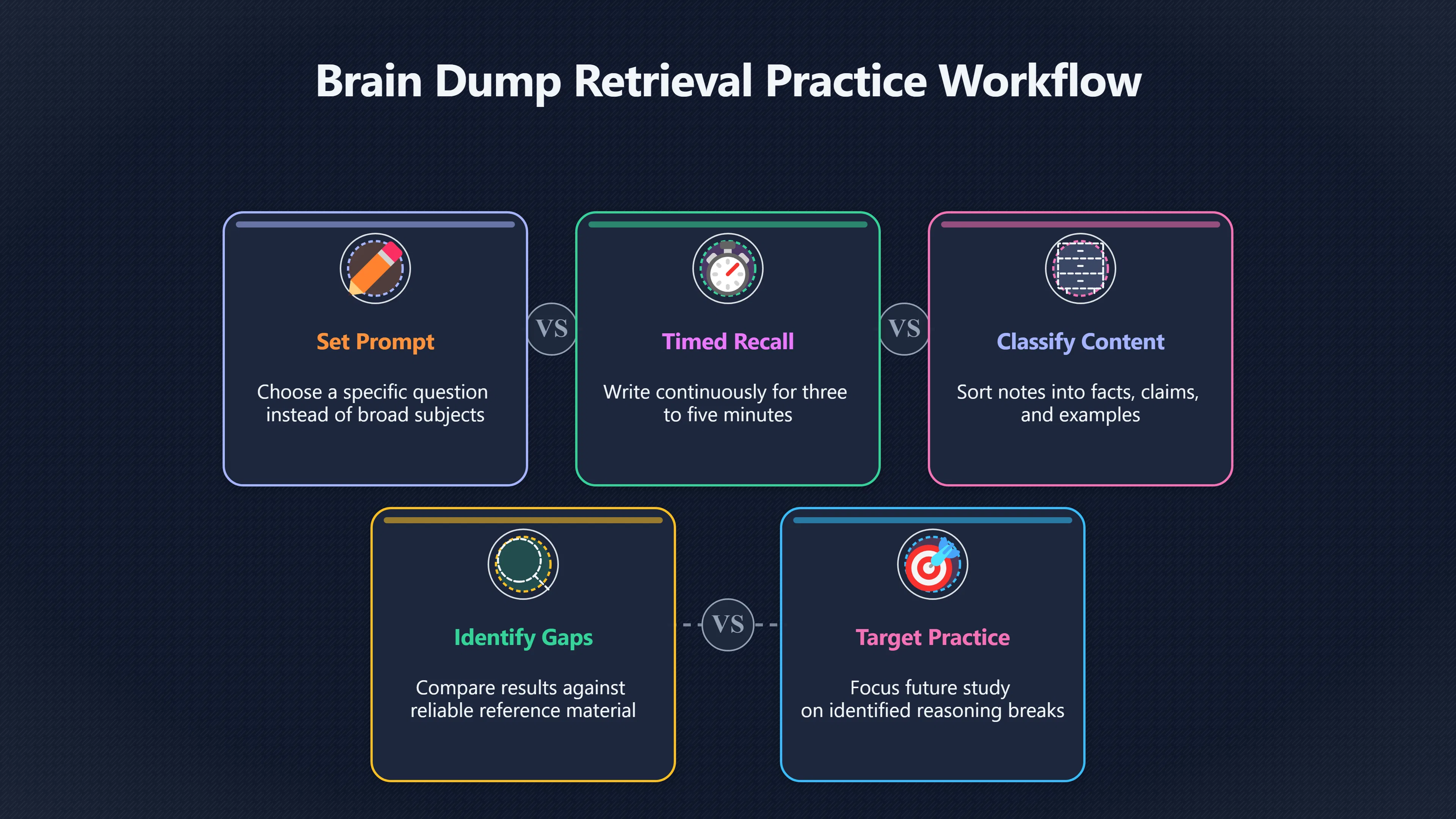
Begin with a clear prompt rather than a broad subject. Instead of writing about “statistics”, ask yourself:
- Why does correlation not imply causation?
- How does this policy produce its intended effect?
- What are the steps in this argument?
- What assumptions does this explanation depend on?
Then write continuously for three to five minutes without checking any source. Do not edit, reorganise or correct while writing. The goal is to capture your current mental model exactly as it exists.
Useful material to include includes:
- definitions you can remember;
- causal links between ideas;
- examples or case studies;
- exceptions or limitations;
- questions that occur naturally while writing.
Research-based guidance on classroom retrieval practice recommends keeping activities low stakes, individual and closed-book where practical, precisely because the objective is learning rather than assessment. Even a five-minute free-recall exercise can strengthen later understanding while exposing areas that need attention. Pooja K. Agarwal, Ph.D.+2Center for Teaching and Learning[retrievalpractice.org]retrievalpractice.orgPooja KAgarwal, Ph.D.Brain Dump: A small strategy with a big impact30 Nov 2017 — Retrieval practice can take 5 minutes or less. A few tips: Have…
How to sort facts, claims and examples
The first draft of a brain dump is often chaotic. That disorder is useful because it reflects how knowledge is currently organised in memory. The next step is to classify what you wrote.
A simple three-column structure helps reveal reasoning weaknesses.
TypeQuestion to askFactsWhat information do I remember?ClaimsWhat conclusions or explanations am I making?ExamplesWhat evidence or situations support those claims?
Once the information is separated, inspect the links between the columns.
A reasoning chain becomes much easier to evaluate:
- Does every important claim have supporting evidence?
- Do the examples actually demonstrate the claim?
- Have I skipped intermediate steps?
- Did I assume something without stating it?
- Are definitions being used consistently?
This process often uncovers “hidden jumps” in reasoning. For example, a learner may write:
Inflation rose. Interest rates increased. Spending slowed.
Only after sorting the ideas does it become obvious that the causal mechanism—higher borrowing costs reducing demand—is missing entirely.
Similarly, someone explaining evolution might remember natural selection and adaptation but forget variation within populations, making the explanation incomplete rather than incorrect.
These missing links are exactly the points where further retrieval practice should concentrate.

How to turn gaps into the next practice target
The most valuable part of a brain dump begins after you compare it with reliable notes or reference material.
Rather than simply filling every blank, classify each gap according to its cause.
Missing facts indicate knowledge that has not yet been retained.
Broken reasoning suggests that individual facts exist but have not been connected into a coherent explanation.
Weak examples often show that understanding remains abstract and may not transfer well to new situations.
False confidence appears when an explanation sounded convincing until comparison revealed omitted assumptions or incorrect details.
Each category suggests a different follow-up activity.
If facts are missing, another retrieval session after spaced review may be sufficient. If reasoning is incomplete, practise reconstructing the entire causal chain without looking. If examples are weak, retrieve fresh examples rather than rereading definitions alone.
This approach turns the brain dump into a planning tool rather than a grading exercise. The purpose is not to count mistakes but to identify the smallest change that will improve future thinking.
Common patterns that reveal missing reasoning
With repeated use, certain patterns tend to recur.
Strong beginnings, weak endings. People often remember definitions but forget implications or applications.
Conclusions without evidence. A learner recalls what is true but not why it is true.
Lists without relationships. Multiple facts appear, yet no explanation connects them.
Examples replacing explanations. A memorable example is recalled while the underlying principle is forgotten.
Circular explanations. A concept is defined by repeating the original claim in different words rather than providing a genuine mechanism.
These patterns matter because analytical skill depends on connecting information, not merely accumulating it. A brain dump makes those connections—or their absence—visible enough to improve.

Mistakes that reduce the value of brain dumps
Several habits weaken the exercise.
Looking at notes “just to check one point” changes the task from retrieval into copying.
Trying to produce polished prose encourages editing rather than honest recall.
Writing for too long shifts attention towards completeness instead of diagnosis.
Treating every omission as failure discourages experimentation. Retrieval practice works best when learners expect imperfect recall and use the resulting errors as guidance for future study rather than evidence of poor ability. Center for Teaching and Learning+2Pooja K. Agarwal, Ph.D.[ctl.wustl.edu]ctl.wustl.eduRetrieval practice is the strategy of recalling facts, concepts, or events from memory in order to enhance learning…
Making brain dumps part of regular thinking
A single brain dump provides a snapshot of current understanding. Repeating the exercise over time shows how reasoning develops.
For analytical subjects, useful prompts include reconstructing an argument, explaining a causal chain, identifying assumptions behind a policy, or comparing competing explanations from memory. Looking back at earlier brain dumps often reveals that the largest improvements are not simply remembering more facts but producing more complete chains of reasoning with fewer unsupported leaps.
Used this way, brain dumps become more than a study technique. They are a practical method for exposing hidden gaps in reasoning, directing future retrieval practice, and gradually building explanations that are both more accurate and more coherent.
Amazon book picks
Further Reading
Books and field guides related to What a Brain Dump Really Shows. Use these as the next step if you want deeper reading beyond the article.
Make It Stick
Explains why active recall and retrieval practice outperform passive review.
Powerful Teaching
Covers retrieval practice, brain dumps, and practical techniques for strengthening memory and understanding.
How We Learn
Explores memory, recall, spacing, and effective study habits that support brain dump practice.
Small Teaching
Shows how low-effort retrieval and learning strategies improve long-term retention.
eBay marketplace picks
Marketplace Samples
Example marketplace items related to this page. Use the search link to explore similar finds on eBay.

Endnotes
1.
Source: retrievalpractice.org
Title: Pooja K
Link:https://www.retrievalpractice.org/strategies/2017/free-recall
Source snippet
Agarwal, Ph.D.Brain Dump: A small strategy with a big impact30 Nov 2017 — Retrieval practice can take 5 minutes or less. A few tips: Have...
2.
Source: structural-learning.com
Title: retrieval practice a teachers guide
Link:https://www.structural-learning.com/post/retrieval-practice-a-teachers-guide
Source snippet
Retrieval practice6 Oct 2021 — Retrieval in lessons involves short, low-stakes activities that strengthen memory, reveal gaps, and build...
3.
Source: ctl.wustl.edu
Link:https://ctl.wustl.edu/resources/using-retrieval-practice-to-increase-student-learning/
Source snippet
Retrieval practice is the strategy of recalling facts, concepts, or events from memory in order to enhance learning...
4.
Source: cultofpedagogy.com
Title: Suppose you’re studying the systems of the human body
Link:https://www.cultofpedagogy.com/retrieval-practice/
Source snippet
Cult of PedagogyRetrieval Practice: The Most Powerful Learning Strategy...24 Sept 2017 — Retrieval practice is the act of trying to reca...
Additional References
5.
Source: education-ni.gov.uk
Link:https://www.education-ni.gov.uk/sites/default/files/2025-04/May%20Newsletter%20-%20Retrieval%20Practice%20%20What%20it%20is%2C%20Why%20it%20Works%20and%20How%20to%20Do%20It%20Better.PDF
6.
Source: mindbrained.org
Title: retrieval practice or how to never throw your old worksheets away
Link:https://www.mindbrained.org/2025/05/retrieval-practice-or-how-to-never-throw-your-old-worksheets-away/
Source snippet
Retrieval Practice or How to Never Throw Your Old...6 May 2025 — This finding demonstrates that retrieval practice ([testing]({{ 'testing/' | relative_url }})) enhances lo...
Published: May 2025
7.
Source: edutopia.org
Title: quick and mighty retrieval practices
Link:https://www.edutopia.org/article/quick-and-mighty-retrieval-practices/
Source snippet
15 Quick (and Mighty) Retrieval Practices25 Jul 2025 — After a brain dump, students can turn and talk with a peer to compare what they bo...
8.
Source: thirdspacelearning.com
Link:https://thirdspacelearning.com/blog/retrieval-practice/
Source snippet
om long-term memory to improve learning and recall...
9.
Source: youtube.com
Title: Quick Tip | Retrieval Practice with Brain Dumps
Link:https://www.youtube.com/watch?v=TFK4wLYfOjw
Source snippet
How to Do Free Recall | Study Smarter and Remember More is highly relevant because it provides step-by-step instructions on utilizing fre...
10.
Source: youtube.com
Title: How to do free recall (AKA active recall)
Link:https://www.youtube.com/watch?v=FatnXnlwAc4
Source snippet
3 How To Use The Free Recall Method To Learn Anything Faster...
11.
Source: youtube.com
Title: How to Do Free Recall | Study Smarter and Remember More
Link:https://www.youtube.com/watch?v=_XodWc6NrlQ
Source snippet
2 How to do free recall (AKA active recall) - Language learning demonstration...
12.
Source: youtube.com
Title: How To Use The Free Recall Method To Learn Anything Faster
Link:https://www.youtube.com/watch?v=j75xzDEzIk8
Source snippet
4 How to Use Free Recall to Learn More Effectively...
13.
Source: youtube.com
Title: How to Use Free Recall to Learn More Effectively
Link:https://www.youtube.com/watch?v=evIuDvQDDSY
Source snippet
5 Quick Tip | Retrieval Practice with Brain Dumps...
Topic Tree