Within Feedback
When Team Reviews Actually Improve Judgement
A good after-action review asks what was expected, what happened, why it differed and what should change next time.
On this page
- The four questions that keep reviews focused
- Why blame ruins feedback
- How teams turn lessons into routines
Page outline Jump by section
Introduction
After-action reviews (AARs) improve team judgement when they are designed as learning conversations rather than performance evaluations. Instead of asking who made the mistake, they compare what the team expected with what actually happened, examine why the two differed, and identify specific changes for the next similar situation. This structure helps teams avoid hindsight bias, capture useful knowledge before it is forgotten, and steadily improve future decisions rather than merely explaining past outcomes. Originally developed in the military and now widely used in healthcare, emergency management and business, AARs work best when they are short, evidence-based and focused on improving future judgement rather than assigning blame.[Wharton Executive Education+2cebma.org]executiveeducation.wharton.upenn.eduWharton Executive Education After Action ReviewWharton Executive EducationAfter Action Review - AAR Process - Nano Tools for LeadersThe After Action Review (AAR) was developed by the U…
The four questions that keep reviews focused
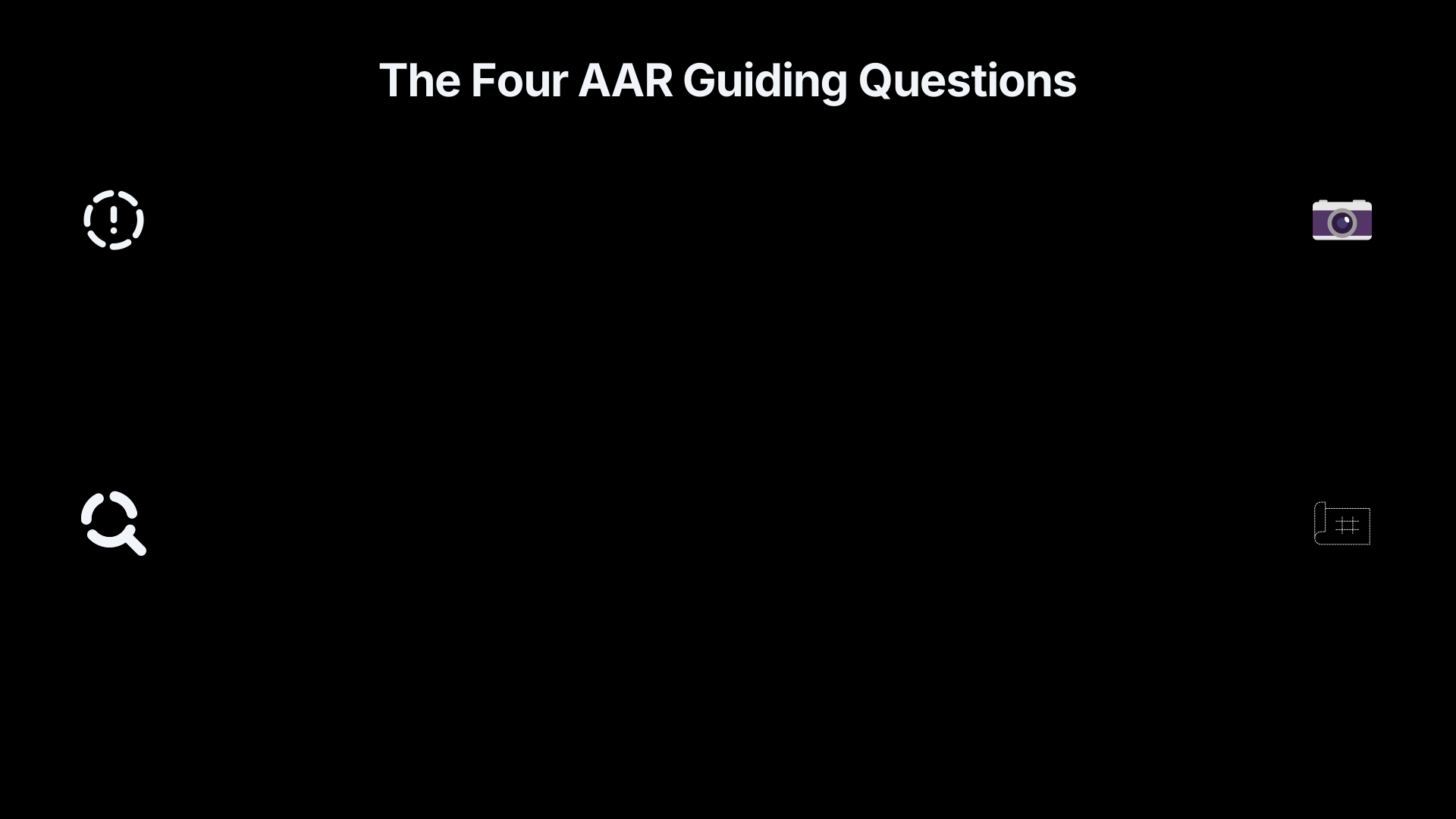
The most effective after-action reviews are built around four simple questions. Their value lies not in their simplicity but in the discipline they impose on the discussion.
- What did we expect to happen?
Starting with expectations forces the team to recover its original reasoning before hindsight reshapes memories. Good reviews compare today’s knowledge with yesterday’s assumptions rather than judging past decisions using information that only became available later.[2. What actually happened?]chiefexecutive.net· What actually happened? · Why did it happen? · Most importantly, how do we improve our next operation?Read more…
This stage establishes a shared factual record. Teams separate observable events from interpretations, reducing arguments over recollection and preventing premature conclusions.
- Why were there differences?
This is the analytical core of the review. The aim is not merely to explain failure but to identify which assumptions proved wrong, which signals were missed, which uncertainties were underestimated, and which decisions were sound despite producing poor outcomes because of chance.
- What should we sustain or change next time?
Reviews should finish by identifying concrete behavioural or procedural adjustments. Successful practices deserve as much attention as failures because understanding why something worked makes it more likely to be repeated.[cebma.org+2Wharton Executive Education]cebma.orgGuide to the After Action ReviewOne team member reported, “without an AAR you eep learning your lessons again the hard way!” An AAR is ce…
Notice that none of these questions asks, “Who caused the problem?” Responsibility still matters, but the review’s purpose is improving collective judgement. Questions centred on reasoning and evidence produce far richer learning than questions centred on individual fault.
Why blame ruins feedback
Many organisations hold meetings after important projects yet continue making similar mistakes. The difference is often not whether they review events but how they review them.
When participants expect criticism or embarrassment, they naturally defend themselves. They explain away mistakes, minimise uncertainty, or avoid mentioning weak signals they ignored. The discussion becomes a negotiation over reputation rather than an investigation into judgement.
Research on psychological safety—the shared belief that people can speak candidly without fear of humiliation—shows why this matters. Teams with greater psychological safety are more willing to report mistakes, ask questions and challenge assumptions, behaviours that support organisational learning rather than conceal problems. Psychological safety does not eliminate accountability; instead, it enables honest reporting so accountability can be based on accurate information rather than incomplete stories.[Sage Journals+2Harvard Business School]journals.sagepub.comIt introduces the construct of team psychological safety—a shared…
Blame also creates another subtle problem: it encourages outcome-based thinking.
A successful project can contain poor decisions that happened to work because circumstances were favourable. Equally, a well-reasoned decision can produce an unfavourable outcome because of uncertainty or bad luck. Teams that evaluate only results often reinforce bad judgement while criticising good reasoning that encountered unpredictable events. Effective AARs therefore examine the quality of the decision process alongside the outcome itself.[Harvard Business Review]hbr.orgby Amy C. Edmondson… In some cases they and their teams had devoted many hours to after-action reviews, postmortems, and…Read more…
How teams turn lessons into routines
Many reviews produce pages of observations that are rarely used again. Teams improve judgement only when lessons become part of future decisions.
Useful AARs therefore produce a small number of practical changes rather than a long catalogue of recommendations. These often include:
- updating decision checklists;
- modifying planning assumptions;
- changing escalation thresholds;
- improving communication protocols;
- recording new warning indicators to monitor;
- clarifying roles during future incidents.
The changes should be specific enough that another team could apply them without attending the original meeting. Vague conclusions such as “communicate better” or “plan more carefully” rarely change behaviour. By contrast, “include operations staff in supplier risk meetings” or “require written probability estimates before approval” creates observable habits that strengthen judgement over time.[alnap.hacdn.io+2ResearchGate]alnap.hacdn.ioAfter-Action Review Technical GuidanceThe meeting should follow an agenda, using the four guiding questions to set up the “meat” of the d…
Another useful practice is assigning ownership for each lesson. Without a named individual or team responsible for implementing a change, even accurate insights are easily forgotten once normal work resumes.

Reviews should examine successes as well as failures
One common misconception is that after-action reviews exist only for things that went wrong.
In fact, successful operations often contain valuable information about sound judgement. Reviewing success helps distinguish repeatable practices from fortunate accidents. It can reveal effective coordination, accurate forecasting, timely information sharing or good contingency planning that might otherwise remain invisible because the outcome appeared routine.
The military tradition that popularised AARs deliberately applies them after successful exercises as well as unsuccessful ones, recognising that sustained excellence depends on understanding why success occurred, not merely celebrating it.[Wharton Executive Education+2Wikipedia]executiveeducation.wharton.upenn.eduWharton Executive Education After Action ReviewWharton Executive EducationAfter Action Review - AAR Process - Nano Tools for LeadersThe After Action Review (AAR) was developed by the U…
Common failure modes
Even organisations committed to learning can undermine after-action reviews through poor design.
Frequent problems include:
- Waiting too long. Memories become reconstructed and important details disappear.
- Allowing senior voices to dominate. Junior participants often observed different evidence but may not volunteer it.
- Collecting opinions before facts. Speculation spreads quickly if the timeline is unclear.
- Trying to solve every organisational problem. Reviews become unfocused and produce little action.
- Recording lessons without follow-through. Knowledge that never changes future practice has little value.
Experienced facilitators therefore keep discussions tightly focused on the specific event, encourage contributions from everyone involved, and distinguish observed facts from interpretations before discussing improvements.[pinnacle-leaders.com+2alnap.hacdn.io]pinnacle-leaders.comLeaders Guide to AARThe Leader's Guide to After-Action Reviews (AAR)by CA Center-Training · 2013 · Cited by 5 — An AAR is a professional discussion of a trai…
A practical review format for improving judgement
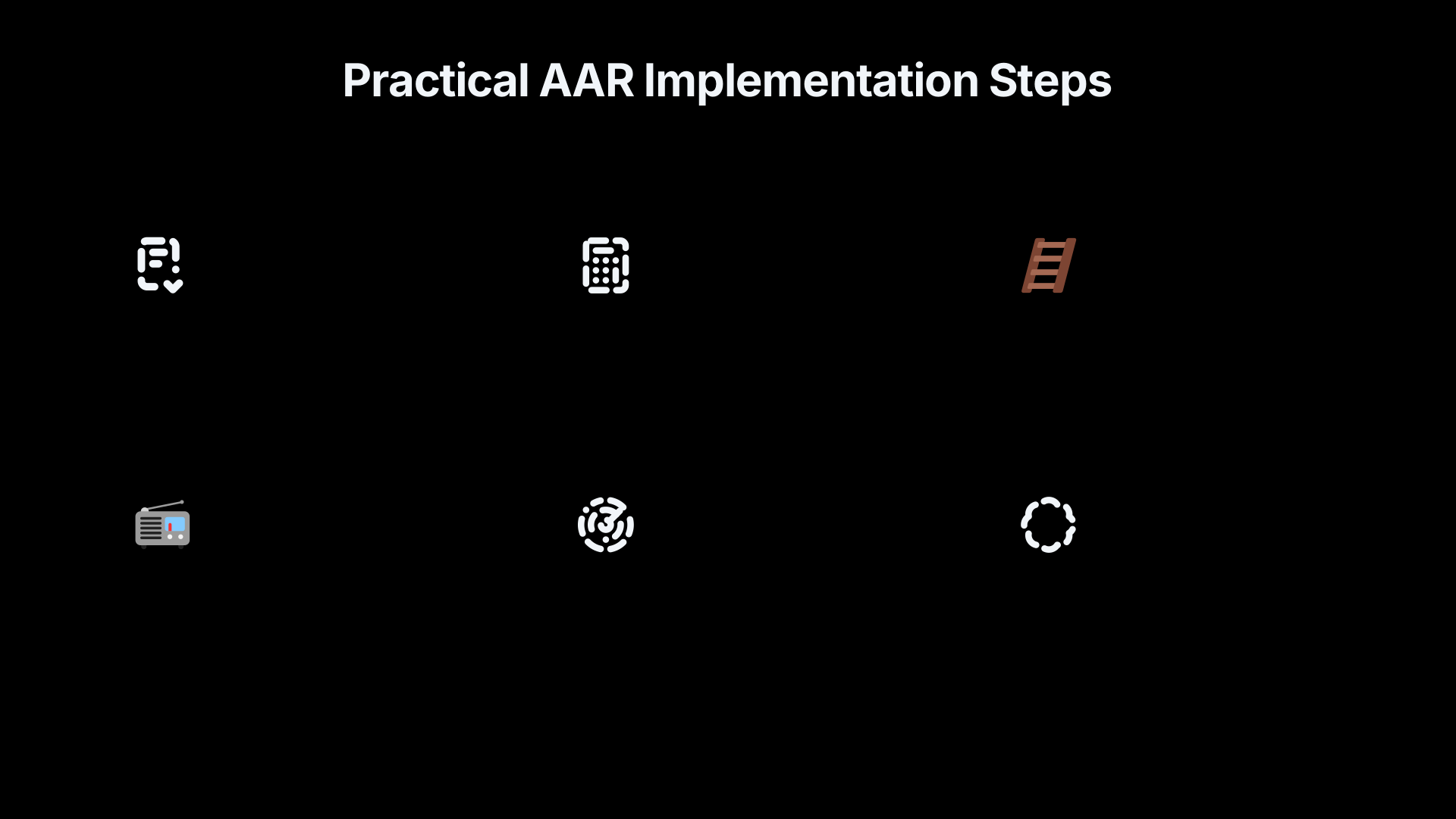
For most project teams, an effective review can often be completed in under an hour if it follows a disciplined sequence:
- Reconstruct the original objectives and assumptions.
- Build a shared timeline using observable events.
- Identify where expectations and reality diverged.
- Examine the reasoning behind key decisions rather than only their outcomes.
- Separate controllable causes from unavoidable uncertainty.
- Agree on a limited number of concrete changes.
- Assign responsibility for implementing each change before ending the meeting.
This format keeps attention on learning rather than retrospective justification. Over repeated projects, the accumulation of these small, documented adjustments creates a stronger decision-making process, allowing teams to recognise recurring patterns, calibrate their judgement more accurately and avoid repeating preventable mistakes.[Wharton Executive Education+2cebma.org]executiveeducation.wharton.upenn.eduWharton Executive Education After-Action Reviews: A Simple Yet Powerful ToolWharton Executive EducationAfter-Action Reviews: A Simple Yet Powerful Tool - WhartonThe process itself is an active discussion centered…
Amazon book picks
Further Reading
Books and field guides related to When Team Reviews Actually Improve Judgement. Use these as the next step if you want deeper reading beyond the article.
The Checklist Manifesto
Shows how structured review and process improvement reduce errors.
eBay marketplace picks
Marketplace Samples
Example marketplace items related to this page. Use the search link to explore similar finds on eBay.


Endnotes
1.
Source: cebma.org
Link:https://cebma.org/assets/Uploads/Salem-Schatz-Guide-to-the-After-Action-Review.pdf
Source snippet
Guide to the After Action ReviewOne team member reported, “without an AAR you eep learning your lessons again the hard way!” An AAR is ce...
2.
Source: Wikipedia
Title: After-action review
Link:https://en.wikipedia.org/wiki/After-action_review
Source snippet
After-action reviewAn after action review (AAR) is a technique for improving process and execution by analyzing the intended outcome a...
3.
Source: alnap.hacdn.io
Link:https://alnap.hacdn.io/media/documents/pnadf360.pdf
Source snippet
After-Action Review Technical GuidanceThe meeting should follow an agenda, using the four guiding questions to set up the “meat” of the d...
4.
Source: researchgate.net
Link:https://www.researchgate.net/publication/292477080_Implementing_after-action_review_systems_in_organizations_Key_principles_and_practical_considerations
Source snippet
Implementing after-action review systems in organizationsAfter-action reviews (AARs) are structured opportunities for shared retrospectiv...
5.
Source: pinnacle-leaders.com
Title: Leaders Guide to AAR
Link:https://pinnacle-leaders.com/wp-content/uploads/2018/02/Leaders_Guide_to_AAR.pdf
Source snippet
The Leader's Guide to After-Action Reviews (AAR)by CA Center-Training · 2013 · Cited by 5 — An AAR is a professional discussion of a trai...
6.
Source: researchgate.net
Link:https://www.researchgate.net/publication/228630786_Failing_to_Learn_and_Learning_to_Fail_Intelligently_How_Great_Organizations_Put_Failure_to_Work_to_Innovate_and_Improve
Source snippet
Action Reviews' and hospitals 'Mortality and Morbidity' conferences to analyze...
7.
Source: researchgate.net
Link:https://www.researchgate.net/publication/268328210_Psychological_Safety_Trust_and_Learning_in_Organizations_A_Group-level_Lens
Source snippet
Psychological Safety, Trust, and Learning in OrganizationsThis paper discusses psychological safety and distinguishes it from the related...
8.
Source: Wikipedia
Title: United States
Link:https://en.wikipedia.org/wiki/United_States
Source snippet
United StatesThe United States of America (USA), also known as the United States (U.S.) or America, is a country primarily located in...
9.
Source: executiveeducation.wharton.upenn.edu
Title: Wharton Executive Education After Action Review
Link:https://executiveeducation.wharton.upenn.edu/thought-leadership/wharton-at-work/2012/04/after-action-reviews/
Source snippet
Wharton Executive EducationAfter Action Review - AAR Process - Nano Tools for LeadersThe After Action Review (AAR) was developed by the U...
10.
Source: executiveeducation.wharton.upenn.edu
Title: Wharton Executive Education After-Action Reviews: A Simple Yet Powerful Tool
Link:https://executiveeducation.wharton.upenn.edu/thought-leadership/wharton-at-work/2021/07/after-action-reviews-simple-tool/
Source snippet
Wharton Executive EducationAfter-Action Reviews: A Simple Yet Powerful Tool - WhartonThe process itself is an active discussion centered...
11.
Source: journals.sagepub.com
Link:https://journals.sagepub.com/doi/10.2307/2666999
Source snippet
It introduces the construct of team psychological safety—a shared...
12.
Source: hbs.edu
Title: 02 062 0b5726a8 443d 4629 9e75 736679b870fc
Link:https://www.hbs.edu/ris/Publication%20Files/02-062_0b5726a8-443d-4629-9e75-736679b870fc.pdf
Source snippet
Harvard Business SchoolManaging the risk of learning: Psychological safety in work...by AC Edmondson · 2002 · Cited by 916 — In psycholo...
13.
Source: hbr.org
Link:https://hbr.org/2011/04/strategies-for-learning-from-failure
Source snippet
by Amy C. Edmondson... In some cases they and their teams had devoted many hours to after-action reviews, postmortems, and...Read more...
Additional References
14.
Source: nwcg.gov
Link:https://www.nwcg.gov/wfldp/toolbox/aars
Source snippet
After Action ReviewsThe Standard 4 Questions · 1. What was planned? (Spend about 25% of total time on this question and the next) · 2. Wh...
15.
Source: betterevaluation.org
Link:https://www.betterevaluation.org/methods-approaches/methods/after-action-review
Source snippet
After action reviewThe after action review (AAR) is a simple method for facilitating an assessment of organisational performance by bring...
16.
Source: linkedin.com
Link:https://www.linkedin.com/posts/amycedmondson_failure-systemsthinking-rightkindofwrong-activity-7338580932825649156-qQK9
Source snippet
Amy Edmondson | 44 commentsCreating systems to catch and correct failure before it happens is one of the best tools we have to fight agai...
17.
Source: linkedin.com
Link:https://www.linkedin.com/posts/amycedmondson_psychologicalsafety-teamwork-failure-activity-7376016210972340224-0DnY
18.
Source: linkedin.com
Link:https://www.linkedin.com/posts/amycedmondson_psychologicalsafety-failure-intelligentfailure-activity-7241925222700916737-WmGd
Source snippet
Psychological safety and failure: A guide to #FailingWellPsychological safety is vital for creating a workplace that allows for #Intellig...
19.
Source: thesystemsthinker.com
Link:https://thesystemsthinker.com/emergent-learning-in-action-the-after-action-review/
Source snippet
Emergent Learning in Action: The After Action ReviewThe AAR was first introduced to the business world by ex-Army leaders, who brought th...
20.
Source: merriam-webster.com
Link:https://www.merriam-webster.com/dictionary/what
Source snippet
WHAT Definition & MeaningThe meaning of WHAT is —used as an interrogative expressing inquiry about the [identity]({{ 'identity/' | relative_url }}), nature, or value of an o...
21.
Source: elft.nhs.uk
Link:https://www.elft.nhs.uk/sites/default/files/2023-04/ELFT%20AAR%20FAQs.docx
Source snippet
ELFT AAR FAQs.docxAn After Action Review (AAR) is a structured review process undertaken as a group, which seeks to rapidly identify and...
22.
Source: chiefexecutive.net
Link:https://chiefexecutive.net/the-us-armys-secret-to-building-a-leader-driven-learning-culture-after-action-reviews/
Source snippet
· What actually happened? · Why did it happen? · Most importantly, how do we improve our next operation?Read more...
23.
Source: adventureassoc.com
Title: The Four Part After Action Review What were the intended results?
Link:https://www.adventureassoc.com/the-four-part-after-action-review/
Source snippet
· What were the actual results? · What caused our results? · What will we sustain, improve, and discard – what were our learnings?Read more...
Topic Tree