Within Health Claims
Does Early Detection Always Help?
Early detection can help, but screening claims need absolute benefit, false positives, overdiagnosis, and mortality outcomes in view.
On this page
- What screening can and cannot prove
- False positives, overdiagnosis, and anxiety
- Why mortality matters more than surrogate wins
Page outline Jump by section
Introduction
Early detection can save lives, but the slogan “catch it early” is not the same as proof that every screening programme improves health. Good analytical thinking requires separating the intuitive appeal of finding disease sooner from the evidence that earlier detection actually reduces illness or death. A screening test is offered to people without symptoms in the hope of identifying disease at a stage when treatment is more effective. That strategy can work extremely well in some circumstances, but it can also expose healthy people to false alarms, unnecessary procedures, anxiety, and treatment for conditions that would never have caused harm.[Iris]iris.who.intIris Screening programmes: a short guideScreening programmes: a short guide - IRISby World Health Organization · 2020 · Cited by 206 — The purpose of screening is to identif…
 The key question is therefore not simply whether a test finds more abnormalities. It is whether the entire screening programme—including testing, follow-up, and treatment—leads to better outcomes than waiting until symptoms develop. That distinction is central to evidence-based thinking about health claims.
What screening can and cannot prove
Screening is designed to shift diagnosis earlier in the course of disease. However, finding disease earlier does not automatically mean people live longer or healthier lives.
A useful way to evaluate screening claims is to distinguish between what a test measures and what ultimately matters:
- A screening test can detect abnormalities before symptoms appear.[theguardian.com]theguardian.comWhile effective screening can detect serious health conditions like diabetes and high blood pressure before symptoms arise, the medical c…
- It can increase the number of diagnosed cases simply because more people are being examined.
- It can move diagnosis to an earlier date on the calendar.
- None of these facts alone proves that fewer people die or avoid serious illness.
For example, a new blood test might double the number of cancers detected at an early stage. That sounds impressive, but if the additional cancers were slow-growing and never destined to cause symptoms, the apparent success reflects more diagnoses rather than better health.
This is why organisations such as the World Health Organization emphasise that screening programmes should be introduced only when there is evidence that benefits outweigh harms across the whole pathway, not merely because a disease can be detected earlier.[Iris]iris.who.intIris Screening programmes: a short guideScreening programmes: a short guide - IRISby World Health Organization · 2020 · Cited by 206 — The purpose of screening is to identif…
Analytical scepticism therefore asks:
- Compared with people who were not screened, did screened people experience fewer deaths or serious complications?
- Were the benefits large enough to justify the harms?
- Did the evidence come from high-quality trials or only from observational comparisons?
These questions are more informative than asking whether the test is technically accurate.
False positives, overdiagnosis, and anxiety
Many people think the main risk of screening is a missed diagnosis. In reality, positive results that later prove unimportant are also a major consideration.
False positives
A false positive occurs when a screening test suggests disease that further testing shows is absent.
Even if the mistake is eventually corrected, false positives can trigger:
- repeat scans or blood tests
- invasive biopsies
- financial costs
- weeks or months of uncertainty
- reduced trust in future healthcare
Research has found that false-positive cancer screening results can produce meaningful psychological distress and even reduce willingness to participate in later screening programmes.[Cancer.gov]cancer.govmammogram false positives affect future screeningOct 4, 2024 — False-positive screening test results can lead to fear, anxiety, and frustration with the health care system, noted Jennife…
Overdiagnosis
Overdiagnosis is different from a false positive.
The diagnosis is technically correct: the abnormality exists. The problem is that it would never have caused symptoms or shortened the person’s life. Detecting it nevertheless labels someone as a patient and often leads to treatment that offers no net benefit.
This distinction is easy to miss because both the doctor and the laboratory are “correct” about the finding. The harm comes from treating disease that never needed treatment.
Examples include certain slow-growing prostate cancers and some breast cancers detected through screening programmes, where estimates suggest that a proportion of screen-detected cases represent overdiagnosis, although the exact magnitude remains uncertain and varies across studies.[PMC+2PMC]pmc.ncbi.nlm.nih.govA Review of Breast, Colorectal, Lung, and Prostate Cancer…by AA Kotwal · 2017 · Cited by 70 — Overdiagnosis also represents a signi…
The cascade effect
Screening can also trigger what researchers call a diagnostic cascade.
One unexpected finding leads to another investigation, then another consultation, then perhaps surgery or long-term monitoring. Each step may appear individually reasonable, yet the overall chain may produce more harm than benefit if the original finding was never clinically important.
Modern imaging illustrates this well. Increasingly sensitive scans frequently discover small incidental abnormalities (“incidentalomas”) that are harmless but difficult to ignore, leading to additional investigations with little evidence of improved outcomes.[The Guardian]theguardian.comWhile effective screening can detect serious health conditions like diabetes and high blood pressure before symptoms arise, the medical c…

Why mortality matters more than surrogate wins
One of the most common reasoning errors in discussions of screening is confusing surrogate measures with meaningful outcomes.
A screening programme may achieve all of the following:
- detect more early-stage disease
- increase five-year survival after diagnosis
- identify smaller tumours
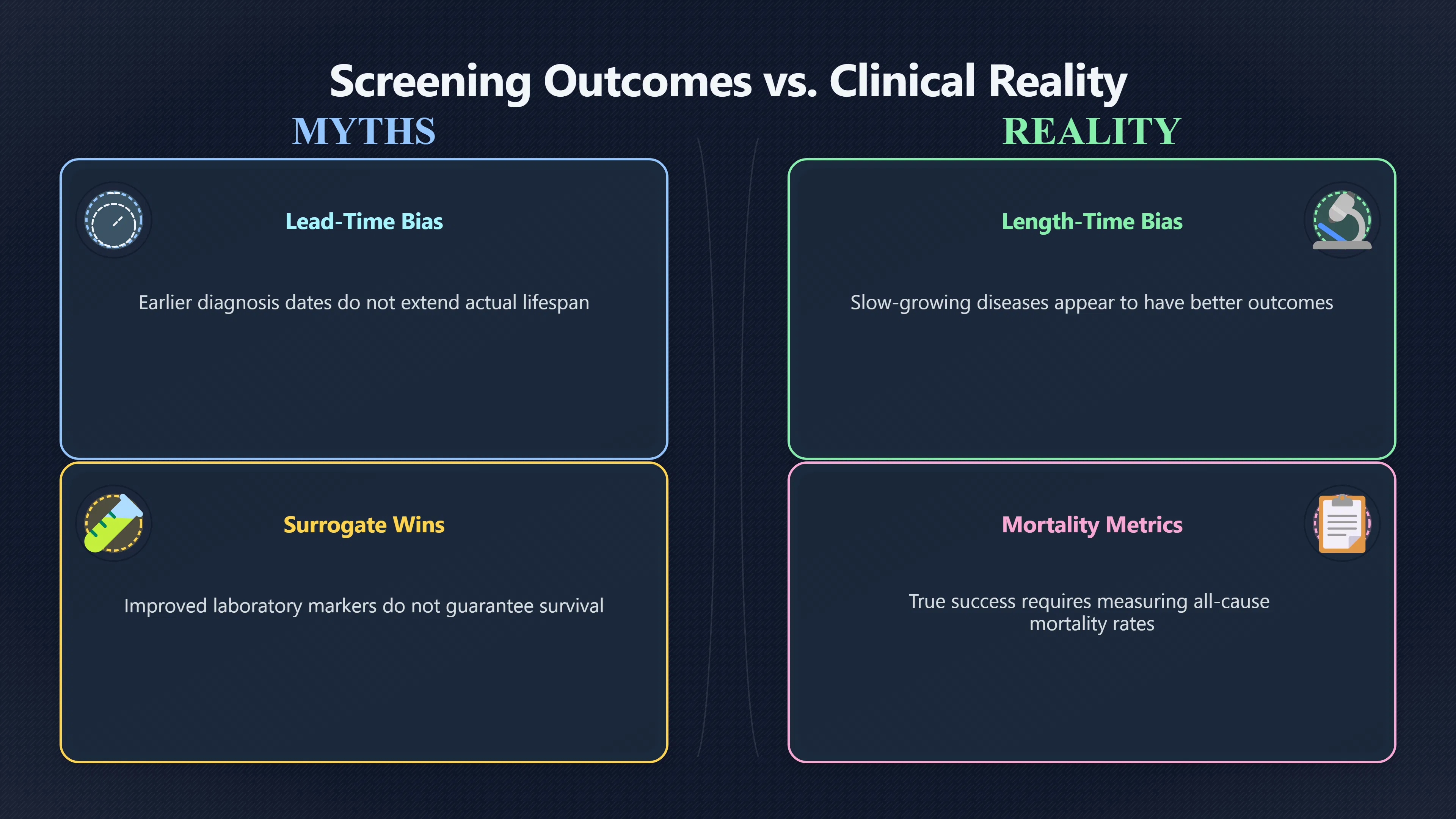
- improve laboratory markers
Yet these improvements do not necessarily mean fewer people die.
Several statistical effects explain why.
Lead-time bias
Suppose two people develop the same cancer.
One is diagnosed through screening at age 60 and dies at 70.
The other develops symptoms at 65 and also dies at 70.
The screened patient appears to have survived ten years after diagnosis, while the unscreened patient survived only five years. However, neither lived longer. Diagnosis simply occurred earlier.
This is called lead-time bias, and it can make survival statistics look better even when overall lifespan is unchanged.[catalogofbias.org]catalogofbias.orgLead time biasLead time bias where health outcome is the same in someone whose disease is detected by screening compared with someone who…
Length-time bias
Screening is more likely to detect slow-growing diseases because they remain detectable for longer.
Rapidly growing, aggressive diseases often develop between screening intervals and may present with symptoms before the next scheduled test.
As a result, screened cases naturally appear to have better outcomes even if screening itself deserves little credit.[BMJ]bmj.comAssociation of computed tomography screening with lung…Mar 30, 2022 — Overdiagnosis bias is the phenomenon whereby screening picks…

Why disease-specific mortality is not always enough
Many screening trials report reductions in deaths from the target disease. That is valuable evidence, but researchers also examine broader outcomes because treatment complications and overdiagnosis can offset some of the gains.
For this reason, evaluations increasingly encourage reporting both benefits and harms, including false positives, invasive follow-up procedures, quality of life, and where feasible all-cause mortality rather than focusing only on detection rates.[BMJ]bmj.comQuantification of harms in cancer screening trialsby B Heleno · 2013 · Cited by 181 — We included seven types of harms related to canc…
Why recommendations differ between populations
A screening programme that benefits one group may provide little benefit—or even net harm—to another.
Important factors include:
- Age. Older adults may be more likely to experience harms from investigation or treatment while having less time to benefit from detecting slow-growing disease.
- Baseline risk. People with strong family histories or genetic predisposition often have more to gain because disease is more likely.
- Life expectancy. Some screening programmes require many years before benefits become apparent.
- Test performance. Accuracy varies across populations and diseases.
This explains why evidence-based guidelines often recommend starting and stopping screening at specific ages rather than advising everyone to be screened indefinitely. The balance between benefit and harm changes as risk changes.[JAMA Network+2USPSTF]jamanetwork.comJAMA NetworkScreening for Colorectal Cancer: US Preventive Services…by US Preventive Services Task Force · 2021 · Cited by 2078 — In a…
Practical questions for evaluating screening claims
When encountering claims that a screening test “saves lives” or that “early detection is always best”, analytical scepticism suggests asking:
- What outcome improved: earlier diagnosis, survival after diagnosis, or actual mortality?
- How large is the benefit in absolute terms rather than percentages alone?
- How common are false positives?
- How common is overdiagnosis?
- What follow-up procedures are required after an abnormal result?
- Does the recommendation apply to average-risk people or only to high-risk groups?
- Is the recommendation supported by randomised trials, systematic reviews, or expert opinion alone?
These questions help distinguish evidence-based screening programmes from marketing claims based primarily on increased detection.
The balanced view
The lesson is not that screening is ineffective. Some screening programmes have strong evidence that they reduce deaths in appropriately selected populations, while others show smaller benefits, uncertain evidence, or important trade-offs. The critical thinking skill is recognising that screening is a policy decision balancing benefits and harms across an entire population, not simply a race to detect the earliest possible abnormality.[Iris+2USPSTF]iris.who.intIris Screening programmes: a short guideScreening programmes: a short guide - IRISby World Health Organization · 2020 · Cited by 206 — The purpose of screening is to identif…
The strongest evidence therefore comes from demonstrating that screened people experience better meaningful outcomes—not merely that more disease is found or that diagnosis happens sooner. That shift in perspective helps guard against one of the most persuasive but misleading assumptions in health reasoning: that earlier detection must always be better.
Amazon book picks
Further Reading
Books and field guides related to Does Early Detection Always Help?. Use these as the next step if you want deeper reading beyond the article.
Less Medicine, More Health
Challenges the assumption that earlier detection and more intervention always improve outcomes.
Overdiagnosed
Directly explains false positives, overdiagnosis, screening trade-offs, and unnecessary treatment.
Know Your Chances
Teaches risk interpretation, absolute benefit, and clearer medical decision-making.
Should I Be Tested for Cancer?
Focuses on screening decisions, uncertainty, benefits, false positives, and harms.
eBay marketplace picks
Marketplace Samples
Example marketplace items related to this page. Use the search link to explore similar finds on eBay.


Endnotes
1.
Source: iris.who.int
Title: Iris Screening programmes: a short guide
Link:https://iris.who.int/bitstreams/b3922afd-3ff9-4bf3-9254-fa6b3f2b6023/download
Source snippet
Screening programmes: a short guide - IRISby World Health Organization · 2020 · Cited by 206 — The purpose of screening is to identif...
2.
Source: pmc.ncbi.nlm.nih.gov
Title: PMCEvaluation of Harms Reporting in United States Cancer
Link:https://pmc.ncbi.nlm.nih.gov/articles/PMC9903969/
Source snippet
by A Kamineni · 2022 · Cited by 29 — We evaluated how US cancer screening guidelines reported harms, within and across organ-specific...
3.
Source: cancer.gov
Title: mammogram false positives affect future screening
Link:https://www.cancer.gov/news-events/cancer-currents-blog/2024/mammogram-false-positives-affect-future-screening
Source snippet
Oct 4, 2024 — False-positive screening test results can lead to fear, anxiety, and frustration with the health care system, noted Jennife...
4.
Source: pmc.ncbi.nlm.nih.gov
Link:https://pmc.ncbi.nlm.nih.gov/articles/PMC5992010/
Source snippet
We conducted logistic regression analysis of 450484...
5.
Source: pmc.ncbi.nlm.nih.gov
Title: PMCOverdiagnosis of breast cancer in population screening
Link:https://pmc.ncbi.nlm.nih.gov/articles/PMC5365181/
Source snippet
of breast cancer in population screening - PMCby N Houssami · 2017 · Cited by 115 — Evidence from randomized trials and also from observa...
6.
Source: ebm.bmj.com
Link:https://ebm.bmj.com/content/23/1/1
Source snippet
BMJ Evidence-Based MedicineOverdiagnosis: what it is and what it isn'tby J Brodersen · 2018 · Cited by 430 — Broadly, overdiagnosis means...
7.
Source: bmj.com
Link:https://www.bmj.com/content/347/bmj.f5334
Source snippet
Quantification of harms in cancer screening trialsby B Heleno · 2013 · Cited by 181 — We included seven types of harms related to canc...
8.
Source: catalogofbias.org
Link:https://catalogofbias.org/biases/lead-time-bias/
Source snippet
Lead time biasLead time bias where health outcome is the same in someone whose disease is detected by screening compared with someone who...
9.
Source: bmj.com
Link:https://www.bmj.com/content/376/bmj-2021-069008/rapid-responses
Source snippet
Association of computed tomography screening with lung...Mar 30, 2022 — Overdiagnosis bias is the phenomenon whereby screening picks...
10.
Source: pmc.ncbi.nlm.nih.gov
Link:https://pmc.ncbi.nlm.nih.gov/articles/PMC9784987/
Source snippet
An extreme form of length-biased sampling is overdiagnosis, which occurs in very...Read more...
11.
Source: uspreventiveservicestaskforce.org
Link:https://www.uspreventiveservicestaskforce.org/uspstf/about-uspstf/methods-and-processes/individualizing-cancer-screening-older-adults
Source snippet
Comparative effectiveness studies need to help prioritize screening relative to...Read more...
12.
Source: uspreventiveservicestaskforce.org
Title: breast cancer screening1
Link:https://www.uspreventiveservicestaskforce.org/uspstf/recommendation/breast-cancer-screening1
Source snippet
USPSTFRecommendation: Breast Cancer: ScreeningApr 30, 2024 — Screening Saves Lives from Breast Cancer: Finalized Guidance. The Task Force...
13.
Source: bmj.com
Link:https://www.bmj.com/content/350/bmj.g7773
Source snippet
Quantifying and monitoring overdiagnosis in cancer...by JL Carter · 2015 · Cited by 261 — This review identified four major research met...
14.
Source: ebm.bmj.com
Link:https://ebm.bmj.com/content/ebmed/30/5/333.full.pdf
Source snippet
A bias in studies comparing symptomatic tumours to those found via screening, as screening tends to detect slower- growing...Read more...
15.
Source: gh.bmj.com
Link:https://gh.bmj.com/content/7/10/e008696
Source snippet
and overuse of diagnostic and screening...by L Albarqouni · 2022 · Cited by 74 — Overdiagnosis happens when people receive a diagnostic...
16.
Source: bmj.com
Title: bmj 2024 080460.full
Link:https://www.bmj.com/content/387/bmj-2024-080460.full.pdf
Source snippet
Direct-to-consumer tests: emerging trends are cause for...4 Dec 2024 — 5 The pre-test probability is low in healthy populations,35 and t...
17.
Source: bmjopen.bmj.com
Link:https://bmjopen.bmj.com/content/15/5/e086648
Source snippet
In the case-control study...Read more...
18.
Source: bmj.com
Link:https://www.bmj.com/content/346/bmj.f158
Source snippet
Women's views on overdiagnosis in breast cancer screeningby J Hersch · 2013 · Cited by 240 — Responses suggested that an overdetection ra...
19.
Source: bmj.com
Link:https://www.bmj.com/too-much-medicine
Source snippet
Too much medicineThe BMJ's Too Much Medicine initiative aims to highlight the threat to human health posed by overdiagnosis and the waste...
20.
Source: bmj.com
Title: first revised article 6.1.21
Link:https://www.bmj.com/sites/default/files/attachments/bmj-article/pre-pub-history/first_revised_article_6.1.21.pdf
Source snippet
Confidential: For Review Only6 Jan 2021 — There is increasing awareness of the complexity of screening (earlier detection), including ris...
21.
Source: cancer.gov
Title: screening guidelines lack harms
Link:https://www.cancer.gov/news-events/cancer-currents-blog/2022/cancer-screening-guidelines-lack-harms
Source snippet
Cancer Screening Guidelines Lack Information on Harms23 Nov 2022 — In a review of 33 cancer screening guidelines, researchers have found...
22.
Source: cancer.gov
Title: Screening Overview (PDQ®)
Link:https://www.cancer.gov/about-cancer/screening/hp-screening-overview-pdq
Source snippet
Cancer Screening Overview (PDQ®) - NCIOct 16, 2023 — In general, the benefit of cancer screening derives from detecting cancer in earlier...
23.
Source: canceraustralia.gov.au
Title: overdiagnosis mammographic screening
Link:https://www.canceraustralia.gov.au/resources/position-statements/overdiagnosis-mammographic-screening
Source snippet
Overdiagnosis from mammographic screening16-Oct-2014 — “Overdiagnosis” from breast screening does not refer to error or misdiagnosis, det...
24.
Source: pmc.ncbi.nlm.nih.gov
Link:https://pmc.ncbi.nlm.nih.gov/articles/PMC5608027/
Source snippet
A Review of Breast, Colorectal, Lung, and Prostate Cancer...by AA Kotwal · 2017 · Cited by 70 — Overdiagnosis also represents a signi...
25.
Source: theguardian.com
Link:https://www.theguardian.com/global/2026/jun/21/preventive-health-screening
Source snippet
While effective screening can detect serious health conditions like diabetes and high blood [pressure]({{ 'pressure/' | relative_url }}) before symptoms arise, the medical c...
26.
Source: jamanetwork.com
Link:https://jamanetwork.com/journals/jama/fullarticle/2779985
Source snippet
JAMA NetworkScreening for Colorectal Cancer: US Preventive Services...by US Preventive Services Task Force · 2021 · Cited by 2078 — In a...
27.
Source: pmc.ncbi.nlm.nih.gov
Link:https://pmc.ncbi.nlm.nih.gov/articles/PMC4649764/
Source snippet
by JD Keen · 2015 · Cited by 20 — Through overdiagnosis, screening produces substantial harm by increasing both lumpectomy and mastect...
28.
Source: pmc.ncbi.nlm.nih.gov
Link:https://pmc.ncbi.nlm.nih.gov/articles/PMC8962120/
Source snippet
Preventive Services Task Force has an A or B rating for screening recommendations for four cancers in the US: breast, colorectal, cervica...
29.
Source: pmc.ncbi.nlm.nih.gov
Link:https://pmc.ncbi.nlm.nih.gov/articles/PMC12505034/
Source snippet
categories in systematic assessment of cancer...by A Barchuk · 2025 · Cited by 2 — False positives/negatives Diagnostic test result. Har...
30.
Source: pmc.ncbi.nlm.nih.gov
Link:https://pmc.ncbi.nlm.nih.gov/articles/PMC5516788/
Source snippet
impact of overdiagnosis on the selection of efficient lung...by SS Han · 2017 · Cited by 57 — One useful metric for assessing the impact...
31.
Source: pmc.ncbi.nlm.nih.gov
Link:https://pmc.ncbi.nlm.nih.gov/articles/PMC10051653/
Source snippet
Due to Screening Mammography for Breast...by AF Flemban · 2023 · Cited by 28 — The incidence of overdiagnosis due to screening mammograp...
Additional References
32.
Source: researchgate.net
Link:https://www.researchgate.net/publication/315342783_Overdiagnosis_of_breast_cancer_in_population_screening_does_it_make_breast_screening_worthless
Source snippet
Overdiagnosis of breast cancer in population screening8 May 2026 — The trade-off between the benefit and the collective harms of BC scree...
Published: May 2026
33.
Source: nationalacademies.org
Link:https://www.nationalacademies.org/read/26019/chapter/2
Source snippet
Chapter: Proceedings of a WorkshopThe aim of cancer screening is to reduce mortality and morbidity by detecting precancerous abnormalitie...
34.
Source: lowninstitute.org
Link:https://lowninstitute.org/earlier-screening-for-breast-cancer-benefits-and-harms/
Source snippet
Earlier screening for breast cancer: Benefits and harmsWith this recommendation, the USPSTF is essentially saying that the tradeoffs of 5...
35.
Source: thennt.com
Link:https://thennt.com/nnt/screening-mammography-for-reducing-deaths/
Source snippet
Screening Mammography for Reducing DeathsWhile overall mortality remains unchanged, in this analysis breast cancer mortality is reduced b...
36.
Source: sciencemediacentre.org
Title: updated cochrane review into whether prostate cancer screening reduces deaths
Link:https://www.sciencemediacentre.org/updated-cochrane-review-into-whether-prostate-cancer-screening-reduces-deaths/
Source snippet
Updated Cochrane review into whether prostate cancer...15 May 2026 — This review looked at clinical trials designed to assess mortality...
Published: May 2026
37.
Source: aafp.org
Link:https://www.aafp.org/pubs/afp/collections/choosing-wisely/189.html
Source snippet
s without considering life expectancy and the risks of testing, overdiagnosis, and...Read more...
38.
Source: bmjgroup.com
Title: Prostate cancer ‘test by request’ drives overdiagnosis,
Link:https://bmjgroup.com/prostate-cancer-test-by-request-drives-overdiagnosis-argue-experts/
Source snippet
May 17, 2023 — Experts writing in The BMJ today argue that these shared decision policies have led to high rates of PSA testing and clear...
Published: May 17, 2023
39.
Source: aol.com
Link:https://www.aol.com/articles/shift-cancer-screening-guidance-experts-182137000.html
Source snippet
itive results, psychological distress, over-diagnosis, over-treatment...Read more...
40.
Source: msdmanuals.com
Link:https://www.msdmanuals.com/professional/multimedia/table/screening-procedures-in-average-risk-asymptomatic-people-as-recommended-by-the-american-cancer-society-acs-u-s-preventive-services-task-force-uspstf-and-the-american-college-of-physicians-acp
Source snippet
ican Cancer Society (ACS), US Preventive Services Task Force (USPSTF),Read more...
41.
Source: news-medical.net
Title: What is Overdiagnosis and Why is it Bad.aspx
Link:https://www.news-medical.net/health/What-is-Overdiagnosis-and-Why-is-it-Bad.aspx
Source snippet
What is Overdiagnosis and Why is it Bad?28 Jun 2022 — Overdiagnosis refers to the diagnosis of a medical condition that would not have pr...
Topic Tree