Within Health Claims
What Does a 50 Percent Risk Cut Mean?
A dramatic percentage can hide a tiny real-world difference unless the baseline risk and time period are made clear.
On this page
- Relative risk versus absolute risk
- Baseline risk and time horizon
- Translating claims into people helped or harmed
Page outline Jump by section
Introduction
A headline claiming that a treatment “cuts your risk by 50%” may sound dramatic, but it does not tell you how much difference the treatment is likely to make in real life. A 50% reduction can mean preventing many illnesses if the starting risk is high, or only a handful if the starting risk is very low. To judge a health claim properly, you need three pieces of information: the relative risk, the baseline (absolute) risk, and the time period over which the risk is measured. Without all three, impressive percentages can give a misleading impression of benefit. Evidence-based medicine organisations increasingly recommend presenting results as natural frequencies (for example, “5 fewer people out of 1,000”) because these are easier for patients and clinicians to interpret accurately. Cochrane+2U.S. Food and Drug Administration[cochrane.org]cochrane.orgChapter 14: Completing 'Summary of findings' tables and…For continuous outcomes, this would be stated as a mean or median valu…
What does a 50 percent risk cut actually mean?
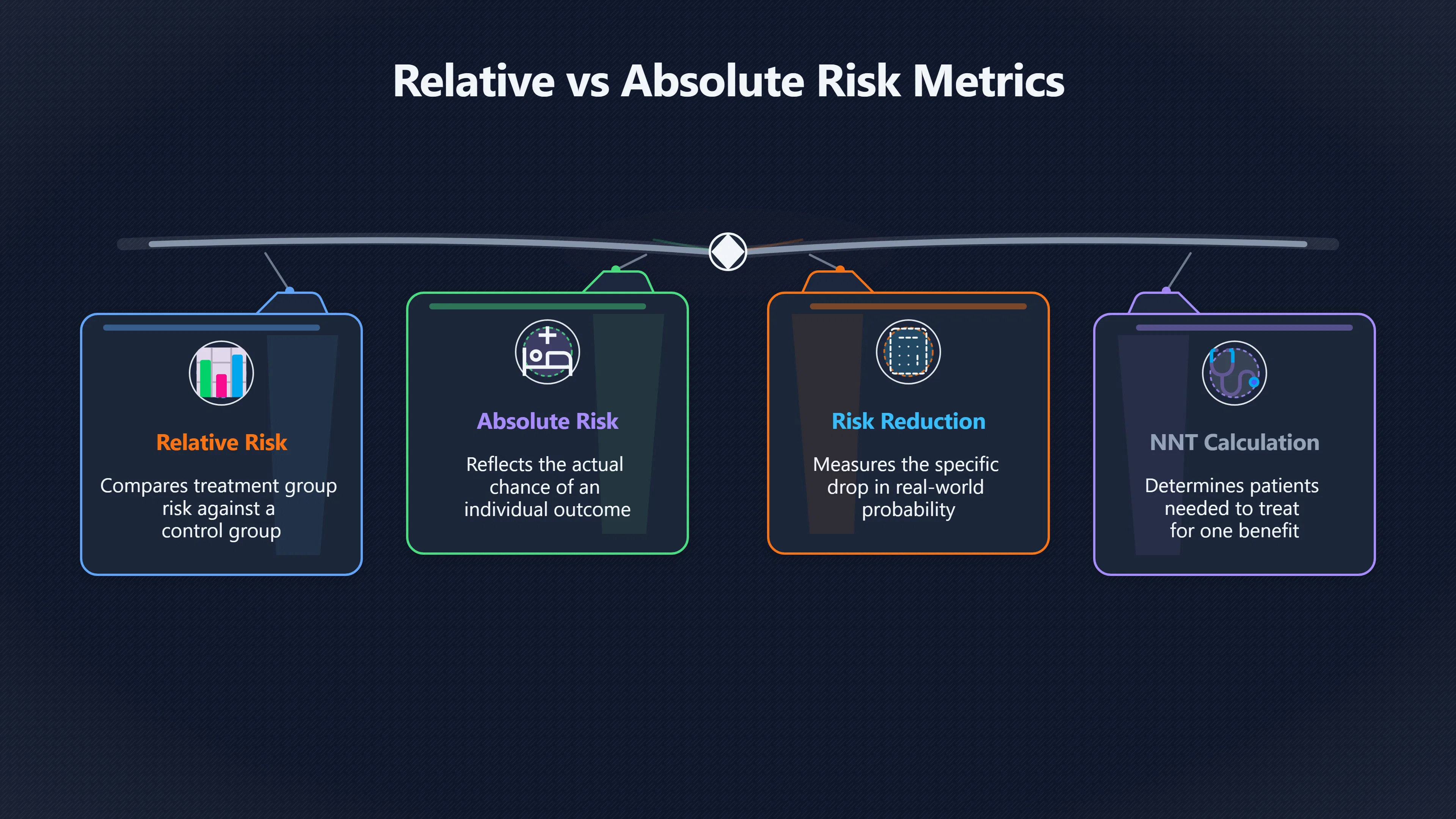
Relative risk compares one group’s risk with another’s. If one group has half the risk of another, the relative risk is 0.5, or a 50% relative risk reduction.
The missing question is: half of what?
Consider two different situations:
ScenarioRisk without treatmentRisk with treatmentRelative risk reductionAbsolute risk reductionA20 in 10010 in 10050%10 percentage pointsB2 in 1,0001 in 1,00050%1 person per 1,000
The relative claim is identical in both examples. The practical benefit is not.
In Scenario A, ten people out of every hundred avoid the outcome. In Scenario B, only one extra person out of every thousand benefits. Neither presentation is wrong, but reporting only the relative figure makes the two situations appear equally impressive when their real-world impact is very different. This distinction is a core principle of evidence-based medicine and health communication.[Cochrane+2CEBM]cochrane.orgChapter 6: Choosing effect measures and computing…the risk difference (RD; also called the absolute risk reduction); and; the…
Relative risk versus absolute risk
Relative risk is useful because it often remains fairly consistent across different populations, allowing researchers to compare treatments efficiently. Absolute risk, however, is usually more useful for personal decision-making because it reflects the chance that someone like you will actually experience the outcome.[PMC]pmc.ncbi.nlm.nih.govPMCImplementing GRADE: calculating the risk differenceby RG Newcombe · 2014 · Cited by 55 — In most contexts, estimates of relative effect of a therapy are more consistent across different…
Think of the measures as answering different questions:
- Relative risk: How much did the treatment change the risk compared with the control group?
- Absolute risk: How many people actually benefit or are harmed?
- Absolute risk reduction: How much lower is the real-world probability?[ncbi.nlm.nih.gov]ncbi.nlm.nih.govNCBIRelative risk, relative and absolute risk reductionby L Irwig · 2008 · Cited by 37 — Relative risk reduction (RRR) tells you by how much the treatment reduced the risk of bad outcomes…
- Number needed to treat (NNT): How many people must receive the treatment for one additional person to benefit?
These measures complement rather than replace one another. Good reporting presents both relative and absolute effects instead of forcing readers to infer one from the other.[Cochrane+2CEBM]cochrane.orgChapter 6: Choosing effect measures and computing…the risk difference (RD; also called the absolute risk reduction); and; the…
Why baseline risk changes everything
The same treatment can produce very different absolute benefits depending on who receives it.
Suppose a medicine consistently reduces risk by 25% relative to no treatment.
- A person whose baseline risk is 40% would see their risk fall to about 30%, an absolute reduction of 10 percentage points.
- Someone whose baseline risk is 4% would see it fall to about 3%, an absolute reduction of only 1 percentage point.
The treatment’s biological effect has not changed. The person’s starting risk has.
This is why doctors consider age, existing illnesses, family history and other risk factors before recommending preventive treatments. Clinical guideline developers likewise estimate absolute benefits by applying relative effects to the baseline risk of the patient group under consideration rather than assuming one number fits everyone.[BMJ+2Cochrane]bmj.comCore GRADE 6: presenting the evidence in summary of…27 May 2025 — One can interpret hazard ratios… Because they depend on baseli…
The time horizon matters as much as the percentage
Risk figures always apply over a specific period, although advertisements and news reports sometimes leave this unstated.
For example:
- A 2% chance over one month is very different from 2% over twenty years.
- A treatment that reduces five-year risk may produce little measurable benefit over six months.
- Screening tests may show small annual differences that accumulate over decades.
Whenever you encounter a percentage reduction, ask:
- Over what length of time was the outcome measured?
- Was the study measuring lifetime risk, yearly risk or short-term risk?
- Would my own expected period of treatment be similar?
Without the time horizon, even accurate statistics can be difficult to interpret correctly. Evidence reporting frameworks therefore encourage presenting baseline risk together with a clearly defined follow-up period.[BMJ]bmj.comCore GRADE 6: presenting the evidence in summary of…27 May 2025 — One can interpret hazard ratios… Because they depend on baseli…
Translating claims into people helped
Many experts recommend converting percentages into natural frequencies because most people understand them more easily.
Instead of saying:
“This medicine reduces stroke risk by 30%.”
Try expressing the same result as:
“Out of 1,000 people like you, about 20 would be expected to have a stroke over five years without treatment, compared with about 14 if everyone received the treatment.”
This presentation immediately reveals:
- how common the outcome is;
- how many people benefit;
- that most treated people would not have had the event anyway; and
- that some events still occur despite treatment.
Cochrane recommends presenting risks per 100 or per 1,000 people in summary tables because these natural frequencies make evidence easier to understand. The FDA also advises that absolute probabilities are generally easier for consumers to interpret than relative measures alone.[Cochrane+2Sheppard]cochrane.orgChapter 14: Completing 'Summary of findings' tables and…For continuous outcomes, this would be stated as a mean or median valu…
Number needed to treat makes benefits concrete
Absolute risk reduction also allows calculation of the Number Needed to Treat (NNT).[cochrane.org]cochrane.orgChapter 6: Choosing effect measures and computing…the risk difference (RD; also called the absolute risk reduction); and; the…
If a treatment reduces the absolute risk by:
- 10%, the NNT is 10.
- 2%, the NNT is 50.
- 1%, the NNT is 100.
An NNT of 100 means that, on average, one additional person benefits for every 100 people treated over the study period.
This does not mean the treatment is ineffective. For severe outcomes such as death or stroke, even small absolute reductions may justify treatment. Conversely, for mild conditions, a small benefit may not outweigh inconvenience, cost or side effects. NNT simply makes the scale of benefit easier to visualise.[CEBM+2healthevidence.org]cebm.ox.ac.ukdditional bad outcome (death, stroke, etc.).Read more…
Questions to ask when you see a dramatic percentage
When a health headline highlights a large percentage improvement, pause before accepting its importance.
Ask:
- What was the baseline risk before treatment?
- What is the absolute risk reduction?[cochrane.org]cochrane.orgChapter 6: Choosing effect measures and computing…the risk difference (RD; also called the absolute risk reduction); and; the…
- Over what period was the outcome measured?
- How many people actually benefit?
- What are the possible harms or side effects?
- Does the report present results per 100 or per 1,000 people?
These questions often transform an eye-catching statistic into information that is much easier to judge.
Understanding the difference between relative and absolute risk does not make health claims less impressive by default. Instead, it makes them more meaningful by revealing whether a large percentage reflects a large real-world benefit or simply a large percentage applied to a very small starting risk.
Amazon book picks
Further Reading
Books and field guides related to What Does a 50 Percent Risk Cut Mean?. Use these as the next step if you want deeper reading beyond the article.
Overdiagnosed
Uses risk framing and population-level thinking to challenge misleading medical promises.
Risk Savvy
Teaches natural frequencies and better interpretation of uncertain risks in medicine and life.
Know Your Chances
Explains absolute risk, relative risk, screening numbers, and how health statistics mislead.
Bad Science
Builds broad scepticism about exaggerated medical statistics, headlines, and health marketing.
eBay marketplace picks
Marketplace Samples
Live-tested eBay searches with available results related to this page.

Top pick
critical thinking card game
Open a targeted eBay search for items related to this topic.
Browse eBay
Related search
critical thinking game
Open a targeted eBay search for items related to this topic.
Browse eBay

Related search
does memorabilia
Open a targeted eBay search for items related to this topic.
Browse eBayEndnotes
1.
Source: cochrane.org
Link:https://www.cochrane.org/authors/handbooks-and-manuals/handbook/current/chapter-14
Source snippet
Chapter 14: Completing 'Summary of findings' tables and...For continuous outcomes, this would be stated as a mean or median valu...
2.
Source: fda.gov
Title: communicating risks and benefits evidence based users guide
Link:https://www.fda.gov/about-fda/reports/communicating-risks-and-benefits-evidence-based-users-guide
Source snippet
Food and Drug AdministrationCommunicating Risks and Benefits: An Evidence-Based...Mar 28, 2018 — Communicating Risks and Benefits: An Ev...
3.
Source: cochrane.org
Link:https://www.cochrane.org/authors/handbooks-and-manuals/handbook/current/chapter-06
Source snippet
Chapter 6: Choosing effect measures and computing...the risk difference (RD; also called the absolute risk reduction); and; the...
4.
Source: cebm.ox.ac.uk
Link:https://www.cebm.ox.ac.uk/resources/ebm-tools/glossary
Source snippet
risk (RR) (or risk ratio): The ratio of the risk of an event in the experimental group compared to that of the control group (RR=EER / CE...
5.
Source: pmc.ncbi.nlm.nih.gov
Title: PMCImplementing GRADE: calculating the risk difference
Link:https://pmc.ncbi.nlm.nih.gov/articles/PMC3913115/
Source snippet
by RG Newcombe · 2014 · Cited by 55 — In most contexts, estimates of relative effect of a therapy are more consistent across different...
6.
Source: bmj.com
Link:https://www.bmj.com/content/389/bmj-2024-083866
Source snippet
Core GRADE 6: presenting the evidence in summary of...27 May 2025 — One can interpret hazard ratios... Because they depend on baseli...
Published: May 2025
7.
Source: cebm.ox.ac.uk
Link:https://www.cebm.ox.ac.uk/resources/ebm-tools/number-needed-to-treat-nnt
Source snippet
dditional bad outcome (death, stroke, etc.).Read more...
8.
Source: sheppard.com
Link:https://www.sheppard.com/insights/blogs/fda-releases-final-guidance-on-quantitative-efficacy-and-risk-information-in-direct-to-consumer-promotional-labeling-and-advertisements
Source snippet
FDA Releases Final Guidance on Quantitative Efficacy and...Jul 14, 2023 — FDA emphasized that absolute probability measures are preferab...
9.
Source: healthevidence.org
Link:https://www.healthevidence.org/glossary.aspx
Source snippet
GlossaryNNT, the common abbreviation of Numbers Needed to Treat, is the number of patients who must be treated to prevent 1 additional ne...
10.
Source: cochrane.org
Link:https://www.cochrane.org/authors/handbooks-and-manuals/handbook/current/chapter-15
Source snippet
Chapter 15: Interpreting results and drawing conclusionsDirect computation of risk difference (RD) or a number needed to treat (NNT) depe...
11.
Source: cochrane.org
Link:https://www.cochrane.org/
Source snippet
Statistics that save livesWe examine the evidence behind questions that affect people's lives, empowering everyone to make bett...
12.
Source: bmj.com
Title: bmj 2022 073141.full
Link:https://www.bmj.com/content/bmj/381/bmj-2022-073141.full.pdf
Source snippet
Methods for deriving risk difference (absolute risk reduction...by MH Murad · 2023 · Cited by 49 — To estimate risk difference in a high...
13.
Source: bmj.com
Link:https://www.bmj.com/content/341/bmj.c6331
Source snippet
Absolute risk reduction (ARR) depends on baseline risk and the event rate...Read more...
14.
Source: bmj.com
Link:https://www.bmj.com/content/381/bmj-2022-073141/rr-0
Source snippet
1% baseline risk: RD is 3 fewer (1 fewer to 4 fewer)Read more...
15.
Source: bmj.com
Link:https://www.bmj.com/content/347/bmj.f5067
Source snippet
Odds and odds ratiosAug 16, 2013 — The odds ratio provides a measure of the association between treatment (intervention compared with con...
16.
Source: bmj.com
Title: rapid responses
Link:https://www.bmj.com/content/381/bmj-2022-073141/rapid-responses
Source snippet
Methods for deriving risk difference (absolute risk reduction...5 May 2023 — The IPDfromKM method distinguishes itself by subjecting Kap...
Published: May 2023
17.
Source: ebm.bmj.com
Link:https://ebm.bmj.com/content/27/6/330
Source snippet
absolute risk reduction to guide the equitable...by E Fassler · 2022 · Cited by 8 — ARR and NNV are more helpful than relative measures...
18.
Source: bmj.com
Title: re number needed treat clinically useful nomogram its proper context
Link:https://www.bmj.com/rapid-response/2011/12/07/re-number-needed-treat-clinically-useful-nomogram-its-proper-context
Source snippet
The number needed to treat: a clinically useful nomogram...17 Feb 1996 — The most defensible method for using the reduction of a baselin...
19.
Source: fda.gov
Link:https://www.fda.gov/
Source snippet
U.S. Food and Drug AdministrationWe Regulate Food Drugs, Medical Devices, Radiation-Emitting Products, Vaccines, Blood, and Biologics, An...
20.
Source: fda.gov
Title: Risk Communication
Link:https://www.fda.gov/science-research/science-and-research-special-topics/risk-communication
Source snippet
May 9, 2019 — The goal of FDA risk communication is to help people make informed decisions about FDA-regulated products.Read more...
Published: May 9, 2019
21.
Source: fda.gov
Title: communicating benefit and risk information
Link:https://www.fda.gov/drugs/fda-drug-info-rounds-video/communicating-benefit-and-risk-information
Source snippet
Mar 3, 2016 — Every medication approved by the FDA has benefits as well as risks. It's important that patients hear both, and have a clea...
22.
Source: ncbi.nlm.nih.gov
Title: NCBIRelative risk, relative and absolute risk reduction
Link:https://www.ncbi.nlm.nih.gov/books/NBK63647/
Source snippet
by L Irwig · 2008 · Cited by 37 — Relative risk reduction (RRR) tells you by how much the treatment reduced the risk of bad outcomes...
23.
Source: pmc.ncbi.nlm.nih.gov
Link:https://pmc.ncbi.nlm.nih.gov/articles/PMC9647013/
Source snippet
risk reduction: Misinformative measure in clinical...by RB Brown · 2022 · Cited by 13 — The present article demonstrates how the relativ...
24.
Source: pmc.ncbi.nlm.nih.gov
Link:https://pmc.ncbi.nlm.nih.gov/articles/PMC3727393/
Source snippet
and expressing “Risk” - PMC - NIHby M Elbarbary · 2010 · Cited by 7 — We often refer to the risk of the adverse outcome in the control gr...
25.
Source: pmc.ncbi.nlm.nih.gov
Link:https://pmc.ncbi.nlm.nih.gov/articles/PMC3342472/
Source snippet
While some FDA drug risk communications had immediate, strong impacts, many had either delayed or no impact on health care utilization...
26.
Source: pmc.ncbi.nlm.nih.gov
Link:https://pmc.ncbi.nlm.nih.gov/articles/PMC8198228/
Source snippet
by TF Monaghan · 2021 · Cited by 46 — Relative risk is a general term that encompasses both risk ratio (exemplified above) and rate ra...
27.
Source: pmc.ncbi.nlm.nih.gov
Link:https://pmc.ncbi.nlm.nih.gov/articles/PMC3809433/
Source snippet
decision making and the importance of baseline riskby SD Stovitz · 2013 · Cited by 10 — Our message is that the baseline risk (BR) for th...
28.
Source: fda.gov.ph
Title: Home Page
Link:https://www.fda.gov.ph/
Source snippet
Food and Drug AdministrationThe FDA remains committed to protecting consumer welfare through continuous monitoring and regulatory efforts...
29.
Source: Wikipedia
Title: Cochrane (organisation)
Link:https://en.wikipedia.org/wiki/Cochrane_%28organisation%29
Source snippet
Cochrane (organisation)Cochrane is a British [1] international charitable organisation formed to synthesize medical research findings...
30.
Source: Wikipedia
Title: Food and Drug Administration
Link:https://en.wikipedia.org/wiki/Food_and_Drug_Administration
Source snippet
Food and Drug AdministrationThe FDA is responsible for protecting and promoting public health through the control and supervision of f...
31.
Source: instagram.com
Link:https://www.instagram.com/fda/?hl=en
Source snippet
(@fda) • Instagram photos and videosOfficial account of the U.S. Food and Drug Administration || This account is FDA approved! · The Amer...
32.
Source: youtube.com
Link:https://www.youtube.com/user/USFoodandDrugAdmin
Additional References
33.
Source: iwh.on.ca
Link:https://www.iwh.on.ca/what-researchers-mean-by/absolute-and-relative-risk
Source snippet
Absolute and relative riskAbsolute risk is the number of people experiencing an event in relation to the population at large. Relative ri...
34.
Source: aafp.org
Link:https://www.aafp.org/afp/authors/ebm-toolkit
Source snippet
EBM Toolkit | AFPThe absolute risk reduction (ARR) can be used to calculate the number NNT, which is the number of patients who need to b...
35.
Source: lipid.org
Link:https://www.lipid.org/communications/lipidspin/2012FALL07
Source snippet
EBM Tools for [Practice]({{ 'practice/' | relative_url }}): Risk ReductionsNNT is derived from absolute risk and does not rely upon relative risk for its calculation. The hi...
36.
Source: investopedia.com
Link:https://www.investopedia.com/terms/f/fda.asp
Source snippet
Food and Drug Administration (FDA): What It Is and DoesThe Food and Drug Administration is a government agency that regulates certain foo...
37.
Source: wmjonline.org
Link:https://wmjonline.org/123no4/calder/
Source snippet
Relative Risk, Absolute Risk, and Number Needed to TreatWe present a story of risk that sets the stage for defining statistical terms tha...
38.
Source: thennt.com
Link:https://thennt.com/thennt-explained/
Source snippet
The NNT, ExplainedThe NNT is an intuitive and simple way of estimating how likely it is that a treatment or medicine will help an individ...
39.
Source: vaccineconfident.pharmacist.com
Link:https://vaccineconfident.pharmacist.com/Conversation-Guide/Using-Numbers-to-Communicate-COVID-19-Risk-to-Patients
40.
Source: facebook.com
Link:https://www.facebook.com/groups/299722283743324/posts/901836123531934/
Source snippet
Absolute risks help put into perspective how much benefit an individual is likely to have from a treatment or prevention. The...Read more...
41.
Source: hscnews.unm.edu
Title: absolute risk reduction supports equitable covid vaccine distribution policies
Link:https://hscnews.unm.edu/news/absolute-risk-reduction-supports-equitable-covid-vaccine-distribution-policies
Source snippet
Prevention | UNM HSC NewsroomAbsolute risk reduction measures how much a vaccine reduces an individual's baseline risk in a population. T...
42.
Source: pslhub.org
Title: communicating risks and benefits an evidence based users guide fda 2011 r9293
Link:https://www.pslhub.org/learn/patient-engagement/how-to-engage-for-patient-safety/communicating-risks-and-benefits-an-evidence-based-users-guide-fda-2011-r9293/
Source snippet
Communicating risks and benefits: An evidence-based user's...Apr 29, 2023 — This book published by the US Food and Drug Administration (...
Topic Tree