Within Intuition
When Familiar Situations Fool Your Judgment
A situation can feel familiar while hiding crucial differences that make the first pattern match misleading.
On this page
- Why the first comparison feels convincing
- Key differences that fast thinking misses
- Questions that break a misleading pattern match
Page outline Jump by section
Introduction
A dangerous mistake in high-stakes decisions is not complete ignorance but false familiarity: the feeling that a new situation is essentially the same as one you have seen before when, in fact, crucial differences make the old pattern unreliable. Fast intuition depends on pattern recognition. Most of the time that is useful. The problem arises when familiarity creates an illusion of understanding and causes people to stop looking for disconfirming details. In medicine, business, investing, emergency response, and other consequential settings, this can lead to premature conclusions, overlooked risks, and costly errors. Research on intuition and expertise repeatedly finds that successful pattern recognition depends on whether the environment is predictable and whether decision-makers receive reliable feedback. When those conditions are weak, familiarity can create confidence without accuracy.[PubMed+2Semantic Scholar]pubmed.ncbi.nlm.nih.govConditions for intuitive expertise: a failure to disagreeby D Kahneman · 2009 · Cited by 3941 — This article reports on an effort t…
Why the First Comparison Feels Convincing
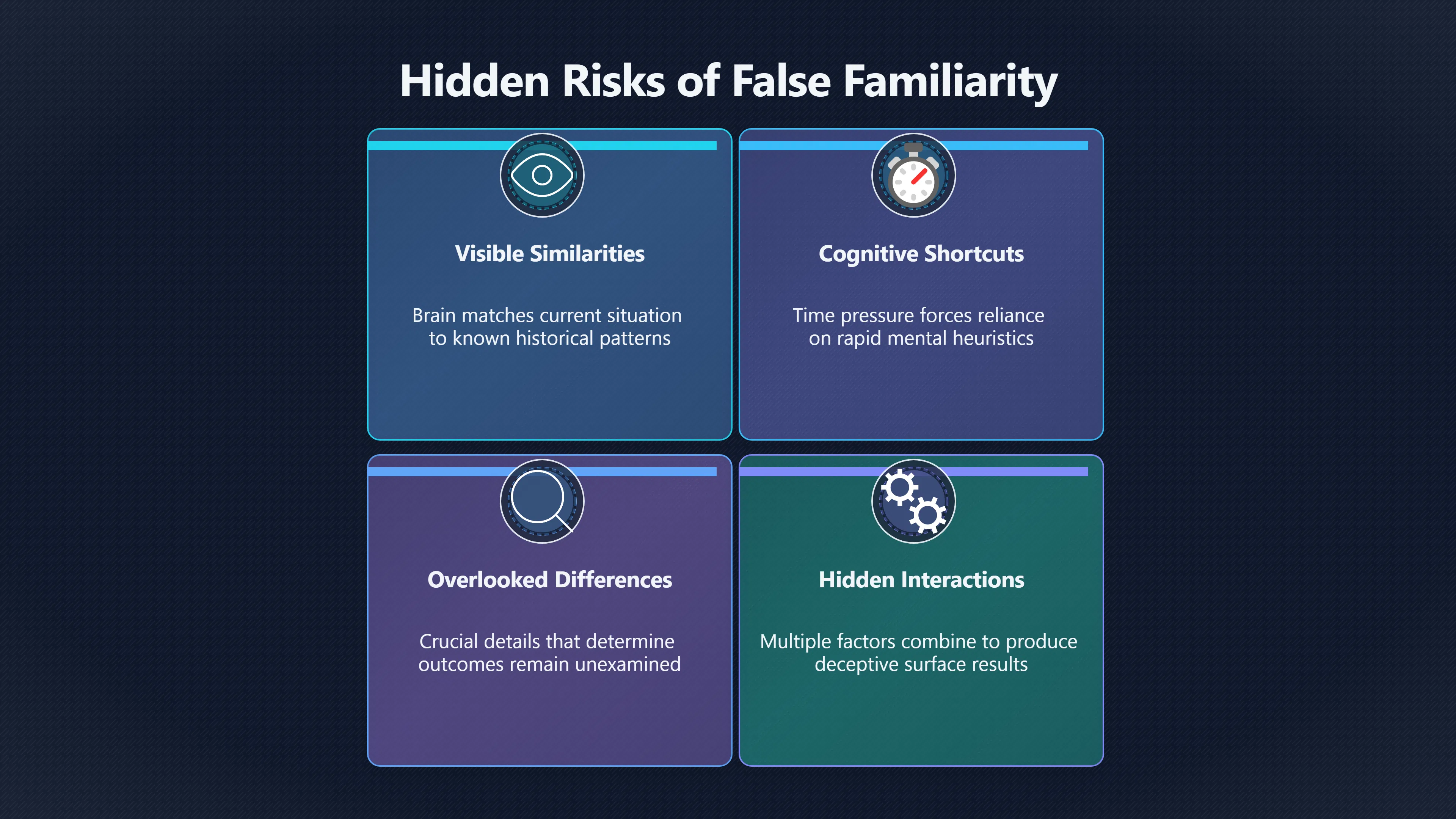
False familiarity begins with a strength of human cognition. The brain is designed to simplify complex situations by matching them to known patterns. Instead of analysing every detail from scratch, it asks a rapid question: “What does this remind me of?”
This shortcut is often effective because many everyday situations genuinely do resemble previous experiences. The difficulty is that similarity is not the same as equivalence. A situation can share a few highly visible features with an earlier case while differing in the details that actually determine the outcome.
The sense of familiarity becomes especially persuasive under pressure. Time constraints, uncertainty, stress, and information overload all increase reliance on pattern recognition. In these conditions, the first plausible interpretation often feels not merely likely but obviously correct. Once that feeling appears, alternative explanations receive less attention. Studies of diagnostic reasoning identify this tendency as a major contributor to error because the initial framing of a problem shapes what information people notice and how they interpret later evidence.[BMJ Open+2PMC]bmjopen.bmj.comBMJ OpenIdentifying early warning signs for diagnostic errors in…by J Balla · 2012 · Cited by 60 — The findings of this study identify…
Another reason false familiarity is convincing is that successful past experiences are memorable. A manager who previously solved a project delay by increasing accountability may instinctively apply the same explanation to a new delay. An investor who profited from a market pattern may assume the pattern remains predictive. A clinician who recently diagnosed a common illness may be more inclined to see the same illness again. The earlier success provides a compelling story, even when the underlying conditions have changed.[PMC+2Fitzgerald Health Education Associates]pmc.ncbi.nlm.nih.govCognitive biases in diagnosis and decision making during…by CS Webster · 2021 · Cited by 80 — Cognitive bias is typically defined a…
Key Differences That Fast Thinking Misses
The defining feature of false familiarity is not that the recognised pattern is completely wrong. It is that the pattern is incomplete.
Fast thinking tends to focus on similarities while overlooking differences that may carry greater diagnostic value. Several types of differences are especially likely to be missed:
- Changed context. A strategy that worked in one market, organisation, or economic environment may fail when incentives, competitors, or regulations differ.
- Different base rates. A common explanation may become less likely when the surrounding circumstances change, even if the symptoms look similar.
- Atypical presentations. Important cases often resemble ordinary cases until a less obvious clue is recognised.
- Hidden interactions. Multiple factors can combine to produce outcomes that look familiar on the surface but arise from entirely different causes.
Medical diagnosis provides a clear example. Experienced clinicians frequently use pattern recognition to identify routine conditions. However, reviews of diagnostic error consistently note that atypical cases can be mistaken for familiar ones. When practitioners settle too quickly on an initial diagnosis, they may fail to investigate alternatives that better explain the evidence. This phenomenon, often called premature closure, is repeatedly identified as a significant source of diagnostic error.[PMC+2PubMed]pmc.ncbi.nlm.nih.govPMCclinical decision-making in a case of aortic dissectionby B Kumar · 2011 · Cited by 41 — Premature closure is a type of cognitive error in which the physician fails to consider reasonable a…
During the COVID-19 pandemic, some clinicians encountered a particularly vivid version of this problem. Because COVID became highly salient, respiratory symptoms were often interpreted through that lens, occasionally delaying consideration of other conditions that shared similar features. The familiar pattern was not irrational; it was simply over-applied.[PMC]pmc.ncbi.nlm.nih.govby VR Ramnath · 2020 · Cited by 10 — Representativeness bias may label all patients with acute respiratory failure as having COVID-19…
The same mechanism appears in organisational settings. Leaders often rely on analogies to previous successes. Yet strategic decisions frequently occur in environments that evolve rapidly and provide delayed feedback. Under those conditions, the resemblance between two situations can be much weaker than it first appears, making intuition less dependable than it feels.[McKinsey & Company+2PubMed]mckinsey.comstrategic decisions when can you trust your gutMcKinsey & CompanyStrategic decisions: When can you trust your gut?1 Mar 2010 — Nobel laureate Daniel Kahneman and psychologist Gary Klei…
Why High-Stakes Decisions Are Especially Vulnerable
False familiarity becomes more dangerous as consequences increase.
In low-stakes situations, an incorrect pattern match may cause a minor inconvenience. In high-stakes situations, the same mental shortcut can affect health, safety, finances, careers, or public policy. The decision-maker often faces an uncomfortable combination of urgency and uncertainty. Ironically, these are precisely the conditions that encourage greater dependence on rapid pattern recognition.
A second problem is that high-stakes environments often provide poor feedback. When outcomes emerge months or years later, people may never learn which features of the situation truly mattered. Kahneman and Klein’s work on intuitive expertise emphasises that reliable intuition develops most effectively when people operate in environments with regular patterns and timely, accurate feedback. Without those conditions, confidence can exceed actual predictive skill.[PubMed+2Semantic Scholar]pubmed.ncbi.nlm.nih.govConditions for intuitive expertise: a failure to disagreeby D Kahneman · 2009 · Cited by 3941 — This article reports on an effort t…
This creates a subtle trap. The more experienced someone becomes, the larger their library of familiar patterns grows. Expertise is valuable, but it can also increase the temptation to classify new situations too quickly. The danger is not expertise itself. The danger is failing to notice when a situation falls outside the boundaries of past experience.
Questions That Break a Misleading Pattern Match
The most effective response to false familiarity is not abandoning intuition. It is deliberately testing the first pattern that comes to mind.
Several questions can force a useful second look:
What would have to be different for this analogy to fail?
This question shifts attention from similarities to differences. Instead of asking why the situation resembles a previous case, it asks what conditions would invalidate the comparison.
What evidence does not fit my first explanation?
When people become attached to an early interpretation, contradictory information is often dismissed as noise. Actively searching for mismatched evidence helps expose hidden distinctions. Research on diagnostic error repeatedly identifies the failure to revisit an initial judgement as a key risk factor.[PMC+2PMC]pmc.ncbi.nlm.nih.govCognitive biases in diagnosis and decision making during…by CS Webster · 2021 · Cited by 80 — Cognitive bias is typically defined a…
Have I seen enough cases to trust this intuition?
A feeling of familiarity can arise from a handful of memorable experiences rather than genuine expertise. Reliable intuition generally requires repeated exposure, consistent patterns, and corrective feedback.[PubMed+2Farnam Street]pubmed.ncbi.nlm.nih.govConditions for intuitive expertise: a failure to disagreeby D Kahneman · 2009 · Cited by 3941 — This article reports on an effort t…
If this were not the answer, what else could explain the facts?
Generating even one or two credible alternatives weakens the tendency toward premature closure. In medicine, aviation, intelligence analysis, and other high-reliability domains, structured consideration of alternatives is often used specifically because the first explanation can be deceptively attractive. Journal of Ethics+2Royal College of Physicians of Edinburgh[journalofethics.ama-assn.org]journalofethics.ama-assn.orgJournal of EthicsBelieving in Overcoming Cognitive Biases | Journal of Ethicsby TS Doherty · 2020 · Cited by 104 — In this article, we fi…
What is unique about this case?
This final question may be the most important. Familiarity directs attention to common features. Good judgement often depends on identifying the uncommon feature that changes everything.
The Practical Lesson
False familiarity is a failure of discrimination rather than a failure of intelligence. The mind recognises a pattern correctly in part but misses the details that make the current situation different from the remembered one.
The strongest decision-makers do not reject intuition. They treat it as a starting hypothesis. When the stakes are high, they assume that a familiar situation might conceal an unfamiliar problem and deliberately search for the differences before committing to action. That second pass often reveals the detail that the first pattern match overlooked—and that detail is frequently where the real decision lies.
Amazon book picks
Further Reading
Books and field guides related to When Familiar Situations Fool Your Judgment. Use these as the next step if you want deeper reading beyond the article.
Thinking, Fast and Slow
Explains how intuitive pattern matching creates systematic judgment errors, including overconfidence from superficial similarities.
The Art of Thinking Clearly
Covers cognitive traps that arise when people rely on familiar patterns and fail to examine important differences.
Sources of Power
Examines when pattern recognition works well and when experience can mislead judgment in complex environments.
Superforecasting
Shows techniques for challenging first impressions and updating beliefs when new evidence contradicts familiar narratives.
eBay marketplace picks
Marketplace Samples
Example marketplace items related to this page. Use the search link to explore similar finds on eBay.




Endnotes
1.
Source: bmjopen.bmj.com
Link:https://bmjopen.bmj.com/content/2/5/e001539
Source snippet
BMJ OpenIdentifying early warning signs for diagnostic errors in...by J Balla · 2012 · Cited by 60 — The findings of this study identify...
2.
Source: pmc.ncbi.nlm.nih.gov
Link:https://pmc.ncbi.nlm.nih.gov/articles/PMC8520040/
Source snippet
Cognitive biases in diagnosis and decision making during...by CS Webster · 2021 · Cited by 80 — Cognitive bias is typically defined a...
3.
Source: pmc.ncbi.nlm.nih.gov
Title: PMCErrors in clinical diagnosis: a narrative review
Link:https://pmc.ncbi.nlm.nih.gov/articles/PMC10467407/
Source snippet
in clinical diagnosis: a narrative review - PMCby ZI Vally · 2023 · Cited by 41 — Diagnostic errors are often caused by cognitive biases...
4.
Source: pmc.ncbi.nlm.nih.gov
Link:https://pmc.ncbi.nlm.nih.gov/articles/PMC7833575/
Source snippet
by VR Ramnath · 2020 · Cited by 10 — Representativeness bias may label all patients with acute respiratory failure as having COVID-19...
5.
Source: mckinsey.com
Title: strategic decisions when can you trust your gut
Link:https://www.mckinsey.com/capabilities/strategy-and-corporate-finance/our-insights/strategic-decisions-when-can-you-trust-your-gut
Source snippet
McKinsey & CompanyStrategic decisions: When can you trust your gut?1 Mar 2010 — Nobel laureate Daniel Kahneman and psychologist Gary Klei...
6.
Source: pubmed.ncbi.nlm.nih.gov
Link:https://pubmed.ncbi.nlm.nih.gov/19739881/
Source snippet
Conditions for intuitive expertise: a failure to disagreeby D Kahneman · 2009 · Cited by 3941 — This article reports on an effort t...
7.
Source: semanticscholar.org
Link:https://www.semanticscholar.org/paper/Conditions-for-intuitive-expertise%3A-a-failure-to-Kahneman-Klein/f1a5fb0c4b9703b3213bc3bd2dfe1f79ee35d511
Source snippet
[PDF] Conditions for intuitive expertise: a failure to disagree.Evaluating the likely quality of an intuitive judgment requires an assess...
8.
Source: fs.blog
Link:https://fs.blog/daniel-kahneman-on-intuition/
Source snippet
Farnam StreetDaniel Kahneman and Herbert Simon on IntuitionOur intuition is more often right if: The environment is unchanging or slow to...
9.
Source: fhea.com
Title: cognitive errors in clinical diagnosis [availability]({{ ‘availability/’ | relative_url }}) bias and premature closure
Link:https://www.fhea.com/resource-center/cognitive-errors-in-clinical-diagnosis-availability-bias-and-premature-closure/
Source snippet
Fitzgerald Health Education AssociatesCognitive Errors in Clinical Diagnosis: Availability Bias and...24 Sept 2021 — Errors in diagnosti...
10.
Source: pmc.ncbi.nlm.nih.gov
Title: PMCclinical decision-making in a case of aortic dissection
Link:https://pmc.ncbi.nlm.nih.gov/articles/PMC3189641/
Source snippet
by B Kumar · 2011 · Cited by 41 — Premature closure is a type of cognitive error in which the physician fails to consider reasonable a...
11.
Source: pubmed.ncbi.nlm.nih.gov
Link:https://pubmed.ncbi.nlm.nih.gov/22818221/
Source snippet
Premature diagnostic closure: an avoidable type of errorby M Vázquez-Costa · 2013 · Cited by 18 — The main cause of failures in cli...
12.
Source: journalofethics.ama-assn.org
Link:https://journalofethics.ama-assn.org/article/believing-overcoming-cognitive-biases/2020-09
Source snippet
Journal of EthicsBelieving in Overcoming Cognitive Biases | Journal of Ethicsby TS Doherty · 2020 · Cited by 104 — In this article, we fi...
13.
Source: rcpe.ac.uk
Title: jrcpe 48 3 osullivan
Link:https://www.rcpe.ac.uk/sites/default/files/jrcpe_48_3_osullivan.pdf
Source snippet
Royal College of Physicians of EdinburghCognitive bias in clinical medicineby ED O’Sullivan · 2018 · Cited by 475 — Cognitive bias is inc...
14.
Source: pdfs.semanticscholar.org
Link:https://pdfs.semanticscholar.org/7ed7/79358a4c80821f08cf56f7decc5ba1b60273.pdf
Source snippet
Medical errors are a significant source of harm to patients and distress to physicians. Despite our desire to provide.Read more...
Additional References
15.
Source: linkedin.com
Link:https://www.linkedin.com/posts/yuliia-drobot_pdf-conditions-for-intuitive-expertise-activity-7137409442857259008-4_mX
Source snippet
(PDF) Conditions for Intuitive Expertise A Failure to DisagreeGary Klein and Daniel Kahneman defined conditions for situations where intu...
16.
Source: researchgate.net
Link:https://www.researchgate.net/publication/316486755_Cognitive_Biases_and_Their_Influence_on_Critical_Thinking_and_Scientific_Reasoning_A_Practical_Guide_for_Students_and_Teachers
Source snippet
Cognitive Biases and Their Influence on Critical Thinking...21 Jul 2023 — Researchers have discovered 200 cognitive biases that result i...
17.
Source: researchgate.net
Link:https://www.researchgate.net/publication/392364365_Cognitive_biases_in_clinical_decision-making_in_prehospital_critical_care_a_scoping_review
Source snippet
Cognitive biases in clinical decision-making in prehospital...3 Jun 2025 — Conclusions This scoping review has identified several cognit...
18.
Source: scribd.com
Link:https://www.scribd.com/document/689600086/Conditions-for-Intuitive-Expertise-A-Failure-to-Disagree
Source snippet
Conditions for Intuitive Expertise | PDF | Decision MakingThis article aims to compare and reconcile two perspectives on intuition and ex...
19.
Source: academia.edu
Link:https://www.academia.edu/Documents/in/Familiarity_Bias
Source snippet
Familiarity Bias Research PapersFamiliarity bias is a cognitive bias that leads individuals to favor options, ideas, or people that are f...
20.
Source: medium.com
Link:https://medium.com/big-self-society/heres-when-you-can-actually-trust-your-gut-decisions-1ecf2a191102
Source snippet
Here's When You Can Actually Trust Your Gut DecisionsKahneman thinks intuition doesn't work well in not-high-enough validity environments...
21.
Source: researchgate.net
Link:https://www.researchgate.net/publication/26798603_Conditions_for_Intuitive_Expertise
22.
Source: medium.com
Link:https://medium.com/%40wuyalixq/how-to-build-[expert-intuition
23.
Source: thedecisionlab.com
Title: thinking fast when intuition isnt all bad according to its biggest critic
Link:https://thedecisionlab.com/insights/society/thinking-fast-when-intuition-isnt-all-bad-according-to-its-biggest-critic
Source snippet
When Intuition Isn't All Bad, According to its Critic28 Oct 2021 — Klein has respect for experts that make snap judgments in difficult si...
24.
Source: linkedin.com
Link:https://www.linkedin.com/pulse/summary-daniel-kahneman-gary-kleins-article-called-failure-herbert-zq9be
Source snippet
A summary of Daniel Kahneman and Gary Klein's article...The article is based on one simple question: Under what conditions are the intui...
Topic Tree