Within Pressure
Why smart people defend their side better
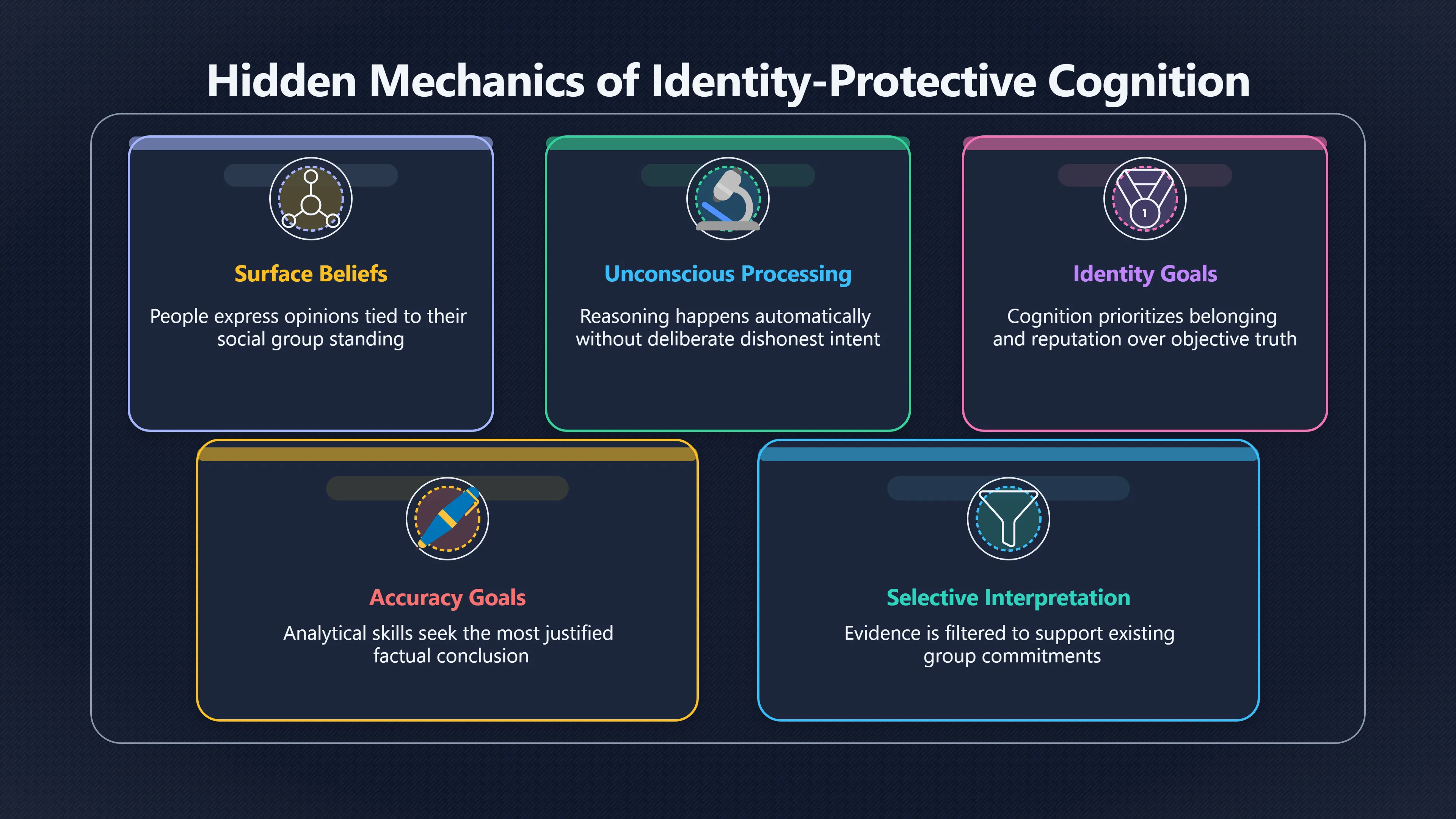
On identity-loaded issues, people may use reasoning skill to defend belonging rather than to update beliefs evenly.
On this page
- How identity changes source trust and standards of proof
- Why more information does not always reduce polarisation
- Questions that reveal asymmetric scepticism
Page outline Jump by section
Introduction
Identity-protective cognition describes a pattern in which people use their reasoning abilities not only to discover what is true, but also to protect their standing within groups that matter to them. On issues tied to politics, culture, profession, religion or other social identities, changing one’s mind can carry social costs: it may signal disloyalty, threaten status or weaken a sense of belonging. As a result, evidence is often evaluated through the question, “What does accepting this claim say about people like me?” rather than simply, “Is this claim supported?” Research suggests that this process is usually unconscious rather than deliberately dishonest, making it particularly difficult to recognise in ourselves.[Cambridge University Press & Assessment]cambridge.orgCambridge University Press & AssessmentIdeology, motivated reasoning, and cognitive reflectionby DM Kahan · 2013 · Cited by 2068 — When i…
 Understanding this mechanism is important for improving analytical thinking because it explains why intelligent, well-informed people can reach sharply different conclusions from the same evidence. It also helps explain why simply supplying more facts often fails to resolve polarised disagreements.
Why smart people defend their side better
Identity-protective cognition is a specific form of motivated reasoning. Rather than reasoning impartially and then forming an opinion, people often begin with commitments linked to their social identity and use their analytical abilities to defend those commitments. The stronger a person’s reasoning skills, the better they may become at finding counterarguments, questioning inconvenient studies and constructing coherent justifications for their existing position.[Cambridge University Press & Assessment]cambridge.orgCambridge University Press & AssessmentIdeology, motivated reasoning, and cognitive reflectionby DM Kahan · 2013 · Cited by 2068 — When i…
This finding challenges the common assumption that political or cultural disagreement mainly reflects ignorance. Several studies associated with Dan Kahan’s cultural cognition research found that greater scientific literacy or numeracy did not necessarily reduce disagreement on politically charged topics. In some circumstances, people with stronger analytical skills became more polarised because they were better equipped to interpret ambiguous evidence in ways that supported their group’s position.[Cambridge University Press & Assessment]cambridge.orgCambridge University Press & AssessmentIdeology, motivated reasoning, and cognitive reflectionby DM Kahan · 2013 · Cited by 2068 — When i…
This does not mean reasoning is harmful. Instead, it suggests that reasoning serves multiple goals simultaneously:
- Accuracy goals, where the objective is to reach the most justified conclusion.
- Identity goals, where the objective is to preserve belonging, reputation or consistency with valued groups.
When these goals conflict, identity goals can quietly shape how evidence is interpreted without the person experiencing themselves as biased.[Cambridge University Press & Assessment]cambridge.orgCambridge University Press & AssessmentIdeology, motivated reasoning, and cognitive reflectionby DM Kahan · 2013 · Cited by 2068 — When i…
How identity changes source trust and standards of proof
Identity-protective cognition rarely works by making people reject every inconvenient fact outright. More often, it changes how people judge the credibility of evidence.
Three related shifts commonly appear.
Trust becomes identity-sensitive. Information coming from trusted members of one’s own community is treated as more credible, while identical information from an opposing group attracts greater suspicion. Expertise itself may be evaluated differently depending on whether the expert appears aligned with or opposed to one’s identity.[The Cultural Cognition Project]culturalcognition.netThe Cultural Cognition Project Motivated reasoning & its cognatesThe Cultural Cognition ProjectMotivated reasoning & its cognates - Cultural Cognition15 May 2013 — Identity-protective cognition, like ot…
Standards of proof become asymmetric. Weak evidence may be accepted when it supports one’s preferred conclusion, while exceptionally strong evidence is demanded before accepting an opposing claim. This asymmetry often feels completely reasonable to the person applying it because each judgement is made separately rather than side by side.[The Cultural Cognition Project]culturalcognition.netThe Cultural Cognition Project Motivated reasoning & its cognatesThe Cultural Cognition ProjectMotivated reasoning & its cognates - Cultural Cognition15 May 2013 — Identity-protective cognition, like ot…
Ambiguity is interpreted selectively. Complex or mixed evidence usually leaves room for interpretation. Identity-protective reasoning directs attention towards interpretations that preserve valued beliefs while identifying weaknesses in conflicting interpretations. The result is not fabricated evidence but unequal scrutiny.[The Cultural Cognition Project]culturalcognition.netThe Cultural Cognition Project Motivated reasoning & its cognatesThe Cultural Cognition ProjectMotivated reasoning & its cognates - Cultural Cognition15 May 2013 — Identity-protective cognition, like ot…
These shifts help explain why disagreements often persist even after participants have examined the same reports, statistics or expert testimony.

Why more information does not always reduce polarisation
A common assumption is that disagreement exists because people lack sufficient information. Research on identity-protective cognition suggests the picture is more complicated.
Additional evidence only improves agreement if people are motivated primarily by accuracy. When evidence threatens important identities, additional information may instead provide more material for selective interpretation. Better-informed individuals can become more sophisticated defenders of their original position rather than more open-minded evaluators.[Cambridge University Press & Assessment]cambridge.orgCambridge University Press & AssessmentIdeology, motivated reasoning, and cognitive reflectionby DM Kahan · 2013 · Cited by 2068 — When i…
This helps explain why public disputes over subjects such as climate policy, firearms, public health or immigration sometimes persist despite enormous amounts of available evidence. Participants are not merely disagreeing about facts; they are often disagreeing within different social worlds where accepting certain facts carries symbolic meaning about loyalty, morality or group membership.[SSRN]papers.ssrn.comIt argues that misinformation has the greatest power to mislead.Read more…
However, the evidence is not entirely one-sided. Some research suggests that presenting information in ways that reduce identity threat—for example by emphasising broad scientific agreement rather than framing issues as victories for one political camp—can lessen defensive processing in some contexts. Other studies have found more mixed results, indicating that no communication strategy reliably eliminates motivated reasoning across all issues.[Wikipedia]WikipediaGateway belief modelGateway belief model
The practical lesson is that information alone is often insufficient when identity is at stake.
Questions that reveal asymmetric scepticism
Identity-protective cognition is easiest to notice when identical standards are applied to competing claims. The following questions can expose hidden asymmetries in one’s own reasoning.
- Would I evaluate this evidence differently if it supported the opposite conclusion?
- Am I questioning the evidence itself, or only the side presenting it?
- How much evidence would realistically persuade me that I am mistaken?
- Have I looked for the strongest argument against my current view, or only its weakest version?
- Would I trust this expert if they reached the opposite conclusion on another issue?
- Am I holding competing claims to identical standards of proof?
These questions do not guarantee objectivity, but they help distinguish genuine critical thinking from selective scepticism.

What this means for analytical thinking
Identity-protective cognition should not be confused with simple irrationality. The same psychological mechanisms that protect social belonging can also support cooperation, trust and shared norms within communities. The difficulty arises when those mechanisms become intertwined with factual questions that require impartial evaluation.[Cambridge University Press & Assessment]cambridge.orgCambridge University Press & AssessmentIdentity-protective reasoning: an epistemic and political…by C Flores · 2025 · Cited by 5 — Ide…
Improving analytical thinking therefore involves more than learning logic or recognising formal fallacies. It also requires recognising situations where accepting evidence feels personally costly because it threatens one’s identity. In such situations, the most reliable safeguard is not assuming that one is immune to bias, but deliberately checking whether one’s standards of evidence remain consistent across competing claims.
The central insight is that intelligence does not automatically protect against identity-driven reasoning. In polarised environments, greater reasoning ability may simply provide better tools for defending the beliefs that keep us connected to the groups we value. Analytical skill is most valuable when it is used not only to critique opposing arguments, but also to examine whether our own standards of evidence change when our identity is on the line. Cambridge University Press & Assessment+2The Cultural Cognition Project[cambridge.org]cambridge.orgCambridge University Press & AssessmentIdeology, motivated reasoning, and cognitive reflectionby DM Kahan · 2013 · Cited by 2068 — When i…
Amazon book picks
Further Reading
Books and field guides related to Why smart people defend their side better. Use these as the next step if you want deeper reading beyond the article.
Mistakes Were Made (but Not by Me)
Explains cognitive dissonance and self-justification.
eBay marketplace picks
Marketplace Samples
Example marketplace items related to this page. Use the search link to explore similar finds on eBay.



Endnotes
1.
Source: cambridge.org
Link:https://www.cambridge.org/core/journals/judgment-and-decision-making/article/ideology-motivated-reasoning-and-cognitive-reflection/F8A6A74C9022363D672B0FD14DD8B89F
Source snippet
Cambridge University Press & AssessmentIdeology, motivated reasoning, and cognitive reflectionby DM Kahan · 2013 · Cited by 2068 — When i...
2.
Source: papers.ssrn.com
Link:https://papers.ssrn.com/sol3/papers.cfm?abstract_id=3046603
Source snippet
It argues that misinformation has the greatest power to mislead.Read more...
3.
Source: papers.ssrn.com
Link:https://papers.ssrn.com/sol3/papers.cfm?abstract_id=2182588
Source snippet
ssrn.comIdeology, Motivated Reasoning, and Cognitive Reflectionby DM Kahan · 2012 · Cited by 2124 — Social psychologists have identified...
4.
Source: Wikipedia
Title: Ziva Kunda
Link:https://en.wikipedia.org/wiki/Ziva_Kunda
5.
Source: Wikipedia
Title: Motivated reasoning
Link:https://en.wikipedia.org/wiki/Motivated_reasoning
6.
Source: Wikipedia
Title: Gateway belief model
Link:https://en.wikipedia.org/wiki/Gateway_belief_model
7.
Source: cambridge.org
Link:https://www.cambridge.org/core/journals/episteme/article/identityprotective-reasoning-an-epistemic-and-political-defense/5C62B4A3FC3F564ADE86BA5B7C5EF2BE
Source snippet
Cambridge University Press & AssessmentIdentity-protective reasoning: an epistemic and political...by C Flores · 2025 · Cited by 5 — Ide...
8.
Source: culturalcognition.net
Title: The Cultural Cognition Project Motivated reasoning & its cognates
Link:https://www.culturalcognition.net/blog/2013/5/15/motivated-reasoning-its-cognates.html
Source snippet
The Cultural Cognition ProjectMotivated reasoning & its cognates - Cultural Cognition15 May 2013 — Identity-protective cognition, like ot...
Published: May 2013
9.
Source: informalscience.org
Link:https://informalscience.org/identity/dan-kahan/
Source snippet
Identity | Dan KahanDan Kahan's identity-related work has focused on “identity protective cognition”, which refers to the tendency of ind...
Additional References
10.
Source: basicknowledge101.com
Link:https://www.basicknowledge101.com/pdf/Kahan_2012_Ideology%2C%20Motivated%20Reasoning%2C%20and%20Cognitive%20Reflection_An%20Experimental%20Study.pdf
Source snippet
Ideology, Motivated Reasoning, and Cognitive Reflectionby DM Kahan · Cited by 2069 — When individuals display identity-protective cogniti...
11.
Source: scispace.com
Link:https://scispace.com/pdf/misconceptions-misinformation-and-the-logic-of-identity-mpc3ka7t6o.pdf
Source snippet
individuals to selectively credit and dismiss evi- dence in patterns that reflect the...Read more...
12.
Source: researchgate.net
Title: Ideology, Motivated Reasoning, and Cognitive Reflection
Link:https://www.researchgate.net/publication/279680482_Ideology_Motivated_Reasoning_and_Cognitive_Reflection
Source snippet
polarizing effects of identity-. protective cognition (Kahan, Peters et al. 2012). EUP also is inconsistent with IAP. Both BRP and IAP. a...
13.
Source: rcgd.isr.umich.edu
Link:https://rcgd.isr.umich.edu/wp-content/uploads/2018/07/science_curiosity_published.pdf
Source snippet
This finding is in tension with two...Read more...
14.
Source: youtube.com
Link:https://www.youtube.com/watch?v=Ee5o1bmMQbs
Source snippet
Dan Kahan- "Cultural Cognition of" or "Political Ideology in" Law- Part 1...
15.
Source: substack.com
Title: 🙉facts don’t [change minds]({{ ‘change-mind/’ | relative_url }})?
Link:https://substack.com/home/post/p-39403528
Source snippet
Identity-protective cognition...✝ According to Dan Kahan's influential theory of “cultural” or “identity-protective” cognition, public d...
16.
Source: youtube.com
Title: Dan Kahan: How cultural values shape beliefs and perceptions of risk
Link:https://www.youtube.com/watch?v=3OFtNm3MlQk
Source snippet
Dan Kahan: Science Literacy, Numeracy and Climate Change Risk Perceptions...
17.
Source: ideas.repec.org
Link:https://ideas.repec.org/a/cup/judgdm/v8y2013i4p407-424_2.html
Source snippet
repec.orgIdeology, motivated reasoning, and cognitive reflectionby DM Kahan · 2013 · Cited by 2126 — Decision scientists have identified...
18.
Source: youtube.com
Title: What is STEM identity? | Dan Kahan
Link:https://www.youtube.com/watch?v=ae2HDgY3sZo
Source snippet
Cardiff University Distinguished Lecture Dan Kahan: The Science Communication Environment...
19.
Source: journals.sagepub.com
Link:https://journals.sagepub.com/doi/10.1177/0032321720964667
Source snippet
Reasoning in Identity Politics: Group Status as a...by MM Boyer · 2022 · Cited by 70 — We argue that the extent to which reasoning is mo...
Topic Tree