Improving your thinking and analytical skills is less about becoming “smarter” in the abstract and more about changing how you handle evidence, uncertainty, explanations and decisions.
Page outline Jump by section
Introduction
The useful goal is not to think slowly all the time. Good analysis means knowing when intuition is enough, when to slow down, and how to check whether a conclusion is being driven by evidence, habit, pressure or wishful thinking.
What better thinking actually means
“Thinking skills” can sound vague, so it helps to separate three related abilities. Critical thinking is the ability to interpret information, evaluate arguments, draw justified conclusions and explain the reasoning behind them. Analytical thinking is the narrower habit of breaking a problem into parts, tracing causes, comparing evidence and testing explanations. Metacognition is thinking about your own thinking: noticing what you know, what you are assuming, and where your confidence may be too high.
Researchers often describe critical thinking as a metacognitive process involving purposeful, self-regulated judgement. That matters because the aim is not just to produce clever opinions, but to improve the odds of reaching a valid conclusion or a workable solution. [PMC]pmc.ncbi.nlm.nih.govby CP Dwyer · 2023 · Cited by 166 — Critical thinking (CT) is a metacognitive process—consisting of a number of skills and disposition… Metacognition is also a recurring theme in education evidence: the Education Endowment Foundation describes metacognition and self-regulation as a well-supported, high-impact and low-cost approach to improving learning. [EEF]educationendowmentfoundation.org.ukEEFMetacognition and Self-Regulated LearningThere is a strong body of research from psychology and education demonstrating the importance…
A good thinker is therefore not someone who never makes mistakes. A good thinker is someone who catches mistakes earlier, notices weak evidence, revises beliefs when the facts change, and chooses methods that fit the problem.
The core habit: make your reasoning visible
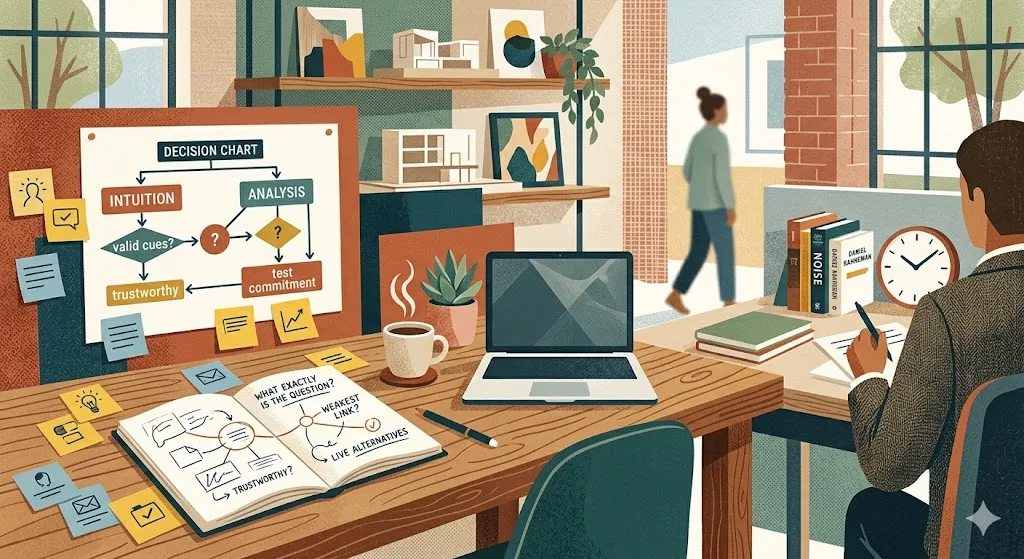
The simplest way to improve analytical thinking is to stop letting conclusions appear fully formed. Write down the chain between question and answer. This turns a private impression into something you can inspect.
For any non-trivial issue, use four prompts:
- What exactly is the question? A vague question invites a vague answer. “Is this project a good idea?” becomes clearer as “Will this project recover its costs within 18 months without delaying higher-priority work?”
- What would count as evidence? Decide what would change your mind before you go looking for support.
- What are the live alternatives? Compare at least two plausible explanations, not just “my idea” against “nothing”.
- What is the weakest link? Identify the assumption that would most damage your conclusion if it turned out to be false.
This habit works because it exposes hidden jumps. Many poor decisions are not caused by lack of intelligence, but by unexamined framing: the wrong question, a missing comparison, a selective evidence search, or an assumption treated as fact.
Learn enough context before trusting pattern recognition
Fast judgement can be useful, but only under the right conditions. Daniel Kahneman and Gary Klein, who came from different traditions in judgement research, converged on an important boundary: expert intuition is more trustworthy in environments with valid cues and timely, clear feedback. In chaotic or weak-feedback settings, confidence can outrun skill. [OA Monitor Ireland]oamonitor.ireland.openaire.euOpen source on openaire.eu.
That distinction changes how you should practise. A chess player, emergency doctor or experienced mechanic can build intuition because the environment supplies repeated patterns and relatively fast correction. By contrast, many workplace, political, investment or personal-life decisions provide delayed feedback, noisy outcomes and ambiguous causes. In those settings, “trust your gut” needs safeguards.
A practical rule is:
- Use intuition for recognition: “This resembles a problem I have seen before.”
- Use analysis for commitment: “Given the evidence, costs, alternatives and uncertainty, this is the best action.”
- Use feedback for calibration: “Was I right for the reasons I thought I was right?”
The point is not to suppress intuition. It is to make intuition earn trust through experience, feedback and comparison with outcomes.
Use evidence like a scientist, not a lawyer
A lawyerly mind searches for evidence that wins the case. A scientific mind asks which explanation survives contact with the evidence. Better analytical thinking requires more of the second stance, especially when you already care about the answer.
One common obstacle is myside bias, a form of confirmation bias in which people evaluate evidence in ways that protect their existing views. Stanovich, West and Toplak describe myside bias as closely related to the critical-thinking challenge of separating prior belief from evidence evaluation. [Maggie Toplak]maggietoplak.comMaggie Toplak Myside Bias, Rational Thinking, and IntelligenceMaggie Toplak Myside Bias, Rational Thinking, and Intelligence Research on actively open-minded thinking also treats willingness to consider alternatives and revise beliefs as central to better judgement. [PMC]pmc.ncbi.nlm.nih.govPMCActively Open-Minded Thinking and Its MeasurementPMCActively Open-Minded Thinking and Its Measurement
A useful antidote is not to tell yourself “be unbiased”, because that instruction is too weak. Use concrete moves:
- Search for the strongest opposing case. Do not settle for the weakest critic of your view.
- Ask what evidence would change your mind. If the answer is “nothing”, you are defending an identity, not analysing a claim.
- Separate source quality from source agreement. A source is not reliable because it agrees with you, and not unreliable merely because it does not.
- Steelman before rebutting. Restate the opposing argument in a form its supporters would recognise.
This is especially important online, where fluency, confident language and attractive formatting can mimic credibility. The Civic Online Reasoning curriculum from the Digital Inquiry Group teaches “lateral reading”: instead of staying on one webpage and judging it by appearance, readers check what other sources say about the site or claim. [cor.inquirygroup.org]cor.inquirygroup.orgOpen source on inquirygroup.org.
Build analytical skill through practice, not passive reading
Reading about thinking is useful only up to a point. Analytical skill improves when you repeatedly solve problems, receive feedback, and adjust your method. That is why evidence from education is relevant even for adults outside school: the mechanisms of learning still apply.
A major review of learning techniques by Dunlosky and colleagues rated practice testing and distributed practice as high-utility techniques. Practice testing means actively retrieving what you know rather than rereading it; distributed practice means spacing study or practice over time instead of cramming. [Westsächsische Hochschule Zwickau]whz.deWestsächsische Hochschule ZwickauImproving Students' Learning With Effective…by J Dunlosky · 2013 · Cited by 5904 — Practice testing a… These methods matter for thinking skills because analysis depends on usable knowledge. You cannot evaluate an argument well if the relevant concepts, facts and distinctions are not retrievable when needed.
For thinking and analytical skills, “practice testing” does not have to mean school-style exams. It can look like this:
- After reading an article, close it and write the author’s argument from memory.
- Before checking an answer, predict what the evidence will show.
- After a decision, record what you expected and review it later.
- When learning a concept, explain it without notes and then check what you missed.
- When analysing a problem, generate two explanations and list what each predicts.
This turns thinking into a feedback loop. Without retrieval and correction, it is easy to confuse familiarity with understanding.
Ask better questions before seeking better answers
Analytical people often look impressive because they answer well, but the deeper skill is question design. A poor question narrows the mind too early. A better question opens useful distinctions.
Consider the difference between these:
- “Is remote work good or bad?”
- “For which roles, tasks and workers does remote work improve performance, and where does it create coordination costs?”
The second question is better because it breaks a slogan into variables. It invites evidence, comparison and tradeoffs. The same move works across everyday decisions: health choices, career planning, hiring, purchases, arguments and public claims.
A strong analytical question usually has at least one of these features:
- A clear comparison: compared with what?
- A defined outcome: good by which measure?
- A timeframe: immediately, this year, or over a decade?
- A scope limit: for whom, where, and under what conditions?
- A testable implication: what should we observe if this is true?
This is where analytical thinking differs from mere scepticism. Scepticism can become a reflexive “no”. Analysis asks what would be true if each explanation were right, and then looks for discriminating evidence.
Slow down at the moments most likely to distort judgement
You do not need to analyse every small choice. The highest return comes from slowing down when predictable distortions are likely.
The Cognitive Reflection Test, introduced by Shane Frederick, became well known because its questions trigger quick but wrong intuitive answers, requiring people to override the first response and reflect. [Warrington College of Business]bear.warrington.ufl.eduWarrington College of Business Cognitive Reflection and Decision MakingWarrington College of Business Cognitive Reflection and Decision Making Later discussion has questioned whether the test measures only “reflection” rather than numeracy and other abilities, but its practical lesson remains useful: sometimes the first answer feels right because it is fluent, not because it is true. [Wikipedia]WikipediaCognitive reflection testCognitive reflection test
Slow down when:
- the answer feels obvious but the stakes are high;
- you strongly want one conclusion to be true;
- the decision is irreversible or expensive;
- the evidence is mainly anecdotal;
- people around you are rushing or signalling consensus;
- the problem involves probabilities, base rates or long-term consequences;
- you are angry, embarrassed, flattered or afraid.
A simple pause can be powerful: “What am I assuming, and how would I know if that assumption were false?”
Improve decisions by reducing noise, not just bias
Many people focus on bias, but inconsistency is another enemy of good judgement. Noise means unwanted variability in judgements of the same problem: two people, or the same person on two different days, may reach different conclusions without a good reason. Kahneman, Sibony and Sunstein popularised this problem in Noise: A Flaw in Human Judgment, and later discussions have applied the idea to professional settings where inconsistent judgement can affect outcomes. [Sage Journals]journals.sagepub.comOpen source on sagepub.com.
For personal and workplace decisions, noise reduction often comes from structure:
- Use criteria before judgement. Decide what matters before seeing the option you are tempted to choose.
- Score dimensions separately. For example: evidence quality, cost, reversibility, upside, downside and confidence.
- Make independent estimates first. In groups, ask people to write their judgement before discussion to reduce conformity.
- Compare similar cases. Ask how you handled a comparable problem before.
- Review outcomes. Track whether your criteria actually predicted success.
This is not bureaucracy for its own sake. It is a way of protecting judgement from mood, order effects, social pressure and whichever detail happens to be most vivid.
A practical weekly routine for sharper thinking
Improving thinking is easier when it becomes a routine rather than a personality project. A realistic weekly practice can be short, but it should include retrieval, analysis, feedback and revision.
Choose one claim to analyse. Pick something relevant to your work, studies or life: a news claim, a business proposal, a health assertion, a policy argument, or a decision you are considering.
Write the argument map. State the conclusion, the main reasons, the evidence offered, and the assumptions connecting them.
Find one strong contrary source. Do not look for a bad opposing argument. Find the best available challenge.
Make a prediction. Write what you expect to happen, what evidence you expect to find, or which option you think will perform better.
Review after a delay. Later, compare your expectation with what happened or with stronger evidence. Note whether the error came from missing information, poor weighting, bad framing, overconfidence or luck.
This rhythm borrows from the best-supported learning principles: active retrieval, spaced practice, feedback and self-explanation. It also keeps critical thinking grounded in real cases rather than abstract admiration for “logic”.
Common mistakes that feel like good thinking
Some habits look analytical but do not reliably improve judgement.
Collecting more information without changing the question. More data helps only if it is relevant. If the question is badly framed, extra information can simply decorate a weak conclusion.
Treating cynicism as intelligence. Rejecting everything is not critical thinking. Good analysis distinguishes weak claims from strong ones.
Overvaluing credentials or confidence. Expertise matters, but it is strongest when the expert domain has valid cues, repeated practice and feedback. Outside those conditions, even experienced people can be overconfident. [OA Monitor Ireland]oamonitor.ireland.openaire.euOpen source on openaire.eu.
Rereading instead of testing understanding. Rereading can feel productive because the material becomes familiar, but evidence reviews give higher marks to retrieval practice and spacing than to passive review strategies. [Westsächsische Hochschule Zwickau]whz.deWestsächsische Hochschule ZwickauImproving Students' Learning With Effective…by J Dunlosky · 2013 · Cited by 5904 — Practice testing a…
Debating to win. Argument can sharpen thought, but only if both sides are responsive to evidence. If the goal is victory, the mind becomes selective.
What progress looks like
Better thinking rarely feels like sudden brilliance. It usually shows up as cleaner questions, calmer disagreement, more precise uncertainty and fewer repeated mistakes. You notice when a claim needs a comparison. You become less impressed by confident but unsupported explanations. You revise faster when evidence changes. You can say “I do not know” without feeling that the conversation has ended.
The most reliable path is deliberately modest: practise on real problems, write down your reasoning, test your recall, seek disconfirming evidence, use structured judgement for important decisions, and review outcomes. Over time, those habits do what raw intelligence alone cannot: they make your thinking more inspectable, more correctable and more useful.
Amazon book picks
Further Reading
Books and field guides related to Improving Your Think. Use these as the next step if you want deeper reading beyond the article.
Thinking in Systems
Shows how to decompose problems according to underlying system structure rather than surface features.
The Scout Mindset
Focused on updating beliefs, evaluating evidence, and changing your mind when warranted.
Superforecasting
Focuses on calibrated confidence, evidence updates, and separating probabilities from decisions.
Super Thinking
Introduces frameworks for selecting better problem structures and analytical approaches.
eBay marketplace picks
Marketplace Samples
Live-tested eBay searches with available results related to this page.


Endnotes
-
Source: pmc.ncbi.nlm.nih.gov
Link: https://pmc.ncbi.nlm.nih.gov/articles/PMC10300824/Source snippet
by CP Dwyer · 2023 · Cited by 166 — Critical thinking (CT) is a metacognitive process—consisting of a number of skills and disposition...
-
Source: educationendowmentfoundation.org.uk
Link: https://educationendowmentfoundation.org.uk/education-evidence/guidance-reports/metacognitionSource snippet
EEFMetacognition and Self-Regulated LearningThere is a strong body of research from psychology and education demonstrating the importance...
-
Source: pmc.ncbi.nlm.nih.gov
Title: PMCActively Open-Minded Thinking and Its Measurement
Link: https://pmc.ncbi.nlm.nih.gov/articles/PMC9966223/ -
Source: cor.inquirygroup.org
Link: https://cor.inquirygroup.org/curriculum/collections/teaching-lateral-reading/ -
Source: cor.inquirygroup.org
Title: Civic Online Reasoning
Link: https://cor.inquirygroup.org/ -
Source: Wikipedia
Title: Cognitive reflection test
Link: https://en.wikipedia.org/wiki/Cognitive_reflection_test -
Source: pmc.ncbi.nlm.nih.gov
Link: https://pmc.ncbi.nlm.nih.gov/articles/PMC11643215/ -
Source: Wikipedia
Title: Noise: A Flaw in Human Judgment
Link: https://en.wikipedia.org/wiki/Noise%3A_A_Flaw_in_Human_Judgment -
Source: journals.sagepub.com
Link: https://journals.sagepub.com/doi/abs/10.3102/0034654314551063Source snippet
Sage JournalsStrategies for Teaching Students to Think Criticallyby PC Abrami · 2015 · Cited by 2010 — Results demonstrate that there are...
-
Source: whz.de
Link: https://www.whz.de/fileadmin/lehre/hochschuldidaktik/docs/dunloskiimprovingstudentlearning.pdfSource snippet
Westsächsische Hochschule ZwickauImproving Students' Learning With Effective...by J Dunlosky · 2013 · Cited by 5904 — Practice testing a...
-
Source: oamonitor.ireland.openaire.eu
Link: https://oamonitor.ireland.openaire.eu/rfo/sfi_rfo/search/publication?pid=10.1037%2Fa0016755 -
Source: maggietoplak.com
Title: Maggie Toplak Myside Bias, Rational Thinking, and Intelligence
Link: https://maggietoplak.com/wp-content/uploads/2025/05/Stanovich-K.-E.-West-R.-F.-Toplak-M.-E.-2013.-Myside-bias-rational-thinking-and-intelligence.pdf -
Source: psychologicalscience.org
Title: learning techniques
Link: https://www.psychologicalscience.org/publications/journals/pspi/learning-techniques.html -
Source: bear.warrington.ufl.edu
Title: Warrington College of Business Cognitive Reflection and Decision Making
Link: https://bear.warrington.ufl.edu/brenner/mar7588/Papers/frederick-jep2005.pdf -
Source: journals.sagepub.com
Link: https://journals.sagepub.com/doi/10.1177/00018392221119294 -
Source: pmc.ncbi.nlm.nih.gov
Link: https://pmc.ncbi.nlm.nih.gov/articles/PMC12241059/ -
Source: pmc.ncbi.nlm.nih.gov
Link: https://pmc.ncbi.nlm.nih.gov/articles/PMC9242397/ -
Source: pubmed.ncbi.nlm.nih.gov
Link: https://pubmed.ncbi.nlm.nih.gov/26173288/ -
Source: journals.sagepub.com
Link: https://journals.sagepub.com/doi/10.1177/016146811912101102 -
Source: journals.sagepub.com
Link: https://journals.sagepub.com/doi/10.1177/1529100612453266 -
Source: iphils.uj.edu.pl
Link: https://iphils.uj.edu.pl/~a.trybus/classes/logic/cs/12.Stanovich.Myside.Bias.pdf -
Source: icarus.cs.weber.edu
Link: https://icarus.cs.weber.edu/~gs35549/la2/learning.html -
Source: ejpbl.org
Link: https://www.ejpbl.org/journal/view.php?number=78 -
Source: scienceofboosting.org
Title: Lateral Reading
Link: https://www.scienceofboosting.org/project/lateral-reading/ -
Source: jtl.uwindsor.ca
Link: https://jtl.uwindsor.ca/index.php/jtl/article/view/8813 -
Source: education-ni.gov.uk
Title: Retrieval Practice
Link: https://www.education-ni.gov.uk/sites/default/files/2025-04/May%20Newsletter%20-%20Retrieval%20Practice%20%20What%20it%20is%2C%20Why%20it%20Works%20and%20How%20to%20Do%20It%20Better.PDF
Additional References
-
Source: youtube.com
Title: Five simple strategies to sharpen your critical thinking | BBC Ideas
Link: http://www.youtube.com/watch?v=NHjgKe7JMNESource snippet
Critical thinking analytical thinking metacognition improve skills Metacognition: The Skill That Promotes Advanced Learning Peterson's Te...
-
Source: youtube.com
Link: http://www.youtube.com/watch?v=h68bS4c4kw0Source snippet
This tool will help improve your critical thinking - Erick Wilberding...
-
Source: youtube.com
Title: Metacognition: The Skill That Promotes Advanced Learning
Link: http://www.youtube.com/watch?v=elZFL4FLVLESource snippet
Metacognition: An Important Skill for Modern Times | Brendan Conway-Smith | TEDxCarletonUniversity...
-
Source: youtube.com
Title: This tool will help improve your critical thinking
Link: http://www.youtube.com/watch?v=vNDYUlxNIAASource snippet
5 tips to improve your critical thinking - Samantha Agoos...
-
Source: youtube.com
Title: 5 tips to improve your critical thinking
Link: http://www.youtube.com/watch?v=dItUGF8GdTwSource snippet
Five simple strategies to sharpen your critical thinking | BBC Ideas...
-
Source: linkedin.com
Link: https://www.linkedin.com/posts/yuliia-drobot_pdf-conditions-for-intuitive-expertise-activity-7137409442857259008-4_mX -
Source: researchgate.net
Link: https://www.researchgate.net/publication/26798603_Conditions_for_Intuitive_Expertise -
Source: researchgate.net
Link: https://www.researchgate.net/publication/326134901_The_Cognitive_Reflection_Test_A_Measure_of_IntuitionReflection_Numeracy_and_Insight_Problem_Solving_and_the_Implications_for_Understanding_Real-World_Judgments_and_Beliefs -
Source: researchgate.net
Link: https://www.researchgate.net/publication/349535570_Lateral_reading_College_students_learn_to_critically_evaluate_internet_sources_in_an_online_course -
Source: researchgate.net
Link: https://www.researchgate.net/publication/390843764_The_Puzzle_of_Myside_Bias_and_Actively_Open-Minded_Thinking_in_the_Conceptualization_of_Critical_Thinking
Topic Tree
Follow this branch
More on this topic 30
- Alternatives Why One Explanation Is Not Enough
- Better Questions Ask Better Questions Before Seeking Answers
- Calibration How Confident Should You Be?
- Cause Check Did It Cause It, or Just Happen Nearby?
- Critical Skills Can Critical Thinking Really Be Taught?
- Decision Journal Keep Score on Your Own Judgement
- Decision Routines A Safer Way to Make Big Decisions
- Domain Knowledge Why Smart Thinking Needs Real Knowledge
- +22 more in sidebar