Within Alternatives
Why First Causes Miss the Chain
Serious accident inquiries show why visible first causes often give way to chains of mechanical, human, organizational, and environmental factors.
On this page
- Why early accident stories over focus on visible causes
- How fact gathering widens the explanation set
- What everyday analysis can learn from causal chains
Page outline Jump by section
Introduction
Serious accident investigations are among the clearest demonstrations that the first explanation is rarely the best one. In the immediate aftermath of a disaster, attention often centres on the last visible event: a pilot’s mistake, a broken component, a missed warning, or a poor decision. Yet formal investigations repeatedly show that catastrophic outcomes usually emerge from a chain of interacting causes rather than a single failure. Mechanical faults, human judgement, organisational policies, environmental conditions, training, communication, and chance often combine in ways that only become clear after systematic evidence gathering.[PMC]pmc.ncbi.nlm.nih.govUnderstanding the “Swiss Cheese Model” and Its Application…by DA Wiegmann · 2022 · Cited by 204 — The Swiss Cheese Model is commonl…
 For anyone trying to improve analytical thinking, accident investigations offer a practical lesson: do not stop when you find a plausible cause. Keep asking what allowed that cause to exist, what alternative explanations fit the evidence, and what combination of factors made the outcome possible.
Why early accident stories over-focus on visible causes
The first public account of an accident almost always relies on what is immediately observable. A crashed aircraft may appear to have fallen because a pilot made an error. A factory explosion may seem to result from one valve being left open. A train collision may initially be blamed on a signal passed at danger.
These explanations are attractive because they identify an obvious event near the end of the causal sequence. They provide a simple story, identify responsibility quickly, and satisfy the natural desire for closure.
Professional investigators deliberately resist this temptation. Their task is not simply to identify what happened last but to reconstruct the entire sequence that made the final event possible. The question changes from “Who made the mistake?” to “Why did the system allow this mistake to become catastrophic?”[Skybrary]skybrary.aeroJames Reason HF ModelThe Swiss Cheese model of accident causation, originally proposed by James Reason, likens human system defen…
This distinction matters because many different causal chains can produce the same visible outcome. A driver crossing into the wrong lane could reflect fatigue, medical incapacity, poor road design, misleading signage, vehicle failure, distraction, or several of these together. Treating the first apparent cause as the only cause closes off rival explanations before they have been tested.
How fact gathering widens the explanation set
Formal accident inquiries expand the explanation space by collecting evidence from many independent sources before settling on conclusions.
Rather than relying on eyewitness accounts alone, investigators compare multiple forms of evidence, including:
- Physical damage patterns.
- Electronic recordings and sensor data.
- Maintenance records.
- Weather observations.
- Training histories.
- Operating procedures.
- Communication transcripts.
- Organisational documentation.
- Human factors evidence such as fatigue or workload.
Each new category of evidence may eliminate some hypotheses while strengthening others.
This process illustrates an important reasoning principle: evidence should discriminate between competing explanations rather than merely fit one preferred story. If several hypotheses explain the same observation equally well, investigators seek new evidence that would be expected under one explanation but not another.
From single mistakes to causal chains
Modern safety investigation increasingly views accidents as products of interacting systems rather than isolated failures.
James Reason’s influential “Swiss Cheese Model” illustrates this idea. Instead of imagining a single broken safeguard, it depicts multiple defensive layers, each containing weaknesses or “holes”. Most hazards are stopped by one or more barriers. Catastrophe occurs only when weaknesses temporarily align across several layers, allowing an accident trajectory to pass through the entire system.[PMC+2EUROCONTROL]pmc.ncbi.nlm.nih.govUnderstanding the “Swiss Cheese Model” and Its Application…by DA Wiegmann · 2022 · Cited by 204 — The Swiss Cheese Model is commonl…
In this framework investigators distinguish between:
- Active failures: immediate unsafe actions with direct consequences, such as an incorrect control input.
- Latent conditions: organisational decisions, maintenance practices, equipment design, staffing levels, training deficiencies, or cultural problems that remain hidden until combined with active failures.
The practical consequence is profound. Removing one operator or replacing one component may prevent a repeat of one accident while leaving the underlying vulnerabilities untouched.
Case study: the Tenerife airport disaster
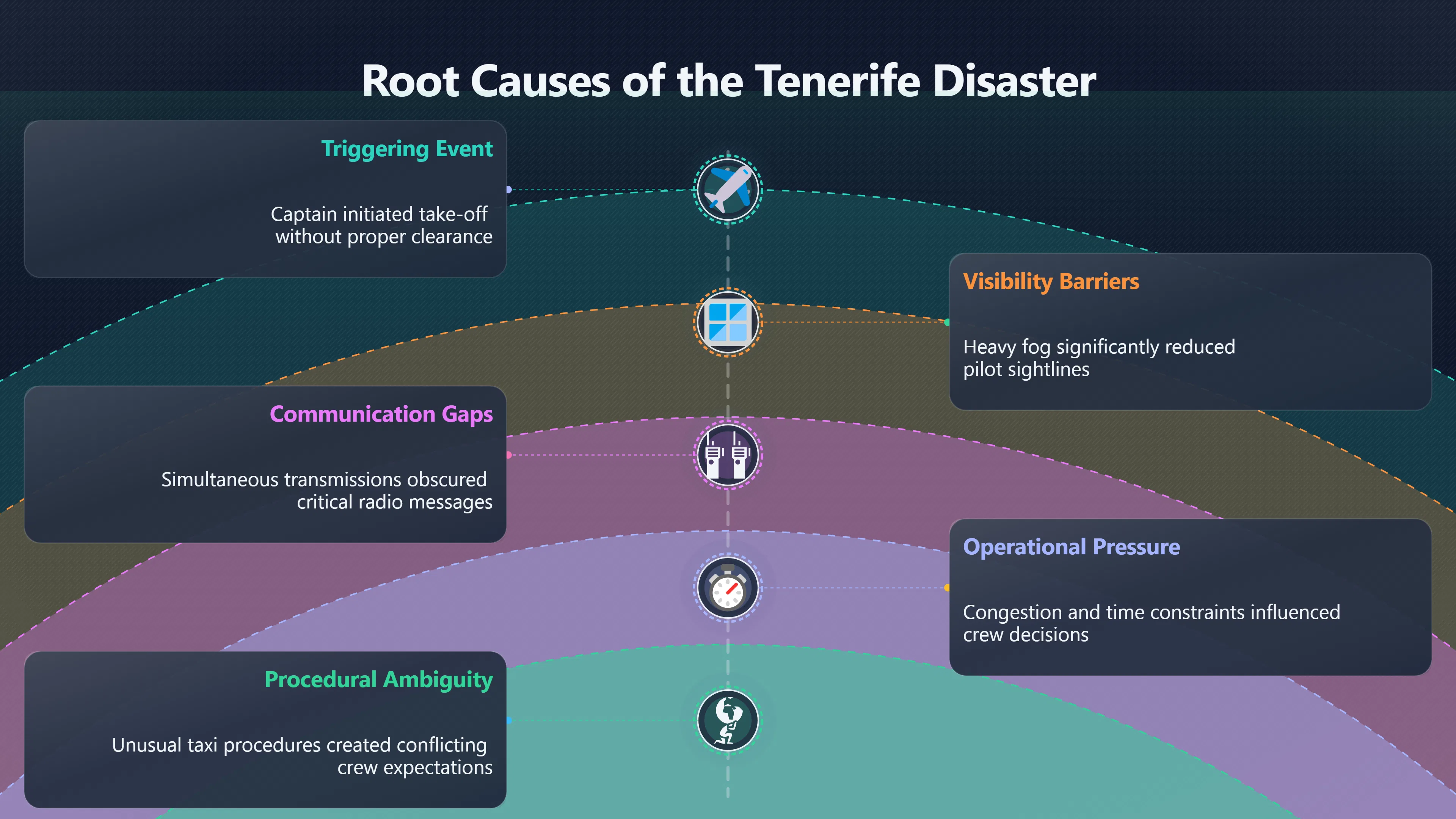
The 1977 runway collision at Tenerife remains one of the clearest examples of why first causes rarely tell the whole story.
An immediate description might simply state that a captain began take-off without clearance. The official investigation indeed identified the unauthorised take-off as the fundamental triggering event.[Wikipedia]WikipediaTenerife airport disasterTenerife airport disaster
However, the broader investigation uncovered a much richer causal chain involving:
- Heavy fog reducing visibility.
- Congestion after another airport closed.
- Unusual taxi procedures.
- Radio communication ambiguities.
- Simultaneous transmissions that obscured messages.
- Crew expectations and assumptions.
- Time pressure associated with operational constraints.
None of these factors alone guaranteed disaster. Together they created conditions in which one mistaken interpretation became fatal. The investigation therefore transformed a seemingly simple explanation into a network of interacting contributors rather than a single act of negligence.[Wikipedia]WikipediaTenerife airport disasterTenerife airport disaster

Case study: the Challenger disaster
The loss of the space shuttle Challenger in 1986 is often remembered as an engineering failure involving damaged O-rings in unusually cold weather.
Subsequent investigations revealed that the physical failure itself was only one link in a longer chain. Engineering concerns had been raised before launch, uncertainty was interpreted differently by managers and engineers, communication between organisational levels broke down, and schedule pressures influenced decision-making.
The lesson extends beyond engineering. The visible technical failure became understandable only after examining organisational judgement, information flow, and institutional incentives. Modern safety literature frequently uses Challenger as an example of latent organisational failures combining with immediate technical causes.[NHS Wales Performance and Improvement]performanceandimprovement.nhs.walesWales Performance and Improvement Reasons Swiss Cheese ModelNHS Wales Performance and ImprovementReasons Swiss Cheese ModelAugust 5, 2024 — The Swiss cheese model is a complex linear safety model o…
Rival explanations are not obstacles—they improve investigations
A well-run investigation actively entertains competing explanations rather than defending the first plausible one.
For example, investigators may initially consider several hypotheses simultaneously:
- Mechanical failure.
- Human error.
- Environmental conditions.
- Design defects.
- Maintenance shortcomings.
- Communication failures.
- Deliberate interference.
Each remains provisional until evidence progressively excludes alternatives.
Importantly, these explanations are not necessarily mutually exclusive. One of the biggest lessons from accident analysis is that multiple rival explanations often survive because each contributes part of the overall causal chain. The final explanation therefore becomes layered rather than singular.
This differs from everyday debates, where people often assume that if one cause is identified, all others become irrelevant.
What everyday analysis can learn from causal chains
The habits used by professional accident investigators transfer surprisingly well to ordinary reasoning.
When analysing an unexpected outcome, ask questions that naturally expand the explanation rather than prematurely closing it:
- What happened immediately before the visible event?
- What conditions made that event possible?
- Which explanations remain compatible with the available evidence?
- What evidence would distinguish between those explanations?
- Which contributing factors would still matter even if the immediate trigger were removed?
This approach helps avoid two common thinking errors.
The first is proximate-cause bias—stopping at the last visible event.
The second is single-cause bias—assuming complex outcomes must have one dominant explanation instead of several interacting contributors.
Accident investigations repeatedly demonstrate that serious failures often arise from ordinary weaknesses that become dangerous only when combined. The same principle applies to business failures, medical errors, project collapses, and many personal decisions.
Thinking in chains rather than snapshots
Perhaps the most enduring lesson from accident investigation is that explanations become stronger as they become more complete, not merely more detailed.
The goal is not to replace one simple story with an impossibly complicated one. Instead, it is to identify the smallest causal chain that genuinely accounts for the evidence. That usually means moving beyond the first visible mistake to include the mechanical, human, organisational, and environmental conditions that allowed it to become consequential.
Thinking in causal chains encourages intellectual humility. It reminds us that the most obvious explanation is often only the final link in a much longer sequence—and that better judgement comes from tracing the chain backwards before deciding where the real explanation begins.
Amazon book picks
Further Reading
Books and field guides related to Why First Causes Miss the Chain. Use these as the next step if you want deeper reading beyond the article.
The Black Swan
Rating: 4.0/5 from 25 Google Books ratings
Challenges oversimplified narratives and hindsight explanations.
The Checklist Manifesto
Shows how systematic investigation reduces preventable errors and missed factors.
Superforecasting
Encourages evidence-based thinking and considering multiple explanations.
Normal Accidents
Directly examines how complex systems produce accident chains rather than single causes.
eBay marketplace picks
Marketplace Samples
Example marketplace items related to this page. Use the search link to explore similar finds on eBay.


Endnotes
1.
Source: pmc.ncbi.nlm.nih.gov
Link:https://pmc.ncbi.nlm.nih.gov/articles/PMC8514562/
Source snippet
Understanding the “Swiss Cheese Model” and Its [Application]({{ 'application/' | relative_url }})...by DA Wiegmann · 2022 · Cited by 204 — The Swiss Cheese Model is commonl...
2.
Source: eurocontrol.int
Link:https://www.eurocontrol.int/sites/default/files/library/017_Swiss_Cheese_Model.pdf
Source snippet
J. Reason has famously developed a model based on the Swiss...Read more...
3.
Source: skybrary.aero
Link:https://skybrary.aero/articles/james-reason-hf-model
Source snippet
James Reason HF ModelThe Swiss Cheese model of accident [causation]({{ 'causation/' | relative_url }}), originally proposed by James Reason, likens human system defen...
4.
Source: Wikipedia
Title: Tenerife airport disaster
Link:https://en.wikipedia.org/wiki/Tenerife_airport_disaster
5.
Source: performanceandimprovement.nhs.wales
Title: Wales Performance and Improvement Reasons Swiss Cheese Model
Link:https://performanceandimprovement.nhs.wales/functions/quality-safety-and-improvement/improvement/improvement-cymru-academy/resource-library/academy-toolkit-guides/reasons-swiss-cheese-safety-model-toolkit/
Source snippet
NHS Wales Performance and ImprovementReasons Swiss Cheese ModelAugust 5, 2024 — The Swiss cheese model is a complex linear safety model o...
Published: August 5, 2024
Additional References
6.
Source: psychsafety.com
Title: the swiss cheese model
Link:https://psychsafety.com/the-swiss-cheese-model/
Source snippet
14 Sept 2023 — In the model, Reason uses slices of Swiss cheese to demonstrate layers of defence against what he calls active failures an...
7.
Source: youtube.com
Title: The 5-Step Accident Investigation: How to Find the Root Cause
Link:https://www.youtube.com/watch?v=50DO44bE9yI
Source snippet
Root Cause: Understanding Why Incidents Happen | Fundamentals of Accident Investigation - Part 3...
8.
Source: youtube.com
Link:https://www.youtube.com/watch?v=i6AimhzMbPI
Source snippet
The Right Way to Investigate Workplace Accidents...
9.
Source: jws.com.au
Link:https://jws.com.au/what-we-think/corporate-governance-defence-in-depth-and-the-swiss-cheese-model-of-incident-causation/
Source snippet
Corporate governance, defence in depth and the Swiss...4 Nov 2024 — So it is with the so-called Swiss Cheese Model (SCM) of incident cau...
10.
Source: youtube.com
Title: The Right Way to Investigate Workplace Accidents
Link:https://www.youtube.com/watch?v=8wTzAGtPoYU
Source snippet
#investiigations - YouTube The Right Way to Investigate Workplace Accidents | #investiigations - YouTube...
11.
Source: icao.int
Link:https://www.icao.int/sites/default/files/WACAF/MeetingDocs/2025/conduite%20des%20enqu%C3%AAtes%20sur%20les%20accidents%20et%20incidents%20d%27aviation/Module-22-Facteurs-humains-et-organisationnels.pdf
Source snippet
tem defences.Read more...
12.
Source: youtube.com
Title: The Swiss Cheese Model Explained: Why Disasters Really Happen
Link:https://www.youtube.com/watch?v=SRhe1oNw2Ws
Source snippet
The Swiss Cheese Model of Accident Causation...
13.
Source: ineris.hal.science
Link:https://ineris.hal.science/ineris-03318305/document
Source snippet
and bad reasons: The Swiss cheese model and its...by J Larouzee · 2020 · Cited by 248 — This article provides a historical and critical...
14.
Source: youtube.com
Title: The Swiss Cheese Model of Accident Causation
Link:https://www.youtube.com/watch?v=ENHWc6gxVRQ
Source snippet
The 5-Step Accident Investigation: How to Find the Root Cause...
15.
Source: leonardo-in-flight.nl
Title: Reason Model
Link:https://leonardo-in-flight.nl/Reason%20Model.htm
Source snippet
LeonardoThe Swiss cheese model shows several layers between management decision making and accidents and incidents.Read more...
Topic Tree