Within Objections
Could Another Explanation Fit Better?
Comparing rival explanations against the same evidence helps prevent one plausible story from becoming the only story.
On this page
- List plausible explanations
- Test evidence against each option
- Watch for surviving alternatives
Page outline Jump by section
Introduction
When you are close to making a decision, the greatest risk is often not a lack of evidence but becoming attached to the first explanation that seems convincing. Analysis of Competing Hypotheses (ACH) offers a practical way to resist that tendency. Rather than asking, “How can I prove my preferred explanation?”, it asks, “Which explanation survives the evidence best after every plausible alternative has had a fair chance?” Originally developed by intelligence analyst Richards Heuer to improve analytical judgement under uncertainty, the approach can be adapted to everyday decisions involving careers, finances, relationships, health, or major purchases.[ialeia.org]ialeia.orgPDF] The Psychology of Intelligence AnalysisDecember 13, 2005 — Heuer's concept of “Analysis of Competing Hypotheses” (ACH) is among his most important contributions to the developm…
 Within the broader practice of testing strong objections before deciding, ACH shifts attention from defending one attractive story to comparing several plausible stories against the same evidence. That comparison often reveals that evidence is less decisive than it first appeared, or that an overlooked explanation fits the facts equally well.
Why one convincing story is rarely enough
Most real-world evidence is compatible with more than one explanation. A delayed reply from a colleague could indicate disinterest, excessive workload, technical problems, or simple forgetfulness. Falling sales could reflect weaker demand, stronger competitors, poor marketing, seasonal variation, or measurement error. The challenge is not finding evidence for one explanation; it is determining whether that evidence distinguishes between competing explanations.
Research on confirmation bias shows that people naturally seek, interpret, and remember information that supports their existing beliefs while giving less weight to contradictory evidence. Simply becoming aware of this tendency does not reliably eliminate it, which is why structured comparison techniques have been developed.[Wikipedia]WikipediaConfirmation biasConfirmation bias
ACH addresses this by making alternative explanations explicit before evaluating the evidence.
List plausible explanations before collecting more evidence
The first practical step is not to choose a favourite hypothesis but to generate several reasonable alternatives.
For everyday decisions, these alternatives do not need to be exhaustive. They should simply represent genuinely different explanations that could account for what you currently observe.
Suppose you are deciding whether to leave your current job because you feel increasingly dissatisfied.
Instead of assuming that “my job is the problem”, you might consider:
- The role itself no longer matches your interests.
- The current manager is the main source of dissatisfaction.
- Temporary workload or personal stress is colouring your judgement.
- Career progression has stalled rather than the work itself becoming unsuitable.
- Another employer would probably create similar frustrations.
Several of these explanations may initially seem plausible. Their value lies in forcing the decision to compete against realistic alternatives rather than against no alternative at all.
Test the same evidence against every explanation
The defining feature of ACH is that evidence is examined across all hypotheses rather than building a separate case for each one. Heuer argued that the most useful evidence is not necessarily evidence that supports a hypothesis, but evidence that clearly contradicts competing explanations because it has high “diagnostic” value.[ialeia.org]ialeia.orgPDF] The Psychology of Intelligence AnalysisDecember 13, 2005 — Heuer's concept of “Analysis of Competing Hypotheses” (ACH) is among his most important contributions to the developm…
A simple comparison table can make this clearer.
EvidenceJob mismatchManager problemTemporary stressCareer stagnationEnjoyed similar work previouslyWeakensNeutralSupportsNeutralProblems began after management changedNeutralStrongly supportsWeakensNeutralDissatisfaction continues during holidaysSupportsNeutralWeakensNeutralPromotion opportunities disappearedNeutralNeutralNeutralSupports
Notice that the goal is not to count supporting observations. Instead, ask which pieces of evidence genuinely separate one explanation from another.
Many facts are consistent with several hypotheses. Those facts contribute relatively little to deciding between them.
Give extra weight to disconfirming evidence
One of ACH’s most important insights is that analysts should actively search for evidence that would weaken their preferred explanation rather than accumulate additional supporting examples.
Suppose you believe that a friend’s recent behaviour means they are avoiding you.
Instead of looking for further signs of distance, deliberately search for observations that would make this explanation less convincing.
For example:
- Have they become less responsive to everyone?
- Have they recently experienced major work or family pressures?
- Do they still initiate contact in other ways?
- Is there evidence that communication problems affect multiple relationships rather than only yours?
Disconfirming evidence often provides more information than additional confirming evidence because it directly challenges the explanation you currently favour. This emphasis on inconsistency rather than confirmation distinguishes ACH from ordinary intuition.[SANS Internet Storm Center]isc.sans.eduSANS Internet Storm CenterAnalysis of Competing Hypotheses (ACH part 1)28 May 2017 — ACH is an analytic process that identifies a set of…

Watch for explanations that refuse to disappear
Sometimes one explanation clearly outperforms the others.
Often it does not.
A valuable outcome of ACH is recognising that several explanations remain viable because available evidence genuinely cannot distinguish between them.
Rather than treating this as failure, it changes the decision itself.
Instead of asking:
Which explanation is definitely correct?
the question becomes:
Which explanation currently has the strongest support, and what evidence would most efficiently distinguish between the remaining possibilities?
This naturally encourages better information gathering.
If you are deciding whether to buy a house, for example, uncertainty about future local employment might dominate the decision. Rather than collecting more property photographs or reading more estate-agent descriptions, you might investigate employer announcements, infrastructure projects, or population trends because those observations better discriminate between competing forecasts.
Everyday situations where rival hypotheses improve judgement
ACH is most useful when evidence is incomplete and emotions make one explanation especially attractive.
Common applications include:
- Financial decisions: distinguishing between a temporary market decline and a permanent change in business quality before investing.
- Workplace problems: separating personality conflict from genuine organisational dysfunction.
- Health choices: recognising that one symptom may have several possible causes while awaiting professional assessment.
- Relationships: considering misunderstanding, external stress, changing priorities, or communication failures before assuming harmful intent.
- Major purchases: deciding whether dissatisfaction with a current product reflects genuine limitations or unrealistic expectations.
In each case, comparing explanations reduces the chance that the first plausible narrative becomes the only narrative considered.
Recognise the limits of the method
ACH is not a guarantee of correct decisions.
Research evaluating its effectiveness has produced mixed findings. Some studies suggest that structured comparison can reduce aspects of confirmation bias, while others find that analysts do not consistently follow the method, and that its benefits depend on the complexity of the task, the quality of evidence, and how carefully the process is applied. Some experiments have even found increases in inconsistency or judgement errors when users apply the technique mechanically without understanding its purpose.[Strathprints]strathprints.strath.ac.ukStrathprints The “analysis of competing hypotheses” in intelligence analysisThe “analysis of competing hypotheses” in intelligence analysisJuly 26, 2019 — by MK Dhami · 2019 · Cited by 81 — We examined…
This means ACH should be viewed as a thinking aid rather than a decision algorithm.
Its greatest value comes from slowing premature commitment, exposing hidden assumptions, and making reasoning more transparent.
A lightweight version for everyday decisions
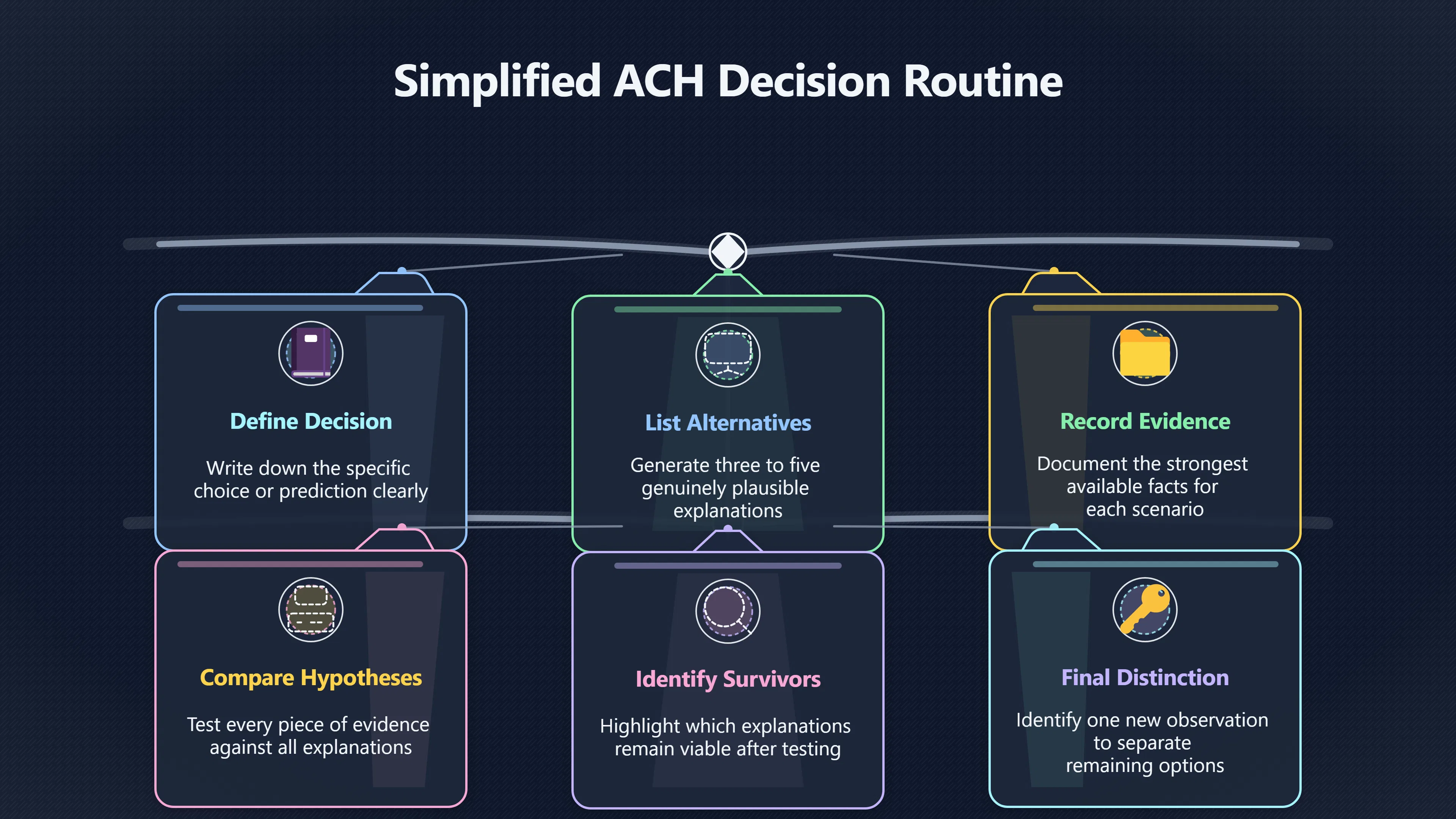
For most personal choices, the full intelligence-analysis procedure is unnecessary. A simplified routine captures most of the benefit.
- List three to five genuinely plausible explanations.
- Record the strongest available evidence.
- Compare each piece of evidence against every explanation instead of examining one explanation in isolation.
- Highlight evidence that clearly weakens particular explanations.
- Identify which explanations still survive.
- Ask what single new observation would best distinguish between the remaining alternatives before deciding.
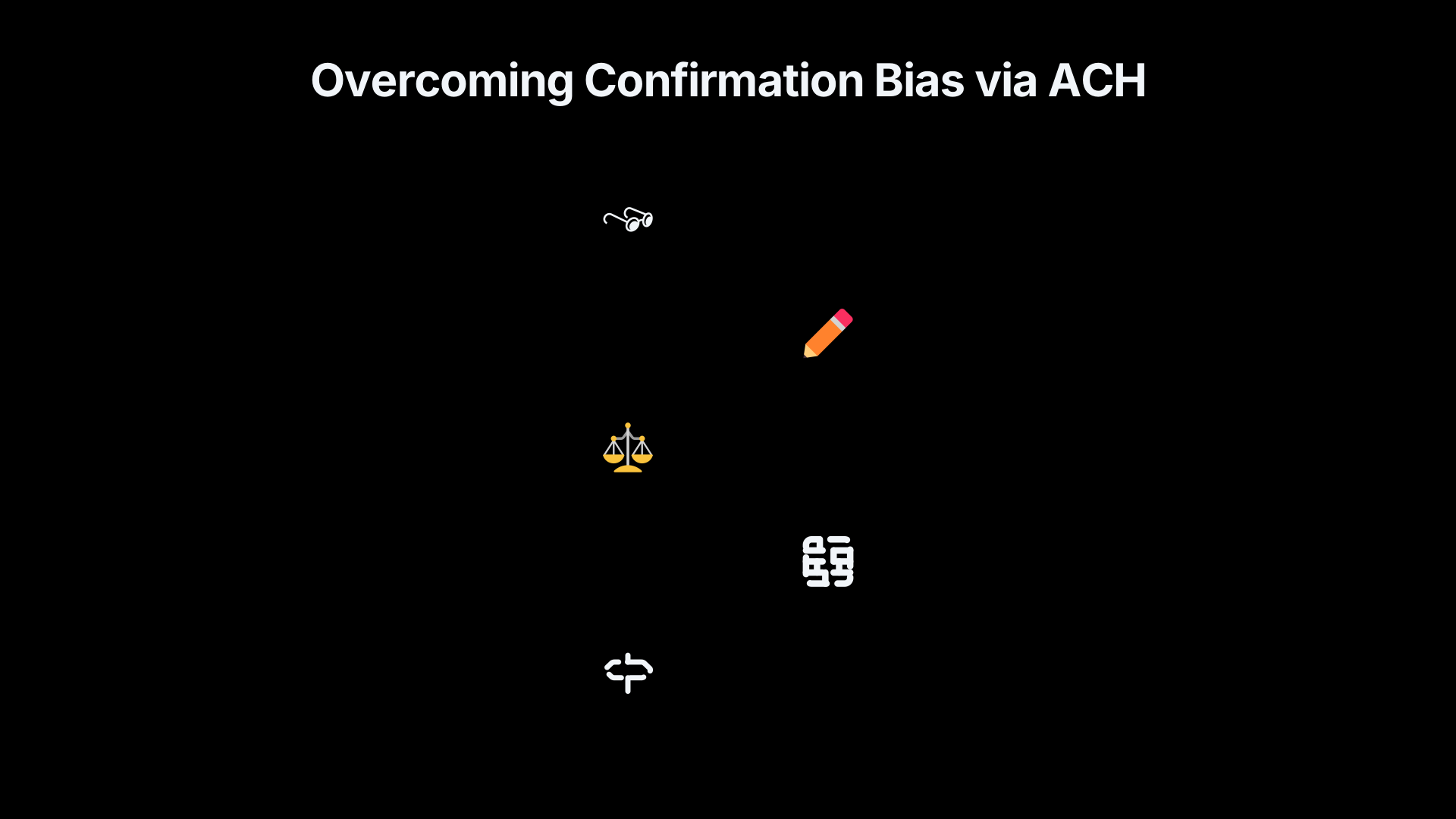
This process usually takes only a few minutes but changes the direction of reasoning. Instead of asking whether your preferred explanation can be defended, you ask whether it has genuinely earned its place after competing against the strongest available alternatives. That simple shift makes everyday decisions more resistant to confirmation bias and more responsive to evidence.
Amazon book picks
Further Reading
Books and field guides related to Could Another Explanation Fit Better?. Use these as the next step if you want deeper reading beyond the article.
How to Think About Weird Things: Critical Thinking for a New Age
Teaches evaluating competing claims.
eBay marketplace picks
Marketplace Samples
Example marketplace items related to this page. Use the search link to explore similar finds on eBay.



Endnotes
1.
Source: ialeia.org
Title: [PDF] The Psychology of Intelligence Analysis
Link:https://www.ialeia.org/docs/Psychology_of_Intelligence_Analysis.pdf
Source snippet
December 13, 2005 — Heuer's concept of “Analysis of Competing Hypotheses” (ACH) is among his most important contributions to the developm...
Published: December 13, 2005
2.
Source: Wikipedia
Title: Confirmation bias
Link:https://en.wikipedia.org/wiki/Confirmation_bias
3.
Source: isc.sans.edu
Link:https://isc.sans.edu/diary/22460
Source snippet
SANS Internet Storm CenterAnalysis of Competing Hypotheses (ACH part 1)28 May 2017 — ACH is an analytic process that identifies a set of...
Published: May 2017
4.
Source: youtube.com
Title: Analysis of Competing Hypotheses (ACH): Finding Plausible Answers
Link:https://www.youtube.com/watch?v=xt4EnzvGA4w
Source snippet
Analysis of Competing Hypotheses...
5.
Source: youtube.com
Title: Analysis of Competing Hypotheses
Link:https://www.youtube.com/watch?v=t6GEvRYMIxs
Source snippet
Intelligence Analysis Skills: Analysis of Competing Hypotheses (Part 1)...
6.
Source: strathprints.strath.ac.uk
Title: Strathprints The “analysis of competing hypotheses” in intelligence analysis
Link:https://strathprints.strath.ac.uk/69049/1/Dhami_etal_ACP_2019_The_analysis_of_competing_hypotheses_in_intelligence.pdf
Source snippet
The “analysis of competing hypotheses” in intelligence analysisJuly 26, 2019 — by MK Dhami · 2019 · Cited by 81 — We examined...
Published: July 26, 2019
Additional References
7.
Source: futuribles.com
Link:https://www.futuribles.com/wp-content/uploads/related-documents/analysis-of-competing-hypotheses.pdf?postId=73706
Source snippet
Analysis of Competing HypothesesAnalysis of Competing Hypotheses (ACH) is an intelligence analysis method based on evaluating plausible a...
8.
Source: sosintel.co.uk
Link:https://sosintel.co.uk/mastering-the-analysis-of-competing-hypotheses-ach-a-practical-framework-for-clear-thinking/
Source snippet
Mastering the Analysis of Competing Hypotheses (ACH)20 Jun 2025 — Psychology of Intelligence Analysis – Richards J. Heuer Jr. The origina...
9.
Source: reddit.com
Link:https://www.reddit.com/r/IsItBullshit/comments/gobt3d/isitbullshit_the_most_probable_hypothesis_is/
Source snippet
IsItBullshit: "The most probable hypothesis is usually...This came from a book (that you can find online as a pdf, by the way) that was...
10.
Source: pherson.org
Link:https://pherson.org/wp-content/uploads/2013/06/06.-How-Does-ACH-Improve-Analysis_FINAL.pdf
Source snippet
This paper identifies three different approaches to Analysis of Competing Hypotheses (ACH) and four major steps in the intelligence analy...
11.
Source: youtube.com
Link:https://www.youtube.com/watch?v=Y-J0FYOQRMY
Source snippet
For a comprehensive breakdown of how this technique functions, watch how Analysis of Competing Hypotheses (ACH): Finding Plausible Answer...
12.
Source: medium.com
Link:https://medium.com/%40ThatThreatGuy/analysis-of-competing-hypotheses-ach-51e9cc02c56c
Source snippet
e alternatives and have them compete against...
13.
Source: youtube.com
Title: CIA Secrets to Thinking Clearly (Psychology of Intelligence Analysis)
Link:https://www.youtube.com/watch?v=qYo1XZzMYLo
Source snippet
Analysis of Competing Hypotheses (ACH): A Structured Analytic Technique (SAT) for FinCrime...
14.
Source: youtube.com
Title: Intelligence Analysis Skills: Analysis of Competing Hypotheses (Part 1)
Link:https://www.youtube.com/watch?v=J_eDCBf7R2I
Source snippet
CIA Secrets to Thinking Clearly (Psychology of Intelligence Analysis)...
15.
Source: pmc.ncbi.nlm.nih.gov
Link:https://pmc.ncbi.nlm.nih.gov/articles/PMC11169332/
Source snippet
It was designed by Heuer (1999, 2005) to overcome some elements of...
Topic Tree