Within Sharper Thinking
What Does Critical Thinking Really Mean?
Critical thinking is purposeful, self-regulated judgment, not just scepticism or having sharper opinions.
On this page
- Judgment not cynicism
- Skills and dispositions
- Explaining the route to conclusions

Page outline Jump by section
Introduction
Critical thinking is best understood as purposeful, self-regulated judgement: the deliberate process of deciding what to believe or what to do by interpreting information, analysing reasons, evaluating evidence, drawing inferences, and explaining how the conclusion was reached. That matters because it separates critical thinking from two common impostors: reflexive cynicism and clever opinion-making. A critical thinker is not simply someone who doubts everything, wins arguments, or spots flaws quickly. The stronger habit is more disciplined: asking what question is being answered, what evidence is available, what assumptions are being made, what alternatives remain plausible, and how confident the conclusion should be. The influential Delphi Report defined critical thinking in exactly this decision-focused way, as “purposeful, self-regulatory judgment” directed towards deciding “what to believe or what to do”.[Insight Assessment]insightassessment.comInsight Assessment The Delphi ReportInsight AssessmentThe Delphi Report - Insight Assessment…
Within improving your thinking and analytical skills, this definition is useful because it makes better thinking visible. It turns “be more critical” into a route: clarify the issue, test the support, compare interpretations, and show why the answer follows. It also makes critical thinking a practice rather than a personality trait. People improve not by becoming permanently suspicious, but by learning when to slow down, how to handle evidence, and how to revise a judgement without treating revision as defeat.
Why judgement, not cynicism, is the centre
The word “critical” often sounds negative in ordinary speech, as though a critical person is mainly fault-finding. In the critical-thinking tradition, however, the root idea is closer to discernment: making reliable judgements from reliable information. Monash University’s student guidance puts the point plainly: applying critical thinking does not mean being negative or focusing on faults; it means clarifying your thinking so that you can break down information, interpret it, and arrive at an informed decision or judgement.[Monash University]monash.eduUniversity What is critical thinking?Monash UniversityWhat is critical thinking? - Student Academic Success…
This distinction is not cosmetic. Cynicism begins with distrust and often ends there. Purposeful judgement begins with a question and moves towards a justified answer. A cynical reader of a health claim, for example, might say, “They are probably lying.” A credulous reader might say, “It sounds scientific, so it is probably true.” A critical thinker asks something more useful: What exactly is being claimed? What kind of evidence would support it? Is the evidence from a controlled study, a personal anecdote, a marketing page, or an expert body? Are there conflicts of interest? How strong should my conclusion be?
That is why critical thinking is not the opposite of trust. It is the discipline of proportioning trust to reasons. Sometimes the critical judgement is “this claim is weak”. Sometimes it is “this claim is well supported”. Sometimes it is “the evidence is incomplete, so the responsible answer is provisional”. The outcome is not always rejection; it may be acceptance, suspension of judgement, a narrower conclusion, or a decision to seek better evidence.
Historically, this emphasis on judgement links modern critical-thinking theory to John Dewey’s older idea of reflective thinking. Dewey described reflective thinking as active, persistent and careful consideration of a belief in light of the grounds supporting it and the further conclusions to which it tends. The Stanford Encyclopedia of Philosophy traces critical thinking as an educational goal through Dewey, later assessment work, Bloom’s taxonomy, and Robert Ennis’s influential definition of critical thinking as reasonable reflective thinking focused on deciding what to believe or do.[Stanford Encyclopedia of Philosophy]plato.stanford.eduEncyclopedia of PhilosophyCritical Thinking (Stanford Encyclopedia of Philosophy)…
The historical pattern is revealing. Critical thinking did not develop mainly as a technique for sounding sceptical. It developed as an educational ideal for judgement under uncertainty: how to think carefully enough that belief and action are answerable to reasons.

The mechanism: deciding what to believe or do
The phrase “purposeful, self-regulatory judgement” contains three important claims.
First, critical thinking is purposeful. It is directed at a task: understanding a text, judging a policy proposal, diagnosing a problem, deciding whether to trust a source, choosing between options, or explaining a conclusion. Without a purpose, “thinking critically” can become endless commentary. With a purpose, it has a standard of success: did the reasoning help answer the question?
Second, it is judgement. Critical thinking does not stop at collecting information. It weighs, compares, and decides. That does not mean rushing to certainty. A good judgement may be tentative, conditional, or limited: “The evidence points this way, but only for this population”; “This explanation is more plausible than the alternatives”; “This is not yet knowable from the available data.” The Delphi Report’s definition connects judgement to interpretation, analysis, evaluation, inference, and explanation, which means the conclusion should be traceable to the work done along the way.[Insight Assessment]insightassessment.comInsight Assessment The Delphi ReportInsight AssessmentThe Delphi Report - Insight Assessment…
Third, it is self-regulatory. The thinker monitors the process rather than merely applying intelligence outward. Self-regulation asks: Am I interpreting the claim fairly? Have I ignored evidence because it is inconvenient? Am I using a double standard? Is my confidence stronger than the evidence? The Stanford Encyclopedia of Philosophy notes that critical thinkers have both abilities and dispositions that lead them to think critically when appropriate, and that the educational goal is not just a one-sentence definition but adoption of criteria and standards for careful thinking.[Stanford Encyclopedia of Philosophy]plato.stanford.eduEncyclopedia of PhilosophyCritical Thinking (Stanford Encyclopedia of Philosophy)…
A practical example makes the mechanism clearer. Suppose a manager hears that remote workers are “less productive”. A non-critical response might accept or reject the claim based on preference. Purposeful judgement would separate the issue into parts:
- What does “productive” mean here: output, availability, quality, collaboration, speed, profit, customer satisfaction?
- What comparison is being made: the same workers before and after remote work, different teams, or industry averages?
- What evidence is available: measured outcomes, impressions, surveillance metrics, missed deadlines, or isolated complaints?
- What alternative explanations exist: unclear goals, poor management, weak tools, meeting overload, selection effects?
- What decision follows: change policy, improve measurement, run a trial, or withhold judgement?
The point is not to make the issue complicated for its own sake. It is to prevent the conclusion from arriving before the reasoning.
Skills and dispositions must work together
Critical thinking has a skill side and a character side. The skill side includes clarifying meanings, identifying arguments, analysing assumptions, evaluating evidence, making inferences, and explaining conclusions. The disposition side is the willingness to use those skills when they are inconvenient, effortful, socially awkward, or personally threatening.
The Delphi Report’s expert consensus described the ideal critical thinker as inquisitive, well-informed, trustful of reason, open-minded, flexible, fair-minded in evaluation, honest about personal biases, prudent in judgement, willing to reconsider, clear about issues, orderly in complex matters, diligent in seeking relevant information, and persistent in seeking results as precise as the situation permits.[Insight Assessment]insightassessment.comInsight Assessment The Delphi ReportInsight AssessmentThe Delphi Report - Insight Assessment…
This is why someone can be verbally sharp yet not especially critical in the deeper sense. A person may be good at finding weaknesses in opponents’ arguments while ignoring weaknesses in their own. They may know the names of fallacies but use them as weapons rather than checks on reasoning. They may demand rigorous evidence from views they dislike and accept thin evidence for views they already hold. Purposeful judgement requires intellectual fairness, not just intellectual agility.
Research on critical-thinking dispositions has tried to make this willingness more explicit. Work associated with the California Critical Thinking Disposition Inventory identified seven positive dispositions: truth-seeking, open-mindedness, analyticity, systematicity, critical-thinking self-confidence, inquisitiveness, and maturity of judgement. The same work describes negative counterparts such as intellectual dishonesty in the use of data, intolerance of opposing ideas, haphazard procedure, mistrust of reason, indifference to new findings, and simplistic judgement.[Insight Assessment]insightassessment.comInsight Assessment Documents\CT&Cap_Docs\J_Infrml_Ppr.PD FInsight Assessment Documents\CT&Cap_Docs\J_Infrml_Ppr.PD F
Those dispositions matter because the hard part of critical thinking is often not knowing the rule. It is applying the rule when it costs something. Truth-seeking matters when the best evidence undermines your first view. Open-mindedness matters when an opposing argument is stronger than expected. Systematicity matters when a problem is boring but consequential. Maturity of judgement matters when the evidence is mixed and the answer must remain qualified.
Explaining the route to conclusions
One of the clearest signs of purposeful judgement is that the thinker can explain the route from question to conclusion. This is more demanding than stating an answer. It means showing the relationship between claim, evidence, assumptions, method, context, and degree of confidence.
The Delphi Report includes “explanation” as part of critical thinking: a critical judgement should be able to state the evidential, conceptual, methodological, criteriological, or contextual considerations on which it is based.[Insight Assessment]insightassessment.comInsight Assessment The Delphi ReportInsight AssessmentThe Delphi Report - Insight Assessment… In plain terms, this means a good thinker should be able to answer questions such as:
- What evidence supports this conclusion?
- What standard are you using to judge it?
- What assumption connects the evidence to the claim?
- What would count against your conclusion?
- Why is this conclusion stronger than the alternatives?
- How certain should we be?
This is where critical thinking becomes teachable and reviewable. If reasoning stays hidden, it is hard to improve. Once the route is visible, others can test it, and the thinker can test it too.
Argument mapping is one practical way to make the route visible. It represents claims, reasons, objections, and assumptions so that the structure of an argument can be inspected rather than merely felt. In a well-known paper on argument maps, Charles Twardy describes how mapping helped reveal a common confusion: students sometimes treated an explanation of facts as though it were evidence for the facts. By laying out the structure, the mistake became easier to see and correct.[University of Southampton Web Archive]web-archive.southampton.ac.ukUniversity of Southampton Web Archive
That example captures the value of explanation. Critical thinking is not just asking “Do I agree?” It is asking “What role is this statement playing?” A statistic may be evidence. A theory may be an explanation. A value may be a criterion. A background assumption may be doing hidden work. Once these roles are separated, judgement improves because the thinker is no longer treating every sentence as the same kind of support.
What purposeful judgement looks like in practice
Purposeful judgement can be used in everyday life without turning every decision into a formal essay. The mechanism is scalable: the more important, uncertain, costly, or contested the issue, the more explicit the reasoning should become.
For a low-stakes decision, critical thinking may be a quick pause: “What am I assuming?” For a high-stakes decision, it may require a structured comparison of evidence, alternatives, risks, and unknowns. The key is not slowness for its own sake, but appropriate control.
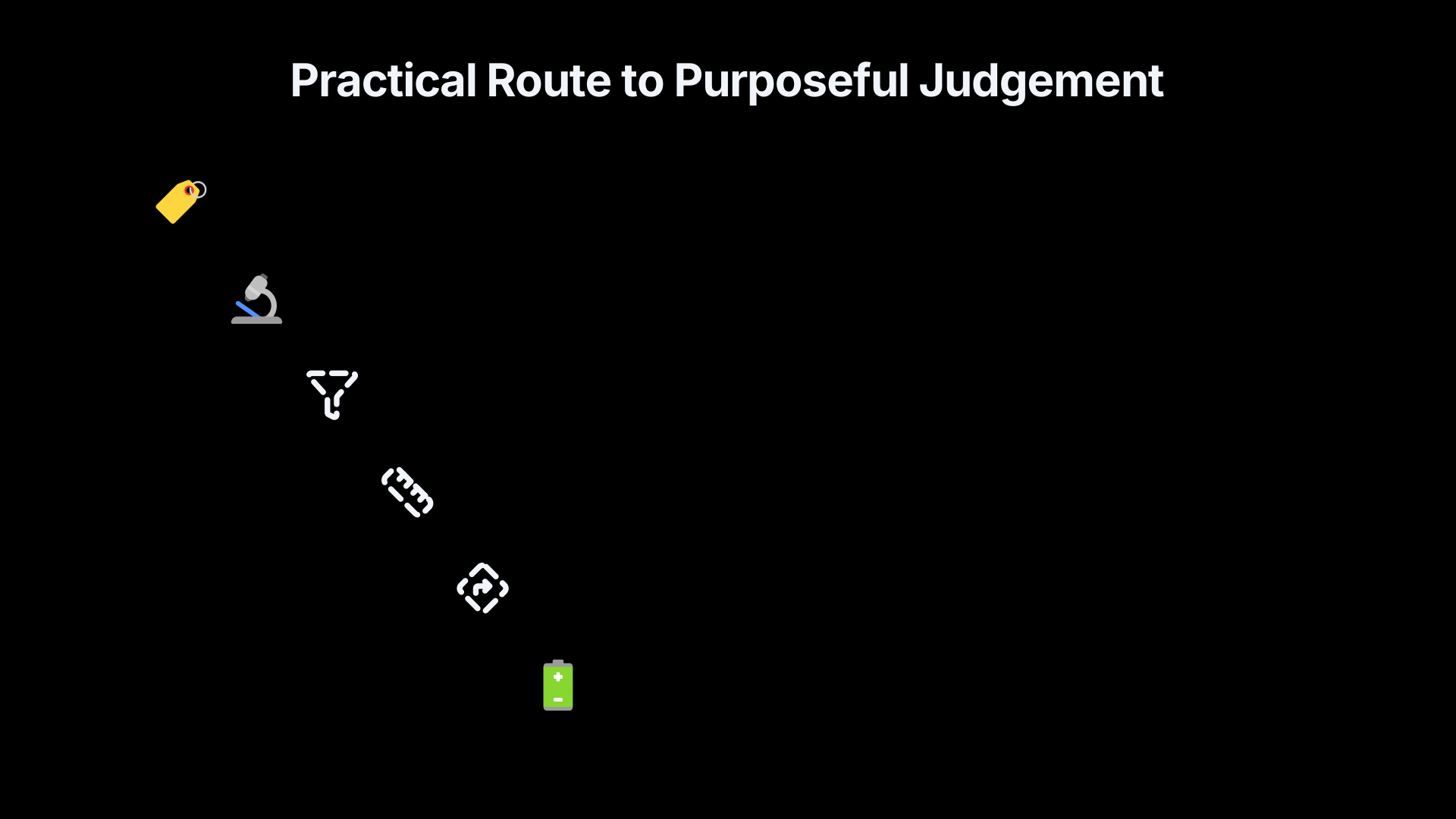
A useful everyday pattern is:
- Name the judgement. Decide whether the task is to believe a claim, choose an action, explain a cause, evaluate a source, or compare options.
- Clarify the claim. Replace vague language with specific terms. “This policy works” might mean it reduces costs, improves outcomes, or satisfies stakeholders.
- Separate evidence from interpretation. Identify what is observed, what is inferred, and what is assumed.
- Check the standard. Ask what would count as good enough evidence for this type of claim.
- Consider alternatives. Look for rival explanations, not just objections.
- State the confidence level. Avoid pretending that every conclusion is certain or that uncertainty means knowing nothing.
- Review the route. Explain why the conclusion follows, and what would change it.
This sequence is not a rigid formula. It is a way to prevent common failures: accepting claims because they are fluent, rejecting claims because they are unfamiliar, confusing confidence with evidence, or treating a first explanation as the only explanation.
Educational evidence supports the idea that critical thinking improves when learners practise these moves explicitly rather than merely being told to “think harder”. A 2015 meta-analysis in the Review of Educational Research, summarised by ERIC, reviewed 341 effect sizes from quasi-experimental and true-experimental studies using standardised critical-thinking outcomes. It found a positive overall effect and reported that dialogue, authentic or situated problems, examples, and mentoring were associated with gains in critical-thinking skills.[ERIC]eric.ed.govEJ1061695 - Strategies for Teaching Students to Think Critically: A Meta-Analysis, Review of Educational Research, 2015-Jun…
That finding fits the mechanism. Purposeful judgement is not strengthened mainly by memorising definitions. It grows when people reason about real problems, expose their reasoning to questions, receive feedback, and try again.
The historical shift from formal logic to reflective judgement
A historical comparison helps explain why purposeful judgement became such an important definition. Earlier approaches to better thinking often emphasised logic, argument validity, or detecting faulty statements. Those remain valuable, but they do not cover the whole problem of judgement in real life. Many everyday decisions involve incomplete evidence, unclear definitions, disputed values, uncertain probabilities, and changing contexts.
The Stanford Encyclopedia of Philosophy notes that definitions of critical thinking are contested but can be understood as different conceptions of “careful thinking directed to a goal”. It also records controversies over whether critical thinking is generalisable across domains, whether theories and teaching methods contain bias, and how critical thinking relates to problem-solving, decision-making, and creative thinking.[Stanford Encyclopedia of Philosophy]plato.stanford.eduEncyclopedia of PhilosophyCritical Thinking (Stanford Encyclopedia of Philosophy)…
The purposeful-judgement model responds to that complexity by widening the focus. It does not abandon logic, but it treats logic as one part of a larger act of judgement. In practice, a person may need to interpret language, assess credibility, understand context, evaluate methods, notice uncertainty, and explain a conclusion in terms that others can inspect. This is why the Delphi definition includes evidential, conceptual, methodological, criteriological, and contextual considerations.[Insight Assessment]insightassessment.comInsight Assessment The Delphi ReportInsight AssessmentThe Delphi Report - Insight Assessment…
The comparison also shows why “critical thinking” should not be reduced to generic cleverness. A person can reason well in one domain and poorly in another if they lack relevant background knowledge. A statistician may assess a poll better than a novice; a mechanic may diagnose an engine fault better than a skilled philosopher; a doctor may read a clinical guideline better than a general reader. Purposeful judgement therefore combines transferable habits with domain knowledge. The transferable habit is asking disciplined questions; the domain knowledge helps you know which questions matter.
How to avoid the common traps
The most common failure is not lack of intelligence. It is misdirected judgement. People often use reasoning to defend a preferred answer rather than to test whether that answer should be held.
One trap is performative scepticism. This looks like critical thinking because it questions claims, but it questions unevenly. It is severe towards disliked claims and generous towards favoured ones. The cure is symmetry: ask the same evidential questions of your own side that you ask of others.
A second trap is premature closure. This happens when the first plausible explanation becomes the final explanation. Purposeful judgement keeps alternatives alive long enough to compare them. It does not demand endless doubt, but it resists stopping merely because an answer feels satisfying.
A third trap is evidence-role confusion. Twardy’s argument-mapping example shows how learners can confuse explanations with reasons for belief. In everyday settings, the same confusion appears when someone treats a story, analogy, expert impression, correlation, or model as if it provides stronger support than it actually does. Mapping or outlining the argument helps because it forces the question: what is this piece of information doing?[University of Southampton Web Archive]web-archive.southampton.ac.ukUniversity of Southampton Web Archive
A fourth trap is skill without disposition. People may know how to analyse an argument but avoid doing so when the conclusion threatens identity, status, convenience, or group loyalty. Facione and colleagues argue that teaching for thinking must nurture truth-seeking, open-mindedness, systematicity, intellectual curiosity, confidence in the proper use of reasons and evidence, and maturity of judgement, not only the skills of interpretation, analysis, inference, explanation, and evaluation.[Insight Assessment]insightassessment.comInsight Assessment Documents\CT&Cap_Docs\J_Infrml_Ppr.PD FInsight Assessment Documents\CT&Cap_Docs\J_Infrml_Ppr.PD F
A fifth trap is over-formalising every decision. Purposeful judgement does not mean treating daily life as a courtroom. It means matching the level of scrutiny to the stakes. A casual preference does not need a literature review. A medical decision, legal claim, public accusation, financial commitment, or major career move deserves a much clearer route from evidence to conclusion.
The practical payoff: better reasons, better revision
Purposeful judgement improves analytical skill because it changes the standard for a good answer. The standard is no longer “Can I defend this?” or “Does this sound smart?” It becomes “Can I show, fairly and proportionately, why this conclusion follows from the best available reasons?”
That standard has two practical payoffs. First, it makes reasoning communicable. Other people can see where they agree, where they disagree, and what evidence would matter. This is especially important in teams, classrooms, public debate, and professional decisions, where hidden reasoning easily becomes conflict over personalities.
Second, it makes revision easier. If a conclusion is tied to a visible route, then new evidence can change the route without humiliating the thinker. A person can say, “I believed this because of A and B; now C weakens B, so I should reduce my confidence.” That is not inconsistency. It is self-regulated judgement working as intended.
The strongest critical thinkers are therefore not the people who never change their minds. They are the people whose changes of mind have reasons. They can explain why they accepted a claim, why they rejected one, why they suspended judgement, and why a later revision was warranted. In that sense, critical thinking is less like having sharper opinions and more like maintaining a reliable intellectual audit trail: a clear account of how a question became a conclusion, and how that conclusion remains open to better evidence.
Amazon book picks
Further Reading
Books and field guides related to What Does Critical Thinking Really Mean?. Use these as the next step if you want deeper reading beyond the article.
The Demon-Haunted World
Rating: 4.5/5 from 43 Google Books ratings
Promotes evidence-based reasoning over cynicism.
eBay marketplace picks
Marketplace Samples
Example marketplace items related to this page. Use the search link to explore similar finds on eBay.



Endnotes
1.
Source: monash.edu
Title: University What is critical thinking?
Link:https://www.monash.edu/student-academic-success/sharpen-your-thinking/critical-thinking/what-is-critical-thinking
Source snippet
Monash UniversityWhat is critical thinking? - Student Academic Success...
2.
Source: plato.stanford.edu
Title: Encyclopedia of Philosophy
Link:https://plato.stanford.edu/entries/critical-thinking/
Source snippet
Critical Thinking (Stanford Encyclopedia of Philosophy)...
3.
Source: web-archive.southampton.ac.uk
Title: University of Southampton Web Archive
Link:https://web-archive.southampton.ac.uk/cogprints.org/3008/1/reasonpaper.pdf
4.
Source: plato.stanford.edu
Link:https://plato.stanford.edu/entries/critical-thinking/history.html
5.
Source: plato.stanford.edu
Link:https://plato.stanford.edu/archives/fall2025/entries/critical-thinking/history.html
6.
Source: reasons.io
Title: Critical Thinking with Argument Maps
Link:https://reasons.io/learn/01
7.
Source: insightassessment.com
Title: Insight Assessment The Delphi Report
Link:https://insightassessment.com/iaresource/the-delphi-report-a-statement-of-expert-consensus-on-the-definition-of-critical-thinking/
Source snippet
Insight AssessmentThe Delphi Report - Insight Assessment...
8.
Source: insightassessment.com
Title: Insight Assessment Documents\CT&Cap_Docs\J_Infrml_Ppr.PD F
Link:https://www.insightassessment.com/var/ezflow_site/storage/pdf/J_Infrml_Ppr%2B_2000%2B-%2BDisp%2B%26%2BSkls.pdf
9.
Source: eric.ed.gov
Link:https://eric.ed.gov/?id=EJ1061695
Source snippet
EJ1061695 - Strategies for Teaching Students to Think Critically: A Meta-Analysis, Review of Educational Research, 2015-Jun...
10.
Source: facebook.com
Link:https://www.facebook.com/Criticalnz/
11.
Source: Wikipedia
Title: Critical thinking
Link:https://en.wikipedia.org/wiki/Critical_thinking
12.
Source: insightassessment.com
Link:https://www.insightassessment.com/var/ezflow_site/storage/pdf/Exernalizing%2BCT_%2BNsg%2BOtlk%2B1996.pdf
13.
Source: dictionary.cambridge.org
Link:https://dictionary.cambridge.org/dictionary/english/critical
14.
Source: youtube.com
Link:https://www.youtube.com/critical
15.
Source: 1000wordphilosophy.com
Title: critical thinking
Link:https://1000wordphilosophy.com/2021/09/28/critical-thinking/
16.
Source: teachingchannel.com
Title: argument mapping
Link:https://www.teachingchannel.com/k12-hub/blog/argument-mapping/
17.
Source: britannica.com
Title: Critical thinking | Definition, History, Criticism, & Skills
Link:https://www.britannica.com/topic/critical-thinking
Additional References
18.
Source: youtube.com
Title: Importance of Critical Thinking Today – Peter Facione, Ph.D
Link:https://www.youtube.com/watch?v=M2_Qww77EOY
Source snippet
Peter Facione - The educational power of measuring Critical Thinking...
19.
Source: reddit.com
Link:https://www.reddit.com/r/philosophy/comments/18jp6ze/critical_thinking_skills_mistaking_arbitrary/
20.
Source: academia.edu
Link:https://www.academia.edu/57634390/Profiling_critical_thinking_dispositions
21.
Source: researchgate.net
Link:https://www.researchgate.net/publication/241897896_The_Disposition_Toward_Critical_Thinking_1
22.
Source: researchgate.net
Link:https://www.researchgate.net/publication/242279575_Critical_Thinking_A_Statement_of_Expert_Consensus_for_Purposes_of_Educational_Assessment_and_Instruction
23.
Source: researchgate.net
Link:https://www.researchgate.net/publication/252896581_The_Disposition_Toward_Critical_Thinking_Its_Character_Measurement_and_Relationship_to_Critical_Thinking_Skill
24.
Source: researchgate.net
Link:https://www.researchgate.net/publication/285707436_Improving_critical_thinking_using_web_based_argument_mapping_exercises_with_automated_feedback
25.
Source: scirp.org
Link:https://www.scirp.org/reference/referencespapers?referenceid=2778998
26.
Source: aft.org
Link:https://www.aft.org/ae/fall2020/willingham
27.
Source: merriam-webster.com
Link:https://www.merriam-webster.com/dictionary/critical
Topic Tree