Within Change Mind
How Review Triggers Make Changing Course Easier
Predefined review triggers help teams revisit decisions without treating every setback as a crisis.
On this page
- Choosing meaningful metrics
- Setting thresholds and time windows
- Assigning review actions and owners
Page outline Jump by section
Introduction
A decision review trigger is a pre-agreed rule that specifies when a decision must be revisited and what kind of evidence could justify changing course. Within the broader practice of asking “What would change my mind?”, review triggers turn an abstract commitment to open-mindedness into an operational governance process. Rather than waiting until a project has clearly failed—or reacting to every temporary setback—they create predictable moments for reassessment based on evidence instead of emotion.
 This matters because people and organisations often become trapped by previous investments of time, money, effort or reputation. Research on escalation of commitment shows that decision-makers frequently continue supporting a struggling course of action even after receiving negative feedback, partly because abandoning it feels like admitting failure rather than making a better forward-looking decision.[PMC+2Project Management Institute]pmc.ncbi.nlm.nih.govA New Inaction-Effect Perspective on the Sunk-Cost Fallacyby G Feldman · 2018 · Cited by 66 — Escalation-of-commitment situations invo…
How review triggers reduce commitment traps
The central purpose of a review trigger is to separate evaluating the original decision from evaluating today’s best option.
Without predefined triggers, reviews often happen only when someone becomes concerned enough to challenge the existing plan. By then, discussions can become personal. Team members may defend earlier decisions because they made them, because others expect consistency, or because substantial resources have already been invested.
A review trigger changes the conversation. Instead of asking:
“Should we admit we were wrong?”
the agreed question becomes:
“Has the agreed review condition been met?”
This shift reduces self-justification and makes changing course appear as following the process rather than abandoning a commitment. Organisational research has repeatedly found that external oversight and separating initial decisions from later review decisions can reduce escalation of commitment because they weaken personal ownership of the original choice.[Northwestern Psychology]psychology.northwestern.eduPsychology Promoting De-Escalation of Commitment: A RegulatoryNorthwestern PsychologyPromoting De-Escalation of Commitment: A Regulatory-…January 5, 2011 — by DC Molden · 2011 · Cited by 117 — Sol…
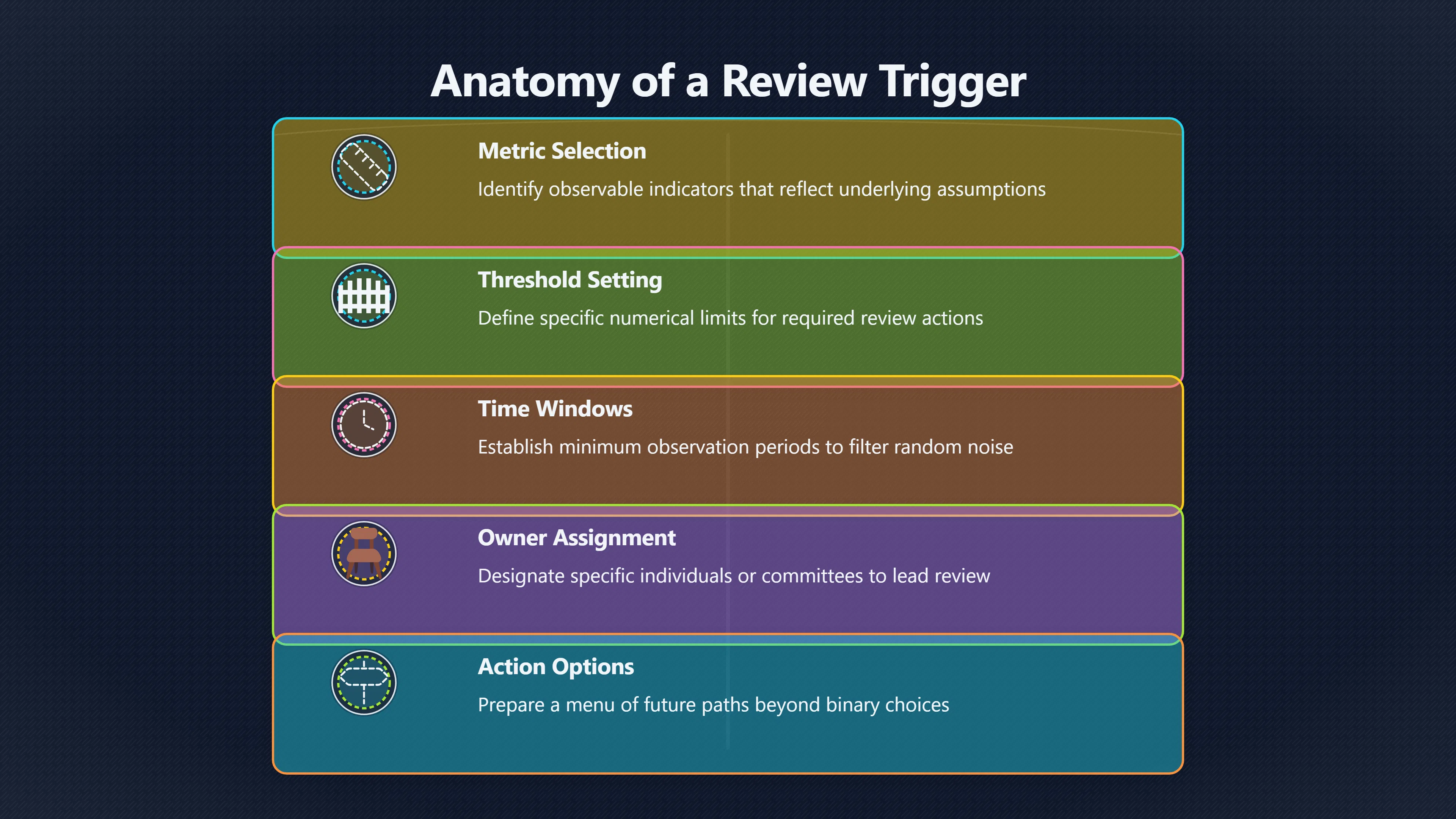
Choosing meaningful metrics
Review triggers are only useful if they rely on measures that genuinely reflect whether the underlying assumptions remain true.
Good review metrics have three characteristics:
- They relate directly to the decision’s expected outcomes.
- They are observable rather than subjective.
- They can deteriorate before complete failure becomes obvious.
For example, a team launching a new software feature might agree in advance to review the rollout if:
- weekly active usage remains below an agreed target;
- customer support requests exceed a defined level;
- critical defects remain unresolved beyond a specified period; or
- infrastructure costs exceed expected limits without corresponding user growth.
The important feature is that these indicators were chosen before knowing whether the decision would succeed. That reduces the temptation to redefine success after disappointing results.
Poor review metrics often measure effort rather than progress. Statements such as “the team is working hard” or “we’ve already invested six months” describe commitment, not evidence that continuing is worthwhile.
Setting thresholds and time windows
A useful trigger combines what will be measured with how much change is sufficient to require a review and when that judgement will be made.
Thresholds prevent constant second-guessing while avoiding indefinite persistence.
Examples include:
- customer retention falls below 80% for two consecutive months;
- project costs exceed the approved budget by 15%;
- recruitment targets remain unmet after one quarter;
- a policy fails to achieve its minimum outcome by the first annual evaluation.
Time windows are equally important.
Reviewing too early may mistake normal variation for failure. Waiting too long increases the risk of additional sunk costs. Different decisions naturally require different review periods:
- operational experiments may justify weekly reviews;
- product launches may need monthly or quarterly reviews;
- strategic investments often require milestone-based reviews rather than continuous reconsideration.
Combining thresholds with minimum observation periods helps distinguish genuine trends from random fluctuations. Instead of reacting to one disappointing week, the organisation asks whether performance has crossed the agreed boundary over the agreed period.
Assigning review actions and owners
A trigger should specify not only when a review occurs but also who conducts it and what happens next.
Without predefined ownership, review meetings are easily postponed or become exercises in defending existing plans.
A practical governance rule normally specifies:
- the individual or committee responsible for initiating the review;
- the evidence to be gathered before discussion;
- who has authority to recommend continuation, modification or termination;
- whether additional approval is needed before significant new resources are committed.
Many organisations deliberately separate implementation from review. The people responsible for delivering a project possess valuable operational knowledge, but an independent reviewer or steering group may be less vulnerable to self-justification because their own reputation is less closely tied to the original decision. Research on de-escalation strategies consistently identifies independent oversight and divided responsibility as mechanisms that reduce commitment bias.[Northwestern Psychology]psychology.northwestern.eduPsychology Promoting De-Escalation of Commitment: A RegulatoryNorthwestern PsychologyPromoting De-Escalation of Commitment: A Regulatory-…January 5, 2011 — by DC Molden · 2011 · Cited by 117 — Sol…
Reviews should create options, not only binary choices
One misconception is that crossing a review threshold means a project automatically stops.
More often, the review creates a structured choice among several future actions, for example:
- continue unchanged because assumptions still hold;
- continue with revised scope;
- pause while key uncertainties are resolved;
- conduct another limited experiment;
- terminate the initiative and redirect resources.
This keeps the review focused on future expected value rather than on judging past decisions. The objective is not to prove that someone was wrong but to determine which option now offers the strongest evidence-supported path forward.
Common design mistakes
Even well-intentioned review systems can fail if the triggers are poorly designed.
Frequent problems include:
- Vague triggers. “Review if things are not going well” leaves too much room for interpretation.
- Moving thresholds. Lowering standards after disappointing results removes the discipline that review triggers are intended to create.
- Too many indicators. Excessive metrics allow decision-makers to ignore the few that genuinely matter.
- Ignoring opportunity costs. Reviews should ask not only whether the current project can still succeed, but whether available alternatives now offer greater expected value.
- Treating reviews as blame sessions. If every review becomes an investigation into personal responsibility, people become less willing to surface negative information early.
Research on escalation of commitment suggests that reputational concerns can themselves encourage persistence. People may continue with weak decisions because consistency is interpreted as trustworthiness or reliability. Effective governance therefore makes evidence-based revision appear as responsible decision-making rather than personal failure.[CHARLES DORISON]charlesdorison.comCHARLES DORISONJournal of Experimental Psychology: Generalby CA Dorison · 2021 · Cited by 37 — Escalation of commitment—the tendency to r…
Making “What would change my mind?” operational
The question “What would change my mind?” becomes substantially more powerful when paired with formal review triggers.
Instead of relying on memory or good intentions, the decision-maker specifies in advance:
- which assumptions are most important;
- which metrics indicate those assumptions remain valid;
- what thresholds require reconsideration;
- when reviews occur;
- who conducts them; and
- which actions are available after review.
This transforms intellectual openness into a repeatable governance practice. Review triggers preserve consistency by preventing constant reversals, while also preventing consistency from becoming an excuse for remaining committed to decisions that no longer fit the evidence.
eBay marketplace picks
Marketplace Samples
Live-tested eBay searches with available results related to this page.




Endnotes
1.
Source: psychology.northwestern.edu
Title: Psychology Promoting De-Escalation of Commitment: A Regulatory
Link:https://psychology.northwestern.edu/documents/faculty-publications/molden-%20hui_2011.pdf
Source snippet
Northwestern PsychologyPromoting De-Escalation of Commitment: A Regulatory-...January 5, 2011 — by DC Molden · 2011 · Cited by 117 — Sol...
Published: January 5, 2011
2.
Source: charlesdorison.com
Link:https://www.charlesdorison.com/uploads/1/2/4/4/124452321/dorisonumphreslerner2021.pdf
Source snippet
CHARLES DORISONJournal of Experimental Psychology: Generalby CA Dorison · 2021 · Cited by 37 — Escalation of commitment—the tendency to r...
3.
Source: pmc.ncbi.nlm.nih.gov
Link:https://pmc.ncbi.nlm.nih.gov/articles/PMC9354500/
Source snippet
the course: Decision makers who escalate...by CA Dorison · 2021 · Cited by 37 — Decision makers who escalated commitment were perceived...
4.
Source: pmc.ncbi.nlm.nih.gov
Link:https://pmc.ncbi.nlm.nih.gov/articles/PMC5904751/
Source snippet
A New Inaction-Effect Perspective on the Sunk-Cost Fallacyby G Feldman · 2018 · Cited by 66 — Escalation-of-commitment situations invo...
5.
Source: pmi.org
Title: psychology project termination decision maker 5914
Link:https://www.pmi.org/learning/library/psychology-project-termination-decision-maker-5914
Source snippet
Project Management InstituteThe psychology of project termination28 Oct 2013 — This paper presents recent research on the topic of escala...
6.
Source: Wikipedia
Title: Escalation of commitment
Link:https://en.wikipedia.org/wiki/Escalation_of_commitment
Additional References
7.
Source: researchgate.net
Link:https://www.researchgate.net/publication/49635118_Promoting_De-Escalation_of_Commitment_A_Regulatory-Focus_Perspective_on_Sunk_Costs
Source snippet
(PDF) Promoting De-Escalation of CommitmentPeople frequently escalate their commitment to failing endeavors. Explanations for such behavi...
8.
Source: db.arabpsychology.com
Link:https://db.arabpsychology.com/escalation-of-commitment-2/
Source snippet
Cost Fallacy: Escalation of Commitment ExplainedThe core mechanism driving this escalation is the powerful human need for self-justification...
9.
Source: semanticscholar.org
Link:https://www.semanticscholar.org/paper/Escalation-of-Commitment%3A-The-Effects-of-Magnitude-Buxton-Rivers/843c7602573e40559973e25abc8edb1375557430
Source snippet
calation of commitment, occurs in many aspects of business and government...
10.
Source: thedecisionlab.com
Link:https://thedecisionlab.com/biases/commitment-bias
Source snippet
ommitted to our past behaviors...
11.
Source: youtube.com
Title: The Tool That Stops You From Holding Losers Too Long | Annie Duke
Link:https://www.youtube.com/watch?v=Nu9qgbRm6bs
Source snippet
Sunk Cost Fallacy: Not Knowing When It's Time to Stop...
12.
Source: youtube.com
Title: Sunk Cost Fallacy: Not Knowing When It’s Time to Stop
Link:https://www.youtube.com/watch?v=jJajz9n9Oi4
Source snippet
What is the Escalation of Commitment? | Psychology Facts...
13.
Source: youtube.com
Title: What is the Escalation of Commitment? | Psychology Facts
Link:https://www.youtube.com/watch?v=xBLQfDtKk7o
Source snippet
What are Sunk Costs? (Easy Explanation)...
14.
Source: youtube.com
Title: What are Sunk Costs? (Easy Explanation)
Link:https://www.youtube.com/watch?v=q4ZOY5fI-e8
Source snippet
08 Annie Duke on “Kill Criteria”...
15.
Source: youtube.com
Title: 08 Annie Duke on “Kill Criteria”
Link:https://www.youtube.com/watch?v=INLGGEEYw3M
Topic Tree
Follow this branch
Parent topic
Change Mind What Evidence Would Change Your Mind?Related pages 5
- Confidence Updates Why Changing Your Mind Can Mean Changing Your Confidence
- Disconfirming Evidence Why Contradictory Evidence Is More Useful Than More Proof
- Premortems Can a Premortem Reveal When You Should Reconsider?
- Revision Rules What Would Actually Make You Change Your Mind?
- Wason 2 4 6 What the 2 4 6 Experiment Teaches About Better Decisions