Within Claims
Do Late Replies Really Show Disrespect?
Late messages may feel personal, but the argument from delay to disrespect depends on assumptions about intent, norms, and context.
On this page
- The claim hidden inside the complaint
- Alternative explanations for the same evidence
- How to test intent without overreading
Page outline Jump by section
Introduction
A late reply can feel like evidence of something important. Many people move quickly from “they took eight hours to answer” to “they do not care”, “they are ignoring me”, or “they do not respect me”. Yet the observation and the conclusion are not the same thing. The gap between them is filled by assumptions about intent, priorities, social norms, and the relationship itself.
 For anyone trying to improve their thinking and analytical skills, late replies provide a useful everyday example of how people often convert ambiguous evidence into confident claims. The delay is real. The meaning of the delay is usually much less certain. Research on attribution, communication expectations, and digital messaging suggests that people frequently overestimate what response times reveal about another person’s character or feelings while underestimating situational explanations.[Psychology Today+2Psych Safety]psychologytoday.comattribution theory and why your relationships hinge on itPsychology TodayAttribution Theory—And Why Your Relationships Hinge on ItMar 17, 2024 — The fundamental attribution error (FAE) describes…
The Claim Hidden Inside the Complaint
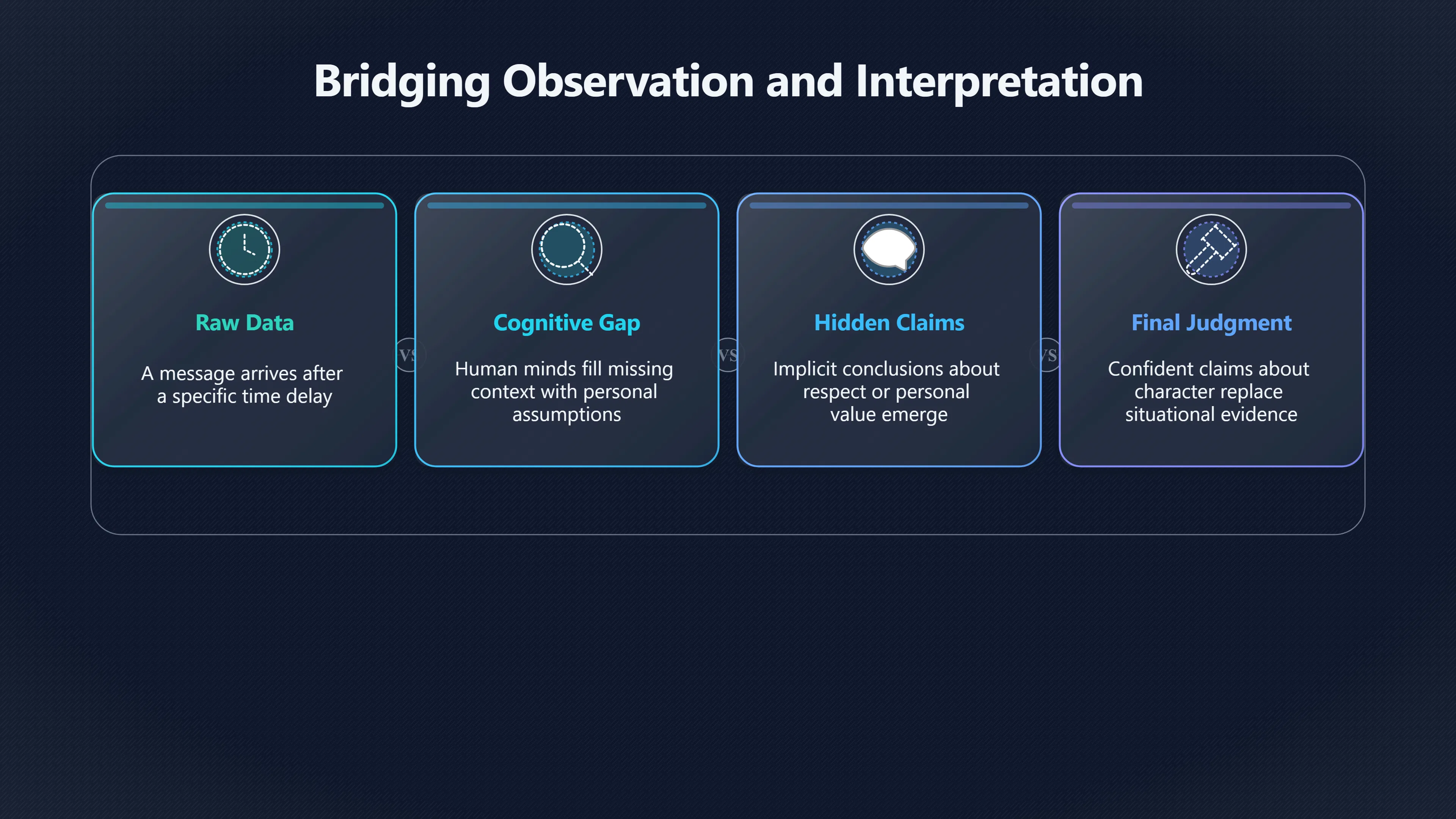
When someone says, “You always reply late,” they may appear to be describing a fact. In many cases, however, the complaint contains a second, hidden claim:
- Observation: You replied late.
- Hidden conclusion: You do not value me, respect me, or care enough.
The reasoning often remains unstated because the emotional conclusion feels obvious to the person making it. Yet analytically, several assumptions must be true before the conclusion follows:
- The person saw the message promptly.
- They were free to respond.
- They understood a quick reply was expected.
- They chose not to respond.
- That choice reflected their feelings toward the sender.
Each step adds uncertainty. A delay may support the conclusion, but it does not prove it.
This pattern reflects a well-studied cognitive tendency known as the fundamental attribution error: people often explain others’ behaviour in terms of personality, character, or intentions while overlooking situational factors. In relationships, this can transform a delayed message into evidence of disrespect when the actual cause may be workload, distraction, stress, competing obligations, or different communication habits. textbooks.whatcom.edu+3Psychology Today+3Psych Safety[psychologytoday.com]psychologytoday.comattribution theory and why your relationships hinge on itPsychology TodayAttribution Theory—And Why Your Relationships Hinge on ItMar 17, 2024 — The fundamental attribution error (FAE) describes…
A useful comparison highlights the asymmetry. If you reply late, you may think, “I was busy.” If someone else replies late, you may think, “They do not care.” The same behaviour receives different explanations depending on who performed it.
Why Delays Feel More Meaningful Than They Often Are
Text messaging creates conditions that encourage overinterpretation.
Unlike face-to-face conversation, messaging removes tone of voice, facial expressions, and immediate context. The recipient often sees only one piece of evidence: elapsed time. Humans naturally try to fill in missing information, and negative interpretations can emerge surprisingly quickly. Research on hostile attribution bias shows that people sometimes infer hostile intent from ambiguous behaviour even when the evidence is unclear.[Taylor & Francis Online]tandfonline.comOpen source on tandfonline.com.
Modern communication also creates expectations that did not exist in earlier forms of contact. Because messages arrive instantly, many people assume responses should be nearly instant as well. Yet studies of romantic and developing relationships show that expectations about messaging speed vary considerably between individuals and couples. What one person sees as normal may seem dismissive to another.[thejsms.org+2Psychology Today]thejsms.orgWhat to expect when you are textingby C Guest · 2024 — This study qualitatively investigates expectations of direct mobile messaging (via…
This mismatch creates a common analytical mistake: treating a personal expectation as a universal rule.
For example:
- Person A believes replies within an hour are normal.
- Person B sees texting as asynchronous and replies when convenient.
- Person A interprets delays as disrespect.
- Person B experiences no disrespectful intention at all.
The evidence is identical. The interpretations differ because the underlying assumptions differ.
Alternative Explanations for the Same Evidence
A delayed reply can be consistent with many explanations at once. Good reasoning requires considering more than the first explanation that comes to mind.
Imagine a message answered six hours later. Possible explanations include:
- The recipient was working or studying.
- They read the message and intended to reply later.
- They were mentally exhausted.
- They wanted to give a thoughtful response.
- They were handling family obligations.
- They have different texting habits.
- They were intentionally avoiding the conversation.
- They were losing interest in the relationship.
Notice that only some of these explanations involve disrespect.
This does not mean disrespect is impossible. It means the evidence alone rarely identifies which explanation is correct.
Research on messaging behaviour reinforces this point. Studies have found that communication frequency and responsiveness can relate to relationship satisfaction, but the meaning of messaging behaviour depends heavily on context, expectations, and the nature of the relationship rather than on a simple rule that “slow replies equal low interest”.[Verywell Mind+3PMC+3PubMed]pmc.ncbi.nlm.nih.govPMCLong-distance texting: Text messaging is linked with higherSome studies have found that more frequent texting is linked to greater relationship satisfaction (Luo & Tuney, 2015), ratings of part…
The analytical question is therefore not, “Could this delay mean disrespect?” but rather, “How many plausible explanations fit the available evidence?”
The more plausible alternatives exist, the weaker the case for any single interpretation.
When the Pattern Matters More Than the Delay
One late reply tells very little. Patterns are often more informative than isolated incidents.
Suppose someone:
- Frequently ignores direct questions.
- Replies quickly to others but rarely to you.
- Makes promises to respond and repeatedly fails to do so.
- Shows similar disregard across multiple forms of interaction.
At that point, the argument becomes stronger because it relies on a broader set of observations rather than a single ambiguous event.
Even then, the strongest claim may still be narrower than people initially assume.
Compare these conclusions:
- “They replied late.”
- “They are inconsistent communicators.”
- “They prioritise communication with me less than I would like.”
- “They do not respect me.”
The first three require progressively more evidence but remain relatively close to observable behaviour. The fourth jumps from behaviour to character and intention.
Analytically, the larger the jump, the more assumptions are required.
How to Test Intent Without Overreading
The best way to reduce uncertainty is to gather better evidence rather than constructing elaborate stories from limited evidence.
Ask About Expectations
Many conflicts arise because expectations were never discussed.
Research on messaging expectations in romantic relationships suggests that people develop informal rules about speed, frequency, and transparency, but those rules are often assumed rather than explicitly negotiated.[thejsms.org]thejsms.orgWhat to expect when you are textingby C Guest · 2024 — This study qualitatively investigates expectations of direct mobile messaging (via…
A question such as “What does normal communication look like for you during a busy day?” often produces more useful information than analysing response times.
Compare Words and Behaviour Over Time
Single incidents are noisy. Patterns are more reliable.
Instead of focusing on one delayed message, look at broader behaviour:
- Do they initiate conversations?
- Do they follow through on commitments?
- Are they engaged when they do respond?
- Do they make time for interaction through other channels?
A person may reply slowly yet still invest heavily in the relationship. Another may reply instantly but show little commitment in other ways.
Separate Impact From Intent
A delay can be hurtful even if no disrespect was intended.
These are different claims:
- “The delay upset me.”
- “The delay proves you do not care.”
The first describes an experience. The second attributes motive.
Keeping these separate allows clearer conversations and better reasoning.
A Better Habit of Interpretation
Late replies are a small but revealing example of how everyday arguments work. The evidence is often clear: a message arrived late. The conclusion is often less clear: what that lateness means.
People commonly fill the gap with assumptions about character, interest, respect, or affection. Attribution research suggests that humans are especially prone to this kind of leap, particularly when emotions, uncertainty, or relationship concerns are involved.[LinkedIn+3Psychology Today+3Psych Safety]psychologytoday.comattribution theory and why your relationships hinge on itPsychology TodayAttribution Theory—And Why Your Relationships Hinge on ItMar 17, 2024 — The fundamental attribution error (FAE) describes…
A more analytical approach is to distinguish between observation and interpretation. Instead of asking, “What does this delay prove?”, ask:
- What exactly happened?
- What conclusion am I drawing?
- What assumptions connect the two?
- What alternative explanations fit the same evidence?
Those questions do not eliminate relationship problems. They do, however, reduce the risk of turning an ambiguous delay into a confident but unsupported judgement about another person’s intentions.
Amazon book picks
Further Reading
Books and field guides related to Do Late Replies Really Show Disrespect?. Use these as the next step if you want deeper reading beyond the article.
Mistakes Were Made (but Not by Me)
Shows how people construct explanations, defend beliefs, and misinterpret evidence in relationships and everyday life.
Thinking, Fast and Slow
Explains cognitive biases, attribution errors, and the tendency to jump from observations to conclusions.
The Scout Mindset
Directly addresses how to evaluate evidence without overcommitting to assumptions about motives or intent.
The Art of Thinking Clearly
Covers common reasoning errors that lead people to infer too much from limited information.
eBay marketplace picks
Marketplace Samples
Live-tested eBay searches with available results related to this page.

Top pick
critical thinking card game
Open a targeted eBay search for items related to this topic.
Browse eBay
Related search
critical thinking game
Open a targeted eBay search for items related to this topic.
Browse eBay

Related search
show memorabilia
Open a targeted eBay search for items related to this topic.
Browse eBayEndnotes
1.
Source: textbooks.whatcom.edu
Link:https://textbooks.whatcom.edu/cmst210/chapter/2-2-perceiving-others/
Source snippet
ch refers to our tendency to explain others' behaviors using internal rather...Read more...
2.
Source: thejsms.org
Link:https://thejsms.org/index.php/JSMS/article/view/1077
Source snippet
What to expect when you are textingby C Guest · 2024 — This study qualitatively investigates expectations of direct mobile messaging (via...
3.
Source: pmc.ncbi.nlm.nih.gov
Title: PMCLong-distance texting: Text messaging is linked with higher
Link:https://pmc.ncbi.nlm.nih.gov/articles/PMC8669216/
Source snippet
Some studies have found that more frequent texting is linked to greater relationship satisfaction (Luo & Tuney, 2015), ratings of part...
4.
Source: linkedin.com
Link:https://www.linkedin.com/posts/estherperel_fundamental-attribution-error-as-explained-activity-7425312423466717184-ZFeF
Source snippet
Fundamental Attribution Error, As Explained by Esther PerelOne of the costs of fundamental attribution error is that it quietly c...
5.
Source: youtube.com
Title: What is the Fundamental Attribution Error? (Easy Explanation)
Link:https://www.youtube.com/watch?v=Hgbe39b0YOE
Source snippet
Fundamental Attribution Error...
6.
Source: youtube.com
Title: Fundamental Attribution Error
Link:https://www.youtube.com/watch?v=4KPFkHjkSwk
Source snippet
Understanding vs. Judging: Averting the Fundamental Attribution Error...
7.
Source: psychologytoday.com
Title: attribution theory and why your relationships hinge on it
Link:https://www.psychologytoday.com/us/blog/beyond-school-walls/202403/attribution-theory-and-why-your-relationships-hinge-on-it
Source snippet
Psychology TodayAttribution Theory—And Why Your Relationships Hinge on ItMar 17, 2024 — The fundamental attribution error (FAE) describes...
8.
Source: psychsafety.com
Title: the fundamental attribution error
Link:https://psychsafety.com/the-fundamental-attribution-error/
Source snippet
Oct 11, 2024 — The Fundamental Attribution Error occurs when we attribute someone's behaviour to their personal characteristics, rather t...
9.
Source: tandfonline.com
Link:https://www.tandfonline.com/doi/full/10.1080/00224545.2026.2626036
10.
Source: psychologytoday.com
Title: texting style and romantic relationship satisfaction
Link:https://www.psychologytoday.com/au/blog/the-teen-doctor/202204/texting-style-and-romantic-relationship-satisfaction
Source snippet
20 Apr 2022 — The takeaway from this study is that partners in a relationship do best with texting if they pay attention to the frequency...
11.
Source: pubmed.ncbi.nlm.nih.gov
Link:https://pubmed.ncbi.nlm.nih.gov/34924671/
Source snippet
nih.govLong-distance texting: Text messaging is linked with higher...by S Holtzman · 2021 · Cited by 89 — Overall, study findings add to...
12.
Source: verywellmind.com
Link:https://www.verywellmind.com/understanding-the-dynamics-of-texting-in-relationships-4769077
Source snippet
Verywell MindUnderstanding the Dynamics of Texting in RelationshipsEmphasizing positive texting habits strengthens bonds and enhances rel...
13.
Source: pmc.ncbi.nlm.nih.gov
Link:https://pmc.ncbi.nlm.nih.gov/articles/PMC4258128/
Source snippet
The Person: Legal and Everyday Person Attributions...by JT Kubota · 2014 · Cited by 46 — These findings indicate that stress may makes p...
14.
Source: pmc.ncbi.nlm.nih.gov
Link:https://pmc.ncbi.nlm.nih.gov/articles/PMC8050118/
Source snippet
by C Adamo · 2020 · Cited by 7 — The present study tests negative attributions for undesirable partner behaviors as a moderator of the...
15.
Source: pmc.ncbi.nlm.nih.gov
Link:https://pmc.ncbi.nlm.nih.gov/articles/PMC8794835/
Source snippet
This finding dovetails with...Read more...
Additional References
16.
Source: researchgate.net
Link:https://www.researchgate.net/publication/382205171_A_viewpoint_on_the_impact_of_fundamental_attribution_error_in_organizational_learning
Source snippet
(PDF) A viewpoint on the impact of fundamental attribution...Jul 15, 2024 — This viewpoint presents a novel perspective by linking FAE b...
17.
Source: researchgate.net
Link:https://www.researchgate.net/publication/260155687_Effects_of_texting_on_satisfaction_in_romantic_relationships_The_role_of_attachment
Source snippet
Effects of texting on satisfaction in romantic relationshipsThe results suggested that texting share showed positive links with both atta...
18.
Source: thedecisionlab.com
Link:https://thedecisionlab.com/biases/fundamental-attribution-error
Source snippet
Fundamental Attribution ErrorThe fundamental attribution error is a phenomenon explaining why people attribute behavior based on personal...
19.
Source: nouvelles.umontreal.ca
Link:https://nouvelles.umontreal.ca/en/article/2026/06/03/can-fighting-via-sms-be-good-for-a-relationship
Source snippet
fighting via SMS be good for a relationship?6 days ago — There is a widely held belief that couples should avoid arguing through text mes...
20.
Source: researchgate.net
Link:https://www.researchgate.net/profile/Alan-Sillars/publication/314625966_Attribution_in_Conflict/links/691f83b2ba4fcf00661b3508/Attribution-in-Conflict.pdf
Source snippet
Attribution in ConflictAttribution research is a body of work, originating in social psychology, with great rele- vance to communication...
21.
Source: instagram.com
Link:https://www.instagram.com/reel/CyisaO8xgma/?hl=en
22.
Source: researchgate.net
Link:https://www.researchgate.net/publication/363167135_Explaining_the_Unexplained_Situational_Differences_in_Fundamental_Attribution_Error
23.
Source: goldengatecounselingservices.com
Link:https://goldengatecounselingservices.com/texting-in-relationships-how-it-helpsand-how-it-hurts/
Source snippet
Golden Gate Counseling ServicesTexting in Relationships: How It Helps and How It Hurts9 Jun 2025 — Establishing and Revisiting Communicat...
24.
Source: menuthai-fleet.co.uk
Link:https://www.menuthai-fleet.co.uk/psychology/how-delayed-responses-make-you-more-respected-the-psychology-of-calm-communication-3881/
Source snippet
Fast replies convey eagerness or [availability]({{ 'availability/' | relative_url }}); slower replies suggest selectivity and composure. Crucially...Read more...
25.
Source: youtube.com
Link:https://www.youtube.com/watch?v=ynb8OT6JhCo
Source snippet
Attribution Theory—And Why Your Relationships Hinge on ItHow do we explain our partner's behavior? In this video, I dive into the Fundame...
Topic Tree