Within Active Learning
Why Tests Can Teach Better Than Review
Practice tests improve thinking because answering from memory strengthens recall and reveals mistakes before they matter.
On this page
- The testing effect in plain language
- Why retrieval changes long term memory
- How to use low stakes practice tests
Page outline Jump by section
Introduction
Practice testing is more than a way of checking what you know. Decades of research show that attempting to recall information from memory is itself a powerful learning activity. Rather than simply revealing whether learning has happened, a well-designed practice test helps create learning by strengthening memory, exposing gaps in understanding, and making knowledge easier to use later. This is why practice testing sits at the heart of active learning. Instead of asking, “Have I seen this before?”, it asks the more demanding question, “Can I produce it without looking?” That shift from recognition to retrieval is one of the most reliable ways to improve long-term retention and support analytical thinking.[PubMed]pubmed.ncbi.nlm.nih.govtaking memory tests improves long-term retentionby HL Roediger · 2006 · Cited by 4857 — Taking a memory test not only assesses what…
The testing effect in plain language
The testing effect refers to the finding that retrieving information from memory improves later learning more than simply reviewing the same material. A learner who closes their notes and answers questions from memory often remembers the material better days or weeks later than someone who spends the same amount of time rereading.
One of the most influential demonstrations came from research by Henry Roediger and Jeffrey Karpicke. Students studied short prose passages and either repeatedly reread them or practised recalling them. Although rereading sometimes produced better immediate performance, the advantage disappeared over longer delays. After a week, learners who had spent more time retrieving the information remembered substantially more than those who had mainly restudied it. The study helped establish that a test can function as a learning event rather than merely an assessment.[PubMed]pubmed.ncbi.nlm.nih.govtaking memory tests improves long-term retentionby HL Roediger · 2006 · Cited by 4857 — Taking a memory test not only assesses what…
The finding has since been replicated across many types of material, including vocabulary, scientific concepts, history, medicine and classroom learning. Reviews of the evidence consistently identify practice testing as one of the highest-utility study techniques available when the goal is durable learning rather than short-lived familiarity.[PMC]pmc.ncbi.nlm.nih.govTesting Improves Performance as Well as Assesses Learningby CW Polack · 2022 · Cited by 46 — Taking a test of previously studied mater…
Why retrieval changes long-term memory
Retrieval practice is effective because it makes the learner reconstruct knowledge rather than merely recognise it. That reconstruction appears to strengthen the memory itself while also improving the ability to locate and use the information later.
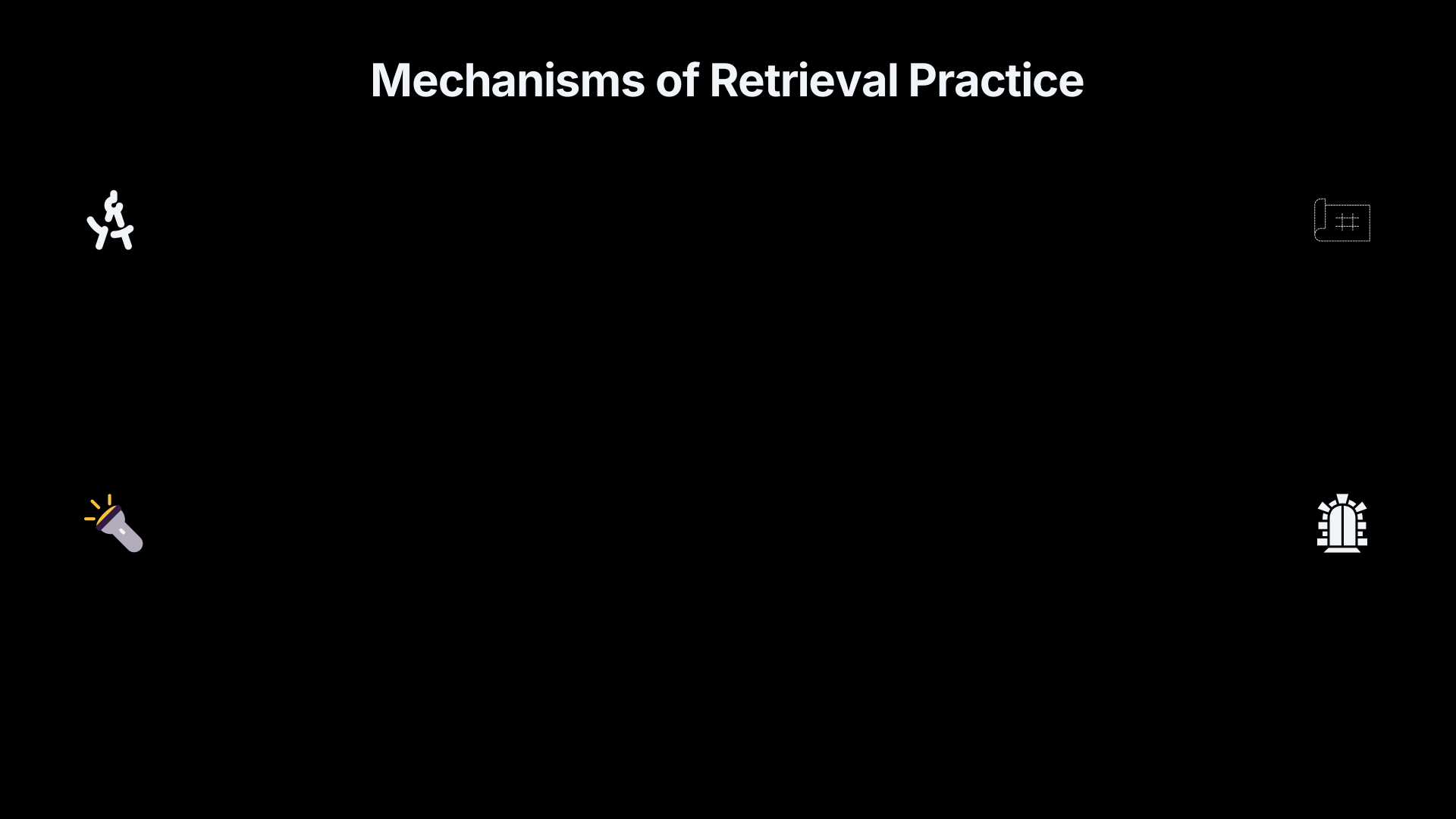
Several mechanisms are thought to contribute:
- Memory becomes more accessible. Successfully recalling an idea strengthens the pathways needed to retrieve it again in the future.
- Knowledge becomes better organised. Retrieval encourages learners to connect ideas instead of storing isolated facts, making later reasoning easier.
- Weaknesses become visible. Failed retrieval attempts reveal exactly what has not yet been learned, allowing targeted correction instead of false confidence.
- Future learning improves. Testing previously learned material can reduce interference from earlier information and make it easier to absorb new material that follows. Researchers describe this as the “forward effect” of testing.[PMC]pmc.ncbi.nlm.nih.govRetrieval practice enhances new learning: the forward effect of…by B Pastötter · 2014 · Cited by 276 — The review discusses current…
These mechanisms matter for analytical thinking because analysis depends on being able to call relevant concepts into working memory when evaluating evidence, comparing explanations or solving unfamiliar problems. Knowledge that can only be recognised on a page is far less useful than knowledge that can be retrieved when needed.
Practice tests measure understanding differently from rereading
Rereading often creates an illusion of mastery because familiar material feels easier to process each time it is encountered. Practice testing provides a more demanding and more informative signal.
For example, someone studying logical fallacies may recognise examples while reading a textbook yet struggle to identify those same fallacies in a newspaper article without prompts. A retrieval exercise immediately exposes this gap. The temporary discomfort of failing to recall is valuable because it identifies where further learning is needed before those weaknesses appear in an examination or real-world decision.
In this way, practice tests serve two purposes simultaneously: they strengthen memory and improve self-assessment. Instead of relying on feelings of familiarity, learners obtain direct evidence of what they can actually produce independently.[PMC]pmc.ncbi.nlm.nih.govTesting Improves Performance as Well as Assesses Learningby CW Polack · 2022 · Cited by 46 — Taking a test of previously studied mater…
Does testing only improve memory, or does it improve thinking?
Practice testing is primarily a memory intervention, but its benefits extend beyond simple recall when the questions require meaningful retrieval.
Research has found that retrieval practice can improve the transfer of learning—the ability to apply previously learned knowledge in new situations—particularly when practice questions resemble the kinds of reasoning learners will later perform. Explaining causes, comparing alternatives, interpreting evidence and solving novel problems all require retrieving and reorganising knowledge rather than repeating isolated facts.[Wikipedia]WikipediaTesting effectTesting effect
The implication is important for improving analytical skills. If practice tests ask only for memorised definitions, they mainly strengthen factual recall. If they require learners to justify conclusions, critique arguments or apply concepts to unfamiliar cases, retrieval practice also strengthens the mental operations involved in analysis.

How to use low-stakes practice tests
Practice testing works best when the goal is learning rather than judgement. Low-stakes quizzes reduce anxiety while preserving the benefits of retrieval.
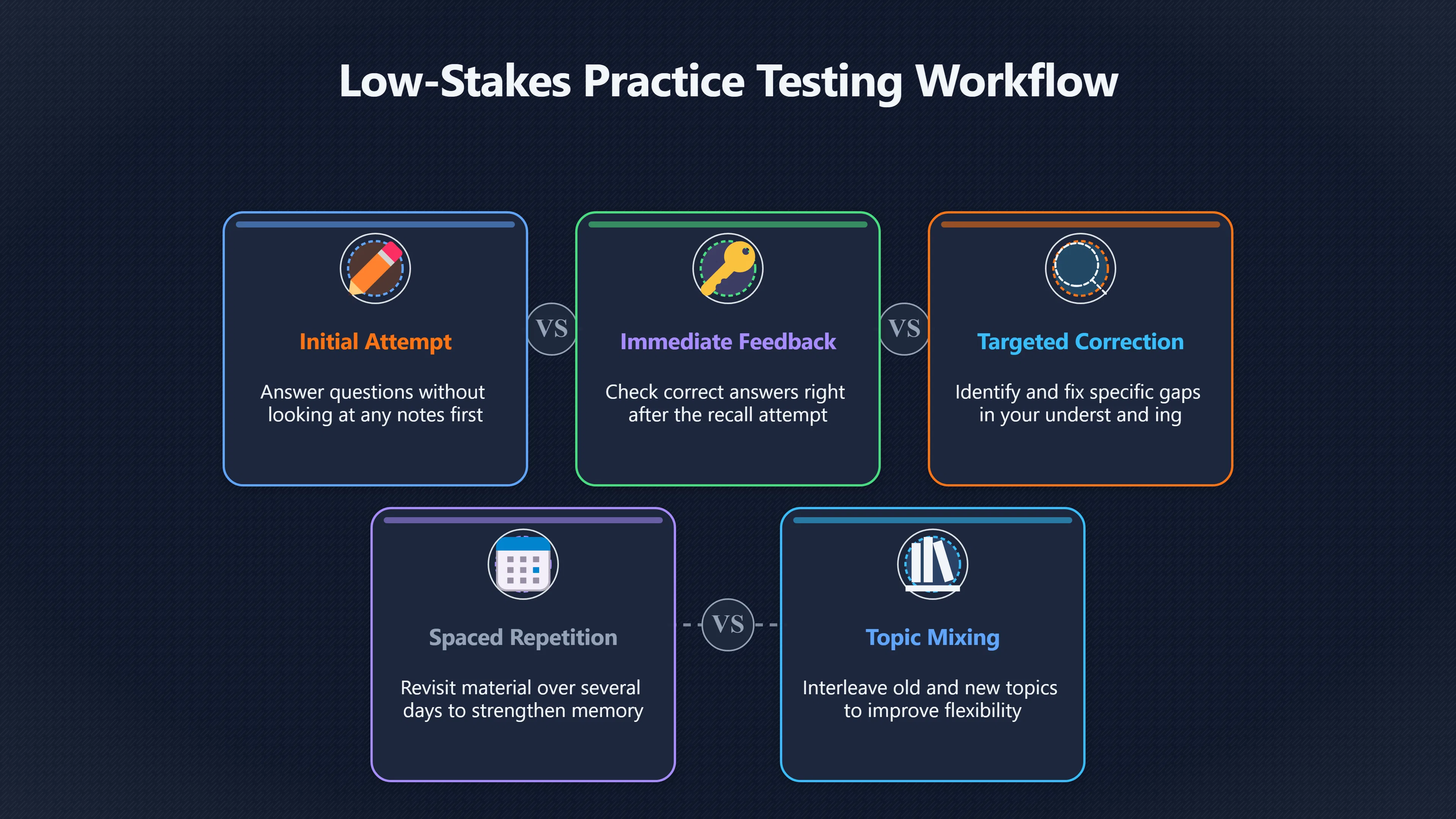
Effective approaches include:
- Answer before checking notes. Even unsuccessful retrieval attempts can improve later learning when followed by correction.
- Use short-answer questions before multiple choice. Producing an answer from memory generally requires more retrieval than recognising one from a list.
- Check feedback immediately after attempting recall. Corrective feedback prevents errors from becoming reinforced while consolidating accurate knowledge.
- Repeat retrieval over time. Revisiting material after delays strengthens long-term retention more effectively than massed practice in one session.
- Mix old and new topics. Returning to earlier material encourages flexible retrieval and reduces forgetting across longer periods. PMC+2PMC
Importantly, practice tests do not need to resemble formal examinations. Flashcards requiring free recall, self-generated questions, explaining a concept aloud, writing everything remembered on a blank sheet of paper, or solving new problems without reference materials all function as forms of retrieval practice.
Common misunderstandings
One misconception is that practice tests are useful only for preparing for examinations. In reality, their greatest value is often during learning itself, when mistakes still have time to be corrected.
Another misunderstanding is that retrieval practice should replace studying altogether. It does not. Learners still need an initial opportunity to understand new material. Retrieval becomes valuable once there is something meaningful to recall. Many successful study routines therefore alternate between brief study periods and repeated retrieval attempts rather than separating learning and testing into different stages.
Finally, people sometimes believe that struggling to remember means learning has failed. In fact, appropriately difficult retrieval often produces stronger long-term learning than effortless review. The challenge is a feature of the process, not evidence that the method is ineffective. PubMed
Amazon book picks
Further Reading
Books and field guides related to Why Tests Can Teach Better Than Review. Use these as the next step if you want deeper reading beyond the article.
Make It Stick
Explains retrieval practice and the testing effect as core principles of durable learning.
Powerful Teaching
Retrieval practice and low-stakes quizzing are central themes throughout the book.
Understanding How We Learn
Covers retrieval practice, memory, and evidence-based learning techniques in plain language.
How We Learn
Explores cognitive science findings that support retrieval-based learning and long-term retention.
Endnotes
1.
Source: pmc.ncbi.nlm.nih.gov
Link:https://pmc.ncbi.nlm.nih.gov/articles/PMC10229024/
Source snippet
Testing Improves Performance as Well as Assesses Learningby CW Polack · 2022 · Cited by 46 — Taking a test of previously studied mater...
3.
Source: pmc.ncbi.nlm.nih.gov
Link:https://pmc.ncbi.nlm.nih.gov/articles/PMC3983480/
Source snippet
Retrieval practice enhances new learning: the forward effect of...by B Pastötter · 2014 · Cited by 276 — The review discusses current...
4.
Source: Wikipedia
Title: Testing effect
Link:https://en.wikipedia.org/wiki/Testing_effect
5.
Source: vocabulary.com
Link:https://www.vocabulary.com/dictionary/retrieval
Source snippet
Definition, Meaning & SynonymsThe act of bringing something back is called retrieval. When you throw a tennis ball to Fido and he brings...
6.
Source: Wikipedia
Link:https://en.wikipedia.org/wiki/Retrieval
Source snippet
RetrievalComputer science · RETRIEVE · Data retrieval · Document retrieval · Image retrieval · Information retrieval · Knowledge retri...
7.
Source: youtube.com
Title: Henry Roediger
Link:https://www.youtube.com/watch?v=oqae85jbfbE
Source snippet
2 Re-Reading Is Useless (The Research Is Clear)...
8.
Source: pubmed.ncbi.nlm.nih.gov
Link:https://pubmed.ncbi.nlm.nih.gov/16507066/
Source snippet
taking memory tests improves long-term retentionby HL Roediger · 2006 · Cited by 4857 — Taking a memory test not only assesses what...
9.
Source: dictionary.cambridge.org
Link:https://dictionary.cambridge.org/dictionary/english-chinese-traditional/retrieval
Source snippet
in Traditional Chinese - Cambridge Dictionary27 May 2026 — the process of finding and bringing back something 找回;取回;輓回 the storage and re...
Published: May 2026
10.
Source: pmc.ncbi.nlm.nih.gov
Link:https://pmc.ncbi.nlm.nih.gov/articles/PMC12894256/
Source snippet
the testing effect on prolific: when retrieval practice...by K Sigayret · 2026 · Cited by 1 — In this paper, we report two preliminary e...
Additional References
11.
Source: merriam-webster.com
Link:https://www.merriam-webster.com/dictionary/retrieval
Source snippet
RETRIEVAL Definition & Meaning2 days ago — 1. an act or process of retrieving 2. possibility of being retrieved or of recovering beyond r...
12.
Source: youtube.com
Link:https://www.youtube.com/watch?v=CmvhFZhcwDo
Source snippet
How to pronounce RETRIEVAL in British EnglishThis video shows you how to pronounce RETRIEVAL in British English. Speaker has an accent fr...
13.
Source: my.chartered.college
Title: does research on retrieval practice translate into classroom practice
Link:https://my.chartered.college/impact_article/does-research-on-retrieval-practice-translate-into-classroom-practice/
Source snippet
research on retrieval practice translate into...12 Sept 2018 — Retrieval practice is strongly supported by over 100 years of research an...
14.
Source: dictionary.cambridge.org
Link:https://dictionary.cambridge.org/dictionary/english/retrieval
Source snippet
English meaning - Cambridge Dictionarythe process of finding and bringing back something: the storage and retrieval of information...
15.
Source: journals.sagepub.com
Title: Sage Journals Test-Enhanced Learning
Link:https://journals.sagepub.com/doi/10.1111/j.1467-9280.2006.01693.x
Source snippet
Roediger, Jeffrey D....by HL Roediger III · 2006 · Cited by 4881 — Taking a memory test not only assesses what one knows, but also enhan...
16.
Source: structural-learning.com
Link:https://www.structural-learning.com/post/testing-effect-retrieval-practice
Source snippet
The Testing Effect: Why Retrieval Practice Works29 Dec 2025 — Research shows retrieving info aids learning more than rereading (Roediger...
17.
Source: codesignal.com
Link:https://codesignal.com/learn/courses/beyond-basic-rag-improving-our-pipeline-in-java/lessons/iterative-retrieval-in-retrieval-augmented-generation-systems
Source snippet
e a more helpful final context.Read more...
18.
Source: youtube.com
Title: How to STUDY so FAST it feels like CHEATING
Link:https://www.youtube.com/watch?v=-v3D8wNUUjk
Source snippet
Henry Roediger - Retrieval Practice to Enhance Learning and Retention is highly relevant because it features Dr. Henry Roediger himself e...
19.
Source: youtube.com
Title: How To study EFFECTIVELY For Exams | Scientifically Proven Techniques
Link:https://www.youtube.com/watch?v=kKm5Iu507vM
Source snippet
4 learning by taking practice tests protects memory against [stress]({{ 'stress/' | relative_url }})...
20.
Source: oxfordlearnersdictionaries.com
Title: retrieval noun
Link:https://www.oxfordlearnersdictionaries.com/definition/english/retrieval
Source snippet
Definition, pictures, pronunciation and...[uncountable] (formal) the process of getting something back, especially from a place where it...
Topic Tree