Within Mistakes
Start with how common it is
Base-rate neglect turns diagnosis, hiring and forecasting into story matching when the first question should be how common the outcome is.
On this page
- The trap of 'this looks like X'
- Medical, hiring and forecasting examples
- Updating from a comparison group
Page outline Jump by section
Introduction
Good judgement often begins with a question that feels almost too simple: how common is this outcome before considering the details of this particular case? Base rates are the background frequencies of events in a relevant comparison group. Ignoring them leads people to match stories rather than estimate probabilities. A candidate “looks like” a successful executive, a patient “sounds like” they have a rare disease, or a new project “feels different” from past failures. These impressions may contain useful information, but they should usually be adjustments to the starting probability, not replacements for it.
 Research on judgement and decision-making consistently shows that people often overweight vivid, case-specific information and underweight statistical prevalence, particularly when a compelling narrative is available. Yet the same body of research also shows that the problem is more nuanced than early laboratory experiments suggested: people can use base rates effectively when information is presented clearly, when they have relevant experience, or when decisions unfold over repeated real-world situations.[PMC+2Branden Fitelson]pmc.ncbi.nlm.nih.govPMCExperts use base rates in real-world sequential decisionsby D Link · 2021 · Cited by 15 — We argue here that while naïve subjects demonstrate base-rate neglect in laboratory conditions, exper…
The trap of “this looks like X”
The classic mistake is to confuse resemblance with probability. If someone matches our mental image of a profession, illness or personality type, we instinctively treat that resemblance as strong evidence. Daniel Kahneman and Amos Tversky demonstrated that people frequently judge likelihood by representativeness: they ask whether a case resembles a stereotype rather than how frequently the outcome actually occurs. The result is base-rate neglect—giving too little weight to prior probabilities when making predictions.[ResearchGate]researchgate.net209410239 On the psychology of predictionOn the psychology of prediction27 Sept 2025 — Considers that intuitive predictions follow a judgmental heuristic-representati…
This shortcut is appealing because stories are concrete while base rates are abstract. A detailed personal description feels informative, whereas “2% of applicants succeed” or “1 in 1,000 people has this disease” can seem impersonal or irrelevant. Research suggests that people often classify specific information as more relevant than general statistical information, even when the statistics are objectively more informative for estimating probability.[The Decision Lab]thedecisionlab.comThe Decision Lab Base Rate FallacyThe Decision LabBase Rate Fallacy - The Decision…Base Rate Fallacy is our tendency to give more weight to the event-specific informati…
The consequence is not that individual details should be ignored. Instead, they should update an initial estimate derived from the appropriate comparison group. The sequence matters:
- Start with the outside frequency.
- Ask how diagnostic the case-specific evidence really is.
- Adjust the probability accordingly.
Skipping the first step often produces overconfident judgements.
Medical, hiring and forecasting examples
Medical diagnosis
Medicine provides one of the clearest demonstrations of why base rates matter.
Imagine a disease affecting only 1% of the population. Even if a diagnostic test correctly identifies affected patients 99% of the time, false positives can outnumber true positives because healthy people vastly outnumber patients. Many people—including trained physicians in some studies—substantially overestimate the probability that a positive result means a patient actually has the disease. The prevalence of the disease must be combined with the test’s accuracy before interpreting the result.[PMC]pmc.ncbi.nlm.nih.govTversky and Kahneman's Cognitive Illusions: Who Can Solve…by G Bruckmaier · 2021 · Cited by 47 — The mathematical reason for the co…
This explains why clinicians often distinguish between screening tests used in low-risk populations and confirmatory tests used after other evidence has increased the prior probability. The same laboratory result can have very different meanings depending on how common the condition is in the population being tested.
Hiring decisions
Recruitment often shifts rapidly from evidence to storytelling. A confident interviewee who resembles previous successful managers may feel like an obvious choice. However, interviews typically provide limited predictive information compared with structured assessments and historical hiring data.
Suppose only one in ten applicants for a demanding role ultimately performs exceptionally. An impressive interview should increase the estimated probability of success, but it rarely justifies acting as though excellence has suddenly become the most likely outcome. Beginning with historical success rates encourages more calibrated expectations and reduces the influence of charisma or stereotype.
The practical question is not, “Does this person remind me of a successful employee?” but, “Among applicants who looked similar in measurable ways, how many actually succeeded?”
Forecasting projects
Forecasting research has repeatedly found that planners favour the “inside view”: concentrating on the unique features of the current project while neglecting how comparable projects actually turned out.
The recommended alternative is an “outside view” or reference class forecast. Instead of asking why the current project will succeed, decision-makers identify a relevant class of similar completed projects, examine the distribution of outcomes, and then adjust only if there is strong evidence that the current case genuinely differs. This approach has become influential in project planning because it counteracts optimism driven by compelling project narratives.[Wikipedia]WikipediaReference class forecastingReference class forecasting
Updating from a comparison group
Using base rates does not mean treating every individual as average. It means establishing a sensible starting point before incorporating additional evidence.
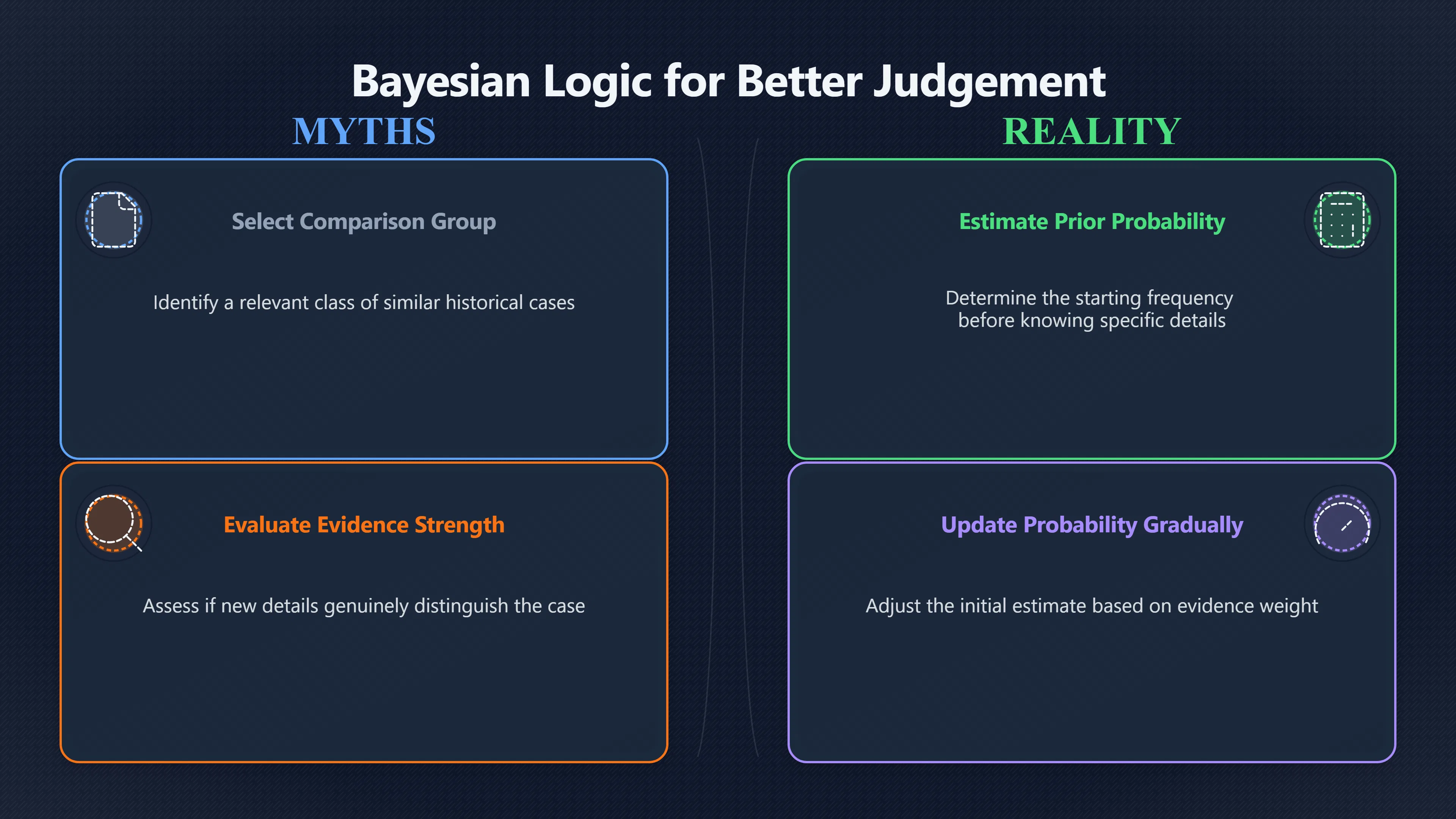
A practical sequence looks like this:
- Choose the right comparison group. The base rate must come from genuinely similar cases. The average success rate of all businesses is less informative than the success rate of businesses in the same industry, scale and market.
- Estimate the prior probability. Ask, “Before I knew anything special about this case, what would I expect?”
- Evaluate the strength of the new evidence. Does it genuinely distinguish this case from others, or is it merely vivid?
- Update gradually. Strong evidence should move the estimate substantially; weak evidence should move it only slightly.
This process reflects the logic behind Bayesian reasoning, even when no formal calculations are performed. The important habit is to begin with frequencies rather than anecdotes.
Why experts sometimes do better—and sometimes do not
Early laboratory studies gave the impression that people almost automatically ignore base rates. Later work has complicated that picture.
Research examining expert decisions in real-world settings has found that experienced decision-makers can make effective use of base-rate information, particularly when decisions are repeated over time and feedback is available. For example, analyses of elite beach volleyball serving decisions suggest that players adapt their choices according to opponents’ underlying success rates rather than relying solely on recent memorable plays. This indicates that repeated experience can encourage attention to statistical regularities.[PMC]pmc.ncbi.nlm.nih.govPMCExperts use base rates in real-world sequential decisionsby D Link · 2021 · Cited by 15 — We argue here that while naïve subjects demonstrate base-rate neglect in laboratory conditions, exper…
However, expertise is not a guarantee. Medical research has documented situations in which physicians still underweight disease prevalence, especially when presented with compelling case descriptions or when statistical information is communicated poorly.[Cambridge University Press & Assessment]cambridge.orgCambridge University Press & AssessmentPhysicians neglect base rates, and it mattersby RM Hamm · 1996 · Cited by 23 — A recent study show…
The lesson is not that experts always avoid base-rate neglect, but that good environments—with repeated feedback, meaningful comparison groups and well-presented statistical information—make correct probabilistic reasoning more likely.
Practical habits that reduce story matching
The most effective defence is to build a routine that forces statistical thinking before narrative thinking.
Before making an important judgement, ask:
- What is the relevant base rate?(#endnote-7 “Endnote 7”)[Wikipedia]WikipediaBase rate fallacyBase rate fallacy
- What comparison group best matches this case?
- How much new information does this specific evidence genuinely add?
- Would I reach the same conclusion if the story were less vivid but the statistics were identical?
Another useful technique is to express probabilities as natural frequencies rather than percentages. Saying “about 10 out of every 1,000 similar people” is often easier to reason about than “1%”. Research has shown that presenting statistical information in frequency formats can improve probabilistic reasoning and reduce common errors.[Gordon Pennycook]gordonpennycook.compennycook thompson base rate neglectGordon PennycookBase-Rate Neglect | Gordon Pennycookby G Pennycook · Cited by 66 — Kahneman's (2003) dual-process account holds that base…
The goal is not to suppress intuition but to anchor it. A compelling story may justify moving away from the average, yet good analytical thinking begins by knowing what the average actually is. Starting with the outside frequency provides a disciplined reference point, making it far less likely that an attractive narrative will overwhelm the evidence.

Amazon book picks
Further Reading
Books and field guides related to Start with how common it is. Use these as the next step if you want deeper reading beyond the article.
The Art of Thinking Clearly
Explains common probability and judgement errors accessibly.
eBay marketplace picks
Marketplace Samples
Live-tested eBay searches with available results related to this page.



Endnotes
1.
Source: pmc.ncbi.nlm.nih.gov
Title: PMCExperts use base rates in real-world sequential decisions
Link:https://pmc.ncbi.nlm.nih.gov/articles/PMC9038831/
Source snippet
by D Link · 2021 · Cited by 15 — We argue here that while naïve subjects demonstrate base-rate neglect in laboratory conditions, exper...
2.
Source: fitelson.org
Title: koehler brf
Link:https://www.fitelson.org/koehler_brf.pdf
Source snippet
Gigerenzer et al. (1988), judgments for high and low base rate groups were virtually indistinguishable, suggesting that.Read more...
3.
Source: researchgate.net
Title: 209410239 On the psychology of prediction
Link:https://www.researchgate.net/publication/209410239_On_the_psychology_of_prediction
Source snippet
On the psychology of prediction27 Sept 2025 — Considers that intuitive predictions follow a judgmental heuristic-representati...
4.
Source: pmc.ncbi.nlm.nih.gov
Link:https://pmc.ncbi.nlm.nih.gov/articles/PMC8075297/
Source snippet
Tversky and Kahneman's Cognitive Illusions: Who Can Solve...by G Bruckmaier · 2021 · Cited by 47 — The mathematical reason for the co...
5.
Source: cambridge.org
Link:https://www.cambridge.org/core/journals/behavioral-and-brain-sciences/article/physicians-neglect-base-rates-and-it-matters/48984E851538FA30B5DE4D6D6CC35CA3
Source snippet
Cambridge University Press & AssessmentPhysicians neglect base rates, and it mattersby RM Hamm · 1996 · Cited by 23 — A recent study show...
6.
Source: Wikipedia
Title: Reference class forecasting
Link:https://en.wikipedia.org/wiki/Reference_class_forecasting
7.
Source: Wikipedia
Title: Base rate fallacy
Link:https://en.wikipedia.org/wiki/Base_rate_fallacy
8.
Source: gordonpennycook.com
Title: pennycook thompson base rate neglect
Link:https://gordonpennycook.com/wp-content/uploads/2016/02/pennycook-thompson_base-rate-neglect.pdf
Source snippet
Gordon PennycookBase-Rate Neglect | Gordon Pennycookby G Pennycook · Cited by 66 — Kahneman's (2003) dual-process account holds that base...
9.
Source: thedecisionlab.com
Title: The Decision Lab Base Rate Fallacy
Link:https://thedecisionlab.com/biases/base-rate-fallacy
Source snippet
The Decision LabBase Rate Fallacy - The Decision...Base Rate Fallacy is our tendency to give more weight to the event-specific informati...
Additional References
10.
Source: youtube.com
Title: Anchoring Bias Explained | Psychology
Link:https://www.youtube.com/watch?v=jVjHdBvX3Nc
Source snippet
Anchoring with Daniel Kahneman features the leading psychologist discussing how cognitive biases like anchoring skew human judgment and d...
11.
Source: youtube.com
Title: Anchoring, with Daniel Kahneman (author of Thinking, Fast and Slow)
Link:https://www.youtube.com/watch?v=HefjkqKCVpo
Source snippet
The Anchoring Bias: Why The First Offer Matters...
12.
Source: youtube.com
Title: The Anchoring Bias: Why The First Offer Matters
Link:https://www.youtube.com/watch?v=JLeyIdWv2Q8
Source snippet
Behavioural Economics - Anchoring...
13.
Source: youtube.com
Title: Behavioural Economics
Link:https://www.youtube.com/watch?v=K58_3fVf0fc
Source snippet
Anchoring bias - S1:E9...
14.
Source: youtube.com
Title: Anchoring bias
Link:https://www.youtube.com/watch?v=P0nRZlu1sFA
Source snippet
Explained | Psychology...
Topic Tree