Within Mistakes
Plans need a past case reality check
Reference-class forecasting checks ambitious plans against what similar past tasks actually took, not what the current plan hopes will happen.
On this page
- Why detailed plans create false confidence
- Inside view versus outside view
- Choosing a useful reference class
Page outline Jump by section
Introduction
One of the most reliable ways to reduce the planning fallacy is to stop treating a project as if it were unique and instead ask what happened to similar projects in the past. This approach, known as reference-class forecasting, replaces optimistic guesses with evidence from comparable cases. Rather than asking, “How long should this take if everything goes well?”, it asks, “How long did similar work actually take?” Research by Daniel Kahneman and Amos Tversky showed that people systematically underestimate time, costs and risks because they focus on the details of the current plan instead of the statistical record of comparable projects. Later work by Bent Flyvbjerg translated this insight into a practical forecasting method used in public planning and large infrastructure projects.[Wikipedia+2IDEAS/RePEc]WikipediaReference class forecastingReference class forecasting
 Within the broader goal of improving analytical thinking, reference-class forecasting is valuable because it provides a disciplined reality check. It does not replace detailed planning; it tests whether the plan is plausible when judged against experience rather than hope.
Why detailed plans create false confidence
Detailed plans often feel convincing because they contain many concrete steps, milestones and dependencies. Ironically, this detail can make forecasts less reliable if it encourages people to imagine an ideal sequence of events while overlooking the delays that routinely arise in real work.
Common sources of error include:
- Unexpected technical problems.
- Coordination between multiple people or teams.
- Waiting for approvals or external dependencies.
- Rework after mistakes or changing requirements.
- Interruptions from unrelated priorities.
Most planners recognise these risks in principle, yet still assume that this particular project will avoid them. Kahneman and Tversky argued that this happens because people rely on an inside view: they mentally simulate the current project instead of considering the distribution of outcomes from previous, similar projects.[Wikipedia]WikipediaReference class forecastingReference class forecasting
This explains why experience alone does not eliminate the planning fallacy. Someone may have repeatedly missed deadlines yet still believe that the next project will be different because its individual features appear more favourable.
Inside view versus outside view
The distinction between the inside and outside view is the central practical idea behind reference-class forecasting.
The inside view asks questions such as:
- What tasks must be completed?
- Which obstacles can we already identify?
- What is our current schedule?
These questions are necessary for execution but tend to encourage optimism because unknown risks receive little weight.
The outside view begins somewhere else. It asks:
- What projects genuinely resemble this one?
- How long did they actually take?
- How often did they exceed their budgets?
- Where did they typically encounter delays?
Instead of building an estimate from imagined future events, the outside view starts with observed historical outcomes and adjusts only when there is convincing evidence that the current case is genuinely unusual. This shifts attention from stories to statistics, making forecasts more resistant to wishful thinking.[Wikipedia]WikipediaReference class forecastingReference class forecasting
A classic illustration comes from Kahneman’s account of a team writing a curriculum. Team members initially predicted completion within roughly two years. When one member was asked how long similar curriculum projects had taken, he recalled that most required seven to ten years and many were never completed. Despite recognising this, the group ignored the outside view and continued with the optimistic estimate. The project ultimately took around eight years. The episode has become a well-known demonstration of the planning fallacy in practice.[Conversable Economist]conversableeconomist.comreference class forecasting an origin story from daniel kahnemanConversable EconomistReference Class Forecasting: An Origin Story from Daniel…Apr 17, 2023 — And one technique used by the superior fo…

Choosing a useful reference class
Reference-class forecasting is only as good as the comparison group. Choosing the wrong reference class can produce misleading forecasts.
A useful reference class should be:(#endnote-1 “Endnote 1”)[Wikipedia]WikipediaReference class forecastingReference class forecasting
- Similar enough to share important characteristics with the current project.
- Large enough to reveal meaningful patterns rather than isolated anecdotes.
- Based on completed projects, using actual rather than planned outcomes.
- Relevant to the decision, matching the type, scale and organisational context where possible.
For example, estimating the completion time for a software migration by comparing it with previous software migrations is generally more informative than comparing it with all technology projects. Conversely, choosing only projects that resemble the current one in every detail can make the sample so small that it loses statistical value.
Researchers sometimes describe this balancing act as the “reference class problem”: the comparison group must be neither too broad nor too narrow.[Wikipedia]WikipediaReference class forecastingReference class forecasting
Applying reference-class forecasting in everyday decisions
The same reasoning works well beyond large engineering projects.
A student estimating the time needed for a dissertation should examine how long previous dissertations of similar scope actually took, rather than relying solely on a personal work schedule.
Someone renovating a house should compare expected costs with completed renovations of similar size, including delays caused by permits, supply shortages and unexpected repairs.
A business launching a new product should review historical launch schedules across comparable products before accepting ambitious internal deadlines.
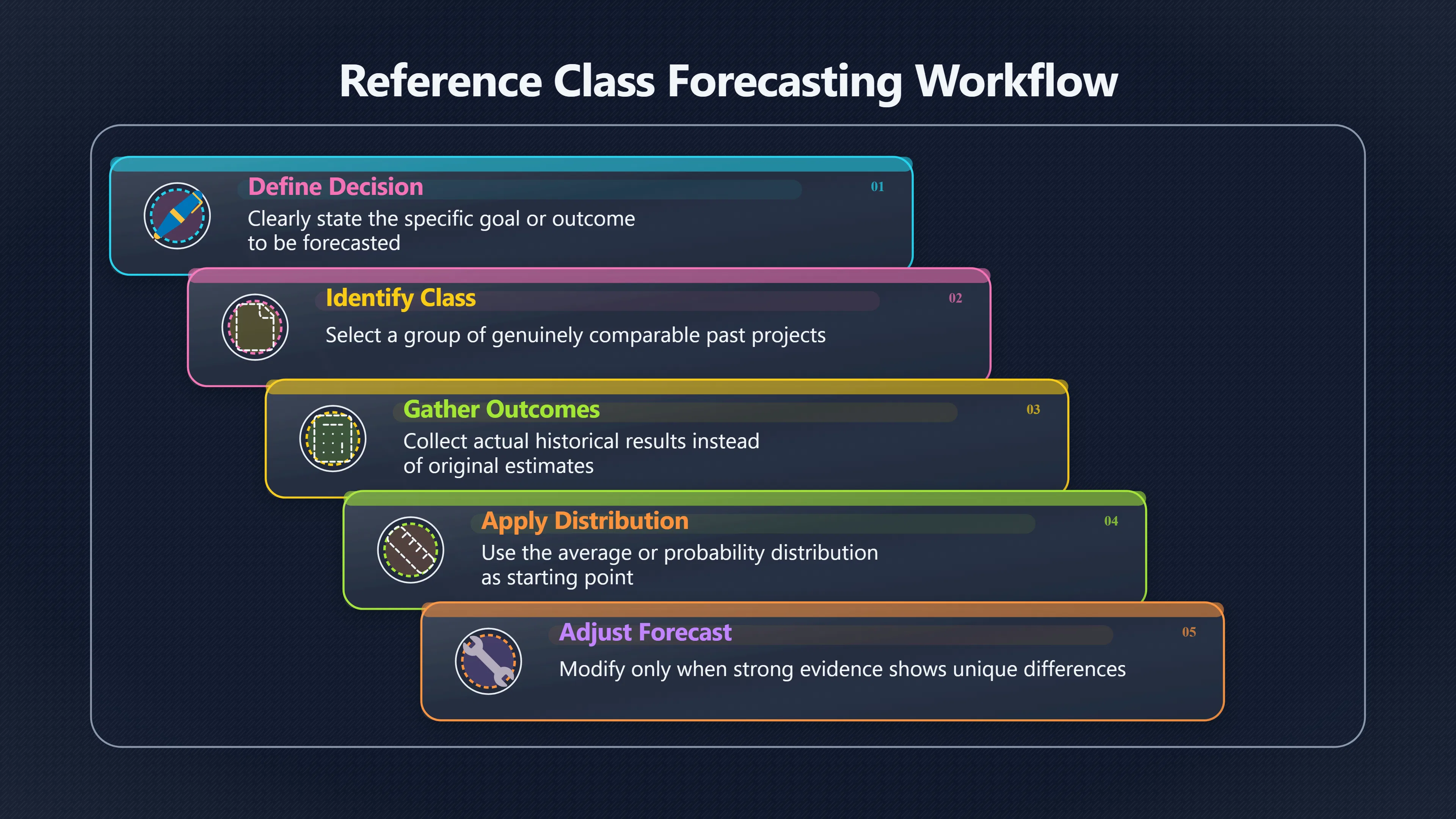
A practical process is:
- Define the decision clearly.
- Identify a genuinely comparable group of past cases.
- Gather actual outcomes rather than original estimates.
- Use the average or probability distribution as the starting forecast.
- Adjust only when there is strong evidence that the current case differs in ways that matter.
The important shift is psychological as much as statistical. Instead of asking, “Why will we succeed?”, the decision-maker asks, “What normally happens?”
What organisations have learned
Reference-class forecasting has had its greatest impact in large public investments, where cost overruns and schedule delays can have substantial financial consequences.
Bent Flyvbjerg developed practical procedures that adapted Kahneman and Tversky’s research for transport planning. The approach has influenced forecasting guidance for major infrastructure projects, including work commissioned by the UK government, and has been applied in countries including Denmark, the Netherlands and Hong Kong. Rather than relying solely on engineering estimates, planners compare proposed projects with large databases of completed projects and adjust budgets or schedules according to observed historical risk.[arXiv+3Wikipedia+3IDEAS/RePEc]WikipediaReference class forecastingReference class forecasting
Research consistently shows that projects judged exceptional are often less exceptional than their planners believe. Recent work has highlighted uniqueness bias—the tendency to treat one’s own project as fundamentally different from previous ones—as another reason forecasts become overly optimistic. Reference-class forecasting works partly because it counters this instinct by forcing planners to search for similarities before emphasising differences.[arXiv]arxiv.orgarXiv Uniqueness Bias: Why It Matters, How to Curb ItUniqueness Bias: Why It Matters, How to Curb ItAugust 13, 2024…
Limits and good practice
Reference-class forecasting is not a substitute for detailed planning. It cannot predict unique events that have no historical precedent, nor can it identify exactly which specific problems will arise. It is best viewed as a calibration tool rather than a complete forecasting system.
It is also important to recognise that some inaccurate forecasts arise from organisational incentives rather than honest optimism. Projects may be presented in an unrealistically favourable light to secure approval or funding. In such cases, better forecasting methods alone cannot eliminate bias unless institutions also reward accurate forecasting instead of attractive forecasts.[IDEAS/RePEc]ideas.repec.orgv16y2006i1p3 21IDEAS/RePEcCurbing Optimism Bias and Strategic Misrepresentation in…by B Flyvbjerg · 2006 · Cited by 698 — The American Planning Assoc…
Used appropriately, however, reference-class forecasting offers one of the most practical forms of “decision hygiene”. By checking ambitious plans against the historical performance of comparable work, it reduces overconfidence, produces more realistic schedules and budgets, and helps people distinguish between what they hope will happen and what experience suggests is most likely.
eBay marketplace picks
Marketplace Samples
Example marketplace items related to this page. Use the search link to explore similar finds on eBay.




Endnotes
1.
Source: Wikipedia
Title: Reference class forecasting
Link:https://en.wikipedia.org/wiki/Reference_class_forecasting
2.
Source: ideas.repec.org
Title: v16y2006i1p3 21
Link:https://ideas.repec.org/a/taf/eurpls/v16y2006i1p3-21.html
Source snippet
IDEAS/RePEcCurbing Optimism Bias and Strategic Misrepresentation in...by B Flyvbjerg · 2006 · Cited by 698 — The American Planning Assoc...
3.
Source: Wikipedia
Title: Planning fallacy
Link:https://en.wikipedia.org/wiki/Planning_fallacy
Source snippet
Planning fallacyLovallo and Kahneman proposed an expanded definition as the tendency to underestimate the time, costs, and risks of fu...
4.
Source: arxiv.org
Title: arXiv Reference Class Forecasting for Hong Kong’s Major Roadworks Projects
Link:https://arxiv.org/abs/1710.09419
5.
Source: arxiv.org
Title: arXiv Uniqueness Bias: Why It Matters, How to Curb It
Link:https://arxiv.org/abs/2408.07710
Source snippet
Uniqueness Bias: Why It Matters, How to Curb ItAugust 13, 2024...
Published: August 13, 2024
6.
Source: arxiv.org
Link:https://arxiv.org/pdf/2202.00125
Source snippet
"reference class forecasting" (Flyvbjerg 2006) and in Thinking, Fast and Slow Kahneman (2011: 251) was. Page 6...
7.
Source: conversableeconomist.com
Title: reference class forecasting an origin story from daniel kahneman
Link:https://conversableeconomist.com/2023/04/17/reference-class-forecasting-an-origin-story-from-daniel-kahneman/
Source snippet
Conversable EconomistReference Class Forecasting: An Origin Story from Daniel...Apr 17, 2023 — And one technique used by the superior fo...
Additional References
8.
Source: thedecisionlab.com
Link:https://thedecisionlab.com/biases/planning-fallacy
Source snippet
Planning fallacyPlanning Fallacy is the tendency to be too optimistic about one's estimates. As a result, the time needed to get somethin...
9.
Source: pmi.org
Link:https://www.pmi.org/learning/library/nobel-project-management-reference-class-forecasting-8068
Source snippet
Project Management InstituteFrom Nobel Prize to project managementReference class forecasting promises more accuracy in forecasts by taki...
10.
Source: researchgate.net
Link:https://www.researchgate.net/publication/233258056_Curbing_Optimism_Bias_and_Strategic_Misrepresentation_in_Planning_Reference_Class_Forecasting_in_Practice
Source snippet
Curbing Optimism Bias and Strategic Misrepresentation in...This paper details the method and describes the first instance of reference c...
11.
Source: corporate.jasoncollins.blog
Link:https://corporate.jasoncollins.blog/outside-view
Source snippet
jasoncollins.blog23 The outside view – Course notes...The planning fallacy is the tendency of people to underestimate the completion tim...
12.
Source: dspace.lib.cranfield.ac.uk
Link:https://dspace.lib.cranfield.ac.uk/server/api/core/bitstreams/076d9c29-659d-4bfd-9b1b-e0019ea9ad20/content
Source snippet
class forecasting: promises, problems, and a...by CC Cantarelli · Cited by 3 — Flyvbjerg defines optimism bias as “a cognitive predis- p...
13.
Source: committees.parliament.uk
Link:https://committees.parliament.uk/writtenevidence/100937/html/
Source snippet
2008. 'Curbing optimism bias and strategic misrepresentation in planning: Reference class forecasting in practice', European Planning Stu...
14.
Source: researchgate.net
Link:https://www.researchgate.net/publication/372122475_Reference_Class_Forecasting
Source snippet
Each project control method...Read more...
15.
Source: tandfonline.com
Link:https://www.tandfonline.com/doi/full/10.1080/09537287.2025.2578708
Source snippet
Taylor & Francis OnlineReference class forecasting: promises, problems, and a...by CC Cantarelli · 2025 · Cited by 3 — Flyvbjerg gathere...
16.
Source: youtube.com
Title: Anchoring Bias Explained | Psychology
Link:https://www.youtube.com/watch?v=jVjHdBvX3Nc
Source snippet
Anchoring with Daniel Kahneman features the leading psychologist discussing how cognitive biases like anchoring skew human judgment and d...
17.
Source: youtube.com
Title: Anchoring, with Daniel Kahneman (author of Thinking, Fast and Slow)
Link:https://www.youtube.com/watch?v=HefjkqKCVpo
Source snippet
The Anchoring Bias: Why The First Offer Matters...
Topic Tree