Within Job Offers
How Do You Test Job Fit?
Interview impressions become more reliable when you turn them into specific questions about daily work, decisions and pressure.
On this page
- Turning vague impressions into checkable assumptions
- Questions that reveal manager and team habits
- Signals that culture claims may be oversold
Page outline Jump by section
Introduction
Accepting a job offer always involves uncertainty, but you can reduce that uncertainty by treating your impressions as hypotheses rather than facts. Interviews are carefully managed events, whereas your experience of the job will be shaped by ordinary days: how priorities change, how managers respond under pressure, how meetings are run, and what happens when deadlines slip. The aim is not to predict every detail, but to replace vague feelings such as “the team seemed nice” or “the culture felt collaborative” with specific, testable assumptions.
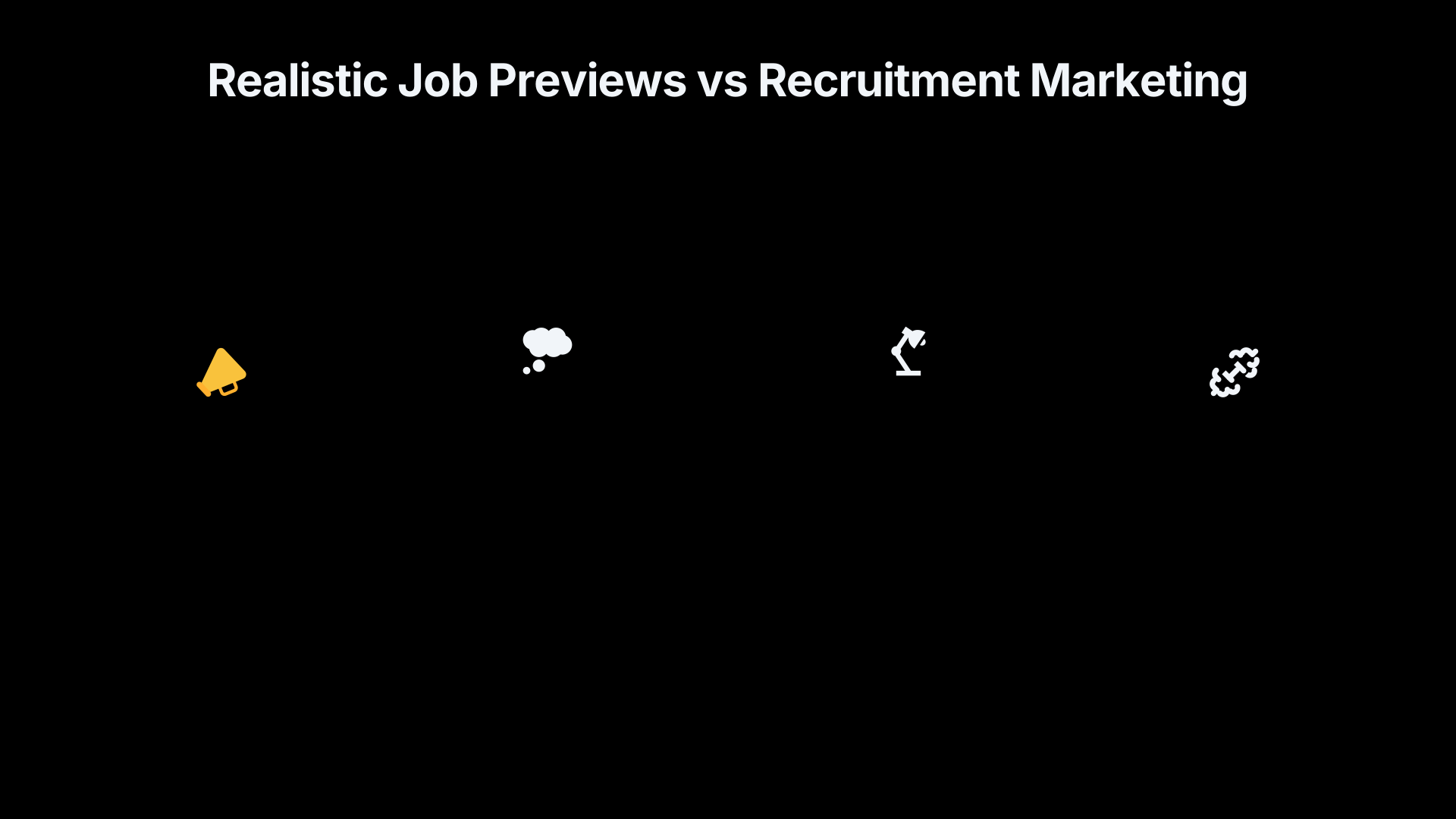 Organisational psychologists have long argued that candidates make better decisions when they receive a realistic picture of both the advantages and the challenges of a role. This idea, known as a realistic job preview, helps applicants judge whether the work genuinely matches their preferences rather than relying on polished recruitment messages. U.S. Office of Personnel Management+2ResearchGate[opm.gov]opm.govrealistic job previewsOffice of Personnel ManagementRealistic Job PreviewsA Realistic Job Preview (RJP) is a recruiting approach used by an organization to com…
Turn vague impressions into checkable assumptions
People naturally fill gaps in information with optimistic assumptions, especially after receiving an offer. A strong interview, an engaging manager or an attractive salary can create a “halo effect”, where one positive feature colours every other judgement.
Instead of asking whether the job “feels right”, translate each impression into a question that can be verified.
For example:
Initial impressionBetter assumption to test”The team seems supportive.”How are new employees trained? Who helps when someone gets stuck?”The work sounds interesting.”What tasks fill a normal Tuesday rather than an exceptional project?”The manager seems flexible.”How are priorities changed when deadlines collide?”There are good growth opportunities.”Which employees were promoted during the past two years, and what did they do to earn those promotions?”The workload sounds manageable.”What does a genuinely busy week look like in hours, meetings and expected availability?
This approach changes the interview from a sales conversation into an information-gathering exercise. Behavioural research on recruitment recommends treating interviews primarily as opportunities to collect relevant evidence rather than making rapid overall judgements.[CIPD]cipd.orgMake sure tests are relevant to the job and fit for purpose…
Ask questions that expose daily work rather than company slogans
Culture is difficult to judge from statements such as “we value collaboration” or “we move fast”. Everyday routines reveal much more.
Questions that often produce concrete answers include:
- “Can you describe a typical week in this role?”
- “What usually causes people in this position to have difficult weeks?”
- “How often do priorities change unexpectedly?”
- “What decisions can someone make independently?”
- “What meetings are fixed every week?”
- “How is success measured during the first six months?”
- “What separates someone who performs adequately from someone who performs exceptionally?”
These questions encourage interviewers to describe behaviour instead of aspirations.
If speaking with future colleagues, ask about ordinary working practices rather than satisfaction alone:
- “When someone makes a mistake, what usually happens?”
- “How often do people ask each other for help?”
- “What surprises new hires most?”
- “Which parts of the job are harder than candidates expect?”
Specific examples are generally more informative than broad opinions. A response describing a recent project, deadline or disagreement provides stronger evidence than statements such as “everyone gets on well”.
Test the manager, not just the organisation
For many employees, the immediate manager influences day-to-day satisfaction more than the company’s public reputation.
Rather than asking whether the manager is “good”, explore how they actually work.
Useful areas include:
- Feedback: How frequently do one-to-one meetings occur? Is feedback mainly corrective or continuous?
- Decision-making: Which decisions require approval, and which are delegated?
- Availability: When urgent problems appear, how quickly is support normally provided?
- Expectations: How are priorities communicated when several tasks compete?
- Development: What has the manager done to help previous team members progress?
Where possible, compare answers from multiple interviewers. Consistency increases confidence. Significant differences may indicate that expectations vary between individuals or that important practices are not well established.

Look for evidence that claims match behaviour
Every employer presents itself positively during recruitment. The useful question is whether the evidence matches the message.
Examples include:
“We support learning.”
Look for funded training, protected learning time, recent promotions and examples of employees acquiring new responsibilities.
“We have excellent work-life balance.”
Ask how often people work evenings, how annual leave is protected and whether urgent messages outside working hours are genuinely unusual.
“We’re highly collaborative.”
Ask how cross-team projects are organised, how disagreements are resolved and whether performance is mainly measured individually or collectively.
“We trust people.”
Ask which decisions junior employees can make without approval and whether flexible working arrangements are widely used or require special permission.
Claims supported by concrete examples deserve more confidence than repeated values statements.
Request a realistic picture of the job
Many organisations now deliberately provide realistic job previews because they improve long-term matching between candidates and roles. A realistic preview includes both attractive and difficult aspects of the position rather than acting purely as recruitment marketing. Research suggests that better-informed candidates are more likely to make decisions they remain satisfied with after joining. U.S. Office of Personnel Management+2Oxford Education[opm.gov]opm.govrealistic job previewsOffice of Personnel ManagementRealistic Job PreviewsA Realistic Job Preview (RJP) is a recruiting approach used by an organization to com…
If one is not offered, you can often create your own by asking:
- “What part of this job do people usually underestimate?”
- “Why have previous people left this role?”
- “What usually causes the most stress?”
- “What would make someone decide this role is not for them?”
- “If I joined tomorrow, what would probably be the hardest adjustment during the first month?”
An employer willing to discuss genuine difficulties often provides more trustworthy information than one presenting only positives.
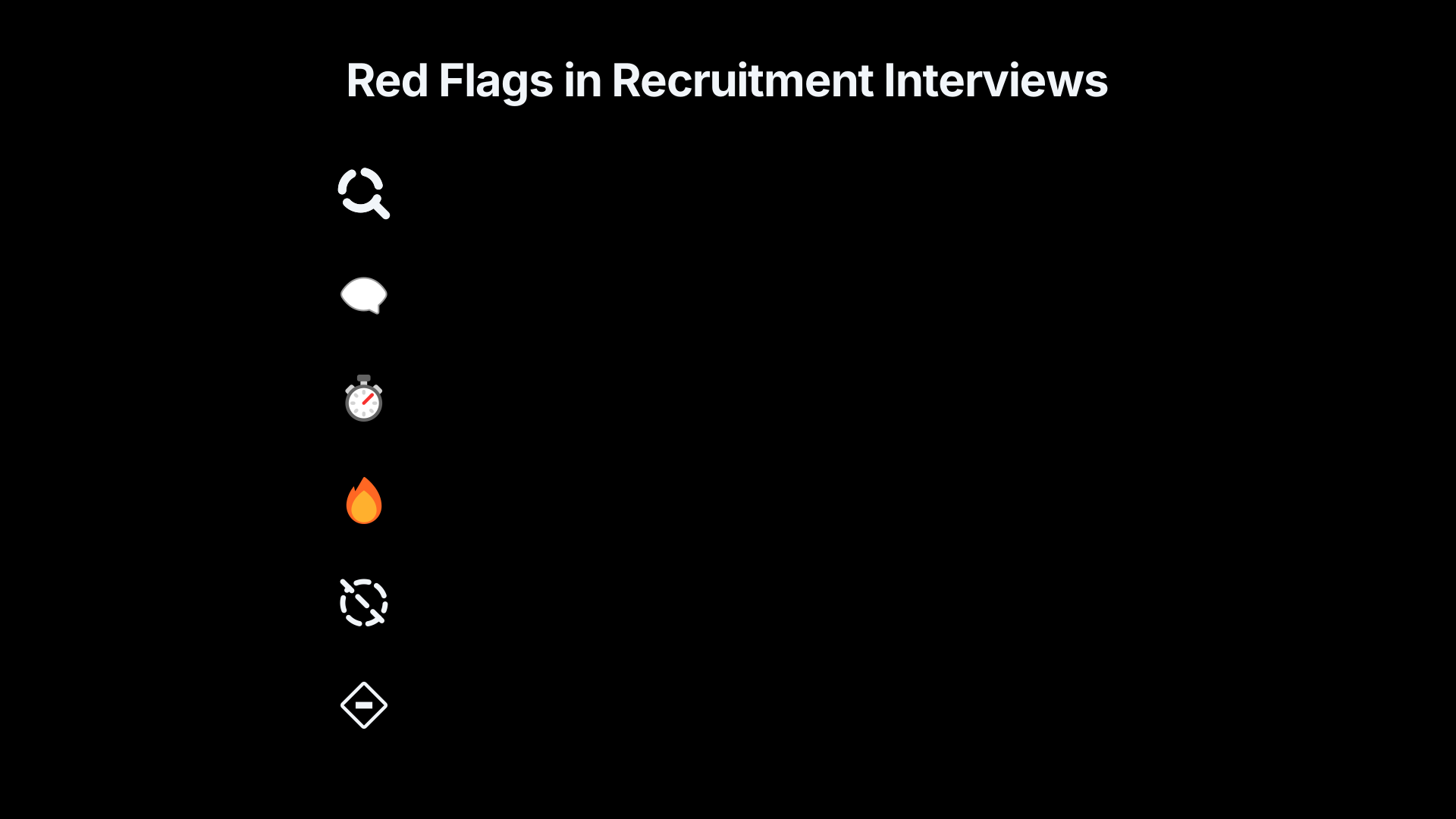
Signals that culture claims may be oversold
No single warning sign proves that a job is unsuitable. However, several patterns deserve closer examination.
Watch for situations where:
- Every answer remains abstract despite requests for examples.
- Different interviewers describe conflicting expectations.
- Nobody can explain how performance is actually evaluated.
- Questions about workload receive defensive or evasive responses.
- Staff describe frequent “firefighting” while leaders insist workloads are consistently manageable.
- High turnover is dismissed without explanation.
- Interviewers repeatedly describe overtime as “just part of being passionate.”
Equally, be cautious if every challenge is portrayed as exciting. Healthy organisations usually acknowledge that certain aspects of the work are demanding while explaining how they are managed.
Small tests that reveal a great deal
Some of the most informative evidence comes from interactions outside formal interviews.
Where appropriate, consider:
- Meeting future colleagues informally.
- Asking to observe part of a normal team meeting.
- Reviewing documents produced by the team if confidentiality permits.
- Completing a realistic work sample or practical exercise.
- Speaking with someone who recently joined the department.
These experiences reduce reliance on imagination because they expose actual workflows, communication styles and expectations. They mirror the logic behind realistic job previews: replacing assumptions with direct observation wherever possible. U.S. Office of Personnel Management+2Hirevue[opm.gov]opm.govrealistic job previewsOffice of Personnel ManagementRealistic Job PreviewsA Realistic Job Preview (RJP) is a recruiting approach used by an organization to com…
Judge consistency rather than perfection
Every workplace has pressure, routine frustrations and occasional conflict. The objective is not to find an organisation without problems but to determine whether the everyday reality matches what you want from your next role.
A useful final check is to write down your three most important assumptions before accepting the offer—for example, “the workload is sustainable”, “the manager develops junior staff” or “the role offers genuine autonomy”. Then ask yourself whether each assumption is supported by multiple pieces of evidence from different people, or mainly by intuition.
The stronger your evidence, the less likely you are to accept a role based on an appealing interview that bears little resemblance to daily work.
eBay marketplace picks
Marketplace Samples
Example marketplace items related to this page. Use the search link to explore similar finds on eBay.


Endnotes
1.
Source: opm.gov
Title: realistic job previews
Link:https://www.opm.gov/policy-data-oversight/assessment-and-selection/other-assessment-methods/realistic-job-previews/
Source snippet
Office of Personnel ManagementRealistic Job PreviewsA Realistic Job Preview (RJP) is a recruiting approach used by an organization to com...
2.
Source: researchgate.net
Link:https://www.researchgate.net/profile/Robert-Bretz/publication/232574755_Realistic_Job_Previews_A_Test_of_the_Adverse_Self-Selection_Hypothesis/links/5a775e2845851541ce5a6007/Realistic-Job-Previews-A-Test-of-the-Adverse-Self-Selection-Hypothesis.pdf
Source snippet
Realistic Job Previews: A Test of the Adverse Self-...The realistic job preview (RJP) literature has focused more on posthire outcomes s...
3.
Source: cipd.org
Link:https://www.cipd.org/globalassets/media/knowledge/knowledge-hub/reports/a-head-for-hiring_2015-behavioural-science-of-recruitment-and-selection_tcm18-9557.pdf
Source snippet
Make sure tests are relevant to the job and fit for purpose...
4.
Source: hirevue.com
Title: what is a realistic job preview and how to make them work for you
Link:https://www.hirevue.com/blog/hiring/what-is-a-realistic-job-preview-and-how-to-make-them-work-for-you
Source snippet
What is a Realistic Job Preview?22 Feb 2018 — A Realistic Job Preview is any video or simulation designed to teach prospective applicants...
5.
Source: education.ox.ac.uk
Link:https://www.education.ox.ac.uk/project/using-realistic-job-previews-to-attract-prospective-teachers/
Source snippet
ford EducationUsing Realistic Job Previews to attract prospective teachersRealistic Job Previews offer a 'try before you buy' insight i...
6.
Source: vervoe.com
Title: realistic job preview
Link:https://vervoe.com/realistic-job-preview/
Source snippet
It shows candidates what the job is really...
7.
Source: thrivemap.io
Title: realistic job preview
Link:https://thrivemap.io/realistic-job-preview/
Source snippet
7 Great Examples to Inspire You20 Nov 2020 — A Realistic Job Preview (RJP) is a hiring approach that provides a transparent and honest vi...
Additional References
8.
Source: aihr.com
Link:https://www.aihr.com/blog/realistic-job-preview/
Source snippet
The Realistic Job Preview Explained: 5 Tips to Do it RightBest practices for realistic job previews are to make them compelling, show a t...
9.
Source: 501ctrust.org
Title: reduce your turnover by utilizing realistic job previews
Link:https://www.501ctrust.org/reduce-your-turnover-by-utilizing-realistic-job-previews/
Source snippet
7 Mar 2018 — An realistic job preview is an honest look at what a job entails and to be successful, it must demonstrate all aspects of th...
10.
Source: homepages.se.edu
Title: Realistic Job Previews What You See Is What You Get
Link:https://homepages.se.edu/cvonbergen/files/2020/03/Realistic-Job-Previews_What-You-See-Is-What-You-Get.pdf
Source snippet
Job Previews: What You See Is WhatThey said, for instance, that they wished they had known the turnover rate for their position, true tra...
11.
Source: corvirtus.com
Title: candidate engagement realistic job previews
Link:https://corvirtus.com/blog/candidate-engagement-realistic-job-previews
Source snippet
Realistic Job Previews: Your Candidate Experience +...28 Apr 2025 — Realistic job previews offer candidates a detailed and honest look a...
12.
Source: thehrobserver.com
Title: how to maximise job retention by providing realistic job previews
Link:https://www.thehrobserver.com/indepth/how-to-maximise-job-retention-by-providing-realistic-job-previews/
Source snippet
This enables both sides to ensure that it is an appropriate job role.Read more...
13.
Source: youtube.com
Title: Should You Accept Or Decline Your Job Offer? How To Evaluate A Job Offer
Link:https://www.youtube.com/watch?v=RCg3kSp7RD4
Source snippet
Never Accept a Job If You See These 5 Interview [Red Flags]({{ 'red-flags/' | relative_url }})...
14.
Source: youtube.com
Title: What Is A Realistic Job Preview?
Link:https://www.youtube.com/watch?v=eYlp9EX_FG0
Source snippet
Should You Accept Or Decline Your Job Offer? How To Evaluate A Job Offer...
15.
Source: youtube.com
Title: Never Accept a Job If You See These 5 Interview Red Flags
Link:https://www.youtube.com/watch?v=nQGisZujroI
Source snippet
Questions to Ask at the End of an Interview: CULTURE QUESTIONS...
16.
Source: redalyc.org
Title: Fit to Last?
Link:https://www.redalyc.org/journal/6923/692374308007/html/
Source snippet
Investigating How Person-Job Fit and...by G Berisha · 2020 · Cited by 79 — This paper investigates the relationship of person-job (PJ) a...
17.
Source: youtube.com
Title: Why you should consider Realistic Job Previews
Link:https://www.youtube.com/watch?v=CQcJNQbOY_A
Source snippet
What Is A Realistic Job Preview? - Job Success Network...
Topic Tree