Within Three Parts
How open minded should good reasoning be?
Open-minded thinking means letting strong contrary evidence count without treating every claim as equally credible.
On this page
- What actively open minded thinking requires
- How to weigh alternatives without false balance
- Why identity and pride make revision harder
Page outline Jump by section
Introduction
Open-minded reasoning is often misunderstood as treating every opinion as equally valid or remaining permanently undecided. In reality, good reasoning is more demanding. It requires allowing strong evidence to change your view while still judging claims by their quality. Actively open-minded thinking is therefore not passive tolerance but an active search for reasons that could prove you wrong, combined with a willingness to revise conclusions when the evidence genuinely warrants it. Research over several decades suggests that this disposition predicts better judgement independently of general intelligence, because it reduces the tendency to defend existing beliefs regardless of the facts.[PMC]pmc.ncbi.nlm.nih.govPMCActively Open-Minded Thinking and Its Measurementby KE Stanovich · 2023 · Cited by 133 — Actively open-minded thinking (AOT) is measured by items that tap the willingness to consider…
 Within the broader goal of improving thinking and analytical skills, actively open-minded thinking is especially important when evidence conflicts with expectations, identity or prior commitments. Those are precisely the situations in which reasoning is most likely to become biased.
What actively open-minded thinking requires
The defining feature of actively open-minded thinking (often abbreviated as AOT) is not simply listening to opposing views. It is deliberately testing whether your current conclusion deserves to survive serious criticism.
Researchers such as Jonathan Baron, Keith Stanovich and Richard West describe AOT as involving several connected habits:
- Seeking evidence that could disconfirm your current belief.
- Considering alternative explanations before settling on one.
- Distinguishing confidence from certainty.
- Updating beliefs when stronger evidence appears.
- Remaining aware that even well-supported conclusions remain open to revision if new evidence emerges.[PMC+2Helda]pmc.ncbi.nlm.nih.govPMCActively Open-Minded Thinking and Its Measurementby KE Stanovich · 2023 · Cited by 133 — Actively open-minded thinking (AOT) is measured by items that tap the willingness to consider…
These habits differ from ordinary curiosity. Someone may enjoy learning new information yet become defensive whenever evidence challenges a deeply held opinion. AOT becomes visible precisely when revision is psychologically uncomfortable.
An important implication follows from this definition: changing your mind is not a failure of reasoning but often evidence that reasoning has worked. If beliefs never change regardless of what is learned, they are no longer functioning as evidence-based conclusions but as fixed commitments.
Research also distinguishes AOT from raw intellectual ability. Studies have found that people with stronger actively open-minded thinking evaluate arguments more according to their logical quality and less according to whether those arguments support their existing beliefs, even after differences in cognitive ability are taken into account.[ResearchGate]researchgate.netReasoning independently of prior belief and individual…Further, actively open-minded thinking predicted variance in AET pe…
How to weigh alternatives without false balance
One of the biggest misunderstandings about open-mindedness is the idea that every disagreement deserves equal weight. Good reasoning does not require splitting the difference between all competing claims.
Instead, evidence should be weighted according to factors such as:
- Quality of evidence. Systematic reviews, well-designed experiments and reliable observations normally deserve more weight than anecdotes or speculation.
- Consistency. Claims supported by multiple independent lines of evidence deserve greater confidence than isolated findings.
- Expert agreement. Consensus is not proof, but widespread agreement among qualified experts generally reflects accumulated evidence rather than mere opinion.
- Ability to survive criticism. Claims that continue to withstand serious attempts at refutation become more credible over time.
Actively open-minded thinkers therefore remain open to minority views without assuming that minority status itself makes a claim equally plausible. A new hypothesis deserves investigation, not automatic acceptance.
This distinction helps avoid false balance. Giving equal credibility to unsupported claims in the name of fairness is not open-mindedness. It is a failure to discriminate between stronger and weaker evidence.
The same principle applies in everyday decisions. Imagine receiving conflicting advice about a medical treatment. An actively open-minded response is neither to believe the first expert nor to average every opinion. It is to examine why experts disagree, what evidence supports each position and whether one explanation better fits the available data.
Why identity and pride make revision harder
The greatest obstacle to changing one’s mind is often not lack of information but attachment to identity.
People naturally connect beliefs with personal values, social groups, professional status and public reputation. Once a belief becomes part of “who I am”, contradictory evidence can feel like a personal attack rather than new information.
Several psychological mechanisms reinforce this tendency:
- Confirmation bias, the tendency to seek supporting evidence while overlooking contradictory information.
- Myside bias, evaluating arguments more favourably when they support one’s existing position.
- Motivated reasoning, using reasoning skills primarily to defend preferred conclusions rather than discover what is true.[Helda+2keithstanovich.com]helda.helsinki.fiHelda Actively open-minded thinkingBaron, one central principle is avoiding myside bias (also known as confirmation bias), that is, looking at issues from a…Read more…
These mechanisms explain why intelligent people are not immune to poor judgement. Greater intelligence can sometimes provide more sophisticated arguments for defending an incorrect conclusion if the motivation is protecting identity rather than evaluating evidence.
Actively open-minded thinking attempts to interrupt this process by separating self-worth from correctness. Instead of asking, “How do I defend my position?” the question becomes, “What would convince me that I am mistaken?”
That small shift changes the function of reasoning from advocacy to investigation.
What revision looks like in practice
Changing your mind rarely means abandoning one extreme for another overnight. More often, evidence leads to gradual refinement.
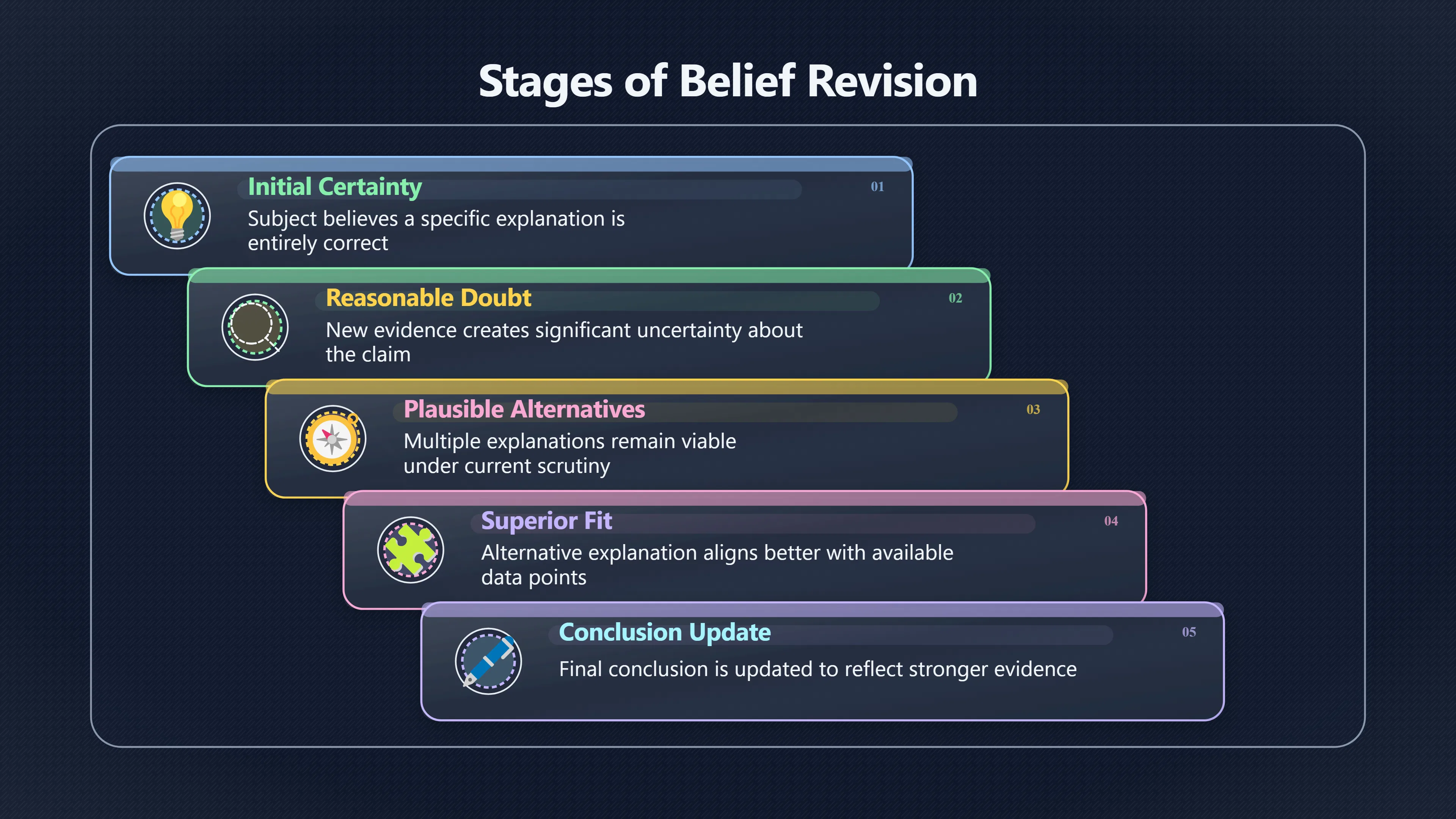
For example, someone might move through stages such as:
- “I am certain this explanation is correct.”
- “Some evidence creates reasonable doubt.”
- “Several explanations remain plausible.”
- “The alternative now fits the evidence better.”
- “I should update my conclusion.”
Notice that each step reflects changing confidence rather than changing identity. The person is not required to become permanently sceptical about everything. Instead, confidence tracks the strength of available evidence.
This process also allows partial revision. Sometimes evidence changes only one part of a belief while leaving the broader conclusion intact. Good reasoning permits nuanced updates instead of demanding complete reversals.
Practical habits that strengthen actively open-minded thinking
Because AOT is a thinking disposition rather than a single skill, improvement comes from repeated habits.
Useful practices include:
- Ask what evidence would change your mind before evaluating new information. Defining this in advance reduces the temptation to move the goalposts later.
- Generate competing explanations. Before deciding, deliberately produce at least two plausible alternatives.
- Separate facts from confidence. Strong confidence should reflect strong evidence, not personal investment.
- Seek informed disagreement. Exposure to knowledgeable critics is usually more valuable than exposure to random opposing opinions.
- Treat belief revision as progress. Recording how your views have changed over time can reinforce the idea that updating beliefs reflects learning rather than inconsistency.
Research also suggests that people higher in actively open-minded thinking tend to make better forecasts under uncertainty because they are more willing to incorporate disconfirming information instead of relying only on their initial expectations.[OECD]oecd.orgOpen mind-setOpen mind-setApril 18, 2024 — An open mind-set refers to openness to others, new ideas, and new experiences. It is the willingness to…
Why actively open-minded thinking is difficult but valuable
Actively open-minded thinking asks people to do something psychologically demanding: allow evidence to outweigh comfort, loyalty and pride without abandoning standards for judging what counts as good evidence.
This balance is what distinguishes it from both dogmatism and indiscriminate scepticism. Dogmatism refuses to revise beliefs. Indiscriminate openness refuses to judge evidence. Actively open-minded thinking occupies the demanding middle ground: it welcomes challenges, scrutinises alternatives and changes course when the reasons are genuinely stronger.
That makes it one of the most important dispositions for improving analytical thinking, because many reasoning failures occur not when people lack intelligence, but when they stop allowing evidence to matter.
eBay marketplace picks
Marketplace Samples
Example marketplace items related to this page. Use the search link to explore similar finds on eBay.




Endnotes
1.
Source: pmc.ncbi.nlm.nih.gov
Title: PMCActively Open-Minded Thinking and Its Measurement
Link:https://pmc.ncbi.nlm.nih.gov/articles/PMC9966223/
Source snippet
by KE Stanovich · 2023 · Cited by 133 — Actively open-minded thinking (AOT) is measured by items that tap the willingness to consider...
2.
Source: researchgate.net
Link:https://www.researchgate.net/publication/220040826_Reasoning_independently_of_prior_belief_and_individual_differences_in_actively_open-minded_thinking
Source snippet
Reasoning independently of prior belief and individual...Further, actively open-minded thinking predicted variance in AET pe...
3.
Source: keithstanovich.com
Link:https://keithstanovich.com/Site/Research_on_Reasoning_files/Stanovich_Cognition_2019.pdf
Source snippet
Keith Stanovichby KE Stanovich · 2019 · Cited by 134 — Actively open-minded thinking (AOT) is measured by questionnaire items that tap th...
4.
Source: oecd.org
Title: Open mind-set
Link:https://www.oecd.org/content/dam/oecd/en/topics/policy-issues/future-of-education-and-skills/learning-compass-constructs/OpenMind-set.pdf
Source snippet
Open mind-setApril 18, 2024 — An open mind-set refers to openness to others, new ideas, and new experiences. It is the willingness to...
Published: April 18, 2024
5.
Source: helda.helsinki.fi
Title: Helda Actively open-minded thinking
Link:https://helda.helsinki.fi/bitstreams/acfce61e-9176-4d02-b620-0b65b4c1ded8/download
Source snippet
Baron, one central principle is avoiding myside bias (also known as confirmation bias), that is, looking at issues from a...Read more...
6.
Source: Wikipedia
Title: Confirmation bias
Link:https://en.wikipedia.org/wiki/Confirmation_bias
Additional References
7.
Source: youtube.com
Title: The Intelligence Trap: Why Smart People Make Bad Decisions
Link:http://www.youtube.com/watch?v=ZrzakMjeX74
Source snippet
"Actively open-minded thinking" OR "AOT" Jonathan Baron Walking on water without any ninja technique [zeppeli walks on water] | #jojo #jo...
8.
Source: sjdm.org
Link:https://sjdm.org/dmidi/Actively_Open-Minded_Thinking_Beliefs.html
Source snippet
s. The present version is suitable for general adult populations.Read more...
9.
Source: czasopisma.uwm.edu.pl
Link:https://czasopisma.uwm.edu.pl/index.php/pp/article/download/9104/6890/29353
Source snippet
This questionnaire allows to assess the...Read more...
10.
Source: youtube.com
Title: Intellectual humility: the rewards of being willing to change your mind
Link:http://www.youtube.com/watch?v=GUnIWyUwi6g
Source snippet
How Can You Stop Ignoring Contradictory Evidence?...
11.
Source: youtube.com
Title: How Can You Stop Ignoring Contradictory Evidence?
Link:http://www.youtube.com/watch?v=kP78Q4KbkT0
Source snippet
The Intelligence Trap: Why Smart People Make Bad Decisions - David Robson #133...
12.
Source: repub.eur.nl
Link:https://repub.eur.nl/pub/126881/Repub_126881_O-A.pdf
Source snippet
properties of the Actively Open-minded...by E Janssen · 2020 · Cited by 51 — Baron (1991) introduced the concept actively open-minded th...
13.
Source: frontiersin.org
Link:https://www.frontiersin.org/journals/psychology/articles/10.3389/fpsyg.2025.1565928/full
Source snippet
The role of actively open-minded thinking in willingness to...by A Segrè Cohen · 2025 · Cited by 3 — Actively open-minded thinking (AOT)...
14.
Source: youtube.com
Title: The Rarest Mind Possible
Link:http://www.youtube.com/watch?v=8vp3pQVaW9c
Source snippet
Intellectual humility: the rewards of being willing to change your mind...
15.
Source: youtube.com
Title: Actively open-minded thinking (AOT)
Link:http://www.youtube.com/watch?v=SunpvLwoKYs
Source snippet
The Rarest Mind Possible...
Topic Tree