Within Intuition
Why Strong Feelings Need a Pause
Strong feelings can carry useful information, but they also make one interpretation feel more obvious than it deserves.
On this page
- Anger, fear, urgency, and narrowed interpretation
- Separating emotional data from a verdict
- A short pause routine for charged decisions
Page outline Jump by section
Introduction
Strong feelings are not a sign that thinking has failed. In many situations they carry useful information about goals, threats, values, relationships, or opportunities. The problem is that emotional activation can make one interpretation feel far more certain than the evidence warrants. When anger, fear, excitement, humiliation, or urgency rises sharply, the feeling itself becomes a cue that a second pass of thinking may be needed.
 Within the broader skill of knowing when fast intuition needs checking, emotional intensity is one of the most practical pause signals available. A decision made during a surge of emotion is not automatically wrong, but it is more likely to be based on a narrowed view of the situation, incomplete evidence, or a premature sense of certainty. Research across psychology and neuroscience shows that emotion influences attention, memory, perception, and judgement, often directing mental resources toward what feels most important at the moment.[Swiss Medical Weekly]smw.chSwiss Medical WeeklyThe impact of emotion on perception, attention, memory…by T Brosch · 2013 · Cited by 638 — Emotion and cognition…
Anger, Fear, Urgency, and Narrowed Interpretation
One reason strong emotions deserve a pause is that they change what we notice.
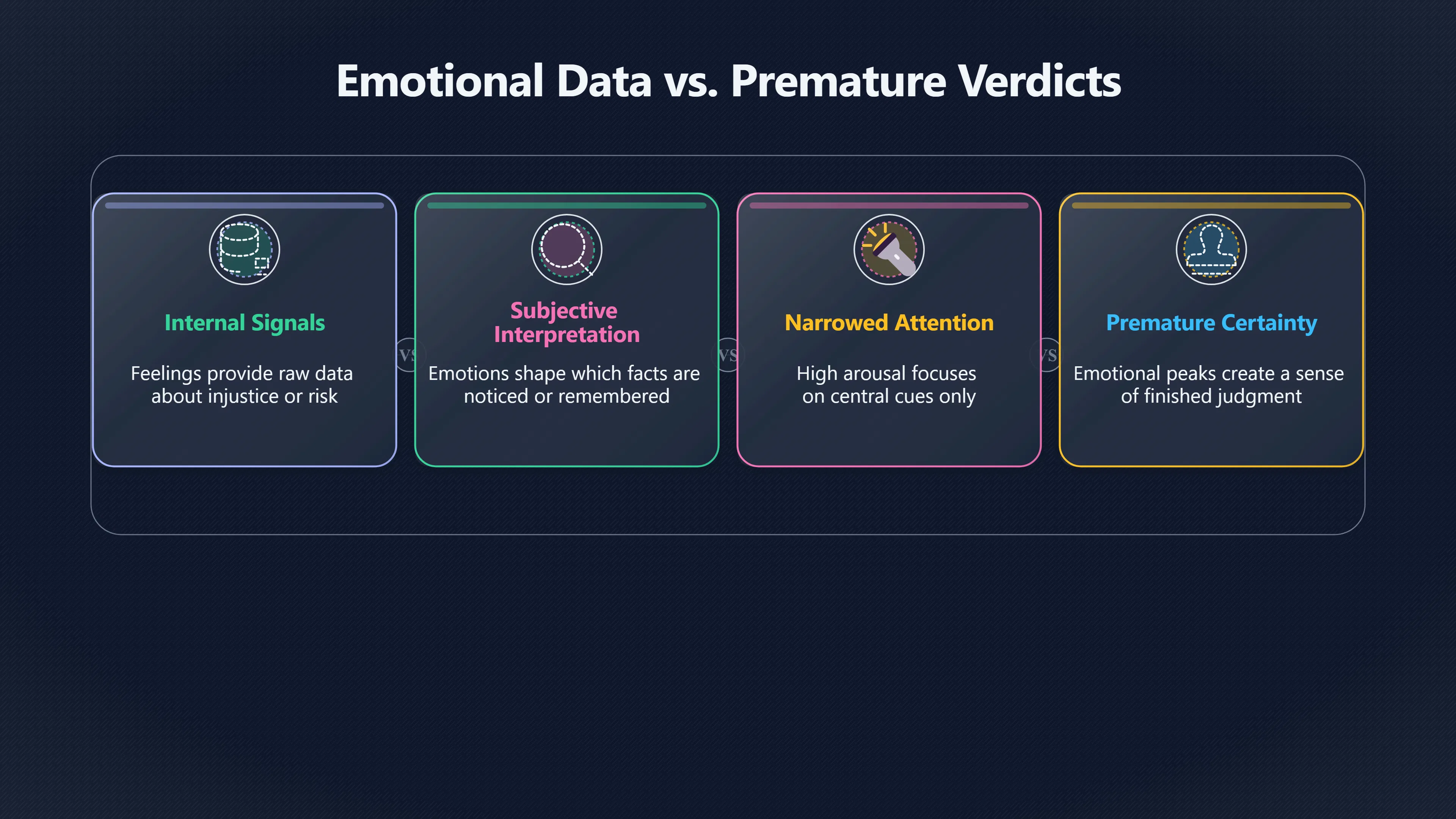
A long-standing finding in psychology is that high emotional arousal tends to narrow attention. Under stress or intense activation, people focus more strongly on central cues and may overlook peripheral information. This can be useful in genuine emergencies, but it can also reduce awareness of context, alternatives, and disconfirming evidence.[PMC]pmc.ncbi.nlm.nih.govThreat But Not Arousal Narrows Attention: Evidence from Pupil…by H van Steenbergen · 2011 · Cited by 181 — According to Easterbrook…
In everyday life, this narrowing often appears as a shift from possibility to certainty:
- An angry manager stops asking what happened and becomes convinced that someone is at fault.
- A worried investor stops evaluating probabilities and starts treating a feared outcome as inevitable.
- A partner in an argument interprets a single remark as proof of a larger pattern.
- A shopper facing a limited-time offer feels that immediate action is necessary, even when delay would be harmless.
The emotional state does not merely colour the judgement. It can shape which facts are noticed, remembered, or considered relevant in the first place. Emotion and cognition are deeply intertwined; emotions help organise attention and guide decision-making rather than operating separately from thought.[Swiss Medical Weekly]smw.chSwiss Medical WeeklyThe impact of emotion on perception, attention, memory…by T Brosch · 2013 · Cited by 638 — Emotion and cognition…
Anger Creates a Sense of Obviousness
Anger deserves special attention because it often feels clarifying.
When people are angry, ambiguity becomes uncomfortable. Motives appear easier to infer, blame feels more justified, and action feels preferable to waiting. In some contexts anger can increase determination and goal-directed behaviour, which is why it is not simply a destructive emotion. Yet the same confidence can create overcommitment to a single explanation.[Kellogg Insight]insight.kellogg.northwestern.eduKellogg Insight How Anger Can Help Us Make Better DecisionsKellogg InsightHow Anger Can Help Us Make Better Decisions - Kellogg InsightAug 1, 2019 — In a series of studies, Maimaran and colleagues…
A useful question during anger is not, “Am I allowed to be angry?” It is, “What information am I currently ignoring because anger has made one story feel complete?”
Fear Compresses Possibilities Into Threats
Fear produces a different distortion.
Research on risk perception shows that people often rely on emotional impressions when judging danger. This can be adaptive when rapid response is necessary, but it can also cause unlikely risks to feel overwhelmingly probable. The emotional experience of threat becomes part of the judgement itself.[eclass.hua.gr+2Frontiers]eclass.hua.grAffect, Risk, and Decision MakingMarch 28, 2012 — Risk is perceived and acted on in 2 fundamental ways. Risk as feelings refers to individuals' fast, instinctive, and int…
A fearful employee may interpret neutral feedback as a sign that dismissal is coming. A worried parent may treat a low-probability danger as an immediate threat. A nervous investor may abandon a sound long-term plan because recent losses feel intolerable.
The feeling is real. The conclusion may not be.
Urgency Is Often Emotion in Disguise
Many poor decisions are not made under anger or fear but under urgency.
The internal message is usually some variation of:
- “I must answer now.”
- “I cannot leave this unresolved.”
- “If I wait, I will lose my chance.”
Sometimes urgency reflects reality. More often, it reflects discomfort. The desire to end uncertainty can become stronger than the desire to make an accurate judgement.
When a decision suddenly feels as though it cannot wait, that feeling alone is often a reason to ask whether the deadline is external or emotional.
Separating Emotional Data From a Verdict
The goal is not to suppress emotion. Strong feelings frequently contain information worth examining.
Anger may signal a perceived injustice. Fear may highlight a genuine risk. Anxiety may reveal uncertainty that deserves investigation. Excitement may point toward opportunity. Emotional reactions evolved partly because they help people respond rapidly to important situations.[Temple University Beasley School of Law]law.temple.eduEmotions quickly condense an experience, and evaluateTemple University Beasley School of LawEmotional Decision Making: Hardwired and HelpfulSeptember 7, 2024 — 7 Sept 2024 — Decisions are ve…
The mistake is treating the emotion as a completed judgement rather than as data.
Consider the difference:
Emotional messagePremature verdict“Something feels unfair.”“They deliberately wronged me.”“This situation feels risky.”“This will definitely fail.”“I feel pressure.”“I must decide immediately.”“I am excited about this.”“This is obviously the best option.”
The first column contains information. The second contains conclusions.
Analytical thinking becomes easier when these two layers are separated. Instead of asking whether a feeling is justified, ask what the feeling might be signalling and what evidence would support or contradict the interpretation attached to it.
This distinction aligns with research showing that emotions influence decisions in predictable ways without necessarily determining the correct choice. Emotions provide inputs into judgement, but they are not equivalent to judgement itself.[jenniferlerner.com]jenniferlerner.comEmotion and Decision MakingJennifer Lernerby JS Lerner · 2015 · Cited by 2 — A revolution in the science of emotion has emerged in the last few decades, with the po…

A Short Pause Routine for Charged Decisions
A pause does not need to be dramatic. The purpose is simply to create enough distance for alternative interpretations to become visible.
Step 1: Label the Emotional State
Use simple language.
- Angry
- Defensive
- Afraid
- Embarrassed
- Excited
- Pressured
- Resentful
Research on emotional regulation consistently finds that recognising and identifying emotional states can improve self-control and reduce impulsive reactions.[PMC]pmc.ncbi.nlm.nih.govA systematic review of neural, cognitive, and clinical studies of…by Y Richard · 2022 · Cited by 95 — One study found that mindfuln…
The label does not solve the problem. It prevents the emotion from remaining invisible.
Step 2: Identify the Story Attached to the Feeling
Finish the sentence:
“I feel this way because I think…”
Examples:
- “…because I think they disrespected me.”
- “…because I think I am about to fail.”
- “…because I think this opportunity will disappear.”
This reveals the interpretation hidden inside the emotion.
Step 3: Generate One Credible Alternative
Not ten alternatives. One.
If the current story is “They ignored my message because they do not care,” a credible alternative might be “They have not had time to reply.”
If the current story is “This investment is collapsing,” an alternative might be “I am reacting to a short-term fluctuation.”
The purpose is not optimism. It is reopening the question.
Step 4: Delay Irreversible Action
Avoid sending the message, making the purchase, ending the relationship, quitting the job, or committing the money while emotional activation is still high.
Even a short delay can help. Research on emotion regulation suggests that introducing cognitive control processes changes how emotional responses influence later decisions.[PMC]pmc.ncbi.nlm.nih.govThe effect of emotion regulation on risk-taking and decision…by C Morawetz · 2019 · Cited by 66 — Emotion regulation impacts the ex…
Step 5: Revisit the Decision When the Emotional Peak Has Passed
The key question becomes:
“What would I think about this situation if I felt the same facts but half the intensity?”
Often the answer is not completely different. It is simply more balanced.
The Practical Value of Treating Emotion as a Pause Signal
Many reasoning errors do not begin with ignorance. They begin with certainty arriving too early.
Strong emotions can make an interpretation feel finished before it has been tested. The value of the pause signal is not that it removes emotion from thinking. It reminds you that heightened emotion changes how evidence is gathered, weighed, and interpreted.
When anger, fear, excitement, or urgency suddenly spikes, the most useful response is often neither obedience nor suppression. It is curiosity. The feeling may contain important information. The pause creates space to discover whether that information supports the conclusion you have already reached—or merely suggests that the situation deserves a closer look.
Amazon book picks
Further Reading
Books and field guides related to Why Strong Feelings Need a Pause. Use these as the next step if you want deeper reading beyond the article.
The Chimp Paradox
Focuses on managing emotional reactions before acting, closely aligned with the idea of pausing when feelings run high.
Emotional Intelligence
Explores recognizing and regulating emotions so they inform judgment without overwhelming it.
The Righteous Mind
Shows how intuitions and emotions often drive conclusions before conscious reasoning catches up.
Decisive
Provides structured techniques for avoiding narrow thinking and making better choices under pressure.
eBay marketplace picks
Marketplace Samples
Example marketplace items related to this page. Use the search link to explore similar finds on eBay.




Endnotes
1.
Source: pmc.ncbi.nlm.nih.gov
Link:https://pmc.ncbi.nlm.nih.gov/articles/PMC3204575/
Source snippet
Threat But Not Arousal Narrows Attention: Evidence from Pupil...by H van Steenbergen · 2011 · Cited by 181 — According to Easterbrook...
2.
Source: jenniferlerner.com
Title: Emotion and Decision Making
Link:https://jenniferlerner.com/wp-content/uploads/2017/08/5.Emotion-and-Decision-Making.pdf
Source snippet
Jennifer Lernerby JS Lerner · 2015 · Cited by 2 — A revolution in the science of emotion has emerged in the last few decades, with the po...
3.
Source: eclass.hua.gr
Title: Affect, Risk, and Decision Making
Link:https://eclass.hua.gr/modules/document/file.php/GEO168/P.%20SLOVIC%20ET%20AL.%20RISK%20AND%20DECISION%20MAKING
Source snippet
March 28, 2012 — Risk is perceived and acted on in 2 fundamental ways. Risk as feelings refers to individuals' fast, instinctive, and int...
Published: March 28, 2012
4.
Source: law.temple.edu
Title: Emotions quickly condense an experience, and evaluate
Link:https://law.temple.edu/aer/2024/09/07/emotional-decision-making-hardwired-and-helpful/
Source snippet
Temple University Beasley School of LawEmotional Decision Making: Hardwired and HelpfulSeptember 7, 2024 — 7 Sept 2024 — Decisions are ve...
Published: September 7, 2024
5.
Source: pmc.ncbi.nlm.nih.gov
Link:https://pmc.ncbi.nlm.nih.gov/articles/PMC6970147/
Source snippet
The effect of emotion regulation on risk-taking and decision...by C Morawetz · 2019 · Cited by 66 — Emotion regulation impacts the ex...
6.
Source: smw.ch
Link:https://smw.ch/index.php/smw/article/download/1687/2255
Source snippet
Swiss Medical WeeklyThe impact of emotion on perception, attention, memory...by T Brosch · 2013 · Cited by 638 — Emotion and cognition...
7.
Source: smw.ch
Link:https://smw.ch/index.php/smw/article/view/1687
Source snippet
Swiss Medical WeeklyThe impact of emotion on perception, attention, memory...by T Brosch · 2013 · Cited by 638 — Emotion determines how...
8.
Source: insight.kellogg.northwestern.edu
Title: Kellogg Insight How Anger Can Help Us Make Better Decisions
Link:https://insight.kellogg.northwestern.edu/article/anger-decision-making
Source snippet
Kellogg InsightHow Anger Can Help Us Make Better Decisions - Kellogg InsightAug 1, 2019 — In a series of studies, Maimaran and colleagues...
9.
Source: frontiersin.org
Link:https://www.frontiersin.org/journals/psychology/articles/10.3389/fpsyg.2020.00970/full
Source snippet
The Affect Heuristic and Risk Perception – Stability Across...by K Skagerlund · 2020 · Cited by 142 — The reliance on feelings when judg...
10.
Source: pmc.ncbi.nlm.nih.gov
Link:https://pmc.ncbi.nlm.nih.gov/articles/PMC9174026/
Source snippet
A systematic review of neural, cognitive, and clinical studies of...by Y Richard · 2022 · Cited by 95 — One study found that mindfuln...
11.
Source: frontiersin.org
Link:https://www.frontiersin.org/journals/neuroscience/articles/10.3389/fnins.2021.638989/full
Source snippet
The Differential Effects of Anger and Sadness on...by T Suo · 2021 · Cited by 15 — In this study, we investigated how anger and sadness...
12.
Source: dash.harvard.edu
Link:https://dash.harvard.edu/bitstreams/7312037e-8c73-6bd4-e053-0100007fdf3b/download
Source snippet
The particular form of...
Additional References
13.
Source: pure.manchester.ac.uk
Link:https://pure.manchester.ac.uk/ws/files/59231223/Learning_and_Memory_02019_How_emotional_arousal_enhances_episodic_memory.pdf
Source snippet
Emotional Arousal Enhances Episodic MemoryReinforcement learning theories of emotion posit that our emotions provide an efficient summary...
14.
Source: thedecisionlab.com
Link:https://thedecisionlab.com/biases/affect-heuristic
Source snippet
Affect HeuristicThe affect heuristic describes how we often rely on our emotions, rather than concrete information, when making decisions...
15.
Source: citationmachine.net
Link:https://www.citationmachine.net/apa
Source snippet
APA Format & APA Citation GeneratorGenerate APA citations in seconds. Start citing books, websites, journals, and more with the Citation...
16.
Source: repository.ubn.ru.nl
Link:https://repository.ubn.ru.nl/bitstream/handle/2066/134521/134521.pdf?isAllowed=y&sequence=1
Source snippet
Radboud RepositoryEmotion Regulation and Decision MakingEmotions such as risk perception, reward, and loss evaluation are modulated this...
17.
Source: coursehero.com
Title: I’ve attached examples of how to format your paper. Please follow the template
Link:https://www.coursehero.com/tutors-problems/Psychology/80830051-The-Influence-of-Emotion-on-Decision-Making-Processes-APA-7th/
Source snippet
The Influence of Emotion on Decision-Making Processes...Oct 16, 2025 — The Influence of Emotion on Decision-Making Processes APA 7th edi...
18.
Source: psychologicalscience.org
Title: Why Do Emotions Hijack Our Decisions?
Link:https://www.psychologicalscience.org/news/utc-2025-may-impulsivity.html
Source snippet
15, 2025 — Emotion-related impulsivity is really this chronic and trait-like pattern of losses of self-control under states of...
Published: May 15, 2025
19.
Source: loterre.istex.fr
Title: Loterre: Memory: Easterbrook’s cue-utilization hypothesis
Link:https://loterre.istex.fr/P66/en/page/-X1VXS02G-J
Source snippet
istex.fr: Memory: Easterbrook's cue-utilization hypothesis - LoterreA testable hypothesis that stress or high levels of emotional arousal...
20.
Source: researchgate.net
Link:https://www.researchgate.net/publication/12134966_Emotional_Distress_Regulation_Takes_Precedence_Over_Impulse_Control_If_You_Feel_Bad_Do_It
Source snippet
Some theories propose that distress impairs one's motivation or one's...Read more...
21.
Source: researchgate.net
Title: 266085406 Emotion and Decision Making
Link:https://www.researchgate.net/publication/266085406_Emotion_and_Decision_Making
Source snippet
(PDF) Emotion and Decision MakingFeb 5, 2016 — The research reveals that emotions constitute potent, pervasive, predictable, sometimes ha...
22.
Source: asteroidhealth.com
Link:https://asteroidhealth.com/blog/psychology-of-decision-making
Source snippet
Psychology of Decision-Making in massachusettsEmotional regulation helps maintain clarity and focus, especially in stressful or ambiguous...
Topic Tree